Choosing the best game server hosting providers requires more than finding the lowest advertised price. The right service must support your game, handle real player activity, provide useful management tools, and make backups and upgrades practical.
Minecraft, Rust, ARK, and other multiplayer games place different demands on hardware. A private Minecraft world may need a different hosting approach from a public Rust community or a multi-map ARK setup.
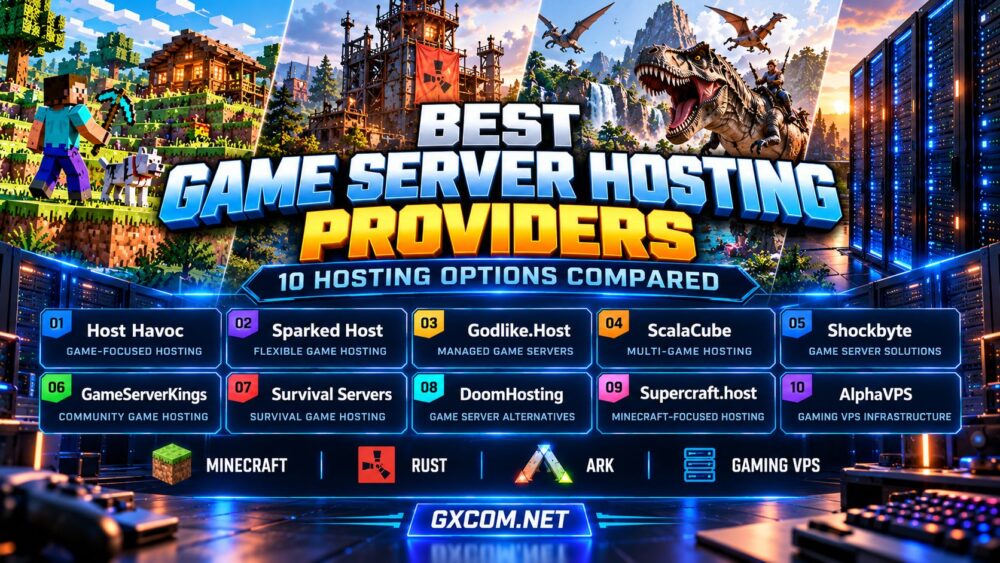
This updated GXCOM.NET guide compares ten hosting providers and infrastructure options: Host Havoc, Sparked Host, Godlike.Host, ScalaCube, Shockbyte, GameServerKings, Survival Servers, DoomHosting, Supercraft.host, and AlphaVPS.
Our comparisons focus on publicly described services, hosting models, management features, and suitable use cases. They are not independent benchmark rankings. Always verify the current game catalog, region, resources, and checkout terms before ordering.
Best Game Server Hosting Providers at a Glance
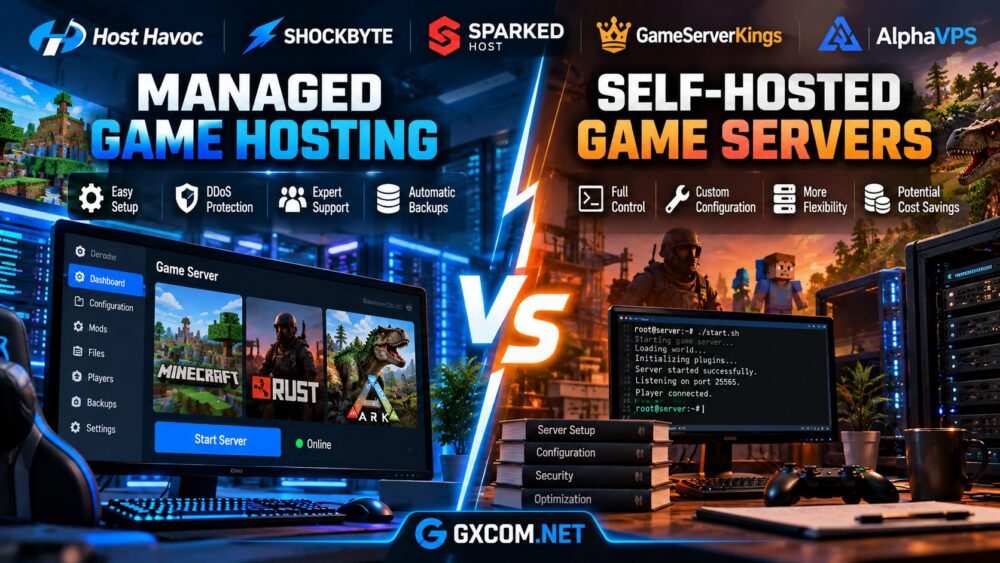
Not every provider below sells the same kind of product. Some specialize in managed game servers, others emphasize Minecraft hosting, and AlphaVPS is included as a VPS infrastructure alternative for technically experienced administrators.
| Provider | Primary Comparison Focus | Best-Fit Use Case |
|---|---|---|
| Host Havoc | Game-specific management and administration | Communities seeking managed multiplayer hosting |
| Sparked Host | Apollo Panel and game management tools | Players who value accessible server controls |
| Godlike.Host | Managed game hosting options | Communities comparing supported games and resources |
| ScalaCube | Game-focused hosting plans | Players comparing game editions and setup options |
| Shockbyte | Minecraft and other game hosting products | Users comparing game-specific managed plans |
| GameServerKings | Community game hosting | Administrators evaluating Rust-oriented options |
| Survival Servers | Survival-game hosting | ARK, Rust, and persistent-world communities |
| DoomHosting | Game server hosting alternatives | Communities comparing customization and resources |
| Supercraft.host | Minecraft-focused hosting | Minecraft Java and Bedrock communities |
| AlphaVPS | VPS infrastructure rather than turnkey game hosting | Experienced administrators building their own servers |
Important: This table describes comparison categories, not verified feature parity. Confirm the exact product and supported game before purchasing. No universal performance winner can be established without comparable workload testing.
How We Compare Game Server Hosting Providers
A useful comparison starts with the game itself. We evaluate providers using six practical criteria:
- Game compatibility: Supported titles, editions, versions, mods, and plugins.
- Server resources: CPU characteristics, RAM allocation, storage, and resource-sharing policies.
- Management: Control panels, file access, scheduled tasks, updates, and administrative tools.
- Network: Available regions, latency, traffic policies, and DDoS protection.
- Reliability: Backup availability, restoration procedures, support, and recovery options.
- Long-term value: Renewal terms, upgrade flexibility, add-ons, and migration effort.
Provider websites are useful for confirming advertised features, but they cannot replace independent measurements of game performance, support response quality, or long-term uptime.
1. Host Havoc: Managed Hosting With Game-Specific Tools
Host Havoc is a relevant option for administrators seeking managed hosting for established multiplayer games. Its published documentation discusses Minecraft management, Rust plugins, backups, server administration, and network protection.
For Rust communities, game-specific maintenance tools can be particularly valuable when managing plugins, wipes, and server configuration. Minecraft administrators should also examine edition support and modpack installation workflows.
Why Consider Host Havoc?
- Game-oriented administration rather than general-purpose VPS setup.
- Published information about Rust management and modding workflows.
- Options worth comparing for established multiplayer communities.
Best for: Administrators who prefer managed services and practical game-specific controls.
Check before buying: Game edition, hosting region, actual resource allocation, backup policy, and support coverage.
Next step: Explore Host Havoc game hosting plans and verify the configuration for your chosen title.
2. Sparked Host: Apollo Panel and Flexible Game Management
Sparked Host offers game hosting services with its Apollo control panel. The provider documents a browser-based console, file manager, plugin management, modpack installation, backups, schedules, and other administration features.

Its Game Vault feature is designed for switching between supported games while retaining saved sessions, but it is available only on eligible plans. It should not be assumed to accompany every product.
Why Consider Sparked Host?
- Apollo Panel with a broad set of management tools.
- Installation features relevant to Minecraft and other supported games.
- Game Vault functionality on specifically eligible plans.
Best for: Communities prioritizing an accessible management interface and flexible game administration.
Check before buying: Whether the desired game, modding features, backup allocation, and Game Vault support are included.
Next step: Compare Sparked Host plans and the features available for your game.
3. Godlike.Host: Another Managed Game Hosting Option
Godlike.Host belongs on the shortlist for readers comparing managed game hosting alternatives. The important decision is not simply whether a provider advertises multiplayer hosting, but whether its specific plan fits your intended workload.
Check supported games, server software, memory allocation, region availability, file access, and backup options. Modded worlds and growing communities should also investigate upgrade procedures before committing.
Best for: Players comparing managed game hosting plans with different resource and administration requirements.
Check before buying: Exact game compatibility, included management features, renewal conditions, and available upgrades.
4. ScalaCube: Compare Game-Specific Hosting Plans
ScalaCube is another game hosting provider to evaluate when choosing a managed multiplayer environment. Its suitability depends on the selected game, edition, server software, and plan.
Minecraft users should examine Java versus Bedrock support and whether the required modpack or plugin framework is available. ARK users should verify the exact game edition rather than assuming that support for one release includes another.
Best for: Users comparing managed plans for specific games and server editions.
Check before buying: Game version, panel functionality, storage limits, backup availability, and upgrade rules.
5. Shockbyte: Game-Focused Hosting for Multiplayer Communities
Shockbyte is worth evaluating alongside other managed hosting providers, particularly for communities comparing Minecraft and other supported multiplayer products.
Before choosing a plan, determine whether you need a vanilla server, a plugin-based environment, or a heavily modded world. These workloads can have substantially different resource requirements.
Best for: Players seeking game-oriented hosting without administering a general-purpose operating system.
Check before buying: Available games, server editions, allocated resources, supported modifications, and recovery features.
Explore Shockbyte Hosting Plans
6. GameServerKings: Hosting for Community Game Servers
GameServerKings is a relevant candidate for administrators comparing managed community hosting, especially when planning a Rust server.
Rust communities should examine map size, plugin framework compatibility, player activity, wipe procedures, and remote administration. The ability to operate a server reliably during busy community events matters more than an impressive advertised slot count.
Best for: Rust community administrators evaluating game-focused hosting services.
Check before buying: Current supported games, available regions, modding options, resource allocation, and wipe-management procedures.
7. Survival Servers: Hosting for Persistent Survival Worlds
Survival Servers is particularly relevant to comparisons involving survival games and persistent multiplayer worlds. These environments can accumulate large saves, player structures, and complex modifications over time.
For ARK, distinguish Survival Evolved from Survival Ascended and check the requirements of the exact map or cluster configuration. For Rust, consider server maintenance, network location, and mod compatibility.
Best for: Survival-game communities comparing managed hosting and persistent-world administration.
Check before buying: Game edition, map support, backup retention, restoration procedures, and available regions.
8. DoomHosting: An Additional Game Hosting Alternative
DoomHosting can be considered when evaluating alternatives to larger game hosting brands. Rather than assuming that similarly named plans deliver identical performance, compare their underlying resource policies and included tools.
Administrators should request clear information about CPU allocation, memory, file management, game compatibility, network protection, and support responsibilities.
Best for: Buyers seeking another option for comparing game hosting plans and administration flexibility.
Check before buying: Product availability, game support, resource limits, management tools, and backup arrangements.
9. Supercraft.host: Minecraft-Focused Hosting
Supercraft.host is especially relevant when your primary requirement is Minecraft rather than a broad collection of multiplayer titles.
Minecraft hosting decisions should begin with Java or Bedrock Edition, followed by the required server software, player activity, and mod or plugin ecosystem. Vanilla, Paper, Fabric, Forge, and other environments do not necessarily have the same compatibility or resource demands.
Best for: Minecraft communities comparing game-specific hosting rather than general-purpose infrastructure.
Check before buying: Edition compatibility, supported server software, modpack installation, storage, backups, and resource headroom.
10. AlphaVPS: Infrastructure for Self-Managed Game Servers
AlphaVPS should be compared differently from turnkey managed game hosts. A VPS gives administrators an operating-system environment in which they can install and maintain supported game server software.
This approach can offer flexibility, but the customer may need to manage security, software installation, firewall rules, backups, monitoring, and updates. Not every VPS plan is suitable for demanding real-time game workloads.
Best for: Technically experienced users who prefer configuring and operating their own game servers.
Check before buying: Virtual CPU policies, memory, operating-system support, network ports, DDoS coverage, and whether game-server management is included.
Which Provider Type Fits Your Game?
Minecraft Server Hosting
For Minecraft, start with edition support and your intended software stack. Supercraft.host, Shockbyte, ScalaCube, Sparked Host, Godlike.Host, and Host Havoc are candidates to investigate according to their current Minecraft products.
Modded Minecraft can require additional memory, CPU headroom, and installation tools. See our modded Minecraft server hosting guide for a more focused comparison.
Rust Server Hosting
Rust administrators should prioritize consistent CPU performance, sufficient memory, network protection, and tools for maintaining community servers. Host Havoc, GameServerKings, Survival Servers, and Sparked Host are relevant starting points.
Read our Rust server hosting comparison for game-specific considerations.
ARK Server Hosting
ARK hosting decisions depend heavily on the game edition, world configuration, modifications, and whether multiple maps run together. Survival Servers, ScalaCube, Godlike.Host, and other providers with verified ARK products should be compared at the plan level.
Our ARK server hosting guide covers the requirements of this category.
Gaming VPS and Dedicated Infrastructure
Administrators seeking operating-system control may prefer a VPS, while larger communities may eventually require dedicated hardware. AlphaVPS represents an infrastructure-focused alternative rather than a direct replacement for every managed hosting feature.
Explore our gaming VPS vs dedicated server comparison before choosing the infrastructure model.
What Actually Determines Game Server Performance?
CPU and Resource Sharing
Many game servers depend on strong per-core performance for simulation and world updates. CPU generation, sustained performance, virtualization, and resource contention can matter more than headline core counts.
RAM and Player Activity
Memory requirements vary with game edition, active players, world size, modifications, and background processes. Advertised player slots are not a guarantee of smooth gameplay.
NVMe Storage and Save Operations
Fast storage can improve file access and save operations, but storage contention and backup activity may still affect performance. Confirm usable capacity and any storage limits.

Server Location and Network Protection
Choose a region near most players and consider routing quality, latency, packet loss, and DDoS protection. A high advertised network speed does not automatically mean a low-latency connection.
Managed Game Hosting vs VPS vs Dedicated Servers
| Hosting Model | Main Advantage | Main Responsibility |
|---|---|---|
| Managed Game Hosting | Game-oriented setup and administration | Confirm included support and management scope |
| Gaming VPS | Operating-system and software flexibility | Security, installation, updates, and troubleshooting |
| Dedicated Server | Exclusive physical hardware resources | Potentially greater cost and administration |
Small private groups often benefit from managed game hosting. Technical administrators may prefer a VPS, while demanding workloads or multiple game instances can justify dedicated hardware.
Game Server Hosting Buying Checklist
- Confirm the exact game, edition, version, and supported modifications.
- Estimate peak concurrent players rather than total community membership.
- Compare CPU characteristics, RAM, storage, and resource-sharing policies.
- Select a suitable region and investigate network protection.
- Verify control-panel functions, file access, and administrative permissions.
- Check backup frequency, retention, download access, and restoration procedures.
- Understand technical support responsibilities and escalation channels.
- Review renewal terms, upgrades, cancellation policies, and optional add-ons.
For additional purchase considerations, see our guide to choosing a game hosting provider.
Frequently Asked Questions
Which Is the Best Game Server Hosting Provider?
There is no universal winner. The right provider depends on your game, player activity, technical experience, server region, and management needs. Compare the exact plans rather than assuming one brand is best for every workload.
Which Hosting Type Is Easiest for Beginners?
Managed game hosting is often the most accessible starting point because it can reduce installation and operating-system administration. However, support scope and included tools vary by provider.
Is a Gaming VPS Better Than Managed Hosting?
A VPS offers greater configuration control, but that flexibility introduces administration responsibilities. Managed hosting may provide better value when convenience and game-specific support are priorities.
Can One Provider Host Minecraft, Rust, and ARK?
Some providers offer multiple game products, but availability and supported editions vary. Check each game’s product page rather than assuming a single plan can run every title.
Should I Choose the Cheapest Game Server Plan?
Not automatically. Consider CPU allocation, memory, backup access, support, server location, renewal terms, and upgrade flexibility. The lowest introductory cost may not represent the best long-term value.
Final Verdict: Choose by Game and Workload
The best game server hosting providers are those whose current products match your actual game requirements, community size, and administrative preferences.
Host Havoc and Sparked Host offer useful game-management approaches. Godlike.Host, ScalaCube, Shockbyte, GameServerKings, Survival Servers, DoomHosting, and Supercraft.host broaden the range of managed hosting options worth comparing. AlphaVPS provides a different path for administrators who want to build and manage their own environments.
Start with game compatibility, then evaluate resources, location, control tools, backups, support, and long-term costs. A well-matched hosting plan is more valuable than a universal ranking that ignores your workload.