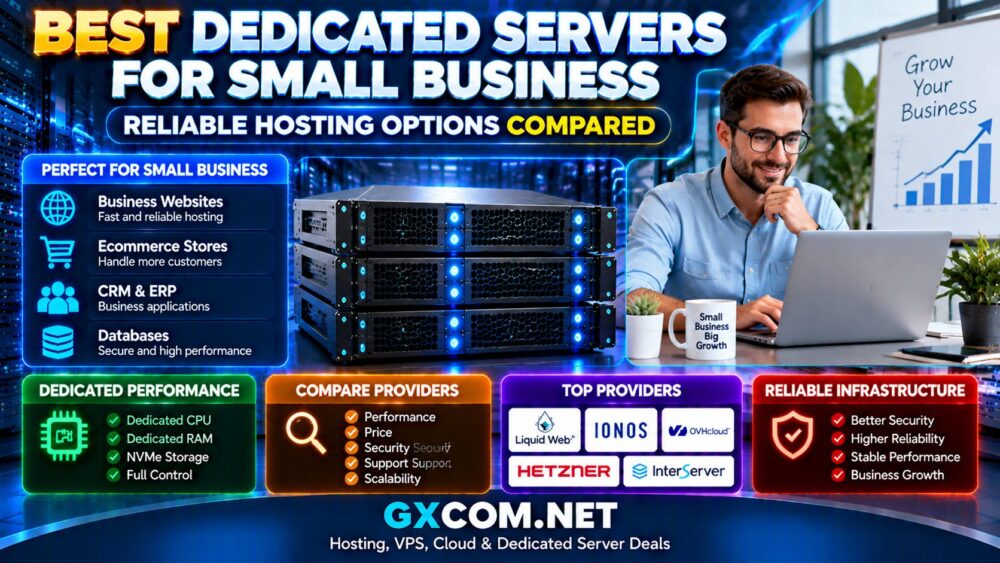
Small businesses increasingly rely on websites, ecommerce platforms, customer management systems, databases, and online applications to operate efficiently. As traffic grows and business applications become more demanding, shared hosting and basic VPS solutions may no longer provide enough performance, reliability, or control.
A dedicated server gives a business an entire physical machine reserved for its own workloads. This provides predictable performance, stronger resource isolation, and greater flexibility for hosting important business applications.
This Best Dedicated Servers for Small Business guide compares reliable dedicated hosting options, explains important features, pricing factors, management choices, and how small businesses can select the right server infrastructure.
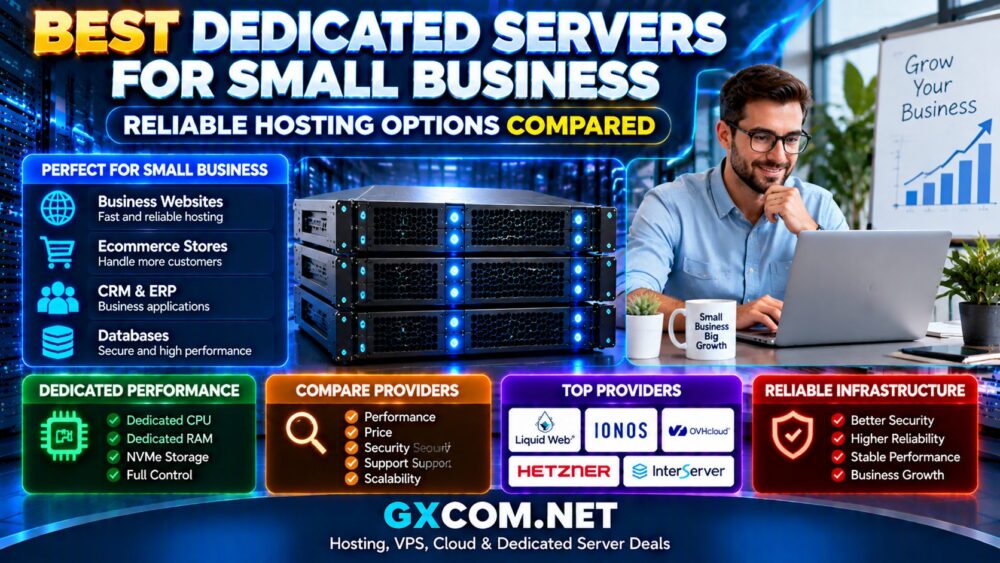
Best Dedicated Servers for Small Business Compared
| Provider | Best For | Main Advantage |
|---|---|---|
| Liquid Web | Managed business hosting | Premium support and management |
| IONOS | Small business websites | Flexible business plans |
| OVHcloud | Growing businesses | Strong hardware selection |
| Hetzner | Technical users | Excellent price-performance |
| InterServer | Budget dedicated hosting | Affordable configurations |
Does a Small Business Need a Dedicated Server?
Not every small business requires dedicated hosting.
Many startups and small websites can operate successfully with shared hosting, managed WordPress hosting, or VPS solutions.
However, a dedicated server becomes valuable when a business needs:
- Consistent website performance
- Higher traffic capacity
- Business application hosting
- Database performance
- Custom software environments
- Greater security control
- Reliable resource availability
Common Small Business Dedicated Server Use Cases
Business Websites
Companies with important online presence may choose dedicated servers to improve reliability and handle increased traffic.
Examples include:
- Corporate websites
- Professional service websites
- Membership websites
- Industry portals
Ecommerce Stores
Online stores depend heavily on speed and availability.
Dedicated servers can support:
- Large product catalogs
- High traffic campaigns
- Customer accounts
- Payment integrations
- Inventory systems
CRM and ERP Applications
Some businesses host internal applications such as CRM, ERP, inventory management, or workflow systems on dedicated infrastructure.
Dedicated resources can provide more predictable performance for business-critical software.
Database Servers
Small businesses managing large amounts of data may benefit from dedicated database infrastructure.
Common databases include:
- MySQL
- MariaDB
- PostgreSQL
- Microsoft SQL Server
Dedicated Server vs VPS for Small Business
| Feature | Dedicated Server | VPS |
|---|---|---|
| Hardware | Entire physical server | Virtual environment |
| Performance | More predictable | Depends on host resources |
| Cost | Higher | Lower |
| Management | Requires more expertise | Easier entry point |
| Scalability | Hardware upgrades | Usually faster scaling |
For businesses still growing, a VPS may provide better value. For businesses where downtime or slow performance directly affects revenue, dedicated hardware may be justified.
See our Dedicated Server vs VPS comparison.
How to Choose a Dedicated Server for Small Business
Small businesses should evaluate servers based on actual workload requirements rather than choosing the largest configuration available.
1. CPU Performance
The processor determines how quickly applications can process requests.
Consider:
- CPU generation
- Core count
- Single-core performance
- Multi-core performance
2. RAM Capacity
RAM affects how many applications and users the server can handle.
| Business Size | Recommended RAM |
|---|---|
| Small website | 16GB–32GB |
| Growing business | 32GB–64GB |
| Database applications | 64GB+ |
3. Storage Performance
Modern businesses should prioritize SSD or NVMe storage.
NVMe is especially useful for:
- Ecommerce platforms
- Databases
- Business applications
- High traffic websites
4. Network Reliability
Network quality directly affects customer experience.
Important factors include:
- Data center location
- Network uptime
- Bandwidth allowance
- Port speed
- DDoS protection
Managed vs Unmanaged Dedicated Servers for Small Business
One of the biggest decisions for small businesses is whether to choose managed or unmanaged hosting.
Unmanaged Dedicated Server
With unmanaged hosting, the business is responsible for:
- Operating system updates
- Security configuration
- Application installation
- Monitoring
- Backups
Unmanaged servers usually cost less but require technical knowledge.
Managed Dedicated Server
Managed hosting provides additional technical assistance.
Providers may help with:
- Server maintenance
- Security updates
- Performance optimization
- Troubleshooting
- Monitoring
For small businesses without dedicated IT staff, managed hosting can reduce operational complexity.
Learn more in our Managed Dedicated Server vs Unmanaged guide.
Linux vs Windows Dedicated Servers for Small Business
The operating system should match the software your business uses.
Linux Dedicated Server
Linux is commonly used for:
- WordPress websites
- PHP applications
- MySQL databases
- Docker environments
- Open-source software
Windows Dedicated Server
Windows is suitable for:
- IIS hosting
- ASP.NET applications
- Microsoft SQL Server
- Windows business software
- Remote Desktop environments
Read our Linux Dedicated Server vs Windows Dedicated Server comparison.
Dedicated Server Security for Small Businesses
Security is one of the biggest reasons businesses choose dedicated hosting.
Recommended security practices include:
- Regular operating system updates
- Firewall configuration
- Strong administrator passwords
- Multi-factor authentication
- Malware protection
- Regular backups
- Access monitoring
A dedicated server provides control, but security still depends on proper management.
Backup Strategy for Business Servers
A dedicated server should never be considered a complete backup solution.
Businesses should maintain:
- Daily backups
- Off-site backup copies
- Database backups
- Recovery testing
How Much Does a Dedicated Server Cost for Small Business?
Dedicated server pricing varies depending on configuration.
Main cost factors include:
- CPU model
- RAM amount
- Storage type
- Bandwidth
- Location
- Management services
- Operating system licensing
Entry-level dedicated servers may be suitable for smaller businesses, while ecommerce platforms and database applications may require more powerful configurations.
Affordable Dedicated Servers for Small Business
Businesses looking for lower-cost dedicated hosting should compare:
- Older generation hardware
- Budget providers
- Unmanaged servers
- Self-managed solutions
However, the cheapest server is not always the best choice. Reliability, support, and upgrade options are often more important for business operations.
Best Small Business Dedicated Server Features
| Feature | Why It Matters |
|---|---|
| NVMe Storage | Faster applications and databases |
| Dedicated RAM | Predictable performance |
| DDoS Protection | Improved availability |
| Backup Options | Business continuity |
| Managed Support | Less technical workload |
Best Dedicated Server Providers for Small Business
Different businesses have different priorities.
- Choose Liquid Web for managed support.
- Choose OVHcloud for global infrastructure.
- Choose Hetzner for hardware value.
- Choose IONOS for business-focused hosting.
- Choose InterServer for budget-friendly options.
When Should a Small Business Upgrade to Dedicated Hosting?
Signs that a business may need a dedicated server include:
- Website slowdown during traffic spikes
- Application performance problems
- Growing database requirements
- Need for custom server software
- Security requirements
- Resource limitations on VPS hosting
Final Thoughts
The best dedicated server for a small business is not necessarily the most expensive configuration.
Businesses should focus on reliability, performance, security, management requirements, and future growth.
Managed dedicated hosting can be valuable for companies without technical teams, while experienced administrators may prefer unmanaged servers for greater control and lower costs.
By selecting the right CPU, RAM, storage, network, and provider, a dedicated server can provide a stable foundation for websites, applications, databases, and business operations.