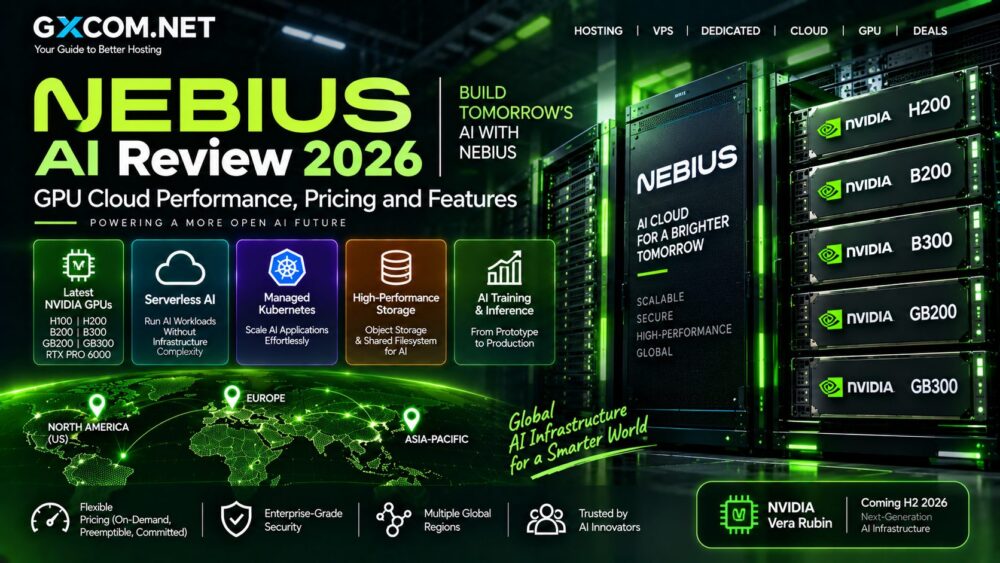
Nebius has rapidly developed into a serious competitor in the specialized AI infrastructure market. Instead of building a conventional cloud and adding GPUs later, the company focuses on full-stack infrastructure for artificial intelligence, combining NVIDIA accelerators, high-performance networking, managed Kubernetes, storage and serverless services. In this Nebius AI Review 2026, we examine GPU performance, current pricing, H100 and H200 infrastructure, Blackwell B200 and B300, managed AI services and the workloads for which Nebius makes the most sense.
The GPU portfolio now stretches from NVIDIA H100 and H200 to B200, B300, GB200 NVL72, GB300 NVL72 and RTX PRO 6000 Blackwell. Nebius is also preparing infrastructure around NVIDIA's next-generation Vera Rubin platform.
This makes Nebius considerably different from a basic GPU rental service. The platform targets developers, AI startups and enterprises that need to move from individual experiments to distributed training and production inference.
Last updated: September 2026. GPU prices, capacity and regional availability can change quickly. Verify the current Nebius console before deploying production workloads.
Nebius AI Review 2026: Quick Overview
| Feature | Nebius AI Cloud |
|---|---|
| Primary Focus | Full-stack AI cloud infrastructure |
| GPU Portfolio | H100, H200, B200, B300, GB200, GB300 and RTX PRO 6000 |
| Pricing Models | On-demand, preemptible and committed capacity |
| Containers | Managed Kubernetes |
| Serverless | Serverless AI workloads |
| Orchestration | Kubernetes, Slurm, SkyPilot and compatible frameworks |
| Storage | Object Storage, Shared Filesystem and local SSD |
| Best For | AI training, inference, LLMs and enterprise AI |
What Is Nebius AI Cloud?
Nebius is an AI-focused cloud provider that builds infrastructure around GPU-intensive workloads rather than treating accelerated computing as a secondary product.
The platform combines:
- NVIDIA GPU compute
- CPU infrastructure
- Managed Kubernetes
- Managed Slurm
- Serverless AI
- Object and shared storage
- High-performance networking
- AI inference services
This full-stack approach is designed to reduce the amount of infrastructure engineering required before an AI team can begin training or serving models.
Readers comparing the broader market can also explore our GPU cloud providers section.
Nebius GPU Pricing in 2026
Pricing is one of the most important parts of this Nebius AI Review 2026. Nebius currently publishes per-GPU-hour prices, which makes comparison between accelerator generations relatively straightforward.
Representative on-demand rates checked in September 2026 include:
| NVIDIA GPU | VRAM | On-Demand / GPU-Hour | Preemptible / GPU-Hour |
|---|---|---|---|
| HGX H100 | 80 GB | $3.85 | $2.15 |
| HGX H200 | 141 GB | $4.50 | $2.45 |
| HGX B200 | 180 GB | $7.15 | $3.95 |
| HGX B300 | 270 GB | $7.85 | $4.30 |
| GB200 NVL72 | Blackwell platform | Contact Nebius | — |
| GB300 NVL72 | Blackwell Ultra platform | Contact Nebius | — |
These are published rates checked in September 2026. Pricing and availability can change, and the total cost of a deployment also depends on the number of GPUs, storage, networking and surrounding infrastructure.
Nebius Preemptible GPU Instances
Preemptible instances provide an important way to reduce GPU costs.
For example, the current published H100 rate drops from $3.85 per GPU-hour on demand to $2.15 for preemptible capacity. H200 falls from $4.50 to $2.45, while B200 falls from $7.15 to $3.95.
The tradeoff is availability.
Preemptible resources can be reclaimed, making them more appropriate for:
- Batch processing
- Fault-tolerant training
- Experiments
- Checkpointed workloads
- Development
Production services that cannot tolerate interruption generally need on-demand or committed capacity.
Nebius Commitment Discounts
Teams with predictable requirements can reserve larger GPU clusters rather than relying entirely on on-demand capacity.
Nebius currently advertises commitment discounts of up to 35% compared with standard on-demand rates for qualifying large-scale reservations.
This matters because GPU economics change significantly at scale. A difference of even a few cents per GPU-hour becomes meaningful when hundreds or thousands of accelerators operate continuously.
NVIDIA H100 on Nebius
H100 remains one of the most established accelerators for AI training, fine-tuning and inference.
Nebius uses NVIDIA HGX H100 infrastructure with 80 GB of HBM3 memory per GPU and support for multi-GPU environments.
H100 remains relevant for teams that do not require the additional memory of H200 or the newer Blackwell architecture.
It can be used for:
- LLM training
- Fine-tuning
- Generative AI
- Inference
- Computer vision
- Scientific computing
Our A100 and H100 GPU section covers this accelerator class in more detail.
NVIDIA H200 on Nebius
H200 increases memory capacity substantially while remaining based on NVIDIA's Hopper architecture.
Each H200 provides 141 GB of HBM3e memory and approximately 4.8 TB/s of memory bandwidth.
That additional memory can be valuable for large-model inference and long-context workloads where VRAM rather than raw compute becomes the limiting factor.
Nebius also provides self-service H200 deployment, meaning smaller teams can launch instances without negotiating a large reserved-capacity contract.
Nebius B200 GPU Cloud
NVIDIA B200 brings Blackwell architecture to the platform.
Nebius currently lists HGX B200 with 180 GB of GPU memory and both on-demand and preemptible pricing.
An important usability change is that Nebius has introduced a one-GPU B200 preset for ad hoc workloads, reducing the need to deploy an entire eight-GPU HGX system simply to experiment with Blackwell.
This makes B200 more accessible to smaller engineering teams while preserving larger cluster options for distributed workloads.
NVIDIA B300 and Blackwell Ultra
B300 pushes GPU memory even further.
Nebius currently lists HGX B300 with 270 GB of memory per GPU and an on-demand price of $7.85 per GPU-hour.
That memory capacity makes B300 relevant to extremely large models, long-context inference, reasoning systems and other workloads where memory requirements continue to increase.
Nebius also supports GB300 NVL72 infrastructure for rack-scale Blackwell Ultra deployments.
Nebius and NVIDIA Vera Rubin
Nebius is already preparing for the generation after Blackwell.
The company announced plans to deploy NVIDIA Vera Rubin NVL72 in the United States and Europe beginning in the second half of 2026.
Rubin is intended for next-generation reasoning, agentic AI and massive mixture-of-experts workloads.
This roadmap matters because AI cloud providers increasingly compete not only on today's GPU pricing but also on how quickly new accelerator architectures become available.
Nebius GPU Cloud Performance
Raw GPU specifications tell only part of the performance story.
Large distributed AI workloads depend on:
- GPU-to-GPU communication
- Networking
- CPU performance
- Storage throughput
- Cluster scheduling
- Software optimization
Nebius says it optimizes its GPU clusters across the hardware and software stack and participates in MLPerf benchmarking.
The company also holds NVIDIA Exemplar Cloud validation across multiple GPU generations, which provides an additional external reference point for training performance.
Nebius Managed Kubernetes
Managed Kubernetes is a core component of the Nebius compute platform.
Rather than manually creating an orchestration layer, teams can use Kubernetes to deploy and scale containerized AI workloads across GPU nodes.
Typical uses include:
- Distributed training
- Inference services
- GPU scheduling
- Microservices
- Autoscaling
- Model-serving platforms
Nebius also supports scheduling frameworks including SkyPilot and Ray-based environments on top of Kubernetes.
Managed Slurm for AI and HPC
Not every GPU workload is best managed through Kubernetes.
Research teams and HPC environments often use Slurm for cluster scheduling.
Nebius supports managed Slurm environments, allowing users to deploy multi-node clusters without manually configuring the entire scheduler and GPU environment.
This gives the platform relevance beyond application developers and into scientific computing and large-scale research.
Nebius Serverless AI
One of the major additions in 2026 was Serverless AI.
Nebius introduced the capability with its Aether 3.5 platform update to reduce the infrastructure work required before running AI workloads.
Instead of provisioning and maintaining GPU environments manually, developers can submit containerized jobs while Nebius handles the underlying runtime infrastructure.
This model can be attractive for:
- Experiments
- Batch AI jobs
- Intermittent GPU workloads
- Model evaluation
- Development pipelines
Nebius Aether 3.6
The Aether 3.6 update in June 2026 pushed Nebius further toward production enterprise AI.
The update introduced or expanded areas including:
- Nebius Echo
- Customer-managed encryption keys
- Workload Identity Federation
- IAM-based cluster access
- Managed SkyPilot
- Storage improvements
- Developer notifications
These features matter because enterprise AI adoption increasingly depends on governance and security rather than GPU performance alone.
What Is Nebius Echo?
Nebius Echo is an AI agent integrated directly into the cloud console.
It is designed to let users interact with infrastructure using natural language, including answering cloud questions and carrying out supported operations with safeguards against unintended actions.
This is an interesting development because cloud management interfaces themselves are beginning to use AI rather than simply hosting AI workloads.
Nebius Storage
GPU clusters require fast and scalable storage to prevent expensive accelerators from waiting for data.
Nebius provides several storage approaches, including:
- Local SSD
- Object Storage
- Shared Filesystem
- Disk snapshots
Aether 3.6 also introduced storage improvements aimed at production AI environments.
The correct architecture depends on whether the workload requires local scratch performance, shared datasets, checkpoints or long-term object storage.
Nebius for AI Training
Training is one of Nebius's primary use cases.
H100 and H200 remain useful for established training stacks, while B200 and B300 provide newer-generation compute and significantly larger memory footprints.
Potential workloads include:
- Large language models
- Fine-tuning
- Reinforcement learning
- Multimodal models
- Computer vision
- Scientific AI
Nebius for AI Inference
Inference is becoming increasingly central to Nebius's strategy as AI applications move into production.
Memory-rich GPUs such as H200, B200 and B300 can help serve larger models and longer contexts, while serverless infrastructure reduces operational work for workloads with variable demand.
Nebius has also expanded its software capabilities around production inference during 2026, reinforcing its goal of competing at the platform layer rather than only selling GPU hours.
Nebius Global Infrastructure
Nebius has been expanding aggressively across the United States and Europe while building a commercial presence in Asia-Pacific.
Its 2026 infrastructure plans include large sites across markets such as Finland, the UK, France, Spain and multiple U.S. locations.
The company also announced an infrastructure-partnership model in July 2026 that allows partners to deploy the Nebius full-stack AI cloud inside third-party AI data centers.
This approach could expand capacity without requiring Nebius to own every physical facility itself.
Nebius vs CoreWeave
Nebius and CoreWeave are among the most relevant direct comparisons because both are purpose-built AI clouds rather than conventional VPS providers.
Both provide advanced NVIDIA infrastructure, Kubernetes, high-performance storage and large-scale GPU clusters.
CoreWeave has developed a strong reputation around massive production AI clusters and inference infrastructure. Nebius combines GPU infrastructure with an increasingly broad AI-native software layer, managed orchestration and serverless services.
Actual GPU availability, workload architecture, regional capacity and pricing should determine the choice rather than assuming either platform is universally better.
Read our CoreWeave Review 2026 for the other side of this comparison.
Nebius vs Lambda GPU Cloud
Lambda provides another AI-focused alternative and can be particularly approachable for teams wanting straightforward GPU instances.
Nebius is increasingly positioned as a broader full-stack AI cloud with Kubernetes, Slurm, serverless infrastructure and enterprise platform features.
Smaller teams should compare the actual GPU configuration and surrounding services they need rather than paying for infrastructure complexity they will not use.
Our Lambda GPU Cloud Review examines that platform separately.
Nebius vs RunPod
RunPod targets developers who want relatively accessible GPU Pods and Serverless GPU infrastructure, including individual GPUs suitable for experimentation and smaller production workloads.
Nebius is more heavily oriented toward full-stack clusters, enterprise AI, managed orchestration and new NVIDIA platforms.
For individual developers, the simpler deployment model may matter more than access to extremely large clusters.
See our RunPod Review 2026 for comparison.
Nebius AI Pros & Cons
| Pros | Cons |
|---|---|
| AI-native cloud infrastructure | Unnecessary for ordinary web hosting |
| H100 through B300 GPU options | Latest rack-scale systems may require sales contact |
| Competitive preemptible pricing | Preemptible workloads can be interrupted |
| Managed Kubernetes and Slurm | Advanced infrastructure has a learning curve |
| Serverless AI | Total cost extends beyond headline GPU pricing |
| Enterprise security features | Capacity varies by GPU and region |
| Vera Rubin roadmap | Smaller users may prefer simpler GPU services |
Who Should Consider Nebius?
Nebius makes the most sense when accelerated computing is central to the application.
Potential users include:
- AI startups
- LLM developers
- Machine-learning teams
- Enterprise AI departments
- Research organizations
- Inference platforms
- Distributed training teams
- HPC users
Who May Prefer an Alternative?
Someone looking for WordPress hosting, a $5 Linux VPS or a general-purpose website server does not need Nebius's AI infrastructure.
Individual developers who need only an inexpensive RTX-class GPU for a few hours should also compare GPU marketplaces and simpler GPU clouds.
Our GPU Server vs Cloud GPU guide explains the broader infrastructure tradeoffs.
Nebius AI Review 2026: Final Verdict
Our Nebius AI Review 2026 shows a platform evolving quickly from GPU infrastructure into a much broader AI-native cloud.
The current portfolio spans H100 and H200, Blackwell B200 and B300, GB200 and GB300 rack-scale infrastructure, Managed Kubernetes, Slurm, Serverless AI and increasingly sophisticated enterprise security and storage capabilities.
The pricing model is also relatively transparent for self-service GPUs. Published per-GPU-hour rates make H100, H200, B200 and B300 easier to compare, while preemptible capacity and commitment discounts provide different ways to control cost.
The strongest reason to consider Nebius is the combination of modern NVIDIA hardware and the software layer surrounding it. Features such as Serverless AI, Managed Kubernetes, Managed Slurm, SkyPilot integration and Nebius Echo show that the company is competing on developer experience and AI operations as well as raw GPU supply.
Nebius is not designed to replace inexpensive general-purpose cloud hosting. For organizations where training, inference or accelerated computing is a core production requirement, however, it has become one of the specialized AI cloud platforms worth evaluating in 2026.