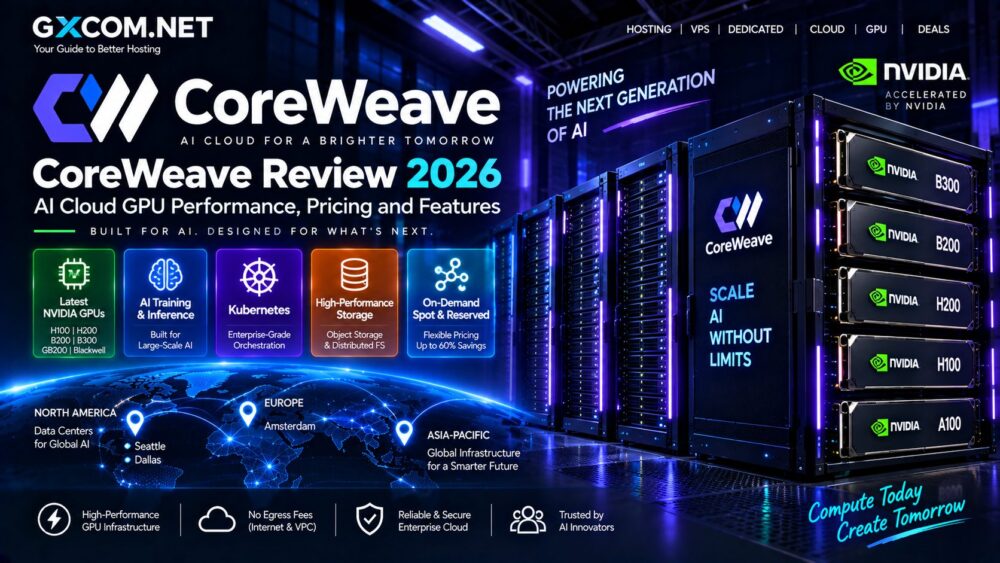
CoreWeave has become one of the most important specialized cloud platforms for artificial intelligence infrastructure. Unlike general-purpose clouds that support thousands of unrelated services, CoreWeave is heavily optimized around accelerated computing, large GPU clusters, AI training and inference. In this CoreWeave Review 2026, we examine its latest NVIDIA GPUs, AI cloud performance, on-demand and Spot pricing, Kubernetes, storage, networking and the workloads for which the platform makes the most sense.
The GPU portfolio now stretches from established NVIDIA A100 and H100 infrastructure to H200, B200, B300, GB200 NVL72 and RTX PRO 6000 Blackwell systems. CoreWeave is also preparing infrastructure around NVIDIA's next-generation Vera Rubin architecture.
This makes CoreWeave very different from a cheap single-GPU marketplace. Its strongest use case is organizations that need AI infrastructure at scale, particularly distributed training, production inference and GPU clusters.
Last updated: September 2026. GPU prices and availability can change rapidly. Always verify the selected region and capacity before deploying production workloads.
CoreWeave Review 2026: Quick Overview
| Feature | CoreWeave Cloud |
|---|---|
| Primary Focus | AI-native cloud and accelerated computing |
| GPU Portfolio | A100, H100, H200, B200, B300, GB200 and RTX PRO 6000 Blackwell |
| Compute Models | On-Demand, Spot and Reserved Capacity |
| Containers | CoreWeave Kubernetes Service |
| Storage | AI Object Storage and Distributed File Storage |
| Internet Data Transfer | No charge under current published pricing |
| Primary Workloads | AI training, inference, LLMs and HPC |
| Best For | AI startups, research teams and large-scale GPU workloads |
What Is CoreWeave?
CoreWeave is a cloud infrastructure provider built primarily around accelerated computing.
Instead of treating GPUs as a small add-on to a conventional CPU cloud, the platform has been engineered around the requirements of artificial intelligence and compute-intensive workloads.
Its infrastructure includes:
- NVIDIA GPU instances
- CPU instances
- Kubernetes
- AI inference infrastructure
- Distributed storage
- Object storage
- High-performance networking
- Reserved GPU capacity
This specialization makes CoreWeave relevant to organizations that have outgrown individual GPU instances and need clusters capable of scaling training or inference workloads.
Readers researching the wider market can compare additional GPU cloud providers before selecting a platform.
CoreWeave GPU Cloud Performance
GPU model alone does not determine AI performance.
Large-scale workloads also depend on networking, storage throughput, CPU resources, memory capacity and how efficiently GPUs communicate across nodes.
CoreWeave builds its infrastructure around this problem rather than simply attaching GPUs to ordinary virtual machines.
Its HGX H100 and H200 clusters, for example, use NVIDIA Quantum-2 InfiniBand NDR networking in configurations designed for distributed training.
This becomes important when training large language models because a poorly connected GPU cluster can leave expensive accelerators waiting for data or synchronization.
CoreWeave GPU Pricing in 2026
Pricing is central to any CoreWeave Review 2026. CoreWeave currently publishes On-Demand and Spot pricing for many GPU configurations, while some of the newest systems require contacting sales.
Representative North American rates checked in September 2026 include:
| GPU | GPU Count | VRAM per GPU | On-Demand Price |
|---|---|---|---|
| NVIDIA A100 | 8 | 80 GB | $21.60/hr |
| NVIDIA HGX H100 | 8 | 80 GB | $49.24/hr |
| NVIDIA HGX H200 | 8 | 141 GB | $50.44/hr |
| NVIDIA HGX B200 | 8 | 180 GB | $68.80/hr |
| RTX PRO 6000 Blackwell High Memory | 8 | 96 GB | $20.00/hr |
| GB200 NVL72 Instance | 4* | 186 GB | $42.00/hr |
| HGX B300 | 8 | 270 GB | Contact Sales |
*CoreWeave describes the GB200 configuration as two GB200 Superchips, with each Superchip containing one Grace CPU and two Blackwell GPUs. Prices are snapshots from September 2026 and may change.
CoreWeave Spot GPU Pricing
Spot capacity can reduce GPU costs substantially when workloads can tolerate interruptions.
Current North American examples include:
- A100 8-GPU instance – approximately $9.65/hour
- H100 8-GPU instance – approximately $19.71/hour
- H200 8-GPU instance – approximately $20.93/hour
- B200 8-GPU instance – approximately $34.11/hour
- B300 8-GPU instance – approximately $35.84/hour
Spot infrastructure is attractive for fault-tolerant batch processing, experimentation and workloads that can checkpoint progress.
It is less appropriate when interruption would cause unacceptable production downtime or significant loss of training progress.
CoreWeave Reserved Capacity
Organizations with predictable GPU requirements can consider reserved capacity rather than continuously paying On-Demand prices.
CoreWeave currently advertises discounts of up to 60% compared with On-Demand rates for committed usage.
The economics can be important at scale. An eight-GPU cluster running continuously represents thousands of GPU-hours each month, so the purchasing model can have as much impact on total cost as the headline hourly rate.
NVIDIA H100 and H200 on CoreWeave
H100 and H200 remain important AI accelerators despite the arrival of Blackwell.
H100 is widely used for generative AI training and inference, while H200 increases GPU memory to 141 GB and uses HBM3e memory.
The additional memory is particularly valuable for large language models where model weights, KV cache and batch sizes can consume enormous amounts of VRAM.
CoreWeave's HGX infrastructure is designed to connect multiple GPUs with high-performance networking rather than treating every accelerator as an isolated server.
For more background on these accelerator classes, see our A100 and H100 GPU coverage.
NVIDIA B200 and B300
Blackwell has become increasingly important to CoreWeave's 2026 infrastructure strategy.
The current HGX B200 configuration combines eight GPUs, 180 GB of VRAM per GPU, 128 vCPUs and 2 TB of system memory.
CoreWeave also made NVIDIA HGX B300 generally available in March 2026.
The published B300 configuration increases GPU memory to 270 GB per accelerator and pairs eight GPUs with 4 TB of system RAM.
That enormous memory footprint is aimed at demanding production AI, reinforcement learning, agentic AI and other workloads where model size and inference context requirements continue to grow.
GB200 NVL72 and Rack-Scale AI
CoreWeave also offers GB200 NVL72 infrastructure.
This represents a shift from thinking about individual GPUs toward rack-scale systems where accelerators, Grace CPUs and high-speed interconnects function as a tightly integrated computing platform.
These systems target organizations running models that require far more compute and memory than a single conventional GPU server can provide.
CoreWeave and NVIDIA Vera Rubin
CoreWeave's hardware roadmap is moving beyond Blackwell.
In June 2026, the company announced that it had completed system-level bring-up and validation of NVIDIA Vera Rubin NVL72 infrastructure.
Vera Rubin is NVIDIA's next-generation rack-scale AI architecture and is intended for increasingly demanding agentic AI and large-scale inference workloads.
This does not mean every CoreWeave customer can instantly deploy Rubin capacity on demand. It does show how aggressively the company is positioning itself around new NVIDIA architectures.
CoreWeave Kubernetes Service
CoreWeave Kubernetes Service, or CKS, is an important part of the platform because modern AI infrastructure increasingly needs orchestration rather than manually configured GPU servers.
Kubernetes can coordinate:
- GPU worker nodes
- Training jobs
- Inference services
- Containers
- Storage
- Networking
- Scaling
This makes CoreWeave more suitable for engineering teams building production AI platforms than services designed primarily around renting one GPU through a simple dashboard.
CoreWeave Storage Pricing
AI workloads can consume enormous amounts of storage, so GPU pricing alone does not reveal total infrastructure cost.
CoreWeave's current published storage rates include:
| Storage Product | Price |
|---|---|
| AI Object Storage – Hot | $0.06/GB/month |
| AI Object Storage – Warm | $0.03/GB/month |
| AI Object Storage – Cold | $0.015/GB/month |
| AI Object Storage – Archive | $0.0125/GB/month |
| Distributed File Storage | $0.070/GB/month |
Archive is currently listed with limited availability and requires contacting CoreWeave.
No Internet Egress Fees?
One notable aspect of CoreWeave's current published pricing is networking.
The company currently lists:
- Internet data transfer – free
- Internal CoreWeave data transfer – free
- VPC – free
- NAT Gateway – free
Public IPv4 addresses are listed separately at $4 per IP per month.
This can materially change the economics of workloads that move large amounts of model data compared with cloud architectures where egress becomes a major cost component.
CoreWeave for AI Training
Large-scale model training is one of CoreWeave's strongest use cases.
Training performance depends on keeping many GPUs busy simultaneously, which requires fast communication between accelerators and storage capable of feeding the cluster.
CoreWeave's combination of HGX systems, InfiniBand networking, Kubernetes and distributed storage is designed around these requirements.
Potential workloads include:
- Large language model training
- Fine-tuning
- Reinforcement learning
- Multimodal models
- Computer vision
- Scientific computing
CoreWeave for AI Inference
Inference is becoming equally important as AI applications move from experimentation into production.
CoreWeave publishes single-GPU inference pricing for supported North American configurations. For example, its current pricing lists approximately $6.16 per hour for an H100 GPU, $6.31 for H200 and $8.60 for B200 under its inference pricing model.
This pricing is specifically associated with CoreWeave inference-platform customers and should not be confused with the price of renting a complete eight-GPU HGX instance.
CoreWeave vs Lambda GPU Cloud
Lambda and CoreWeave both specialize in AI infrastructure, making this a more relevant comparison than comparing CoreWeave only with conventional VPS providers.
Lambda offers accessible GPU cloud instances and AI-focused infrastructure, while CoreWeave places particularly strong emphasis on massive clusters, Kubernetes, production inference and rack-scale systems.
Smaller teams should compare actual available configurations rather than assuming they need the largest possible cluster.
Read our Lambda GPU Cloud Review for a detailed alternative.
CoreWeave vs RunPod
RunPod generally targets a broader range of users looking for accessible GPU Pods, Serverless GPUs and individual accelerators.
CoreWeave's infrastructure is more strongly oriented toward organizations operating production AI at substantial scale.
A developer experimenting with Stable Diffusion or a smaller LLM may find RunPod's deployment model more approachable. A company orchestrating large distributed training or enterprise inference has a different infrastructure problem.
See our RunPod Review 2026 for its current GPU pricing and Serverless platform.
CoreWeave vs Vast.ai
Vast.ai represents an even more different approach.
Its marketplace aggregates GPU capacity from independent hosts, allowing users to search for inexpensive individual machines based on hardware, reliability and price.
CoreWeave provides purpose-built cloud infrastructure rather than an open GPU marketplace.
Vast.ai can be compelling when minimizing the hourly cost of experimentation is the main priority. CoreWeave is aimed more directly at organizations that require consistent infrastructure, orchestration and large-scale AI deployment.
Our Vast.ai Review 2026 explains the marketplace model in detail.
CoreWeave Pros & Cons
| Pros | Cons |
|---|---|
| Purpose-built for AI workloads | Overkill for ordinary web hosting |
| Latest NVIDIA GPU architectures | Large clusters can become expensive quickly |
| H100, H200, B200 and B300 | Some newest products require sales contact |
| High-performance cluster networking | Requires cloud and AI infrastructure expertise |
| Kubernetes-based orchestration | Not designed around beginner VPS use |
| Spot and reserved pricing | Spot workloads can be interrupted |
| No current internet egress charge | GPU availability still depends on capacity and region |
Who Should Consider CoreWeave?
CoreWeave is most relevant when GPUs are central to the workload rather than an occasional requirement.
Strong use cases include:
- AI startups
- Machine-learning engineering teams
- LLM developers
- Enterprise AI platforms
- Research organizations
- Large-scale inference services
- Distributed model training
- HPC workloads
Who May Prefer an Alternative?
Users who simply need a Linux VPS, WordPress server or inexpensive development VM do not need this class of infrastructure.
Individual developers requiring a single low-cost GPU should also compare simpler GPU cloud platforms and marketplaces.
For a broader explanation of the infrastructure choices, see our GPU Server vs Cloud GPU comparison.
CoreWeave Review 2026: Final Verdict
Our CoreWeave Review 2026 shows how quickly specialized AI cloud infrastructure is moving beyond the conventional concept of renting a GPU virtual machine.
CoreWeave now spans H100 and H200 systems, Blackwell B200 and B300 infrastructure, GB200 NVL72, RTX PRO 6000 Blackwell, Kubernetes, high-performance storage and production inference services. Its work on Vera Rubin NVL72 also indicates where the platform is heading next.
The main advantage is specialization. Compute, networking, orchestration and storage are designed around GPU-intensive workloads rather than added to a general-purpose hosting platform as secondary products.
The tradeoff is complexity and scale. CoreWeave is unlikely to be the logical choice for someone who simply wants one inexpensive GPU for occasional experiments. Its strongest case emerges when AI infrastructure becomes a core production requirement and cluster performance, high-speed networking, storage throughput and access to new NVIDIA architectures matter as much as the hourly GPU price.
For serious AI training and inference deployments, CoreWeave belongs on the shortlist of specialized GPU cloud platforms to evaluate in 2026.