Choosing a managed VPS vs self-managed VPS for ecommerce involves more than comparing monthly server prices. An online store must protect customer information, process orders reliably, and recover quickly when something fails.
A self-managed VPS may offer lower infrastructure costs and greater control. Managed VPS hosting adds defined technical assistance, potentially reducing maintenance work and incident response delays. However, neither option automatically guarantees security, compliance, or uninterrupted sales.
This guide compares operational responsibilities, WooCommerce and Magento requirements, downtime exposure, and total hosting costs.
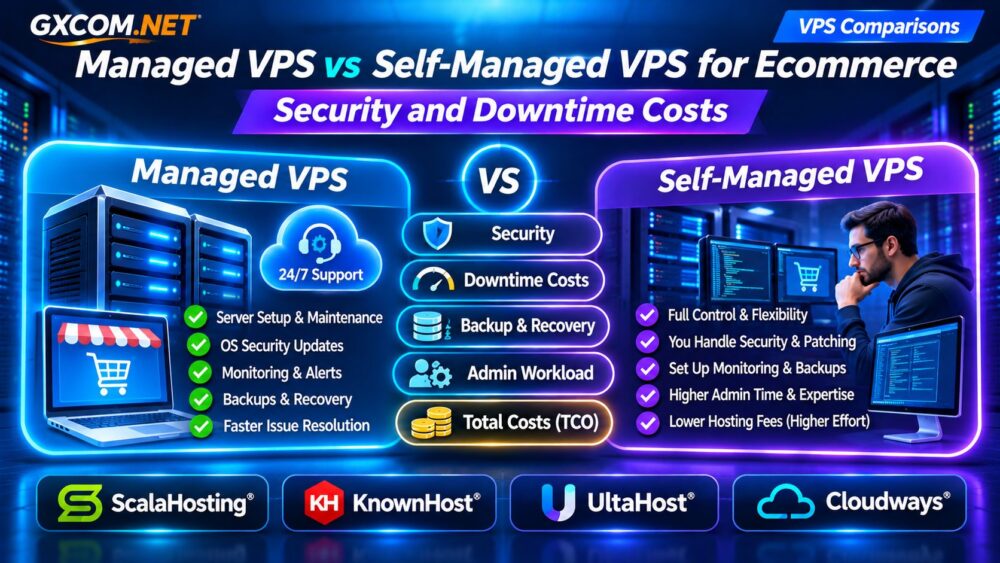
Managed VPS vs Self-Managed VPS for Ecommerce: Quick Comparison
| Factor | Managed VPS | Self-Managed VPS |
|---|---|---|
| OS security updates | Often provider-managed | Store owner’s responsibility |
| Server monitoring | Depends on plan | Customer configures monitoring |
| Firewall and hardening | May include assistance | Customer maintains controls |
| Application updates | Frequently excluded | Customer or developer |
| Incident response | Within support scope | Internal team or contractor |
| Operating costs | Higher service fees possible | Lower fees, more labor |
The critical difference is responsibility. Always review the provider’s written support scope instead of assuming every managed plan covers the entire ecommerce application.
Why Ecommerce VPS Management Matters
Unlike informational websites, ecommerce stores depend on continuous access to shopping carts, payment integrations, inventory systems, and customer accounts.
During a server incident, visitors may abandon checkout, payment callbacks may fail, and administrators may lose access to order processing. Recovery also requires checking whether transactions completed correctly.
Our Managed vs Unmanaged VPS Comparison explains the broader differences between these hosting models.
Security Responsibilities: Who Protects the Store?
Both hosting models require layered security. Important controls include operating system patches, restricted administrative access, firewall rules, malware detection, secure backups, and timely application updates.
A managed provider may maintain supported server components, but WooCommerce plugins, Magento extensions, custom checkout code, and payment integrations often remain the merchant’s responsibility.
PCI DSS obligations also depend on the payment architecture and applicable requirements. Purchasing managed hosting does not automatically make a store PCI compliant.
Ask whether security monitoring, vulnerability remediation, web application firewall services, and emergency assistance are included or separately charged.

Use our Unmanaged Server Security Checklist to identify controls that need an assigned owner.
How Much Does Ecommerce Downtime Cost?
Downtime costs vary according to traffic, conversion rates, average order value, and the timing of an outage.
Consider a hypothetical store generating $2,400 in daily revenue. Its average hourly revenue is $100, although actual sales may fluctuate considerably.
| Outage Duration | Illustrative Revenue Exposure |
|---|---|
| 1 hour | $100 |
| 3 hours | $300 |
| 8 hours | $800 |
| 24 hours | $2,400 |
These figures represent revenue exposure, not confirmed lost sales or profit. Some customers return later, while other losses may include advertising waste, support expenses, and reputational damage.
Calculate risk using your own peak-hour sales and realistic recovery times rather than assuming a fixed industry-wide downtime cost.
Backups, RTO, and RPO: Recovery Matters More Than Promises
A backup is useful only when it can be restored successfully. Ecommerce recovery planning should define two measurements:
- Recovery Time Objective (RTO): How long the store can tolerate an interruption.
- Recovery Point Objective (RPO): How much recent transaction data the business can afford to lose.
Daily backups may be insufficient for a busy store processing orders continuously. Database backups, transaction consistency, off-server storage, and restoration testing deserve particular attention.
Managed hosting may provide backup tools, but retention periods, restoration assistance, and recovery guarantees vary.
Read our VPS Snapshot and Backup Recovery Guide before choosing a backup strategy.
WooCommerce vs Magento: Different Server Requirements
WooCommerce commonly relies on WordPress, PHP workers, database performance, and caching. Busy stores can experience resource pressure during checkout or promotional traffic spikes.
Magento and Adobe Commerce deployments may require more complex caching, search services, scheduled jobs, and application maintenance.
Neither platform automatically requires managed VPS hosting. The decision depends on technical expertise, workload complexity, and the ability to investigate failures quickly.
Before upgrading, benchmark CPU usage, RAM consumption, database latency, and checkout performance under representative traffic.
Four Approved Hosting Providers to Compare
ScalaHosting: Managed VPS for Growing Stores
ScalaHosting is worth evaluating for growing WooCommerce websites that need VPS resources alongside supported server management. Compare available memory, control panel options, backups, and the boundaries of application-level assistance.
KnownHost: Managed VPS Support
KnownHost is a candidate for businesses prioritizing established VPS administration workflows. Verify security maintenance, monitoring, backup restoration, and troubleshooting coverage for the selected hosting package.
UltaHost: Ecommerce VPS Options
UltaHost may suit merchants comparing managed VPS configurations. Review CPU allocation, storage, support response procedures, and whether the intended ecommerce software is covered by technical assistance.
Cloudways: Managed Cloud Application Hosting
Cloudways provides an alternative managed cloud platform approach for website teams. Compare its supported application environment, scaling options, backup features, and limitations before selecting it for WooCommerce.
These services are not interchangeable. Compare actual specifications, management responsibilities, and renewal charges before purchasing.
Monthly TCO: Managed vs Self-Managed VPS
Lower hosting fees do not always produce lower operating costs. Consider this hypothetical monthly comparison:
| Expense | Managed VPS | Self-Managed VPS |
|---|---|---|
| Hosting | $75 | $30 |
| Additional tools | $15 | $20 |
| Administration labor | $30 | $120 |
| Total | $120 | $170 |
Assuming labor costs $30 per hour, this example allocates one monthly hour to managed hosting and four hours to self-management.

Actual results depend on staffing efficiency, incident frequency, service coverage, and store complexity. The table excludes hypothetical downtime losses to avoid treating uncertain risks as guaranteed expenses.
When Should an Ecommerce Store Choose Managed VPS?
Managed VPS is attractive when the business lacks server administration expertise, relies heavily on online revenue, or wants developers focused on store functionality rather than infrastructure maintenance.
Self-managed VPS can be appropriate when experienced administrators already maintain secure systems, automated monitoring, tested backups, and reliable incident response procedures.
For broader purchasing options, consult our Best VPS Providers Guide.
Frequently Asked Questions
Does Managed VPS Prevent Ecommerce Downtime?
No. It may improve maintenance and incident handling, but application bugs, provider outages, and infrastructure failures can still occur.
Is Self-Managed VPS Safe for WooCommerce?
It can be when qualified administrators maintain updates, access controls, monitoring, and tested recovery procedures.
Does Managed Hosting Include PCI Compliance?
Not automatically. Compliance responsibilities depend on the payment architecture, provider services, and applicable PCI DSS requirements.
Final Verdict
Choose managed VPS when reducing operational workload and improving access to technical assistance justify the service cost. Choose self-managed VPS when your team can reliably handle security, maintenance, monitoring, and recovery.
Compare ScalaHosting, KnownHost, UltaHost, and Cloudways against your ecommerce platform, expected traffic, support requirements, and total monthly costs. The best hosting decision protects checkout reliability without paying for services your team does not need.