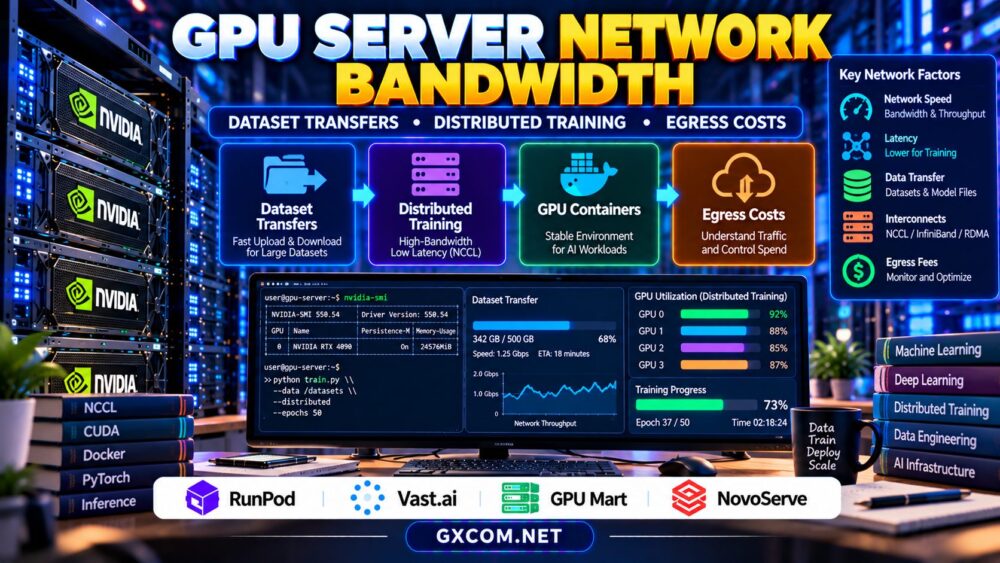
GPU server network bandwidth can determine whether expensive AI accelerators spend their time processing data or waiting for it to arrive. For machine learning teams, network performance affects dataset transfers, distributed training, model deployment, and the total cost of GPU hosting.
However, advertised port speed does not tell the whole story. Actual throughput depends on storage performance, network congestion, geographic distance, transfer protocols, and provider policies. This guide explains how to evaluate GPU networking before committing to cloud or dedicated infrastructure.
Why GPU Server Network Bandwidth Matters
Modern AI workloads frequently move large datasets between object storage, training servers, and inference environments. If data arrives too slowly, even powerful GPUs may remain underutilized.
Network requirements differ by workload. A single inference server may primarily receive requests and return results. A training cluster may continuously exchange gradients, checkpoints, and dataset shards.
Start by identifying three traffic categories: incoming datasets, communication between computing nodes, and outgoing model artifacts or inference results. Each category can have different performance requirements and billing rules.
Bandwidth vs Throughput vs Latency
Bandwidth describes a connection’s theoretical data-carrying capacity. Throughput measures the useful data transferred in practice, while latency describes communication delay.
A 10 Gbps port does not guarantee sustained 10 Gbps transfers. Shared infrastructure, storage limitations, protocol overhead, and remote endpoint capacity can reduce actual performance.
Latency becomes especially important when distributed applications repeatedly synchronize small messages. High bandwidth alone cannot eliminate communication delays.
For complementary storage planning, read our GPU server storage requirements guide.
How Long Does a Large Dataset Transfer Take?
A useful estimate is:
Transfer time in seconds = Dataset size in bits / Effective throughput in bits per second.
Consider a hypothetical 500 GB dataset transferred over a connection delivering 1 Gbps of effective throughput. Using decimal units, the theoretical transfer time is approximately 4,000 seconds, or 67 minutes.
At 5 Gbps effective throughput, the same dataset would take approximately 13 minutes. These estimates exclude additional processing, retries, and other delays.
For repeated experiments, caching datasets near GPU workers can reduce unnecessary transfers. Compare network throughput with local NVMe read speeds before upgrading either resource.
Distributed GPU Training: Networking Changes Everything
Distributed training introduces communication requirements beyond ordinary dataset downloads. Multiple GPUs or servers may exchange gradients and coordinate model updates throughout training.
Frameworks using collective communication libraries such as NVIDIA NCCL can benefit from appropriate high-performance networking. Depending on hardware and configuration, technologies including RDMA and InfiniBand may reduce communication overhead.

However, GPU-to-GPU communication inside one server differs from communication across separate machines. PCIe and NVLink, where supported, are not substitutes for an inter-server network.
Before renting a multi-node cluster, verify topology, available interconnects, supported software, and whether the provider permits the required networking configuration.
GPU Cloud Egress Costs Explained
Ingress refers to incoming data, while egress generally describes outgoing traffic. Providers may price internet transfers, cross-region traffic, and private-network communication differently.
Never assume that unlimited bandwidth means unlimited free data transfer. A plan may include a fixed traffic allowance, port-speed limits, or additional usage charges.
For example, suppose a project transfers 3 TB externally each month and a hypothetical provider charges $0.05 per GB after a 1 TB allowance. Using decimal units, the additional 2,000 GB would cost $100.
This is an illustrative calculation, not a quoted provider price. Always inspect the actual billing terms, included traffic, and destination-specific rules.
Our GPU cloud idle costs guide explains additional expenses that can accumulate outside active computing time.
GPU Hosting Providers: Network Factors to Compare
The following approved providers offer different infrastructure approaches. Their inclusion does not establish current bandwidth guarantees, network pricing, or GPU inventory.
| Provider | Potential Use Case | Network Questions |
|---|---|---|
| RunPod | AI training and inference workloads | Storage transfers, regional connectivity, egress rules |
| Vast.ai | Flexible GPU marketplace rental | Host-specific throughput and connectivity |
| GPU Mart | Persistent GPU server environments | Port speed, traffic allowance, remote storage |
| NovoServe | Dedicated infrastructure evaluation | GPU availability, network capacity, transfer policy |
RunPod: Evaluate GPU and Storage Connectivity
RunPod may suit teams deploying containerized AI applications and training workloads. Compare available locations, storage options, data movement requirements, and applicable transfer charges before selecting an environment.
For broader purchasing context, see our RunPod GPU cloud review.
Vast.ai: Check Individual Host Conditions
Vast.ai uses a marketplace model, so networking characteristics may vary across listings. Evaluate host location, available connectivity, reliability, and dataset access alongside GPU specifications.
Test representative transfers before committing to long-running workloads.
GPU Mart: Consider Persistent Data Workflows
GPU Mart is relevant when evaluating persistent GPU server environments. Ask about network port capacity, included transfer allowances, storage connectivity, and administrative access.
Persistent datasets can reduce repeated downloads, although storage costs and backup responsibilities remain important.
NovoServe: Dedicated Network Infrastructure
NovoServe is an approved dedicated infrastructure provider worth considering when network control is a major requirement. Verify suitable GPU hardware availability before treating any offering as a GPU training solution.
Request written clarification of bandwidth commitments, traffic policies, and supported network configurations.
How to Test GPU Server Network Performance
Use controlled measurements rather than relying exclusively on advertised specifications. Tools such as iperf3 can help measure throughput between endpoints you control and have permission to test.
Measure dataset download speed, storage read performance, latency, and sustained transfer behavior during realistic workloads.
For distributed training, monitor GPU utilization and communication time. A faster network provides limited benefit if CPU preprocessing or storage remains the actual bottleneck.
Our GPU servers for university research labs guide discusses shared workloads and infrastructure planning.
GPU Network Procurement Checklist
Before purchasing, confirm advertised port speed, expected throughput, included monthly traffic, egress rates, regional transfer charges, storage locality, and any high-performance interconnect requirements.
Also verify whether bandwidth is shared, whether traffic is metered, and how network usage appears on invoices. Obtain written clarification when contract terms are ambiguous.
Compare GPU Hosting Beyond GPU Specifications
Evaluate network performance, storage connectivity, transfer allowances, and total operating costs before choosing GPU infrastructure.
Frequently Asked Questions
Is 1 Gbps enough for GPU training?
It can be sufficient for some single-node workloads with locally cached datasets. Large distributed training jobs may require substantially different networking capabilities.
Does a 10 Gbps GPU server guarantee faster training?
No. Training speed also depends on GPU utilization, storage throughput, preprocessing, and communication patterns.
Are GPU cloud data transfers free?
Not necessarily. Transfer allowances and charges vary by provider, region, destination, and service type.
Final Verdict
The right GPU server network bandwidth depends on how data enters, moves through, and leaves your AI infrastructure. Compare RunPod, Vast.ai, GPU Mart, and verified NovoServe configurations using measured throughput, storage locality, distributed training requirements, and total transfer costs. A balanced infrastructure plan often delivers better value than choosing the fastest advertised network port.