Choosing a GPU server for AI inference or professional rendering requires more than comparing theoretical processing power. Memory capacity, workload compatibility, deployment costs, and sustained utilization determine whether an accelerator delivers practical value.
The NVIDIA L40S GPU server targets this intersection of AI computing and visual workloads. Built on NVIDIA’s Ada Lovelace architecture, the L40S combines 48GB of graphics memory with Tensor Cores and dedicated ray-tracing hardware.
For businesses running image generation, 3D rendering, or language model inference, it offers an alternative to more expensive training-oriented accelerators. But is it the right choice for your application?
This review examines L40S specifications, real deployment considerations, and the economics of renting GPU infrastructure.
Editorial note: GXCOM.NET evaluates published specifications and infrastructure requirements. No independent GPU benchmarks were conducted for this review.
NVIDIA L40S Specifications and Architecture
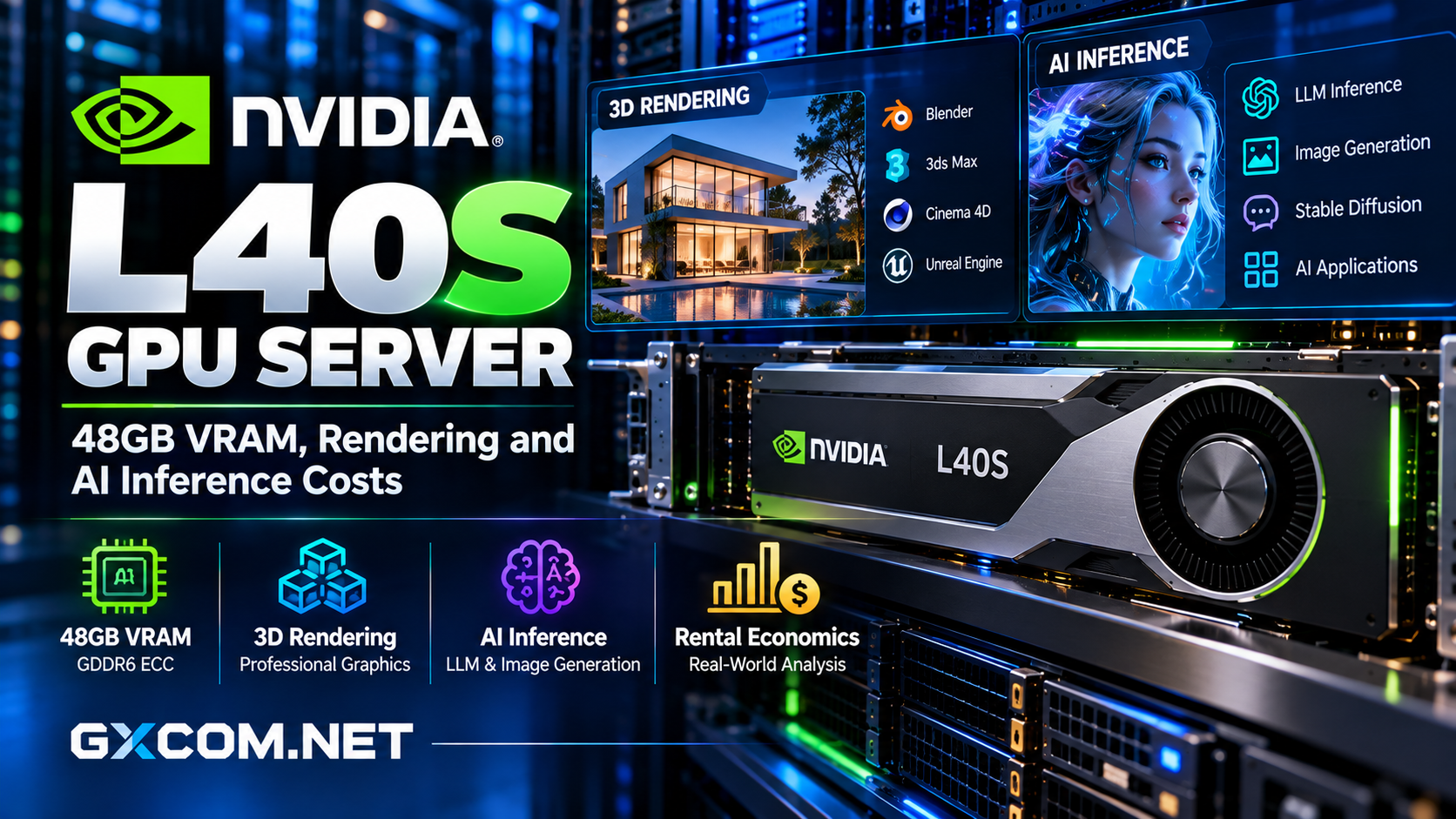
The L40S uses NVIDIA’s Ada Lovelace architecture and includes 18,176 CUDA cores, 568 fourth-generation Tensor Cores, and 142 third-generation RT Cores.
Its 48GB GDDR6 ECC memory provides 864GB/s of bandwidth, while maximum board power consumption reaches 350W.
Unlike NVIDIA’s H100 SXM, the L40S does not support NVLink. It also lacks Multi-Instance GPU partitioning, although supported NVIDIA virtual GPU software enables certain virtualized workloads.
| Specification | NVIDIA L40S |
|---|---|
| Architecture | Ada Lovelace |
| GPU Memory | 48GB GDDR6 ECC |
| Memory Bandwidth | 864GB/s |
| CUDA Cores | 18,176 |
| Tensor Cores | 568 |
| RT Cores | 142 |
| Maximum Power | 350W |
| NVLink / MIG | Not supported |
These specifications establish its capabilities, but application performance depends on software optimization and server configuration.
Is 48GB VRAM Enough for AI Inference?
GPU memory determines whether model weights, runtime buffers, and intermediate computations can fit on the accelerator.
With 48GB VRAM, the L40S can support many smaller and medium-sized inference workloads, including selected quantized language models and diffusion pipelines.
However, advertised model parameter counts do not directly translate into memory requirements.
Precision, quantization, context length, batch size, and key-value caching all affect total consumption.
LLM Inference and Quantization
Quantization reduces model memory requirements by storing weights at lower numerical precision. This can make larger models practical on limited GPU memory.

Nevertheless, additional context and concurrent requests consume memory beyond the weights themselves.
Developers should test realistic request patterns rather than assuming that a model fitting into 48GB will deliver acceptable production throughput.
For broader hardware selection, read our NVIDIA GPU server providers comparison.
L40S Performance for 3D Rendering
Professional rendering is a major strength of the L40S. Its RT Cores accelerate supported ray-tracing operations, while CUDA and Tensor Cores contribute to compatible rendering and denoising workflows.
Applications using GPU rendering can benefit from substantial memory capacity when handling complex scenes, textures, and geometry.
However, rendering performance depends heavily on the engine, scene complexity, memory usage, and software version.
A GPU that performs well in an offline rendering queue may not deliver identical advantages in an interactive visualization environment.
Virtual Workstations and Graphics Applications
NVIDIA supports L40S deployments with compatible RTX Virtual Workstation software, making it relevant to remote graphics and visualization environments.
Organizations should verify virtualization licensing, application certification, and display requirements before deployment.
The distinction between rendering infrastructure and ordinary GPU compute matters because software licensing can affect total ownership costs.
Stable Diffusion, SDXL, and Image Generation
The L40S also supports generative image workflows, including Stable Diffusion-based applications.
Its 48GB memory capacity provides room for model components, larger images, and selected batch-processing configurations.
Batching can increase total output, but excessive batch sizes may increase latency or exhaust available memory.
For production image generation, monitor completed images per hour, failure rates, and GPU utilization.
Compare these metrics under identical resolution, inference steps, and model settings.
Our AI GPU VPS providers guide covers additional deployment options.
L40S vs H100: Which GPU Makes Sense?
The L40S and H100 serve overlapping but different infrastructure requirements.
The H100 emphasizes high-bandwidth memory and advanced interconnect capabilities for demanding AI training and large-scale distributed workloads.
The L40S combines AI inference acceleration with dedicated graphics and ray-tracing features.
For rendering and smaller inference deployments, L40S may provide better economics when its performance meets application requirements.
For memory-bandwidth-intensive training or tightly coupled multi-GPU workloads, H100-class infrastructure may be more appropriate.
Neither option is universally cheaper per completed task. Benchmarking remains essential.
Understanding L40S GPU Rental Costs
GPU rental prices depend on provider, region, availability, storage, and billing structure.
Instead of focusing exclusively on hourly rates, calculate the cost of completed work.
Cost per Task = Total Billable Infrastructure Cost / Successful Tasks Completed
For example, suppose a hypothetical L40S instance costs $0.90 per hour and completes 180 acceptable image-generation tasks during that hour.
Compute cost would average $0.005 per completed task, excluding storage, network transfer, and operational expenses.
These figures are illustrative, not measured L40S performance or current rental pricing.
Utilization and Hidden Expenses
Idle GPU time, model loading, data transfer, and failed requests can significantly increase effective costs.
Rendering studios should measure cost per completed frame, while inference services should monitor cost per request or generated token.
Our affordable GPU servers guide explores related cost comparisons.
L40S GPU Hosting Providers to Compare
RunPod: Flexible L40S Cloud Rentals
RunPod publicly lists NVIDIA L40S GPU options, making it a relevant starting point for cloud-based inference and rendering experiments.

Review deployment availability, storage persistence, and billing before selecting a configuration.
Vultr: Cloud GPU Infrastructure
Vultr offers L40S-based GPU cloud options for AI applications and enterprise deployments.
Confirm the selected instance’s allocated GPU memory, region, and resource specifications.
Cherry Servers: Dedicated GPU Infrastructure
Cherry Servers provides dedicated infrastructure for GPU workloads. Buyers should confirm current L40S availability and compare server configurations against sustained utilization requirements.
GPU Mart: GPU Server Alternatives
GPU Mart offers dedicated GPU hosting options that may suit continuously running applications.
Compare available GPU models and contractual terms rather than assuming every configuration includes L40S hardware.
For infrastructure planning, explore our bare metal server providers comparison.
Who Should Choose NVIDIA L40S?
L40S is particularly attractive for rendering studios, AI image-generation platforms, remote visualization environments, and inference services whose models fit comfortably within 48GB VRAM.
It is less suitable when workloads require NVLink-connected GPU clusters, MIG-based hardware partitioning, or substantially more accelerator memory.
Before renting, test representative workloads and compare total task costs against alternative GPUs.
Final Verdict
The NVIDIA L40S GPU server offers a versatile combination of 48GB VRAM, AI acceleration, and professional graphics capabilities.
Its value is strongest where rendering and inference requirements overlap, particularly when H100-class training features are unnecessary.
Choose L40S based on measured throughput, memory requirements, and completed-work economics rather than theoretical performance figures alone.