Modern VPS hosting depends on more than the number of CPU cores inside a physical server. Memory locality, processor scheduling, storage performance, and resource contention determine how consistently virtual machines perform under load.
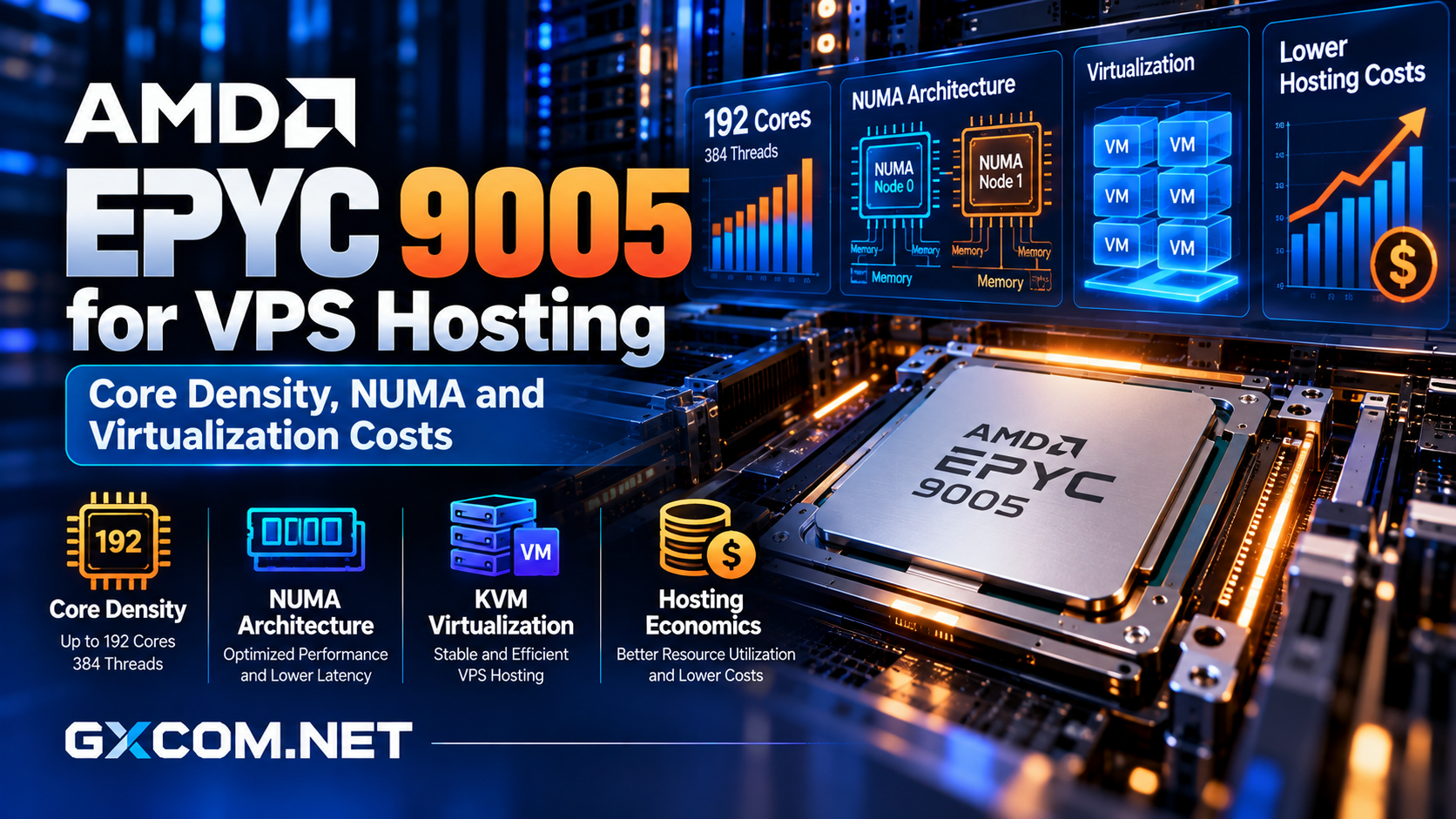
The AMD EPYC 9005 series brings Zen 5 and Zen 5c architectures to enterprise servers, offering configurations with up to 192 physical cores per processor. For hosting providers, that density creates opportunities to consolidate workloads and improve infrastructure efficiency.
But does a higher core count translate into better VPS hosting? This review examines processor architecture, NUMA behavior, virtualization performance, and the actual economics of running high-density VPS infrastructure.
Editorial note: This analysis uses published hardware specifications and virtualization guidance. GXCOM.NET has not independently benchmarked EPYC 9005 hosting systems.
AMD EPYC 9005: Architecture and Core Density
AMD’s fifth-generation EPYC processors, also known as Turin, support configurations ranging from smaller enterprise models to high-density server CPUs.
The EPYC 9965 features 192 cores and 384 threads, while other models balance core counts, clock frequencies, cache capacity, and power consumption differently.
The family supports twelve DDR5 memory channels and PCIe 5.0 connectivity, providing substantial resources for memory-intensive virtual machines and high-speed NVMe storage.
However, the maximum-core model is not necessarily the best choice for every hosting business. High-frequency processors may deliver better results for latency-sensitive applications, while Zen 5c models prioritize density.
Why Core Density Matters for VPS Hosting
Core density describes how much CPU capacity fits within a physical server. A higher-density processor can support more virtual machines without requiring additional server chassis, network ports, or rack space.
For hosting operators, consolidation may reduce hardware footprint and simplify infrastructure management.
Nevertheless, physical cores and advertised virtual CPUs are not interchangeable. A VPS provider may allocate multiple virtual CPUs against shared physical processing resources.
Performance therefore depends on scheduling policies, simultaneous workloads, and the degree of CPU oversubscription.
Our NVMe VPS performance guide explains why storage responsiveness also matters when evaluating virtual servers.
NUMA Architecture and Memory Locality
Non-Uniform Memory Access, or NUMA, describes systems where memory access latency varies according to the location of the requesting CPU core and memory controller.
EPYC 9005 processors support configurable NUMA Nodes Per Socket settings, commonly called NPS.

With NPS1, a processor is presented as one NUMA domain. NPS2 divides it into two domains, while NPS4 creates four domains per socket.
These configurations affect how CPU cores, memory channels, and I/O devices are grouped.
Why NUMA Placement Affects Virtual Machines
A virtual machine may experience additional latency when its processing threads frequently access memory associated with a distant NUMA domain.
For databases, application servers, and other memory-sensitive workloads, poor placement can reduce consistency even when unused CPU capacity remains available.
Hypervisors can manage placement automatically, but larger virtual machines may require more careful topology planning.
Administrators should benchmark realistic workloads before changing BIOS settings or manually pinning virtual CPUs.
KVM Virtualization and CPU Scheduling
AMD EPYC processors support hardware-assisted virtualization, making them suitable for platforms such as KVM and enterprise hypervisors.
For VPS hosting, the scheduler determines when virtual CPUs execute on available physical threads.
SMT increases the number of logical threads, but two threads sharing a physical core do not provide the same capacity as two independent cores.
High-density environments must therefore monitor CPU steal time, scheduling delays, and noisy-neighbor effects.
CPU pinning can improve predictability for selected workloads, although it reduces scheduling flexibility and may leave resources underutilized.
For a broader comparison of server architectures, read our dedicated server versus VPS guide.
Memory Bandwidth and NVMe Infrastructure
Large CPU counts create corresponding demands for system memory and storage throughput.
EPYC 9005 supports twelve DDR5 memory channels per socket, but actual bandwidth depends on installed DIMMs, memory population, processor configuration, and operating conditions.
A server with many CPU cores but insufficient RAM may reach its practical VPS capacity long before exhausting processing resources.
Likewise, overloaded NVMe arrays can increase application latency across otherwise healthy virtual machines.
Providers should balance CPU allocations with memory reservations, storage IOPS, and network bandwidth rather than maximizing VM counts alone.
Virtualization Costs: More Than Server Price
The economic argument for high-density EPYC servers depends on total operating cost, not simply the purchase price of the processor.
Relevant expenses include hardware acquisition, RAM, NVMe drives, networking, electricity, cooling, software licensing, maintenance, and available rack space.
A useful calculation is:
Cost per Active VPS = Total Monthly Infrastructure Cost / Average Active VPS Count
Consider a hypothetical server costing $1,200 monthly to operate. At 120 active virtual machines, infrastructure cost averages $10 per VPS.
If better resource allocation supports 150 comparable workloads without compromising service quality, that figure becomes $8.
These figures are illustrative, not measured EPYC 9005 hosting economics.
Increasing VM density is worthwhile only when performance, reliability, and customer experience remain acceptable.
AMD EPYC Hosting Providers Worth Comparing
Bacloud: Dedicated EPYC Infrastructure
Bacloud offers AMD EPYC dedicated servers, including selected EPYC 9005 configurations. It is relevant for organizations considering dedicated virtualization hosts or private VPS infrastructure.
Confirm the exact CPU model, installed memory, storage configuration, location, and availability before ordering.
Cherry Servers: EPYC Virtual Dedicated Servers
Cherry Servers provides EPYC-based virtual dedicated servers and dedicated infrastructure. Its offerings deserve consideration when predictable resource allocation matters more than maximum shared-host density.
Verify the processor generation for each plan rather than assuming every EPYC service uses the 9005 series.
AlphaVPS: Performance-Oriented VPS Hosting
AlphaVPS offers KVM-based VPS plans using AMD EPYC processors and NVMe storage. Its published performance-tier configurations reference earlier EPYC generations.

This makes AlphaVPS a useful alternative for buyers prioritizing practical VPS specifications over the newest processor generation.
Hetzner: Dedicated Server Alternatives
Hetzner is another option for comparing dedicated-server economics, network capacity, and virtualization deployment requirements.
Buyers should check current hardware listings and confirm processor generations before making direct performance comparisons.
Explore our best VPS providers comparison and bare metal server providers guide for additional options.
Who Should Choose EPYC 9005?
EPYC 9005 is particularly attractive to hosting operators consolidating numerous virtual machines, businesses building private clouds, and organizations running memory-intensive virtualized applications.
However, smaller workloads may perform adequately on earlier EPYC generations at a lower total cost.
Before upgrading, compare application latency, CPU contention, NUMA placement, power consumption, and usable VM capacity under realistic load.
Final Verdict
AMD EPYC 9005 for VPS hosting offers impressive core density, modern memory connectivity, and flexible virtualization capabilities.
Its strongest advantage is the potential to support more productive workloads per physical server. Yet NUMA tuning, CPU scheduling, storage performance, and responsible resource allocation remain essential.
For hosting providers, the winning configuration is not necessarily the one with the most cores. It is the platform that delivers consistent VPS performance at a sustainable cost per workload.