Renting a GPU is no longer simply about finding the lowest hourly rate. For AI developers, unreliable instances, storage charges, slow deployments, and interrupted training jobs can make an apparently inexpensive GPU surprisingly costly.
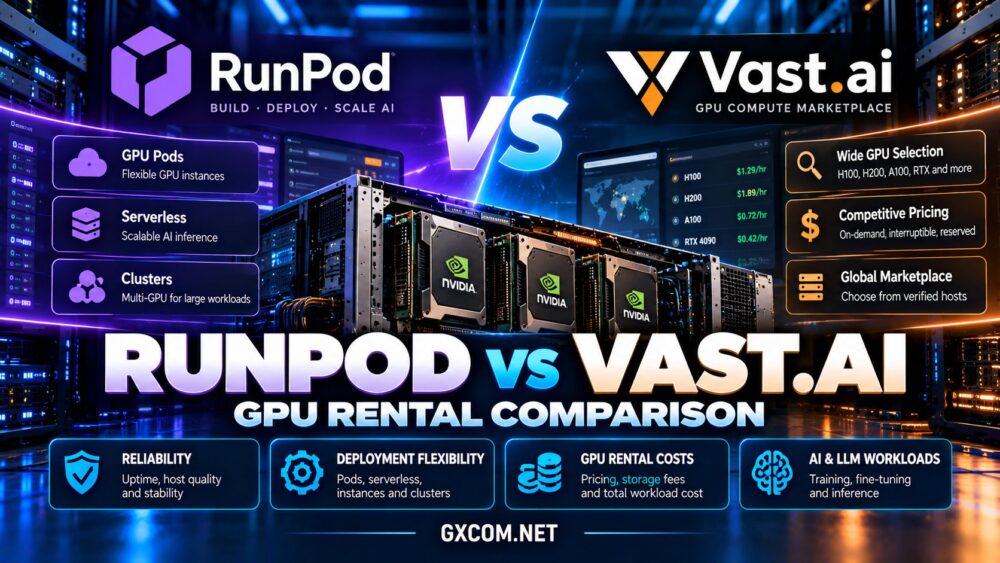
In this RunPod vs Vast.ai comparison, we examine GPU rental reliability, deployment flexibility, serverless inference, hardware availability, and total operating costs. We also explain which platform makes more sense for experimentation, model fine-tuning, and production AI applications.
RunPod vs Vast.ai: Quick Verdict
RunPod is a strong choice for developers who want an integrated environment combining GPU Pods, Serverless endpoints, and multi-GPU clusters. Its different deployment products support workflows ranging from interactive development to production inference.
Vast.ai is particularly attractive to price-conscious users who want to compare GPU offers across a competitive marketplace. It provides extensive hardware choices, host-level information, and several rental arrangements.
Our recommendation: Start with RunPod when a streamlined deployment workflow is your priority. Consider Vast.ai when flexible hardware selection and careful cost optimization matter most. Neither platform guarantees superior reliability or performance for every configuration.
For a broader selection, explore our NVIDIA GPU server providers guide.
RunPod vs Vast.ai: Feature Comparison
| Feature | RunPod | Vast.ai |
|---|---|---|
| Primary model | GPU cloud platform | GPU compute marketplace |
| GPU deployment | Pods, Serverless, Clusters | Instances, Serverless |
| Hardware selection | Published GPU catalog | Marketplace listings |
| Pricing approach | Published product rates | Supply-and-demand pricing |
| Rental flexibility | On-demand GPU workflows | On-demand, interruptible, reserved |
| Reliability assessment | Cloud tier and service configuration | Host reliability and listing details |
| Best fit | Integrated AI deployment | Flexible GPU procurement |
Actual GPU availability, service terms, and supported features can change. Always inspect the specific offer before deploying important workloads.
GPU Rental Reliability: Which Platform Is Safer?
Reliability is not determined by a provider’s brand name alone. Physical host quality, networking, storage, maintenance practices, and the selected rental tier all affect uptime.
RunPod Reliability Considerations
RunPod distinguishes between infrastructure offerings such as Secure Cloud and Community Cloud. These choices allow users to evaluate different deployment environments rather than treating every GPU listing as equivalent.
For production applications, examine the selected service tier, data persistence, region, restart behavior, and documented service commitments.
Do not assume that a GPU Pod automatically provides the same availability characteristics as a managed, redundant application architecture.
Vast.ai Host Reliability
Vast.ai operates a marketplace where hardware can be supplied by different hosts. Its listings include reliability information that helps renters assess individual machines.
This visibility is useful, but host quality can vary. A low-cost listing with weaker reliability characteristics may be unsuitable for a long-running training job.
Evaluate host history, network quality, disk performance, availability, and rental conditions before selecting an instance.
Winner: Neither universally. RunPod offers a more integrated selection process, while Vast.ai gives buyers additional marketplace-level host considerations.

Deployment Flexibility and Developer Experience
Deployment flexibility determines how easily a team can move from a notebook experiment to a working AI service.
RunPod GPU Pods and Serverless
RunPod Pods provide GPU-backed environments suitable for containers, model development, fine-tuning, and persistent application workloads.
Its Serverless product supports API-based inference with workers that can scale according to demand. Clusters provide another deployment option for larger distributed computing jobs.
This combination can reduce the need to move between unrelated infrastructure products as an application grows.
Vast.ai Instances and Serverless
Vast.ai lets developers filter marketplace offers by GPU model, memory, pricing, and other characteristics.
Its instance model works well for users comfortable managing containerized workloads and selecting their own compute environment. Vast.ai also offers serverless capabilities, so the comparison is not simply serverless versus non-serverless.
Developers should assess template compatibility, startup time, persistent storage, API integration, and operational responsibilities on both platforms.
Winner: RunPod for an integrated deployment workflow; Vast.ai for granular marketplace selection.
GPU Availability: H100, H200 and Consumer GPUs
Both platforms offer access to multiple GPU classes, but available models and quantities vary.
High-memory accelerators such as NVIDIA H100 and H200 are relevant for demanding LLM inference and training. Consumer GPUs may offer better economics for smaller models, experimentation, and selected fine-tuning tasks.
GPU model names alone are insufficient for comparison. Check VRAM capacity, PCIe versus SXM configurations, available GPU count, interconnects, CPU resources, and system memory.
A single H100 cannot automatically replace a multi-GPU configuration, and two instances with the same GPU may deliver different application performance.
Our affordable GPU servers comparison explains how to match hardware to budget.
RunPod vs Vast.ai Pricing: What Actually Costs More?
Hourly rental prices are only the beginning of GPU hosting costs.
RunPod publishes pricing for its GPU products, while Vast.ai marketplace rates respond to available supply, demand, host characteristics, and rental type.
Both support fine-grained compute billing in relevant products, but the complete bill depends on the chosen configuration.
Storage and Data Transfer Charges
Persistent storage can remain billable even when compute resources are stopped. Vast.ai explicitly separates compute, storage, and bandwidth charges in its rental documentation.
RunPod users should also examine storage options, attached volumes, and applicable network charges for their selected product.
Large training datasets, model checkpoints, and repeated downloads can materially affect project costs.
Interruptible vs On-Demand GPUs
Vast.ai offers interruptible rentals that may cost less than regular on-demand capacity. However, these instances can be reclaimed.
They are better suited to checkpointed training, retryable batch jobs, and fault-tolerant experiments than uninterrupted production services.
RunPod users should compare the specific cloud and deployment products available rather than assuming all GPU rental arrangements have identical interruption risks.
Calculate Cost Per Completed Workload
Suppose one GPU costs less per hour but takes longer to finish a job. Its actual cost advantage may disappear.
Measure total GPU runtime, failed attempts, storage expenses, data transfer, and engineering effort.
For inference, compare cost per million output tokens at a specified latency and concurrency level. For training, compare cost per completed experiment.
Which Is Better for LLM Inference?
Production inference needs predictable response times, appropriate VRAM, request handling, and reliable scaling.
RunPod Serverless can be attractive when traffic fluctuates and developers want an endpoint-oriented deployment workflow.
Vast.ai can be competitive when teams want to optimize infrastructure selection and are comfortable evaluating marketplace offers or its serverless options.
Benchmark time to first token, generated tokens per second, queue delays, and concurrency before choosing.
For alternative architectures, see our AI GPU VPS providers comparison.
Which Is Better for Model Fine-Tuning?
Fine-tuning workloads often require uninterrupted compute, fast storage, sufficient GPU memory, and reliable checkpoint management.
RunPod Pods are suitable for interactive development and containerized training environments. Vast.ai offers flexible hardware selection that may help reduce costs when suitable hosts are available.
For long training runs, prioritize instance stability and checkpoint recovery over small differences in hourly rates.
Test a representative training step before committing to a larger rental.
Alternative GPU Hosting Providers
RunPod and Vast.ai are not the only options worth evaluating.
GPU Mart: Dedicated GPU Server Alternative
GPU Mart is relevant for buyers comparing GPU VPS and dedicated GPU infrastructure. It may suit workloads requiring a more conventional server rental arrangement.
Confirm exact accelerator availability, resource allocation, management responsibilities, and operating system support.
Vultr: Cloud Infrastructure Alternative
Vultr offers cloud infrastructure and GPU-related products that may appeal to teams combining compute with broader cloud services.
Evaluate its current GPU catalog, region availability, networking, and integration requirements.
Our Vultr NVIDIA GPU cloud review provides additional context.
How to Test Both Platforms Before Buying
Deploy the same container, model version, and inference framework on comparable GPUs from both providers.
Use identical prompts, datasets, batch sizes, and precision settings. Record startup time, sustained throughput, error rates, and storage behavior.
Repeat measurements at different times and avoid comparing an optimized environment with an unconfigured one.
Finally, calculate the total cost of each successful test, including failed deployments and retained storage.
Frequently Asked Questions
Is Vast.ai cheaper than RunPod?
Vast.ai can offer competitive marketplace pricing, but the cheapest listing is not necessarily the lowest-cost solution after reliability, storage, and workload performance are considered.
Does RunPod offer serverless GPU inference?
Yes. RunPod provides Serverless endpoints alongside GPU Pods and cluster products.
Can Vast.ai instances be interrupted?
Vast.ai offers interruptible rentals, but it also provides on-demand and reserved options. Interruption conditions depend on the selected rental type.
Which platform is better for H100 or H200 rentals?
Compare the exact GPU configuration, current inventory, memory, networking, host characteristics, and total workload cost. Neither platform is automatically better for every accelerator.
Can I run production AI applications on either platform?
Yes, with appropriate deployment design. Production readiness depends on the selected infrastructure, redundancy, monitoring, recovery procedures, and application requirements.
Final Verdict: RunPod or Vast.ai?
Our RunPod vs Vast.ai comparison shows that the better platform depends on operational priorities.
Choose RunPod when you value an integrated workflow spanning GPU development, serverless inference, and larger deployments.
Choose Vast.ai when flexible marketplace selection, competitive offers, and careful host evaluation fit your team’s capabilities.
GPU Mart and Vultr provide useful alternatives for teams exploring different infrastructure models.
Before committing, test the actual workload, verify reliability requirements, and compare total cost per successful job. The lowest advertised GPU price should never be the only purchasing criterion.