Web hosting can cost less than a cup of coffee per month—or hundreds of dollars every month.
That enormous price range exists because “web hosting” covers everything from basic shared hosting for a small blog to managed WordPress platforms, virtual private servers, cloud infrastructure and dedicated servers.
There is another complication: the price advertised on a hosting company's homepage is not always the price you will pay long term.
Introductory discounts, renewal rates, domains, backups, email, control panels and management services can all change the real cost.
So how much does web hosting cost?
For many small websites, entry-level hosting can start at only a few dollars per month when purchased on a longer term. More demanding websites may require plans costing tens or even hundreds of dollars per month.
This guide explains web hosting pricing, the cost differences between hosting types, and the hidden fees you should check before buying.
ADVERTISED PRICE ≠ REAL HOSTING COST.
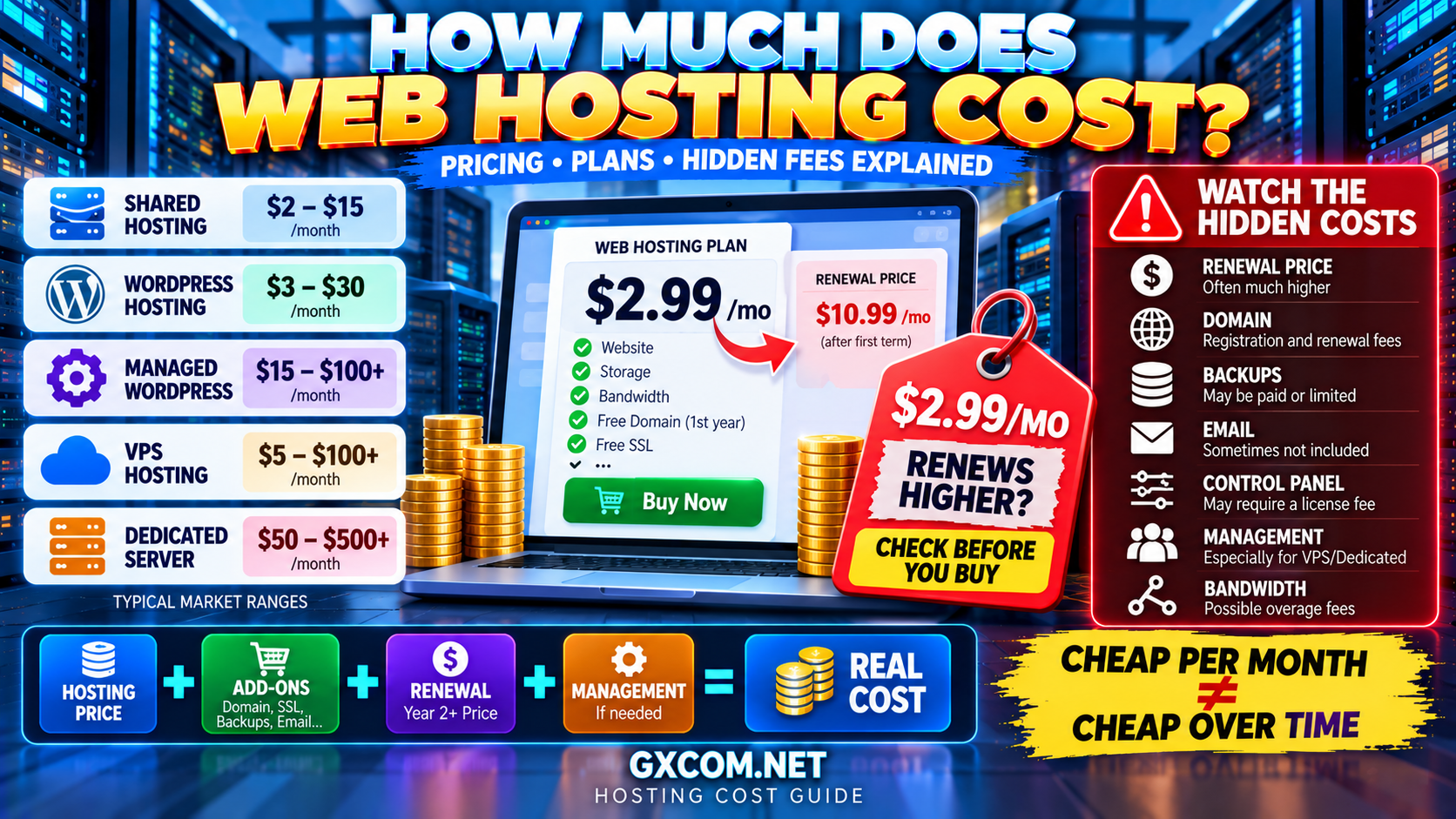
How Much Does Web Hosting Cost? Quick Answer
| Hosting Type | Typical Price Range | Best For |
|---|---|---|
| Shared Hosting | About $2–$15/month | Blogs and small websites |
| WordPress Hosting | About $3–$30/month | WordPress websites |
| Managed WordPress | About $15–$100+/month | Business WordPress sites |
| VPS Hosting | About $5–$100+/month | Growing websites and applications |
| Managed VPS | About $20–$150+/month | Businesses needing VPS resources |
| Cloud Hosting | About $5 to hundreds per month | Scalable workloads |
| Dedicated Server | About $50–$500+/month | High-resource workloads |
These are broad market ranges rather than fixed prices. Actual costs vary by provider, hardware, resources, location, management level and billing term.
The most important rule is:
COMPARE TOTAL COST—not just the number displayed beside the Buy button.
1. Shared Hosting Cost
Shared hosting is usually the least expensive conventional hosting option.
Multiple customers use common server infrastructure, allowing the provider to spread hardware and administration costs across many accounts.
Entry-level shared hosting frequently targets:
- Personal websites
- Blogs
- Portfolios
- Small business websites
- Landing pages
- Small WordPress sites
A typical price range is approximately:
$2–$15 PER MONTH
However, the lowest advertised price often requires a long initial billing commitment.
For example, a host may advertise an attractive monthly equivalent but require you to pay one, two, three or even four years upfront.
Therefore, compare both:
MONTHLY EQUIVALENT
and
TOTAL AMOUNT DUE TODAY
If you are unsure whether shared hosting provides enough resources, read our Shared Hosting vs VPS comparison before paying for a larger plan.
2. WordPress Hosting Cost
WordPress hosting can overlap significantly with shared hosting.
Some inexpensive WordPress plans are essentially shared hosting environments with WordPress-specific installation and management features.
Others include more advanced features such as:
- Server-side caching
- Automatic WordPress updates
- Staging
- Backups
- Security tools
- WordPress-focused support
Basic WordPress hosting may cost roughly:
$3–$30 PER MONTH
while premium managed WordPress services can cost considerably more.
Do not pay extra simply because the plan has “WordPress” in its name.
Compare what additional optimization, management and support you actually receive.
Our WordPress Hosting vs Web Hosting guide explains the difference in more detail.
3. Managed WordPress Hosting Cost
Managed WordPress hosting usually costs more because the provider handles more of the operational workload.
Depending on the plan, this may include:
- Automatic updates
- Managed caching
- Backups
- Security monitoring
- Staging environments
- Migration assistance
- WordPress-specific technical support
Pricing may start around:
$15–$30 PER MONTH
and increase to:
$100+ PER MONTH
for higher traffic limits, additional websites, premium support or greater resources.
The higher price can make sense when the website generates revenue and reducing maintenance work has business value.
4. VPS Hosting Cost
Virtual Private Server hosting is commonly priced according to allocated computing resources.
The major pricing variables include:
- vCPU
- RAM
- SSD or NVMe storage
- Bandwidth
- Operating system
- Backup services
- Management
Small unmanaged VPS plans can start around:
$5–$10 PER MONTH
while larger VPS instances can cost:
$50–$100+ PER MONTH
But an inexpensive VPS may require you to manage the operating system, firewall, web server, database, backups and security yourself.
This creates an important distinction:
SERVER PRICE ≠ OPERATING COST.
5. Managed VPS Cost
Managed VPS hosting combines virtual server resources with additional administration from the provider.
Depending on the service, management may include:
- Operating system updates
- Security patches
- Server monitoring
- Web stack configuration
- Backups
- Troubleshooting
Managed VPS plans commonly cost more than comparable unmanaged infrastructure.
A broad starting range might be:
$20–$150+ PER MONTH
depending on resources and the scope of management.
If you are comparing these service models, see our Managed Hosting vs Unmanaged Hosting guide.
6. Cloud Hosting Cost
Cloud hosting pricing can be more complicated because many services use consumption-based billing.
You may pay for combinations of:
- Compute
- Memory
- Storage
- Data transfer
- Snapshots
- Load balancing
- Managed databases
- Public IP addresses
A small cloud instance may cost only a few dollars per month, while a production environment using multiple services can cost hundreds or thousands.
This creates both an advantage and a risk.
PAY FOR WHAT YOU USE
can become:
PAY FOR EVERYTHING YOU FORGOT YOU WERE USING.
Cloud users should monitor usage and configure billing alerts where available.
7. Dedicated Server Cost
Dedicated servers provide physical server resources for a single customer rather than a virtual environment shared across multiple VPS instances.
Pricing depends heavily on:
- CPU model
- CPU generation
- Core count
- RAM
- Storage configuration
- Bandwidth
- Network port
- Data center
- Management
Entry-level dedicated servers can sometimes be found around:
$50–$100 PER MONTH
while modern high-performance systems can cost hundreds of dollars per month or more.
Do not choose dedicated infrastructure merely because it sounds more powerful.
A properly sized VPS or cloud server may provide better value for workloads that do not require an entire physical machine.
Why Is Some Web Hosting So Cheap?
Low hosting prices are possible for several reasons.
Shared Infrastructure
Many customers share underlying hardware and operating costs.
Long-Term Prepayment
The lowest advertised monthly equivalent may require paying years in advance.
Introductory Discounts
Providers may heavily discount the first billing term and charge a higher renewal rate later.
Limited Resources
An inexpensive plan may impose tighter CPU, memory, I/O or process limits.
Paid Add-ons
Features that appear standard elsewhere may cost extra.
Cheap hosting is not automatically bad.
The important question is whether the low price matches the resources and features your website needs.
Web Hosting Hidden Fees: What Should You Check?
The advertised hosting price is only one component of total cost.
Before purchasing, check these potential additional expenses.
1. Renewal Pricing
This is one of the biggest potential surprises.
A heavily discounted introductory plan may renew at a significantly higher rate.
Always check:
FIRST TERM PRICE → RENEWAL PRICE
before purchasing a multi-year hosting plan.
2. Domain Registration and Renewal
Some hosting plans include a free domain for the first year.
That does not necessarily mean the domain remains free.
Check the renewal price separately.
3. SSL Certificates
Many hosting providers now include basic SSL certificates at no additional cost.
However, premium certificate products may still be sold separately.
For most ordinary websites, do not assume that paying for an SSL certificate automatically provides stronger encryption than a properly configured free certificate.
4. Website Backups
Some plans include daily backups, while others provide weekly backups, charge extra or limit restoration options.
Check:
- Backup frequency
- Retention period
- Restore fees
- Download access
5. Email Hosting
Email may be included, limited or sold separately.
Business users should check mailbox limits, storage and renewal costs before assuming hosting includes unlimited professional email.
6. Website Migration
Some providers migrate websites free of charge.
Others may charge depending on the number of sites or complexity of the migration.
7. Control Panel Licenses
This becomes particularly important with VPS and dedicated servers.
Commercial control panels may require additional monthly licensing fees.
8. Backup Storage and Snapshots
Cloud and VPS providers may charge separately for snapshots or automated backup services.
9. Bandwidth Overages
Some hosting plans include generous transfer allowances, while others charge when usage exceeds a specified threshold.
10. Server Management
An inexpensive unmanaged server may become much more expensive if you later need professional administration.
The Real Cost of Web Hosting
Instead of comparing only the headline hosting price, calculate:
HOSTING PLAN
+ Domain
+ Email
+ Backups
+ Security
+ CDN
+ Control Panel
+ Management
+ Bandwidth Overages
=
REAL HOSTING COST
This is particularly important when comparing a bundled managed hosting plan with inexpensive infrastructure where features are purchased separately.
Monthly Hosting vs Annual Hosting: Which Is Cheaper?
Longer billing terms usually provide a lower monthly equivalent.
For example:
| Billing Model | Typical Advantage | Typical Disadvantage |
|---|---|---|
| Monthly | Low commitment | Higher monthly price |
| Annual | Better discount | Larger upfront payment |
| Multi-Year | Lowest introductory equivalent | Highest commitment |
Do not automatically buy the longest term simply because it produces the lowest monthly number.
For a new provider, consider:
- Refund policy
- Provider reputation
- Expected website lifespan
- Renewal pricing
- Migration difficulty
A three-year deal is only a bargain if you actually want to remain with the provider for three years.
Cheap Web Hosting vs Expensive Web Hosting
More expensive hosting may provide:
- More CPU
- More RAM
- Higher resource limits
- Better management
- More backups
- Premium support
- Staging tools
- Greater scalability
But a higher price does not automatically mean better performance.
Likewise, inexpensive hosting does not automatically mean poor quality.
The better question is:
WHAT ARE YOU PAYING FOR?
Compare actual resources and services rather than assuming price alone indicates quality.
How Much Should You Spend on Hosting?
| Website | Reasonable Starting Category |
|---|---|
| Personal Blog | Low-cost Shared / WordPress Hosting |
| Portfolio | Shared Hosting |
| Small Business Website | Quality Shared / Managed Hosting |
| Growing WordPress Website | WordPress / Managed Hosting |
| Small WooCommerce Store | Quality WordPress / Managed Hosting |
| Growing E-Commerce Store | Managed VPS / Cloud |
| Web Application | VPS / Cloud |
| High-Resource Application | Cloud / Dedicated |
Start with enough resources for the current workload plus reasonable growth capacity.
Do not buy years of unused computing power simply to avoid upgrading later.
Hosting Providers to Compare at Different Budgets
Once you understand the real cost model, you can compare providers based on the type of hosting you actually need.
For smaller websites and WordPress projects where entry cost matters, Hostinger is worth comparing—but pay attention to billing term and renewal pricing rather than looking only at the introductory monthly equivalent.
hosting.com (formerly A2 Hosting) is another provider to evaluate for conventional web and WordPress hosting when performance features are part of your buying decision.
If you expect to move toward managed VPS resources, ScalaHosting is worth comparing when you want more server resources without taking on all infrastructure management yourself.
For developers comfortable managing their own environment, DigitalOcean and Vultr provide cloud/VPS pricing models that are better evaluated by computing resources and additional services rather than conventional shared-hosting feature lists.
Do not compare these providers as though they all sell exactly the same product.
COMPARE SHARED WITH SHARED.
MANAGED WITH MANAGED.
VPS WITH VPS.
How to Compare Hosting Prices Correctly
When comparing two plans, create a simple three-stage calculation.
Step 1: Calculate the First-Term Cost
Include the entire upfront payment rather than only the advertised monthly equivalent.
Step 2: Calculate the Renewal Cost
Find out what the same service costs after the introductory period.
Step 3: Add Required Extras
Add domains, backups, email, management, licenses and other services you actually need.
Then compare:
YEAR 1 COST
and:
YEAR 2+ COST
This provides a much more realistic picture than comparing homepage prices.
Web Hosting Pricing Red Flags
Investigate further when you see:
- Very low prices with unclear billing terms
- Renewal prices that are difficult to locate
- Unclear CPU or memory limits
- Important features available only as paid add-ons
- “Unlimited” claims without clear usage policies
- Backup policies with no clear retention period
- Long commitments with restrictive refund terms
None of these automatically means a provider should be avoided, but you should understand the terms before paying.
How to Reduce Web Hosting Costs Without Hurting Performance
Choose the Right Hosting Type
Do not buy VPS or dedicated infrastructure for a workload that runs comfortably on quality shared hosting.
Pay for Resources You Actually Use
More storage, RAM and CPU are useful only when your workload needs them.
Optimize Before Upgrading
Caching, image optimization, database optimization and efficient code may delay the need for a more expensive server.
Compare Renewal Pricing
A slightly more expensive introductory plan may provide better long-term value if its renewal structure is more reasonable.
Use Bundled Features When They Provide Value
A plan including backups, SSL, email or CDN may cost less overall than purchasing each service separately.
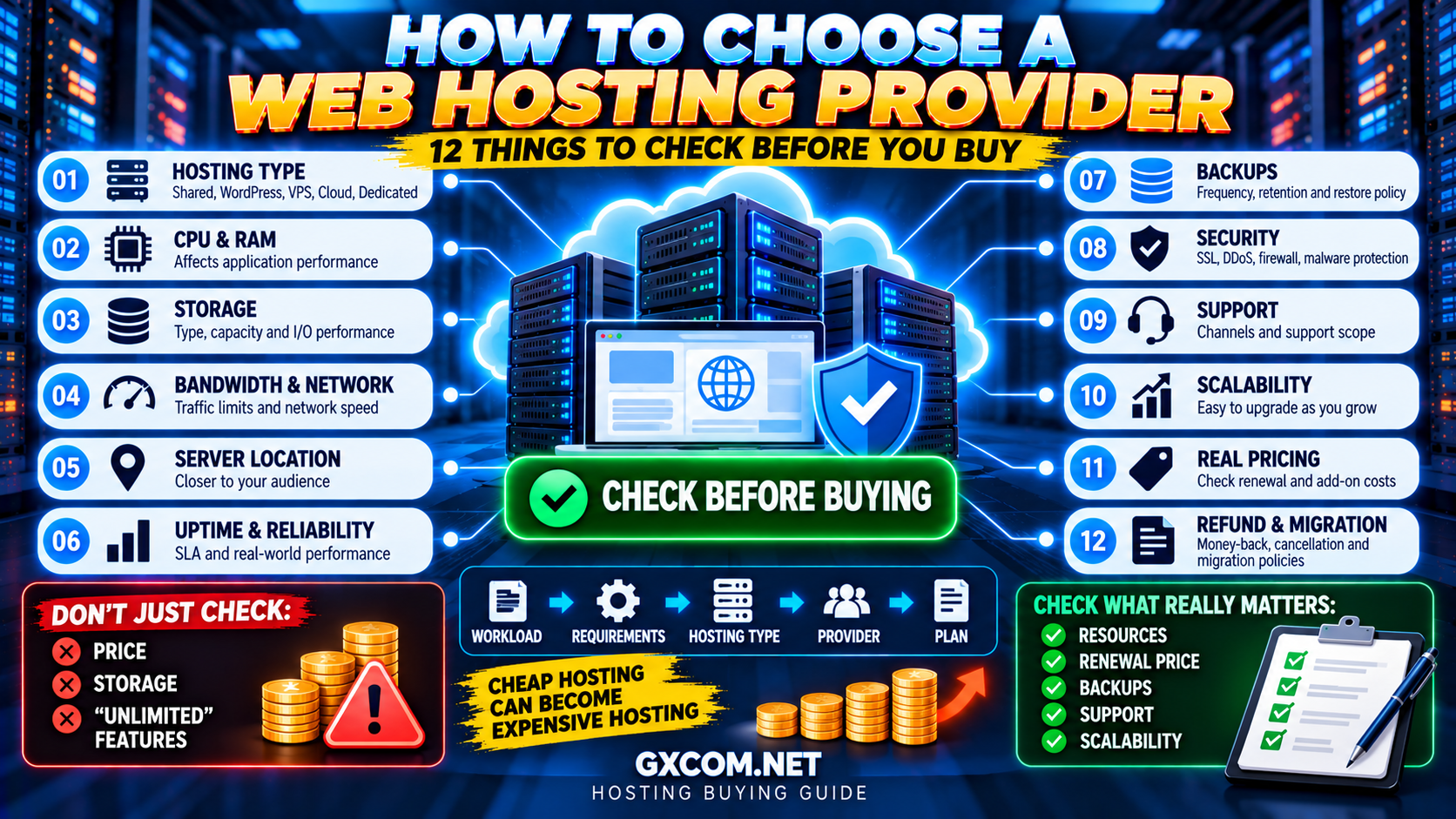
If you have not selected a provider yet, use our 12-point hosting buying checklist in How to Choose a Web Hosting Provider before purchasing.
Web Hosting Cost FAQ
How much does web hosting cost per month?
Basic shared hosting can cost only a few dollars per month during introductory periods, while managed hosting, VPS, cloud and dedicated infrastructure can range from tens to hundreds of dollars per month or more.
Can I host a website for free?
Free hosting options exist, but they may have limitations involving resources, domains, advertising, support or reliability. For an important business website, paid hosting usually provides a more practical environment.
Why does web hosting cost more when it renews?
Many providers use discounted introductory pricing for new customers. After the initial term, the account renews at the provider's standard rate.
Is $10 per month enough for web hosting?
For many small websites, yes. The answer depends on traffic, application requirements, resource limits and what services are included in the plan.
Is expensive hosting faster?
Not automatically. Higher-priced plans may include more resources or management, but website speed also depends on server configuration, caching, databases, application code and network performance.
Do I need to pay for SSL?
Many hosting providers include basic SSL certificates at no additional charge. Paid certificates may be useful for specific organizational or validation requirements, but they are not mandatory for every website.
Should I pay monthly or annually for web hosting?
Monthly billing provides greater flexibility, while annual or multi-year plans often reduce the effective monthly price. Consider commitment, refund terms and renewal pricing before choosing.
What hidden hosting fees should I watch for?
Common additional costs include domain renewal, backups, email, migrations, control panel licenses, server management, premium security features, snapshots and bandwidth overages.
Final Verdict: What Does Web Hosting Really Cost?
There is no single correct price for web hosting.
A small website may need only inexpensive shared hosting, while an e-commerce store, application or high-traffic platform may justify significantly more expensive infrastructure.
The important calculation is:
HOSTING
+
REQUIRED FEATURES
+
RENEWAL COST
+
MANAGEMENT
=
REAL COST
Do not choose a host because it advertises the lowest monthly number.
Choose the hosting type that fits your workload, compare equivalent plans, calculate the total cost and make sure the provider gives you a practical path to scale.
CHEAP PER MONTH
≠
CHEAP OVER TIME.
The best-value hosting is not necessarily the cheapest hosting.
IT IS THE HOSTING THAT DELIVERS THE RESOURCES YOU NEED AT THE LOWEST REAL TOTAL COST.