Artificial intelligence infrastructure is no longer limited to one GPU ecosystem. AMD has expanded its data center accelerator portfolio with the Instinct family, giving enterprises, researchers, cloud platforms, and AI developers another option for machine learning, large language models, high-performance computing, and AI inference.
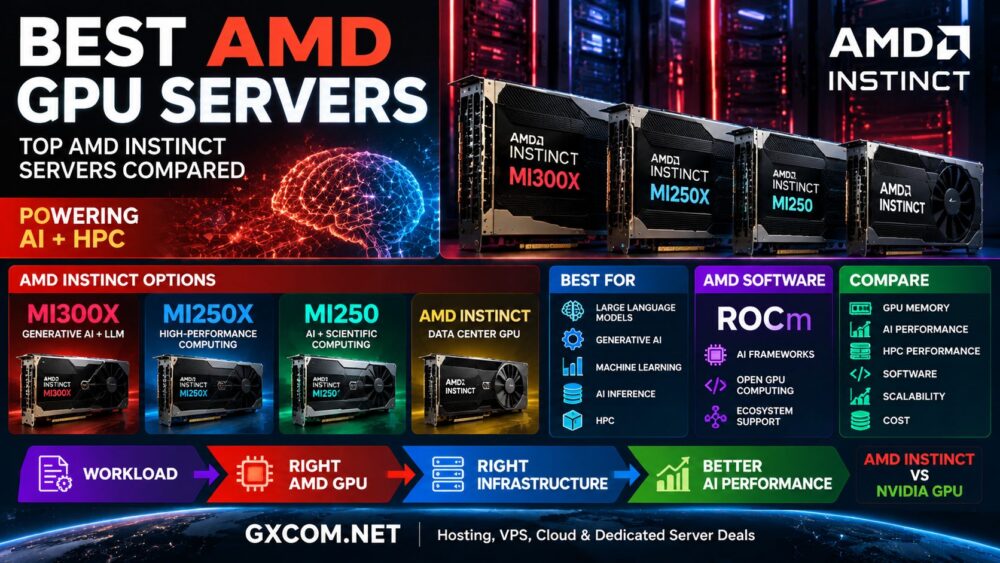
The Best AMD GPU Servers combine powerful AMD Instinct accelerators with sufficient system memory, fast storage, high-bandwidth networking, and software support for demanding AI and HPC workloads.
AMD Instinct MI300X has attracted particular attention for generative AI and large language model workloads, while other Instinct accelerators remain relevant for HPC, machine learning, and established GPU computing environments.
This guide compares major AMD Instinct server options, explains the ROCm software ecosystem, and helps you decide when an AMD GPU server makes sense for your AI infrastructure.
Best AMD GPU Servers at a Glance
| AMD GPU | Best For | Position | Typical Workloads |
|---|---|---|---|
| Instinct MI300X | Generative AI and LLMs | High-End AI | LLM inference, AI training, generative AI |
| Instinct MI250X | HPC | High Performance | Scientific computing, research, HPC |
| Instinct MI250 | AI and HPC | High Performance | Machine learning, simulation, compute |
| Previous Instinct GPUs | Budget / Existing Workloads | Variable | Research, development, specialized computing |
What Is an AMD GPU Server?
An AMD GPU server is a server equipped with one or more AMD graphics or compute accelerators. In the data center and AI market, the most important product family is AMD Instinct.
These accelerators are designed for workloads that benefit from massive parallel processing, including:
- Artificial intelligence
- Machine learning
- Large language models
- Generative AI
- AI inference
- High-performance computing
- Scientific simulation
- Data analytics
For AI buyers, the hardware is only part of the equation. Software compatibility, framework support, memory capacity, interconnects, storage, networking, and provider expertise can be just as important as raw GPU performance.
AMD Instinct MI300X Servers
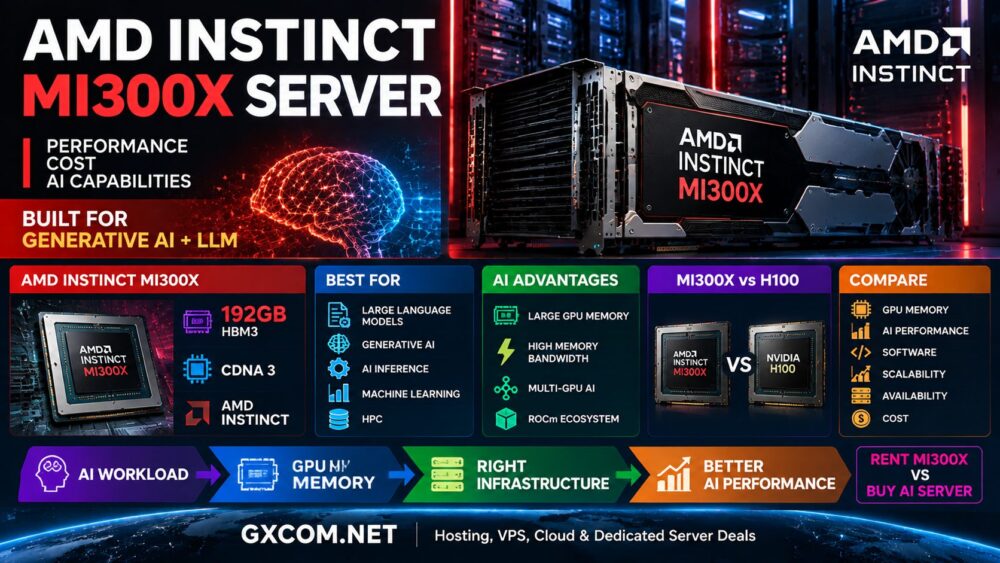
AMD Instinct MI300X is one of AMD's most important accelerators for modern AI infrastructure. It is designed for memory-intensive artificial intelligence workloads and is particularly relevant to large language models and generative AI.
MI300X servers are suitable for:
- Large language models
- Generative AI
- AI inference
- Machine learning
- Enterprise AI platforms
- Memory-intensive AI workloads
One of the major considerations in large-model computing is GPU memory. AI models can require substantial accelerator memory, and additional capacity can help reduce the need to split workloads across more devices.
This makes MI300X particularly interesting when evaluating infrastructure for large AI models rather than simply comparing theoretical GPU performance.
AMD Instinct MI250X Servers
The AMD Instinct MI250X is strongly associated with high-performance computing and scientific workloads.
It can be relevant for:
- Scientific research
- Simulation
- HPC clusters
- Engineering workloads
- Large-scale data processing
Organizations with established MI250X environments may continue to find these systems useful even as newer Instinct generations enter the market.
AMD Instinct MI250 Servers
MI250 is another member of the Instinct accelerator family designed for compute-intensive data center workloads.
Its potential applications include machine learning, HPC, research, and GPU-accelerated computing.
When evaluating previous-generation AMD GPU infrastructure, price and availability become particularly important. An older accelerator can sometimes offer better overall value when the workload does not require the newest architecture.
AMD Instinct MI300X vs MI250X
| Feature | MI300X | MI250X |
|---|---|---|
| Primary Focus | AI / Generative AI | HPC / Scientific Computing |
| LLM Workloads | Excellent Fit | Workload Dependent |
| AI Inference | Strong | Capable |
| HPC | Strong | Strong |
| Generation | Newer | Previous Generation |
The choice should therefore be based on workload rather than simply selecting the newest GPU.
What Is AMD ROCm?
ROCm is AMD's open software platform for GPU computing and is a critical part of the AMD AI server ecosystem.
It provides tools, libraries, compilers, and framework integration that allow developers to use AMD GPUs for accelerated computing.
For AI projects, software compatibility should be checked before choosing hardware. Important considerations include:
- Operating system support
- ROCm version
- AI framework compatibility
- Model requirements
- Container support
- Required libraries
This is especially important when migrating an existing workload originally developed around NVIDIA CUDA.
AMD GPU Servers vs NVIDIA GPU Servers
AMD and NVIDIA take different positions in the AI infrastructure market. NVIDIA has a mature CUDA ecosystem and broad adoption, while AMD Instinct provides an increasingly important alternative for AI and HPC workloads.
| Factor | AMD Instinct | NVIDIA GPU |
|---|---|---|
| Software Platform | ROCm | CUDA |
| AI Infrastructure | Growing | Very Broad |
| HPC | Strong | Strong |
| LLM Options | MI300X and newer Instinct platforms | H100 and other AI accelerators |
| Provider Availability | More Limited | More Widely Available |
If you are also evaluating NVIDIA infrastructure, see our
Best NVIDIA GPU Servers
guide.
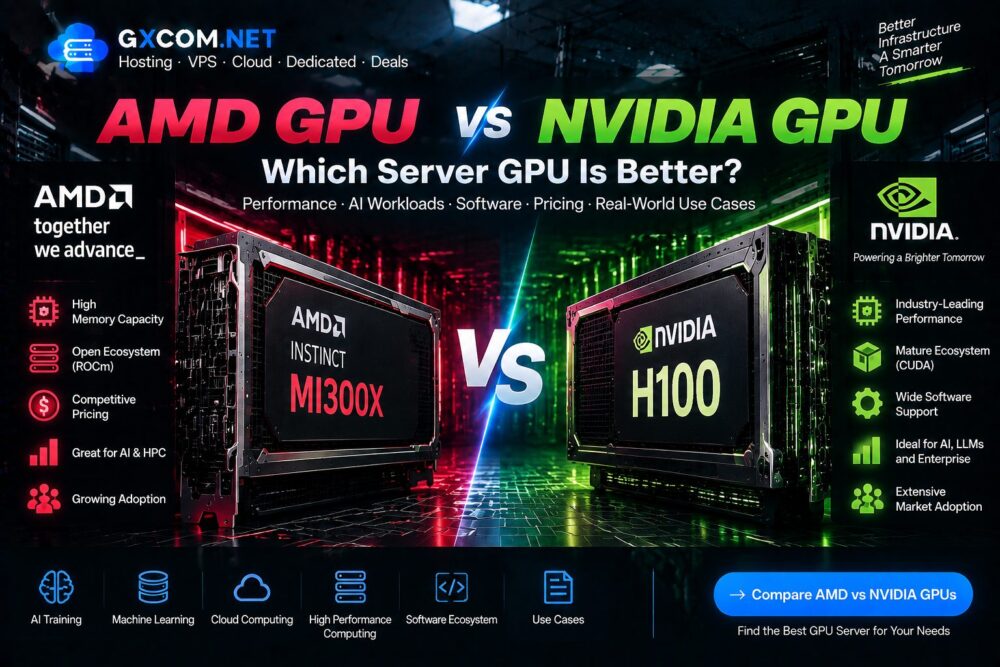
AMD MI300X vs NVIDIA H100
MI300X and H100 frequently appear in discussions about enterprise AI infrastructure because both target demanding artificial intelligence workloads.
However, choosing between them should not be reduced to a single benchmark.
Compare:
- Model requirements
- GPU memory requirements
- Training vs inference
- Framework compatibility
- ROCm vs CUDA dependencies
- Multi-GPU scaling
- Provider availability
- Total infrastructure cost
An organization with a CUDA-dependent software stack may value NVIDIA compatibility, while workloads validated for ROCm can make AMD Instinct infrastructure more attractive.
AMD GPU Servers for Large Language Models
LLMs require more than raw compute performance. GPU memory is one of the most important factors because large models, context windows, batch sizes, and inference configurations can consume significant accelerator memory.
A production LLM environment may also require:
- Multiple GPUs
- Large system RAM
- Fast NVMe storage
- High-speed networking
- Efficient model serving software
MI300X is particularly relevant to this market because AMD positions it for generative AI and large-model workloads.
AMD GPU Servers for AI Inference
Inference can be an attractive use case for AMD GPU infrastructure because production applications often prioritize memory capacity, throughput, efficiency, and total cost rather than maximum training performance.
Common applications include:
- AI chat services
- LLM APIs
- Enterprise assistants
- Content generation
- Computer vision
- AI automation
Organizations should benchmark their actual models because AI performance can vary significantly depending on framework, precision, optimization, and software configuration.
AMD GPU Servers for HPC
AMD Instinct has a significant presence in high-performance computing.
HPC workloads can include:
- Weather modeling
- Scientific simulation
- Computational research
- Engineering
- Physics
- Large-scale numerical computing
For these environments, GPU selection should be evaluated alongside CPU architecture, memory bandwidth, networking, storage, and cluster design.
Where Can You Rent AMD GPU Servers?
AMD GPU hosting is generally less widespread than NVIDIA GPU hosting, so availability should be verified directly with providers before selecting a platform.
AMD Instinct infrastructure can appear through major cloud platforms, specialized AI infrastructure providers, data center operators, and dedicated server companies.
When comparing providers, look for:
- Exact AMD Instinct model
- Number of GPUs
- GPU memory
- ROCm environment
- Storage performance
- Network configuration
- Hourly or monthly billing
- Technical support
For a broader explanation of rental models, see our
GPU Server Rental
guide.
AMD GPU Server Cost
AMD GPU server pricing depends heavily on the accelerator, number of GPUs, server architecture, billing model, and supporting infrastructure.
Important cost components include:
- GPU accelerator
- CPU resources
- System RAM
- NVMe storage
- Network traffic
- Multi-GPU configuration
- Software and support
- Hourly or monthly commitment
Do not compare GPU prices alone. A cheaper accelerator that takes substantially longer to complete a workload may result in a higher total computing cost.
For more information about budgeting, read our
AI Server Cost Guide.
AMD GPU Server vs GPU Cloud
| Feature | Dedicated AMD GPU Server | AMD GPU Cloud |
|---|---|---|
| Hardware Access | Dedicated | Platform Dependent |
| Deployment | Usually slower | Fast |
| Scaling | Hardware dependent | Flexible |
| Billing | Often monthly | Often usage based |
| Best For | Continuous workloads | Variable workloads |
Cloud infrastructure can be more practical for experimentation, while dedicated AMD GPU servers may appeal to organizations with stable, continuous workloads.
How to Choose the Best AMD GPU Server
Start by defining the workload before choosing the accelerator.
| Workload | AMD GPU Direction |
|---|---|
| Large Language Models | MI300X-class infrastructure |
| Generative AI | MI300X / newer Instinct platforms |
| AI Inference | Workload-optimized Instinct GPU |
| HPC | MI300X / MI250X depending on environment |
| Research | Instinct platform based on software requirements |
Common AMD GPU Server Buying Mistakes
Ignoring ROCm Compatibility
Do not assume that software designed for another GPU ecosystem will run unchanged. Verify your operating system, frameworks, libraries, containers, and applications before deploying production infrastructure.
Comparing Only GPU Performance
CPU resources, RAM, storage, networking, GPU memory, and software optimization can significantly affect real-world performance.
Ignoring Provider Availability
AMD Instinct servers are not offered as widely as many NVIDIA GPU configurations. Confirm hardware availability and deployment location before designing infrastructure around a specific accelerator.
Choosing Hardware Before Defining the Workload
The most expensive GPU is not automatically the most cost-effective GPU.
Start with:
Workload → Memory → Software → Performance → Cost
Are AMD GPU Servers Worth It?
AMD GPU servers can be a compelling alternative for organizations whose AI or HPC workloads are compatible with the ROCm ecosystem.
MI300X is particularly relevant to large language models, generative AI, and memory-intensive workloads, while other Instinct accelerators remain useful across HPC, research, and established compute environments.
However, NVIDIA still has broader provider availability and a mature CUDA ecosystem, so software compatibility should remain a central part of the decision.
Final Thoughts
The best AMD GPU server is the one that matches the workload rather than simply offering the newest accelerator.
AMD Instinct MI300X is a major option for modern AI and large-model infrastructure, while MI250-series systems continue to serve demanding HPC and scientific workloads.
Before choosing an AMD GPU server, evaluate GPU memory, ROCm compatibility, framework support, provider availability, networking, storage, scalability, and total computing cost.
As competition in AI infrastructure expands, AMD Instinct gives organizations another path for building high-performance AI systems beyond a single GPU ecosystem.