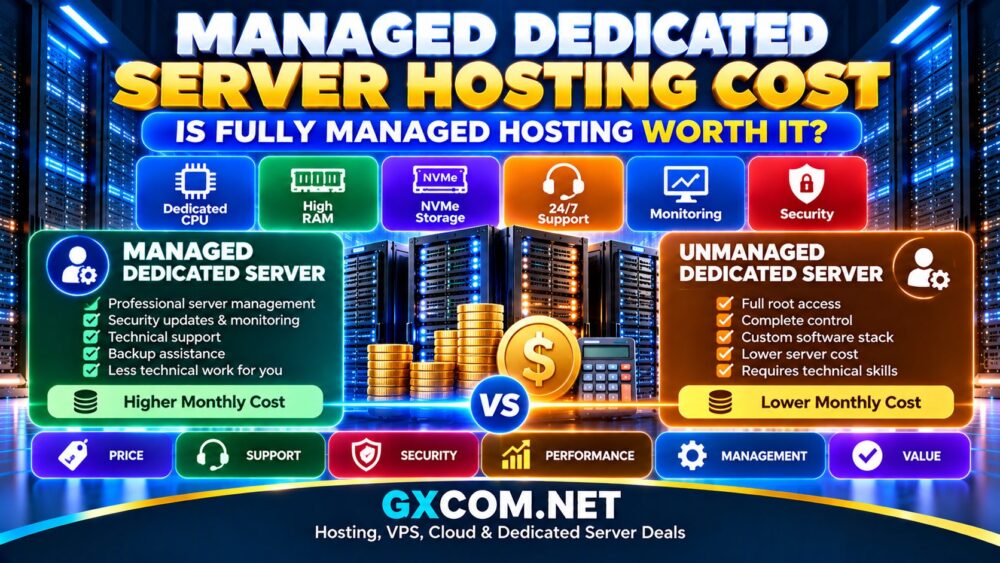
Choosing a dedicated server is only the first infrastructure decision. You also need to decide who will manage it. A managed dedicated server includes professional administration from the hosting provider, while an unmanaged dedicated server places most operating system, security, software, and maintenance responsibilities on you.
The Managed Dedicated Server vs Unmanaged decision can significantly affect hosting costs, security responsibilities, technical workload, and how much control you have over the server.
This guide compares managed and unmanaged dedicated servers across performance, pricing, security, maintenance, support, control, and technical requirements so you can determine which model better fits your website, application, or business infrastructure.
What Is a Managed Dedicated Server?
A managed dedicated server combines physical server resources with administrative services provided by the hosting company.
The exact definition of “managed” varies between providers, but management may include:
- Operating system installation and configuration
- Security updates and patches
- Server monitoring
- Web server configuration
- Control panel maintenance
- Backup assistance
- Database troubleshooting
- Performance optimization
- Security assistance
- Technical troubleshooting
Some companies offer several management levels, so never assume that the term “fully managed” includes every application or administration task.
Businesses comparing providers can start with our
Best Managed Dedicated Server Hosting Providers
guide.
What Is an Unmanaged Dedicated Server?
An unmanaged dedicated server still gives you physical hardware dedicated to your workload, but the hosting provider primarily takes responsibility for the data center, network, power, and physical server hardware.
You normally assume much more responsibility for the software environment.
This can include:
- Operating system administration
- Security patching
- Firewall configuration
- SSH or RDP security
- Web server configuration
- Database administration
- Application installation
- Monitoring
- Backups
- Troubleshooting
Unmanaged dedicated hosting is generally designed for experienced administrators, developers, DevOps teams, and organizations with internal infrastructure expertise.
See our
Best Unmanaged Dedicated Server Providers
comparison for self-managed bare metal options.
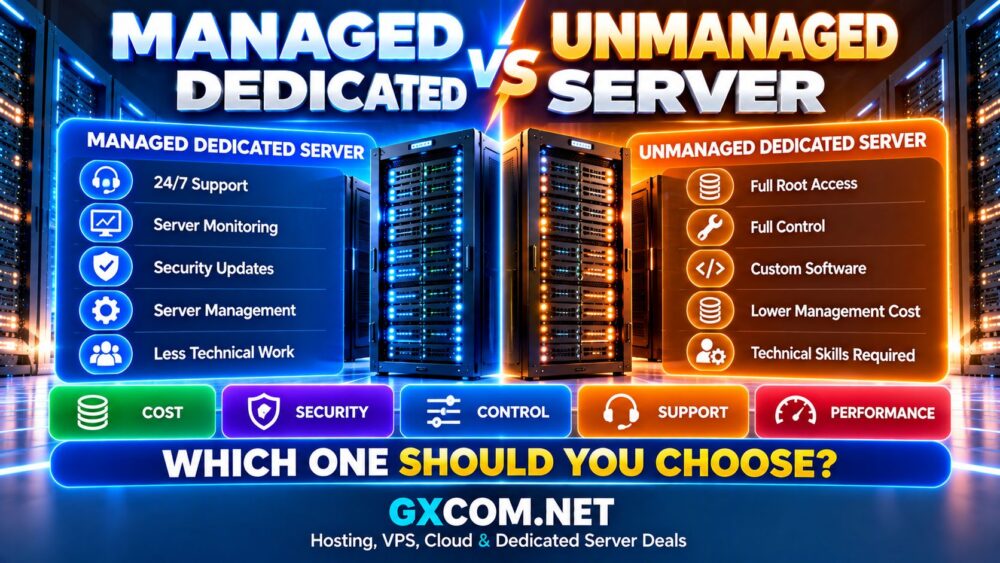
Managed vs Unmanaged Dedicated Server: Key Differences
| Feature | Managed Dedicated Server | Unmanaged Dedicated Server |
|---|---|---|
| Physical Hardware | Dedicated | Dedicated |
| Server Administration | Provider assists | Customer |
| Security Updates | Often provider-assisted | Customer |
| Monitoring | Often included | Customer configures |
| Backups | May be included or optional | Customer responsibility |
| Software Support | Depends on management scope | Primarily customer |
| Administrative Control | High, but policies may apply | Very high |
| Technical Skill Required | Lower | High |
| Management Cost | Higher | Lower |
Performance: Is Managed or Unmanaged Faster?
Management level does not automatically determine server performance.
If two servers use the same CPU, RAM, storage, and network infrastructure, simply labeling one managed and the other unmanaged does not make one physically faster.
Performance depends more directly on:
- CPU model and generation
- CPU frequency and core count
- RAM capacity
- NVMe or SSD performance
- RAID configuration
- Network connectivity
- Application configuration
- Database optimization
Management can indirectly affect performance, however. Experienced administrators can optimize databases, caching, web servers, and operating system settings. Poorly configured software can waste the capabilities of powerful hardware.
Managed vs Unmanaged Dedicated Server Cost
Unmanaged dedicated servers generally have a lower management cost because the customer performs most administrative tasks.
Managed dedicated hosting costs more because you are purchasing both physical infrastructure and technical services.
The total cost can include:
- Server hardware rental
- Management package
- Operating system licenses
- Control panel licenses
- Backup services
- Security services
- Additional storage
- Extra bandwidth
However, the lowest monthly server bill does not necessarily mean the lowest business cost.
If an unmanaged server requires several hours of administrator time every month, that labor should be included when comparing the true cost of each model.
Security Responsibilities
Security is one of the biggest differences between managed and unmanaged hosting.
Managed Dedicated Security
Depending on the provider and management package, administrators may assist with operating system updates, security patches, monitoring, firewall configuration, and supported software.
This does not mean the hosting provider assumes responsibility for every aspect of application security. Website software, custom code, user permissions, passwords, and unsupported third-party applications may remain the customer's responsibility.
Unmanaged Dedicated Security
With unmanaged hosting, you should expect to take responsibility for most operating system and software security.
This includes:
- Installing updates
- Closing unnecessary ports
- Securing SSH or RDP
- Configuring firewall rules
- Monitoring login attempts
- Maintaining web applications
- Protecting databases
- Reviewing logs
Root access provides freedom, but it also means configuration mistakes can create vulnerabilities.
Server Control and Customization
Unmanaged servers usually provide the greatest operational freedom because the customer controls the software stack directly.
Experienced administrators can choose their preferred operating system, web server, database, virtualization platform, container environment, monitoring tools, and security software.
Managed servers can also provide substantial administrative control, but the provider may define which operating systems, control panels, or software environments are covered by its management service.
If you need an unusual custom stack, check the management policy before purchasing.
Technical Support
Hardware and network support should not be confused with server management.
An unmanaged provider may still provide excellent support for failed drives, network problems, power, or other infrastructure under its responsibility. What it may not do is troubleshoot your database configuration or repair a broken web server configuration.
Managed hosting expands the support boundary, although exactly how far it expands depends on the provider.
Backups and Disaster Recovery
Never assume that a dedicated server automatically includes complete backups.
Some managed providers offer backup services or assist with configuration, while unmanaged customers commonly need to build their own backup system.
A reliable strategy should consider:
- Automated backup schedules
- Off-server storage
- Database backups
- Retention periods
- Encryption
- Restoration testing
RAID is useful for certain disk-failure scenarios, but RAID should not be treated as a replacement for independent backups.
Managed Dedicated Server Advantages
Less Administrative Work
Businesses can spend less time maintaining the operating system and supported server software.
Access to Technical Expertise
Provider administrators can assist with supported infrastructure issues that may otherwise require an internal system administrator.
Monitoring
Some managed services include proactive monitoring that can identify infrastructure problems before customers report them.
Useful for Business-Critical Websites
Ecommerce stores, agencies, membership websites, and business applications may benefit from having professional server administration available.
Managed Dedicated Server Disadvantages
The tradeoffs include:
- Higher monthly cost
- Possible limitations on supported software
- Management scope varies between providers
- Some tasks may still require customer involvement
The term “fully managed” should always be evaluated against the actual service agreement.
Unmanaged Dedicated Server Advantages
Maximum Administrative Control
You can build the server environment around your own technical requirements.
Lower Management Cost
You are not paying the hosting provider for administration that your own team can perform.
Flexible Software Stack
Experienced users can deploy custom operating systems, web servers, databases, containers, virtualization platforms, and monitoring systems.
Good for Infrastructure Teams
Organizations already employing system administrators may prefer to maintain complete control over production infrastructure.
Unmanaged Dedicated Server Disadvantages
The main disadvantages are:
- Higher technical skill requirement
- More administrative work
- Greater security responsibility
- You must build your own monitoring strategy
- Backup management is usually your responsibility
- Software problems can take significant time to diagnose
Who Should Choose Managed Dedicated Hosting?
Managed dedicated hosting is generally a strong fit for:
- Businesses without system administrators
- High-traffic websites
- Ecommerce stores
- Digital agencies
- Membership websites
- SaaS businesses with limited infrastructure staff
- Companies that value technical support over minimum cost
Management can also make sense when employees have technical skills but their time is better spent developing applications or operating the business.
Who Should Choose Unmanaged Dedicated Hosting?
Unmanaged dedicated servers are generally better suited to:
- Experienced Linux administrators
- Windows Server administrators
- DevOps teams
- Hosting companies
- Developers with server management experience
- Virtualization environments
- Game server operators
- Companies with internal IT teams
The cost savings are most valuable when you already possess the technical resources required to operate the server correctly.
Managed vs Unmanaged for Small Businesses
A small business should consider more than the hosting invoice.
If no employee understands operating system security, backups, web server configuration, and monitoring, purchasing an unmanaged dedicated server simply because it is cheaper can create unnecessary risk.
Managed hosting can reduce this technical burden.
However, a technically experienced small business may prefer unmanaged infrastructure when it wants complete control and does not need external administration.
Managed vs Unmanaged for High-Traffic Websites
Both models can run high-traffic websites because the underlying hardware—not the management label—provides the physical resources.
The decision depends on who will optimize, secure, monitor, and troubleshoot the environment.
For organizations where downtime directly affects revenue, the availability of experienced administration can be an important part of the hosting decision.
Managed Dedicated Server vs Managed VPS
If management is important but your workload does not require an entire physical machine, a managed VPS may provide a less expensive alternative.
Dedicated servers become more attractive when you require substantial physical resources, specialized hardware, predictable resource availability, or configurations that do not fit your current VPS environment.
Our
Dedicated Server Hosting Guide
explains the performance, cost, and workload considerations involved in moving to dedicated hardware.
Can You Switch from Unmanaged to Managed Hosting?
This depends on the provider.
Some hosting companies allow customers to purchase management services later, while others separate managed and unmanaged infrastructure into different product lines.
If you expect your management requirements to change, check upgrade and migration options before ordering the server.
Questions to Ask Before Choosing
Before purchasing either model, ask:
- Who installs operating system updates?
- Who monitors server availability?
- Who configures the firewall?
- Who maintains the web server?
- Who troubleshoots database problems?
- Are backups included?
- Who restores backups?
- Is third-party software supported?
- Is control panel management included?
- What happens outside normal support hours?
- Do I have root or administrator access?
These questions are more useful than relying on the words “managed” or “unmanaged” alone.
Managed vs Unmanaged Dedicated Server: Which Should You Choose?
Choose managed dedicated hosting when you need dedicated hardware but do not want to handle most routine server administration internally. The higher monthly price can be worthwhile when professional management reduces technical workload and provides access to expertise your business does not have.
Choose unmanaged dedicated hosting when you or your team already have the skills to secure, monitor, update, optimize, back up, and troubleshoot production servers. It offers greater operational freedom and can reduce management costs.
If you are still selecting the underlying hardware provider rather than the management model, our
Best Dedicated Server Hosting Providers
comparison covers dedicated server options in more detail.
Final Thoughts
The difference between managed and unmanaged dedicated hosting is primarily about responsibility rather than raw server performance.
Both can provide powerful dedicated hardware. The real question is who will maintain the operating system, security, monitoring, backups, software stack, and day-to-day server environment.
For businesses without experienced administrators, managed hosting can simplify dedicated infrastructure considerably. For technical teams that already manage servers internally, unmanaged hosting can provide greater control and lower management costs.
Before choosing, calculate both the hosting bill and the operational cost of managing the server. The right option is the one that matches your technical resources, workload requirements, support expectations, and long-term infrastructure strategy.