Choosing the right hosting solution is one of the most important decisions when building a website. Many beginners and businesses compare cloud hosting vs web hosting because both options can power websites, but they work in very different ways.
Traditional web hosting is usually based on a single server environment, while cloud hosting uses multiple connected servers to provide better flexibility, scalability and reliability.
This guide explains the differences between cloud hosting and web hosting, including performance, pricing, security, scalability and which option is better for different types of websites.
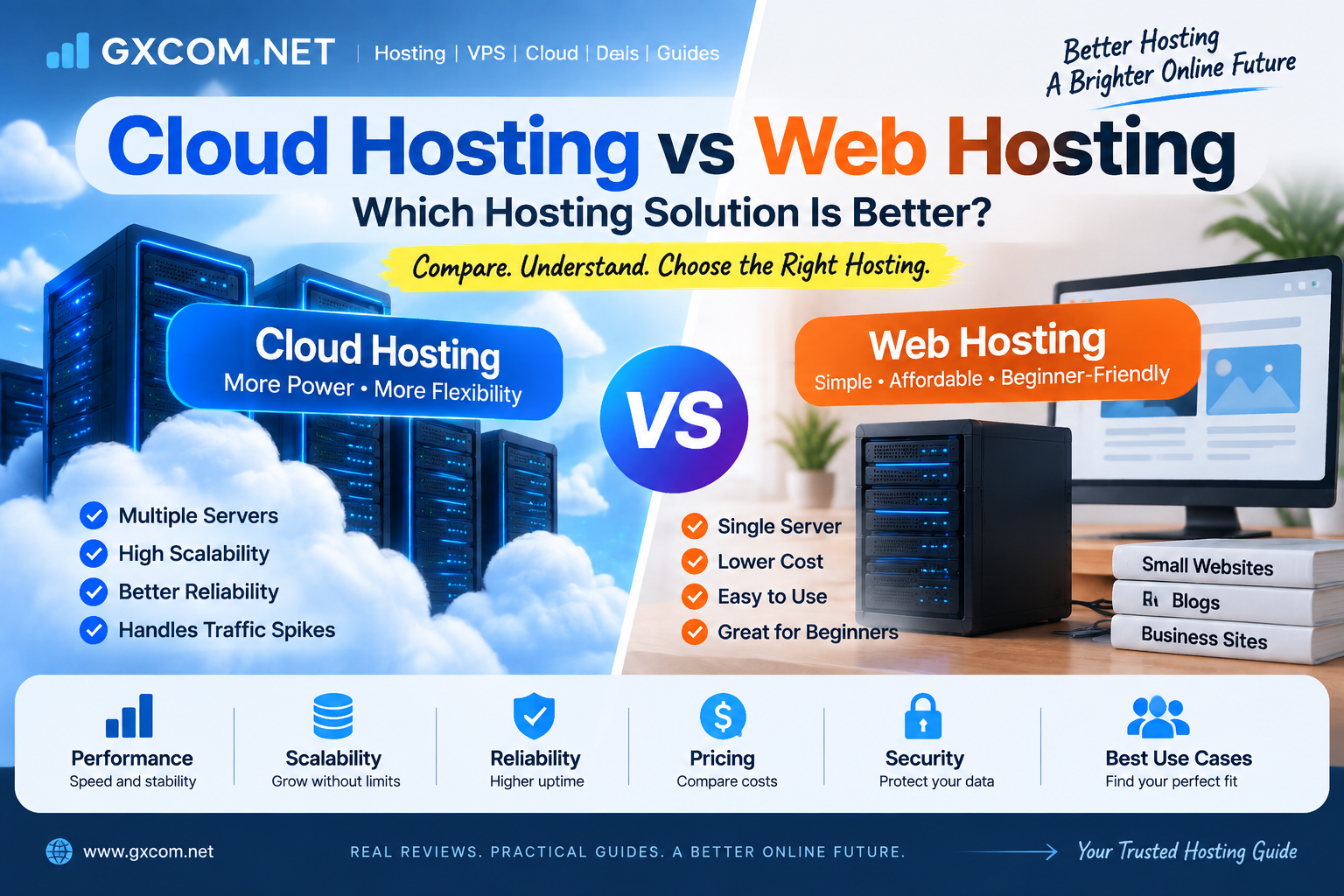
Quick Comparison: Cloud Hosting vs Web Hosting
| Feature | Cloud Hosting | Web Hosting |
|---|---|---|
| Infrastructure | Multiple connected servers | Usually one server |
| Performance | Higher scalability | Basic performance |
| Reliability | Higher availability | Depends on server stability |
| Price | Flexible pricing | Usually cheaper |
| Best For | Growing websites and applications | Small websites and beginners |
What Is Web Hosting?
Web hosting is a traditional hosting service where websites store their files and databases on a physical server.
Most beginner hosting plans use shared hosting, where multiple websites share resources from the same server.
Web hosting usually includes:
- Website storage
- Bandwidth allocation
- Control panel access
- Email hosting options
- Basic security features
For users looking for traditional hosting solutions, explore our best hosting providers comparison.
What Is Cloud Hosting?
Cloud hosting uses a network of connected servers instead of relying on a single physical machine.
This architecture allows websites and applications to use resources from multiple servers, improving flexibility and reliability.
Cloud hosting features often include:
- Scalable resources
- Multiple server locations
- Improved uptime
- Flexible pricing models
- Advanced infrastructure
See our guide to the best cloud hosting providers for recommended cloud platforms.
Cloud Hosting vs Web Hosting: Main Differences
1. Server Infrastructure
The biggest difference between cloud hosting and web hosting is the underlying infrastructure.
Web hosting typically relies on one server, while cloud hosting distributes resources across multiple connected servers.
2. Performance
Cloud hosting generally provides better performance because resources can be adjusted according to website requirements.
Traditional web hosting performance depends heavily on the server environment and the number of websites sharing resources.
3. Scalability
Scalability is one of the strongest advantages of cloud hosting.
Growing websites can increase resources quickly without migrating to another server.
Web hosting plans usually have fixed limits and may require upgrading to a larger plan.
4. Reliability and Uptime
Cloud hosting can provide better reliability because websites are not dependent on a single server.
If one server experiences problems, resources can often be moved to another available server.
5. Pricing
Web hosting is usually cheaper, making it attractive for beginners and small websites.
Cloud hosting often uses flexible pricing based on resources, making it suitable for websites with changing traffic.
Cloud Hosting vs Web Hosting Performance
| Performance Factor | Cloud Hosting | Web Hosting |
|---|---|---|
| Speed | High with scalable resources | Depends on server load |
| Traffic Handling | Better for traffic spikes | Limited by plan resources |
| Resource Scaling | Flexible | Usually requires upgrade |
| Server Control | More options | Basic management |
Security Comparison
Both cloud hosting and web hosting can provide secure environments, but cloud platforms often offer more advanced security tools.
Cloud hosting may include:
- Network protection
- Automated backups
- Monitoring systems
- Advanced access controls
Web hosting usually provides basic security features suitable for smaller websites.
Who Should Choose Web Hosting?
Web hosting is suitable for:
- Personal blogs
- Small business websites
- Portfolio websites
- New websites
- Low traffic projects
Who Should Choose Cloud Hosting?
Cloud hosting is better suited for:
- Growing businesses
- Ecommerce websites
- High traffic websites
- Web applications
- Online platforms
Cloud Hosting vs Web Hosting: Pros and Cons
Cloud Hosting Advantages
- Better scalability
- Higher reliability
- Flexible resources
- Suitable for growth
Cloud Hosting Disadvantages
- Can cost more
- May require more technical knowledge
Web Hosting Advantages
- Affordable pricing
- Easy setup
- Beginner-friendly
Web Hosting Disadvantages
- Limited scalability
- Shared resources
- Less flexibility
Cloud Hosting vs Web Hosting: Which One Should You Choose?
The right choice depends on your website size, budget and future growth plans.
Choose web hosting if:
- You are launching your first website.
- Your traffic is small.
- You need an affordable solution.
Choose cloud hosting if:
- Your website is growing.
- You need better scalability.
- You run business applications or ecommerce websites.
Final Verdict
Cloud hosting and web hosting serve different purposes.
Web hosting remains a good choice for beginners and small websites because it is affordable and easy to manage.
Cloud hosting is a better solution for businesses, growing websites and applications that require higher performance, flexibility and reliability.
Before choosing a hosting solution, consider your current needs and future growth plans.
Frequently Asked Questions
Is cloud hosting better than web hosting?
Cloud hosting is usually better for scalability and reliability, while web hosting is better for beginners who need an affordable solution.
Is cloud hosting more expensive?
Cloud hosting can cost more because it provides flexible resources and advanced infrastructure.
Can beginners use cloud hosting?
Yes. Managed cloud hosting services make cloud hosting easier for beginners.
Should a small business use cloud hosting?
Small businesses expecting growth may benefit from cloud hosting because it provides better scalability.