Two dedicated server providers can offer similar AMD EPYC processors, NVMe storage, and high-speed network ports while delivering very different purchasing and operating experiences.
One may emphasize rapid bare-metal deployment, API-driven infrastructure, and flexible billing. Another may be a better fit for custom hardware, North American data center selection, unmetered bandwidth, and hands-on infrastructure planning.
That is the central question in this Cherry Servers vs ServerMania comparison.
Both companies provide physical dedicated server infrastructure, but choosing between them requires more than comparing advertised CPU cores or monthly server prices.
Hardware generation, storage redundancy, network routes, traffic allowances, remote management, technical support boundaries, and contract terms can all influence long-term value.
This guide compares Cherry Servers and ServerMania for production applications, databases, high-traffic websites, virtualization, SaaS platforms, and bandwidth-intensive workloads. We also consider when GTHost or DediXLAB may be relevant alternatives.
Editorial methodology: This comparison is based on publicly documented provider specifications and service descriptions reviewed in October 2026. GXCOM.NET has not independently benchmarked matched servers from both providers or conducted controlled support-response testing. Availability, hardware, network policies, prices, and service terms may change by region and configuration.
Cherry Servers vs ServerMania: Quick Verdict
Choose Cherry Servers if you prioritize automated bare-metal provisioning, API-oriented infrastructure management, flexible billing options, and transparent traffic allowances for supported configurations.
Choose ServerMania if you prioritize North American dedicated server locations, configurable enterprise hardware, unmetered network options, and a provider that emphasizes personalized infrastructure support.
Neither provider is automatically faster simply because it advertises newer hardware or a higher network port speed.
The better choice depends on the exact server configuration, target users, expected traffic, operational requirements, and total contract cost.
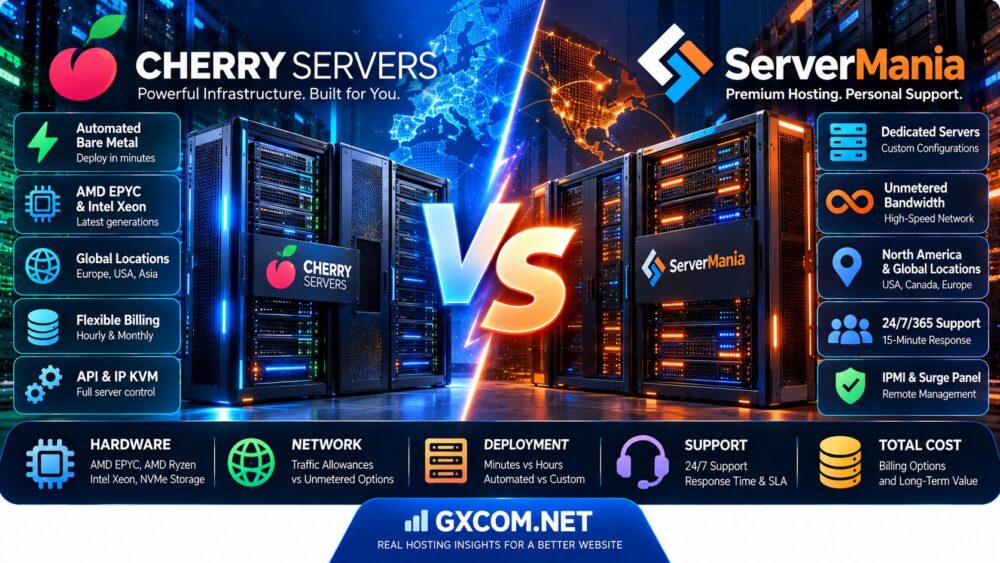
| Comparison Factor | Cherry Servers | ServerMania |
|---|---|---|
| Primary offering | Automated bare-metal and custom dedicated infrastructure | Dedicated servers, custom configurations, and high-bandwidth hosting |
| Processor options | AMD Ryzen, AMD EPYC, Intel Xeon and other listed platforms | AMD Ryzen, AMD EPYC, Intel Xeon and custom configurations |
| Deployment approach | Automated provisioning for eligible prebuilt servers | Configuration-dependent deployment and provisioning |
| Billing flexibility | Hourly, monthly, and other eligible billing models | Dedicated server contracts and quote-dependent terms |
| Network options | Plan-specific traffic allowances and high-speed uplinks | Metered and unmetered bandwidth products |
| Geographic emphasis | Europe, selected North American and Asian regions | Multiple North American markets and selected European regions |
| Remote administration | Control panel, API, IP KVM | Surge panel, IPMI/KVM, remote power control |
| Technical support | 24/7 technical support advertised | 24/7/365 technical support advertised |
| Network SLA | Review applicable product SLA | 100% network uptime SLA advertised, subject to terms |
| Best initial fit | Automation-oriented teams and flexible bare-metal workloads | Businesses needing configurable servers and network options |
What Is Cherry Servers?
Cherry Servers is a Lithuania-based infrastructure provider offering bare-metal servers, virtual servers, custom hardware, and related networking and storage services.
Its dedicated server products emphasize single-tenant hardware, automated provisioning, and direct server control.
Automated Bare-Metal Deployment
Cherry Servers advertises rapid provisioning for eligible preconfigured bare-metal servers.
Its current pricing pages describe an average dedicated server deployment time of approximately 12 minutes.
That figure is a provider-wide marketing average, not a guaranteed delivery time for every server, location, or custom hardware request.
Flexible Infrastructure Management
Cherry Servers provides a management interface and API capabilities that can be useful for infrastructure automation.
These features may appeal to developers and operations teams that frequently provision, rebuild, or retire physical servers.
Hardware Configuration
The provider lists multiple processor generations and configurations, including AMD Ryzen, AMD EPYC, and Intel Xeon options.
Memory, storage, GPU compatibility, and network connectivity depend on the selected server.
Billing Models
Cherry Servers supports different billing models for eligible products, including hourly and fixed-term options.
That flexibility can be useful for temporary infrastructure projects, testing, and workloads with uncertain durations.
However, spot or interruptible offerings should not be treated as equivalent to standard production server commitments.
For a more detailed overview, see our Cherry Servers Bare Metal Review.
What Is ServerMania?
ServerMania provides dedicated server infrastructure, custom server configurations, cloud services, and other data center solutions.
Its dedicated hosting products emphasize enterprise hardware, networking flexibility, and customer support.
Dedicated Hardware Selection
ServerMania lists AMD Ryzen, AMD EPYC, and Intel Xeon server options across its dedicated hosting portfolio.
Customers can evaluate configurations based on CPU architecture, memory capacity, storage, and networking requirements.
Custom Infrastructure
ServerMania offers custom server solutions for customers whose requirements do not match standard configurations.
This can be relevant for businesses requiring particular hardware combinations or deployment arrangements.
Network Options
The provider markets dedicated servers with metered and unmetered bandwidth options, including high-speed network configurations.
Port speeds, traffic policies, and availability depend on the specific plan and data center.
Remote Management
ServerMania provides management capabilities through its Surge control panel, including remote power operations and IPMI access on supported dedicated server products.
Support
ServerMania advertises 24/7/365 technical support and a 15-minute response target.
Response time should not be confused with guaranteed incident resolution time.
For a provider-specific examination, read our ServerMania Dedicated Server Review.
Cherry Servers vs ServerMania: Dedicated Server Hardware
Hardware selection is one of the most important factors when comparing dedicated hosting providers.
However, processor brand and core count alone do not determine application performance.
AMD Ryzen Dedicated Servers
AMD Ryzen processors can be attractive for workloads that benefit from strong per-core performance.
Examples include some application servers, game servers, web workloads, and latency-sensitive software.
Both Cherry Servers and ServerMania advertise Ryzen-based dedicated server options.
Compare the exact CPU generation, clock characteristics, memory configuration, and storage system before selecting a plan.
AMD EPYC Dedicated Servers
AMD EPYC processors are commonly used for enterprise server workloads requiring high core counts, large memory capacities, and extensive I/O connectivity.
They may be suitable for virtualization, databases, parallel processing, and infrastructure consolidation.
Both providers offer EPYC-based products, but specific models and configurations vary by location.
Intel Xeon Dedicated Servers
Intel Xeon platforms remain relevant for enterprise applications, software compatibility requirements, and particular hardware configurations.
Older Xeon systems may provide economical capacity for some workloads, but buyers should compare performance per core and power efficiency against newer hardware.
CPU Generation Matters
A newer processor with fewer cores may outperform an older processor in some single-threaded applications.
Conversely, a high-core-count platform may be more effective for parallel workloads.
There is no universal CPU winner without specifying the application.
Memory Capacity and ECC
Memory requirements can be critical for database servers, virtualization hosts, and in-memory applications.
Compare installed memory, upgrade limits, memory generation, and error-correcting capabilities.
Hardware Verdict
Both providers offer configurations suitable for demanding workloads.
Choose the hardware based on processor generation, actual application benchmarks, memory requirements, storage design, and regional availability.
Single-Core Performance vs Multi-Core Capacity
Not every workload benefits equally from additional CPU cores.
Single-Core-Sensitive Workloads
Some game servers, application processes, and database operations depend heavily on individual thread performance.
For these workloads, CPU architecture and effective clock behavior can matter more than total core count.
Parallel Workloads
Virtualization, rendering, data processing, and certain scientific applications can use many CPU cores effectively.
Mixed Production Workloads
Production systems often combine latency-sensitive requests with background processing.
Evaluate both per-core performance and total CPU capacity.
Benchmarking Recommendation
Use representative application tests rather than relying on one synthetic benchmark score.
Test response latency, sustained throughput, CPU utilization, and application stability under realistic load.
Cherry Servers vs ServerMania: Storage and RAID
Storage design can have a greater impact on application reliability than small differences in processor specifications.
NVMe SSD Storage
Both providers offer NVMe storage configurations on eligible servers.
NVMe can provide high throughput and low storage latency, but actual results depend on drive models, PCIe connectivity, and workload patterns.
SATA SSD and HDD
Traditional SSD and hard disk options may still be appropriate for applications that prioritize storage capacity over maximum I/O performance.
RAID 1
RAID 1 mirrors data across drives and can protect against certain individual drive failures.
It does not replace an independent backup.
RAID 10
RAID 10 combines mirroring and striping and can provide useful performance and redundancy characteristics.
It requires sufficient drives and reduces usable storage capacity.
Hardware RAID vs Software RAID
Customers should verify whether the selected configuration supports hardware RAID, software RAID, or both.
Storage Expansion
Check available drive bays, supported drive types, and the provider's upgrade process.
Hardware changes may require downtime or a scheduled maintenance window.
Storage Verdict
Compare usable capacity, IOPS requirements, drive redundancy, backup arrangements, and replacement procedures rather than raw disk capacity alone.
Cherry Servers vs ServerMania: Network Quality
Network quality is a major factor for dedicated servers running production websites, SaaS platforms, APIs, and data-intensive applications.
However, advertised port speed is not the same as guaranteed application throughput.
Cherry Servers Network
Cherry Servers documents a network footprint across Europe, North America, and Asia.
Its network information describes Tier 1 transit relationships, peering connectivity, and high-speed regional infrastructure.
Eligible dedicated servers can offer high-speed uplinks, with traffic allowances determined by the selected configuration.
ServerMania Network
ServerMania operates dedicated hosting infrastructure in multiple North American locations and selected European regions.
Its dedicated server portfolio includes metered and unmetered bandwidth options, with higher-speed ports available on selected configurations.

Port Speed vs Throughput
A 10Gbps port indicates a nominal interface speed.
It does not guarantee 10Gbps of sustained end-to-end transfer to every destination.
Actual throughput depends on routing, congestion, packet loss, server performance, and the receiving network.
Network Peering
Direct peering can improve routing efficiency to particular networks.
However, network quality should be evaluated from the regions where users or application clients are located.
Latency
Latency-sensitive applications may benefit from hosting close to their primary users.
Geographic distance is important, but routing quality can also affect results.
Packet Loss and Jitter
Packet loss can reduce effective throughput and application reliability.
Jitter matters for real-time communications, streaming, and other latency-sensitive services.
Network Verdict
Neither provider should be declared the universal network winner.
Run regional latency, packet loss, and throughput tests against the exact data center being considered.
Metered vs Unmetered Bandwidth: A Critical Difference
One of the most important purchasing distinctions is the difference between traffic allowances and unmetered network plans.
Cherry Servers Traffic Allowances
Cherry Servers publishes monthly outgoing traffic allowances for its dedicated server products.
Included allowances differ between product families and configurations.
Its bandwidth documentation states that outgoing traffic is measured for billing purposes, while incoming traffic is generally unmetered under the described policy.
Additional charges may apply when the included outgoing traffic allowance is exceeded.
ServerMania Unmetered Options
ServerMania offers unmetered dedicated server products.
Unmetered usually means that traffic is not billed according to a conventional monthly transfer allowance, subject to the provider's contract and network usage rules.
It does not necessarily mean unlimited throughput under every circumstance.
Bandwidth vs Data Transfer
Bandwidth describes a rate of data transfer, commonly expressed in Mbps or Gbps.
Monthly data transfer describes the total amount of traffic moved during a billing period.
These are different measurements.
Example: 1Gbps Continuous Transfer
At a sustained transfer rate of 1Gbps for 30 days, theoretical data transfer is approximately 324TB, using decimal units.
Actual application transfer is usually lower because of protocol overhead, variable demand, and other limitations.
Example: 10Gbps Continuous Transfer
At 10Gbps continuously for 30 days, theoretical transfer is approximately 3.24PB.
A server with a 10Gbps port and a 100TB monthly allowance cannot be assumed to include 3.24PB of outgoing traffic.
Which Bandwidth Model Is Better?
Metered plans can be economical when outgoing traffic is predictable and remains within the included allowance.
Unmetered plans may be attractive when sustained outgoing traffic is high and the contract provides appropriate usage rights.
How to Compare Dedicated Server Network Performance
Use the same testing methodology for both providers.
- Choose the exact data center and server configuration.
- Record the advertised port speed and traffic policy.
- Measure latency from representative user regions.
- Measure packet loss and jitter.
- Test single-stream and multi-stream throughput.
- Repeat tests at different times.
- Check the provider's acceptable-use and testing policies.
- Document routing and upstream network differences.
- Compare actual application response times.
For meaningful results, test from more than one external network.
Data Center Locations: Which Provider Has the Better Geographic Fit?
Location selection should follow the application's audience and data residency requirements.
Cherry Servers Locations
Cherry Servers lists infrastructure locations in Lithuania, Amsterdam, Frankfurt, Stockholm, Chicago, Singapore, and Tokyo, among others shown in its current network materials.
Not every hardware configuration is available in every region.
ServerMania Locations
ServerMania emphasizes North American locations including Buffalo, New York City Metro, Dallas, and Los Angeles.
It also markets infrastructure in Canada and selected European locations.
North American Applications
ServerMania may be worth prioritizing when a specific North American city is important to the deployment.
Cherry Servers can also be relevant for workloads that fit its available North American infrastructure.
European Applications
Cherry Servers offers several European infrastructure locations.
ServerMania also provides European options, although product availability and configuration choices should be verified.
Asia-Pacific Applications
Cherry Servers lists Asian infrastructure locations, including Singapore and Tokyo.
ServerMania's Los Angeles network may also be relevant for some trans-Pacific traffic patterns, but this should be tested rather than assumed.
Location Verdict
Select the location based on measurable latency, routing quality, legal requirements, and actual hardware availability.
Deployment Speed: Automated Bare Metal vs Custom Provisioning
Deployment time can influence the value of dedicated infrastructure, especially for temporary projects or rapid capacity expansion.
Cherry Servers Deployment
Cherry Servers emphasizes automated provisioning for eligible prebuilt bare-metal configurations.
This may be attractive to teams that need repeatable server deployment through an interface or API.
ServerMania Deployment
ServerMania offers both standard and custom server configurations.
Delivery times vary according to location, hardware, and the selected product.
Some regional product materials describe provisioning measured in hours rather than minutes.
Custom Hardware Changes
Additional drives, unusual memory configurations, or specialized networking may extend deployment time at either provider.
Deployment Verdict
Cherry Servers has a clear automation-oriented advantage for eligible prebuilt configurations.
For custom deployments, request an exact delivery estimate from both providers.
Remote Management: IPMI, KVM and API Access
Remote management is essential when an operating system becomes inaccessible or a server requires low-level maintenance.
Cherry Servers Remote Access
Cherry Servers advertises remote server control through IP KVM and its management platform.
Its API-oriented approach can support automated infrastructure workflows.
ServerMania Remote Access
ServerMania provides IPMI and KVM-related functionality for supported dedicated servers.
Its Surge panel supports remote server power operations and other management tasks.
Why Out-of-Band Access Matters
Out-of-band management can allow administrators to diagnose boot problems, access consoles, and perform recovery operations when ordinary SSH or RDP access is unavailable.
Security Considerations
Remote management interfaces should be protected through strong authentication and appropriate access controls.
Administrative access should be limited to authorized personnel.
Management Verdict
Both providers offer remote management capabilities.
Cherry Servers may be attractive for API-driven deployment, while ServerMania offers an established dedicated server management workflow.
Cherry Servers vs ServerMania: Technical Support
Support is often the most difficult category to evaluate without real incident testing.
Cherry Servers Support
Cherry Servers advertises 24/7 technical support through multiple communication channels.
Its dedicated server materials also describe account management and infrastructure assistance.
ServerMania Support
ServerMania advertises 24/7/365 technical support through ticket, email, and telephone channels.
It also promotes a 15-minute response target.
Response Time vs Resolution Time
An initial support reply does not mean the incident has been resolved.
Hardware replacement, network diagnosis, or complex software troubleshooting can require additional time.
Hardware Support
Dedicated server providers generally remain responsible for covered physical infrastructure components under the applicable service agreement.
Customers should verify replacement procedures, spare part availability, and maintenance expectations.
Operating System Support
Unmanaged dedicated servers typically leave substantial operating system administration responsibility with the customer.
Managed services may cover additional tasks, depending on the purchased service level.
Application Support
Database optimization, custom application debugging, and WordPress plugin problems should not automatically be assumed to fall within infrastructure support.
Support Verdict
ServerMania publishes a specific response-time target, while Cherry Servers emphasizes around-the-clock technical assistance.
Neither can be declared the support-quality winner without comparable incident-resolution testing.
For a deeper explanation of administration responsibilities, read our Managed vs Unmanaged Dedicated Server Guide.
Network SLA vs Actual Server Uptime
Service level agreements are important, but their scope must be understood.
ServerMania Network SLA
ServerMania advertises a 100% network uptime SLA for applicable dedicated hosting services.
The exact covered events, exclusions, claim requirements, and service credits depend on the contract.
Cherry Servers SLA
Cherry Servers customers should review the applicable service-level and product-specific terms for their selected server.
Network Uptime Is Not Application Uptime
A server can remain connected to the network while its operating system, database, or application is unavailable.
Maintenance Exclusions
Scheduled maintenance and other excluded events may not qualify for SLA credits.
Service Credits
An SLA may provide account credits or another defined remedy rather than compensation for all business losses.
SLA Verdict
Compare the actual contractual remedies rather than the headline percentage alone.
DDoS Protection and Security
Security requirements vary widely between ordinary business websites and high-risk public infrastructure.
Cherry Servers DDoS Protection
Cherry Servers advertises network-level protection against common DDoS attack patterns.
Protection capabilities and optional services may differ by product.
ServerMania DDoS Protection
ServerMania offers DDoS-related protection options, with availability and conditions depending on the selected service.
Application Security
Neither network protection nor a dedicated server eliminates the need for operating system patching, firewall configuration, access management, and application security.
Backup Strategy
Maintain independent backups and test restoration procedures.
RAID and network redundancy are not substitutes for backups.
Cherry Servers vs ServerMania: Pricing and Billing
Dedicated server pricing should be evaluated over the full intended deployment period.
Cherry Servers Billing
Cherry Servers offers hourly and fixed-term billing on eligible dedicated server configurations.
Some products may support additional billing models or promotions.
ServerMania Billing
ServerMania offers dedicated server pricing and custom quotations, with terms depending on configuration and service requirements.
Setup Charges
Confirm whether setup charges apply, particularly to custom hardware.
Operating System Licensing
Windows Server licensing can add material recurring cost.
Verify whether licensing is included, separately billed, or unavailable for a particular configuration.
Additional IP Addresses
Additional public IP addresses may require justification, approval, and recurring charges.
Traffic Charges
Metered egress overages can affect total cost for bandwidth-intensive applications.
Management Services
Managed administration, monitoring, and other support services may be billed separately.
Three-Year Dedicated Server Cost Comparison
Consider two hypothetical server quotations.
| Cost Component | Server A | Server B |
|---|---|---|
| Monthly base rental | $180 | $230 |
| Monthly additional traffic | $35 | $0 |
| Monthly backup service | $15 | $20 |
| Monthly management service | $0 | $0 |
| One-time setup | $0 | $100 |
| Total recurring monthly cost | $230 | $250 |
| Three-year total | $8,280 | $9,100 |
These are hypothetical examples and do not represent actual Cherry Servers or ServerMania quotations.
The calculation assumes 36 months of unchanged recurring charges and no additional taxes or incident-related expenses.
Total Cost Formula
Three-year TCO = 36 × (Server Rental + Recurring Network Charges + Backups + Management + Licensing) + Setup Fees + Other One-Time Costs.
Why Monthly Price Is Not Enough
A lower base server price can be offset by traffic overages, licensing, support, or storage requirements.
A higher-priced server may provide better value when its included resources closely match the workload.
Cherry Servers vs ServerMania for SaaS Applications
SaaS applications need predictable compute resources, reliable networking, and appropriate recovery procedures.
Cherry Servers for SaaS
Cherry Servers may appeal to teams using automated provisioning and infrastructure-as-code workflows.
ServerMania for SaaS
ServerMania may appeal to teams that want to evaluate custom server configurations and North American deployment options.
Key SaaS Requirements
- Consistent application response times
- Database performance
- Appropriate network location
- Backup and disaster recovery
- Hardware replacement procedures
- Scalable deployment processes
Cherry Servers vs ServerMania for Databases
Database servers can be sensitive to storage latency, memory capacity, and CPU architecture.
CPU Requirements
Evaluate the balance between single-thread performance and parallel query processing.
Memory Requirements
Large database working sets may benefit from substantial RAM.
Storage Requirements
Use storage appropriate for transactional I/O, write endurance, and redundancy requirements.
Backup Requirements
Database-consistent backups and tested recovery procedures are essential.
Database Verdict
Neither provider has an inherent advantage without comparing equivalent hardware and actual database workloads.
Cherry Servers vs ServerMania for Virtualization
Dedicated servers can support multiple virtual machines when configured with compatible virtualization software.
Core Count
High-core-count CPUs can support multiple workloads, subject to performance requirements.
Memory Capacity
RAM is often a limiting resource for virtualization hosts.
Storage Architecture
Multiple virtual machines can create demanding random I/O patterns.
Virtualization Licensing
Commercial hypervisor and operating system licensing may add substantial cost.
Remote Management
IPMI or KVM access is particularly useful when maintaining virtualization hosts.
For a broader infrastructure comparison, see our Bare Metal Server Comparison.
Cherry Servers vs ServerMania for High-Bandwidth Workloads
Video distribution, large file delivery, backups, and data synchronization can create substantial outgoing traffic.
Cherry Servers
Cherry Servers may be suitable when a published monthly traffic allowance and additional egress pricing provide an economical fit.
ServerMania
ServerMania's unmetered server options may be worth evaluating for workloads with consistently high outgoing traffic.
Important Qualification
Unmetered bandwidth is not automatically equivalent to unlimited guaranteed throughput.
Compare port speed, sustained usage policies, network routing, and the actual contract.
When Should You Consider Another Dedicated Server Provider?
Cherry Servers and ServerMania are not the only dedicated infrastructure providers worth evaluating.
GTHost
GTHost offers dedicated server products that may be relevant when rapid provisioning or particular regional configurations are important.
Customers should verify current hardware availability, deployment conditions, network allowances, and support terms.
DediXLAB
DediXLAB is another option to investigate when comparing dedicated server configurations and regional infrastructure requirements.
Check the exact product specification, contract, and support responsibilities rather than assuming it offers the same capabilities as Cherry Servers or ServerMania.
When Alternatives Make Sense
Consider additional providers when the required CPU, network location, bandwidth model, or contract structure is unavailable from the primary two vendors.

Cherry Servers vs ServerMania: Pros and Cons
Cherry Servers Advantages
- Automated provisioning for eligible bare-metal servers
- Hourly and fixed-term billing options
- API-oriented infrastructure management
- Multiple AMD and Intel hardware families
- European and selected global infrastructure locations
- Published traffic allowance policies
- Remote KVM and management tools
Cherry Servers Limitations
- Hardware availability varies by location
- Outgoing traffic allowances can introduce overage charges
- Custom configurations may take longer to deploy
- Windows licensing may add significant cost
- High-speed port availability depends on the server
ServerMania Advantages
- Multiple North American dedicated server locations
- Custom AMD and Intel server configurations
- Metered and unmetered network options
- High-speed network products
- IPMI and Surge management tools
- 24/7/365 technical support
- Published network SLA and support response targets
ServerMania Limitations
- Provisioning time varies by hardware and location
- Custom quotations may be necessary
- Unmetered terms must be checked carefully
- Managed services may involve additional costs
- Some hardware options may be region-specific
Dedicated Server Buying Checklist
Before ordering from Cherry Servers or ServerMania, confirm the following:
- Exact processor model and generation
- Physical core and thread count
- Installed RAM and maximum upgrade capacity
- Memory type and ECC support
- NVMe or SSD drive models
- RAID configuration and usable storage
- Public port speed
- Included outgoing traffic
- Overage charges or unmetered usage conditions
- Data center location and test network
- IPMI or KVM availability
- Expected deployment time
- Operating system licensing
- Backup and disaster recovery arrangements
- Support coverage and escalation procedures
- Hardware replacement expectations
- Network SLA conditions and remedies
- Setup charges and cancellation terms
- Monthly and annual billing options
- Full three-year total cost
Frequently Asked Questions
Is Cherry Servers better than ServerMania?
Cherry Servers may be more attractive for automated bare-metal deployment and flexible billing. ServerMania may be more attractive for custom dedicated servers, North American locations, and unmetered bandwidth options. The best choice depends on the workload.
Which provider has better dedicated server hardware?
Both offer AMD and Intel hardware. Compare the exact CPU generation, memory, storage, and application performance rather than assuming one provider is universally faster.
Does Cherry Servers offer AMD EPYC servers?
Yes. Cherry Servers lists multiple AMD EPYC dedicated server configurations.
Does ServerMania offer AMD Ryzen servers?
Yes. ServerMania offers AMD Ryzen-based dedicated server products.
Does Cherry Servers offer hourly dedicated servers?
Yes. Eligible dedicated server products support hourly billing.
Does ServerMania offer unmetered bandwidth?
Yes. ServerMania markets unmetered dedicated server configurations, subject to the applicable plan and usage terms.
Does Cherry Servers include monthly traffic?
Yes. Dedicated server configurations include plan-specific outgoing traffic allowances.
Does a 10Gbps port guarantee 10Gbps throughput?
No. Actual throughput depends on routing, congestion, hardware, remote endpoints, and contractual usage conditions.
Does ServerMania offer a 100% network SLA?
ServerMania advertises a 100% network uptime SLA for applicable services. Customers should review the detailed terms and exclusions.
Does Cherry Servers provide IP KVM?
Cherry Servers advertises remote IP KVM functionality for its dedicated server products.
Does ServerMania provide IPMI?
Yes. ServerMania advertises IPMI and remote management capabilities for supported dedicated server products.
Which provider deploys servers faster?
Cherry Servers emphasizes automated deployment of eligible prebuilt servers. ServerMania deployment depends on hardware and location. Confirm actual provisioning estimates before purchasing.
Which provider is better for North American customers?
ServerMania offers several North American locations, while Cherry Servers also provides selected North American infrastructure. Network testing and hardware availability should determine the choice.
Which provider is better for European customers?
Cherry Servers offers several European regions, while ServerMania also markets European dedicated hosting. Compare the specific location and server availability.
Can I run Windows Server on Cherry Servers?
Windows Server is available for eligible configurations, with additional licensing costs. Verify the exact server and license terms.
Can I run Windows Server on ServerMania?
ServerMania offers Windows Server options on supported dedicated configurations. Confirm licensing costs and supported versions.
Are dedicated servers managed by default?
Not necessarily. Dedicated hardware does not automatically include full operating system or application administration.
Which provider is better for database hosting?
Choose based on processor architecture, memory, storage latency, backup requirements, and tested database performance.
Which provider is better for high traffic?
Evaluate sustained throughput, traffic allowances, network routes, and total cost. High-bandwidth or unmetered options may be relevant.
What are alternatives to Cherry Servers and ServerMania?
GTHost and DediXLAB are additional dedicated server providers worth evaluating when their available hardware, network locations, and terms match the workload.
Final Verdict: Cherry Servers vs ServerMania
The most important conclusion from this Cherry Servers vs ServerMania comparison is that the right dedicated server provider depends on the complete infrastructure requirement, not the advertised processor or base monthly price alone.
Cherry Servers stands out for automated bare-metal deployment, flexible billing on eligible products, and API-oriented infrastructure management.
ServerMania stands out for its dedicated server configuration options, North American network footprint, unmetered bandwidth products, and published support commitments.
Both can be relevant for production infrastructure, but neither should be declared universally faster or more reliable without matched hardware and network testing.
Before purchasing, request comparable quotations that include the exact CPU, RAM, storage, network policy, location, operating system licensing, support coverage, and billing terms.
Then evaluate the three-year total cost against the application's actual performance and operational requirements.
For additional context on choosing between physical and virtual infrastructure, read our Dedicated Server vs VPS Comparison.
WORKLOAD → HARDWARE → NETWORK → LOCATION → MANAGEMENT → SUPPORT → TOTAL COST → PROVIDER DECISION
Always verify current hardware availability, network conditions, SLA terms, support responsibilities, and pricing directly with the provider before purchasing.