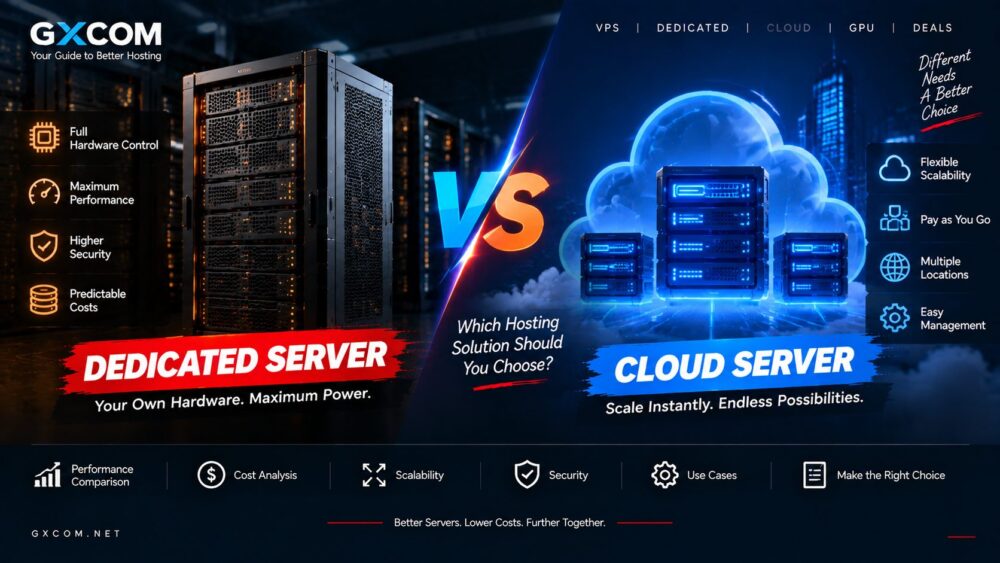
Choosing between Bare Metal vs Dedicated Hosting can be confusing because both solutions provide exclusive access to physical server hardware. However, the two terms are often used differently by hosting providers, and the differences usually come down to virtualization, management options, deployment flexibility and infrastructure design.
Bare metal servers typically refer to physical servers without a virtualization layer, designed for maximum hardware performance and direct access. Dedicated hosting usually means renting an entire physical server from a hosting provider, which may include additional management services and hosting features.
This comparison explains the differences between bare metal and dedicated hosting, including performance, pricing, scalability, security and which option is better for different workloads.
Last updated: September 20, 2026. Server specifications and pricing vary by provider. Always compare current hardware configurations before purchasing.
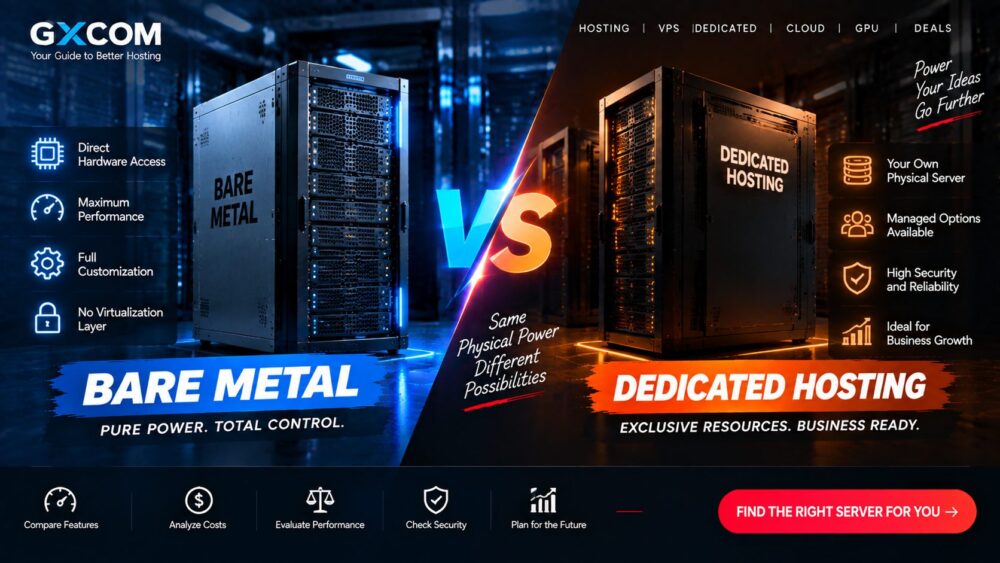
Bare Metal vs Dedicated Hosting: Quick Comparison
| Feature | Bare Metal Server | Dedicated Hosting |
|---|---|---|
| Hardware | Entire physical machine | Entire physical machine |
| Virtualization | No virtualization layer | Usually no sharing, provider dependent |
| Performance | Maximum hardware performance | High predictable performance |
| Management | Usually self-managed | Managed options available |
| Customization | Very high | High |
| Best For | Enterprise workloads and performance computing | Businesses requiring dedicated resources |
What Is a Bare Metal Server?
A bare metal server is a physical server dedicated to one customer without a virtualization layer between the operating system and hardware.
Because applications communicate directly with the physical hardware, bare metal servers provide maximum performance, predictable resource availability and complete control over server configuration.
Bare metal infrastructure is commonly used for:
- High-performance computing
- Artificial intelligence workloads
- Large databases
- Enterprise applications
- Financial systems
- Gaming infrastructure
What Is Dedicated Hosting?
Dedicated hosting means renting an entire physical server from a hosting provider instead of sharing resources with other customers.
The customer receives exclusive access to the server's CPU, RAM, storage and network resources.
Dedicated hosting providers may offer additional services such as:
- Server management
- Operating system installation
- Security monitoring
- Backups
- Technical support
This makes dedicated hosting attractive for businesses that need dedicated hardware without managing every infrastructure detail themselves.
Bare Metal vs Dedicated Hosting: Performance Comparison
Performance is one of the biggest reasons organizations choose physical servers instead of virtualized infrastructure.
Bare metal servers provide direct hardware access with no hypervisor overhead. This can be important for workloads requiring maximum CPU efficiency, low latency and consistent performance.
Dedicated hosting can provide almost identical hardware performance because customers also receive an entire physical machine.
The actual performance difference often depends more on:
- Processor generation
- RAM speed
- Storage technology
- Network configuration
- Server optimization
Hardware Resources Comparison
Both bare metal and dedicated hosting provide exclusive physical resources.
Typical resources include:
- Dedicated CPU cores
- Dedicated memory
- NVMe or SSD storage
- Dedicated network capacity
The difference is usually not the hardware itself, but how the service is delivered and managed.
Virtualization Difference Between Bare Metal and Dedicated Hosting
The biggest technical difference is often virtualization.
Bare metal servers are designed to run directly on physical hardware without a virtualization layer.
Dedicated servers can also run without virtualization, but some providers may offer dedicated hosting solutions with additional virtualization, management platforms or hosting environments.
For workloads requiring maximum hardware efficiency, bare metal provides a simpler direct hardware model.
Cost Comparison: Bare Metal vs Dedicated Hosting
Pricing depends heavily on hardware specifications and provider services.
| Solution | Cost Characteristics | Best For |
|---|---|---|
| Bare Metal | Higher hardware-focused pricing | Performance workloads |
| Dedicated Hosting | Wide range including managed options | Businesses and websites |
Bare metal can become more expensive when advanced hardware is required, especially for AI, GPU computing or high-performance applications.
Dedicated hosting may provide better value for businesses that need support and management services.
Scalability Comparison
Neither bare metal nor dedicated hosting scales as quickly as cloud infrastructure.
Adding more capacity usually requires:
- Upgrading hardware
- Migrating to a larger server
- Adding additional machines
Cloud servers are generally easier to scale instantly, while physical servers provide stronger predictable performance.
For cloud alternatives, explore our cloud servers comparison resources.
Security Comparison
Both bare metal and dedicated hosting provide strong physical isolation because customers do not share the underlying hardware.
This makes them suitable for organizations requiring:
- Compliance requirements
- Private databases
- Sensitive applications
- Enterprise workloads
Security still depends on operating system configuration, access controls, monitoring and application security.
Bare Metal vs Dedicated Hosting for AI Workloads
Artificial intelligence workloads often require maximum hardware performance, especially when using GPUs.
Bare metal infrastructure is frequently used for:
- AI model training
- Machine learning workloads
- Large-scale data processing
- High-performance computing
However, dedicated GPU servers can provide similar advantages depending on hardware configuration and provider offerings.
Explore our GPU server deals section for AI computing infrastructure.
Bare Metal vs Dedicated Hosting for Websites
Most websites do not require bare metal infrastructure.
Small and medium websites usually perform well on VPS or managed hosting solutions.
Large websites, eCommerce platforms and applications with predictable heavy traffic may benefit from dedicated hosting.
Bare metal is generally selected when maximum hardware performance becomes more important than simplicity.
Management Difference
Management is one of the biggest practical differences between these services.
Bare metal servers are commonly designed for technical users who want complete control.
Dedicated hosting providers often offer managed options including:
- Server setup
- Updates
- Monitoring
- Security assistance
- Technical support
Businesses without dedicated system administrators may prefer managed dedicated hosting.
Bare Metal vs Dedicated Hosting: Which Should You Choose?
| Choose Bare Metal If | Choose Dedicated Hosting If |
|---|---|
| You need maximum hardware performance | You need dedicated resources with support |
| You manage infrastructure yourself | You prefer managed services |
| You run demanding workloads | You operate business websites |
| You require custom configurations | You want easier server management |
Bare Metal vs Dedicated Hosting: Final Checklist
The Bare Metal vs Dedicated Hosting decision depends on performance requirements, management preferences and workload complexity.
Bare metal servers provide maximum hardware control and are ideal for demanding applications requiring direct physical resources.
Dedicated hosting provides similar dedicated hardware benefits while often offering additional management services and easier business deployment.
Before choosing, compare hardware specifications, provider support, pricing structure and future growth requirements.
GXCOM.NET will continue publishing server comparisons to help users select the right infrastructure solution.