



In this guide, GXCOM.NET compares Ryzen-based dedicated hosting options, explains the role of NVMe and network performance, and helps you decide when bare metal is worth the investment.
What Makes a Dedicated Game Server Different?
The term “dedicated game server” can describe two different products: a standalone multiplayer game instance or an entire physical server reserved for one customer. For hardware comparisons, the distinction is essential.
A true bare-metal dedicated server provides exclusive access to the underlying machine. You can install an operating system, allocate resources among game instances, configure networking, and manage supporting services.
Managed game hosting, meanwhile, usually provides a preconfigured game instance on infrastructure operated by the hosting company. It is easier to use, but it does not necessarily include exclusive physical hardware.
If you are still evaluating hosting models, read our game server hosting explained guide before choosing a dedicated machine.
Best Dedicated Game Server Hosting Providers Compared
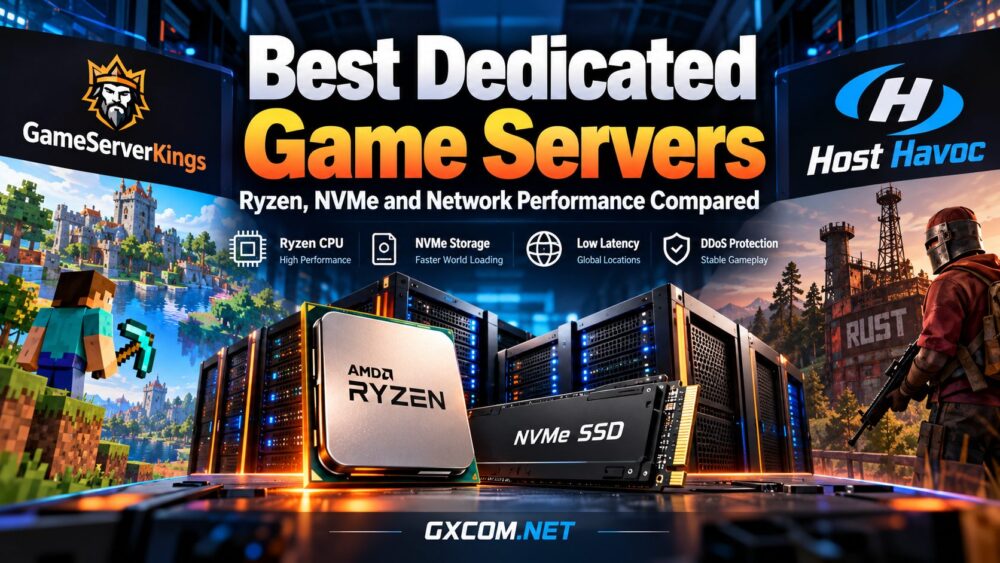
Two relevant options for dedicated gaming infrastructure are GameServerKings and Host Havoc. Both advertise physical dedicated server products, although their hardware configurations, management options, availability, and ordering requirements differ.
| Provider | Dedicated Hardware | Management Options | Best For |
|---|---|---|---|
| GameServerKings | Configurable Ryzen systems, DDR5 and NVMe options | Self-managed or Managed Dedicated | Ryzen-focused gaming communities |
| Host Havoc | Dedicated Intel and AMD systems with NVMe storage | Unmanaged or game-panel-managed | Multiple game instances and community hosting |
1. GameServerKings — Best for Configurable Ryzen Dedicated Servers
GameServerKings offers dedicated server configurations built around gaming-oriented processors, including the AMD Ryzen 7 7800X3D.
Its published 7800X3D configuration supports customizable DDR5 memory, NVMe storage, and network connectivity. Customers can select bare-metal access or explore Managed Dedicated services with a game management panel.
This flexibility makes GameServerKings particularly interesting for administrators who know their resource requirements and want control over the entire machine.
Best fit: High-population Rust servers, demanding Minecraft worlds, and communities that want configurable Ryzen hardware.
Consider before ordering: Hardware may be built to order, and initial billing commitments or deployment times can differ from ordinary instant-setup game hosting.
2. Host Havoc — Best for Dedicated Hardware with Game Management
Host Havoc provides dedicated servers with NVMe storage and a choice of managed or unmanaged operation.
One notable feature is its game management panel, which can simplify the deployment of multiple game servers on the same physical machine. Its dedicated hosting documentation also discusses Ryzen hardware, network protection, and scaling larger communities.

Host Havoc is particularly relevant when a community needs several Minecraft, Rust, or ARK instances alongside supporting services.
Best fit: Community operators seeking dedicated resources without building every management workflow from scratch.
Consider before ordering: Check current inventory, included management responsibilities, hardware generation, and available locations.
AMD Ryzen vs Intel: Which CPU Is Better for Game Hosting?
Many multiplayer games depend heavily on one or a few primary simulation threads. Consequently, high single-thread performance often matters more than simply maximizing total CPU cores.
Modern AMD Ryzen processors are attractive because they combine strong per-core performance with efficient multi-core capacity. Ryzen X3D models add a larger cache, which can benefit some cache-sensitive workloads.
However, a larger cache does not guarantee better performance in every game server. Server software, player activity, plugins, world complexity, and memory behavior all influence results.
| CPU Priority | Recommended Workload |
|---|---|
| High single-core speed | One busy Minecraft or Rust instance |
| More CPU cores | Several game servers running simultaneously |
| Large CPU cache | Potentially cache-sensitive simulation workloads |
| Strong sustained performance | Long-running communities with heavy activity |
Before selecting a processor, examine the requirements of your actual game rather than assuming the newest or most expensive CPU is always necessary.
Why NVMe Storage Matters for Dedicated Game Servers
Game servers constantly read and write world data, player inventories, logs, plugins, and backups. Modded environments and large persistent worlds can generate substantial small-file storage activity.
NVMe SSDs offer lower latency and higher potential throughput than traditional hard drives, helping reduce storage-related bottlenecks during saves, restarts, and world loading.
Still, NVMe alone cannot fix CPU saturation, inefficient plugins, or overloaded databases. Ask providers whether storage is shared, whether additional drives are available, and how backups are handled.
For a broader breakdown of hardware sizing, see our game server CPU, RAM, storage and bandwidth requirements guide.
Network Latency, Bandwidth and DDoS Protection
A fast CPU cannot compensate for a poor network route. When selecting a dedicated game server, prioritize locations close to your players and examine network quality rather than relying exclusively on advertised port speed.
Latency and Server Location
Lower round-trip latency generally improves responsiveness, particularly in competitive games. Choose a region that minimizes latency for most active players, and test routing from relevant geographic areas where possible.
Port Speed vs Actual Throughput
A 10 Gbps network port does not mean every player receives 10 Gbps of performance. Transit quality, congestion, bandwidth policies, and the game's traffic patterns determine practical results.
DDoS Mitigation
Public game servers can attract disruptive traffic. Confirm whether protection is included, what types of attacks are covered, and whether mitigation affects legitimate UDP game traffic.
For Rust communities, our best Rust server hosting comparison explains why stable routing and attack protection deserve special attention.
How Much RAM Does a Dedicated Game Server Need?
Memory requirements vary widely by game, modpack, world size, and concurrent player activity. A lightweight private server and a large modded multiplayer network should not be sized identically.
Reserve memory for the operating system, game panel, monitoring tools, databases, and backup operations. If multiple game instances share one machine, calculate their combined peak usage rather than their idle consumption.
For Minecraft communities, our Minecraft server hosting comparison explores the differences between Java, Bedrock, and modded hosting.
Managed vs Unmanaged Dedicated Game Servers
An unmanaged dedicated server gives experienced administrators extensive flexibility. You handle operating system updates, game installations, firewall rules, backups, monitoring, and incident response.
A managed dedicated option can reduce operational effort through an included game panel or provider-assisted maintenance. However, management coverage varies. Some providers manage the operating system but not custom plugins, while others focus on hardware and networking.
Before purchasing, confirm exactly who handles security patches, game updates, data recovery, migrations, and configuration problems.
When Should You Upgrade from Game Hosting to Bare Metal?
Dedicated hardware becomes attractive when several game instances require predictable resources, administrative control, or custom software that ordinary hosting plans cannot accommodate.
It may be unnecessary for a small private server with a handful of friends. Managed game hosting can remain more economical and convenient when technical administration is not a priority.
If you are comparing virtualized and physical infrastructure, read our bare metal vs VPS comparison for the broader cost and isolation trade-offs.
Dedicated Game Server Buying Checklist
- CPU: Evaluate single-thread performance, sustained clocks, and core requirements.
- RAM: Include headroom for peak player activity and supporting services.
- Storage: Prefer reliable NVMe configurations with a clear backup strategy.
- Location: Select a region near the majority of players.
- Network: Review traffic allowances, routing, and DDoS protection.
- Management: Understand which maintenance tasks are included.
- Billing: Check setup fees, initial commitments, renewals, and cancellation terms.
- Availability: Confirm stock and provisioning time before planning a migration.
Frequently Asked Questions
Is Ryzen better than Intel for dedicated game servers?
Neither brand wins universally. Compare specific processor generations, per-core performance, cache behavior, and the game server workload rather than the manufacturer alone.

Is NVMe necessary for Minecraft and Rust hosting?
NVMe is highly desirable for busy or modded servers because world saves and file operations can benefit from faster storage. It does not replace sufficient CPU and RAM.
Do dedicated game servers always have lower ping?
No. Ping primarily depends on geography, routing, and network conditions. Dedicated hardware improves resource isolation but cannot eliminate distance-related latency.
Can one dedicated server host multiple games?
Yes. With enough CPU, RAM, storage, and appropriate port assignments, one physical machine can run multiple game instances. A management panel can simplify deployment and administration.
Final Verdict: Which Dedicated Game Server Should You Choose?
For configurable Ryzen hardware and a choice between bare-metal control and managed deployment, GameServerKings deserves consideration. For communities prioritizing an integrated game management experience on dedicated hardware, Host Havoc is another relevant option.
The best choice depends on your games, concurrent player load, technical expertise, server location, and total operating cost. Prioritize verified hardware specifications, realistic network expectations, and a clear migration plan over marketing claims.
GXCOM.NET recommendation: Choose dedicated hosting when predictable resources and administrative flexibility justify the additional cost. Otherwise, a well-configured managed game server may be the more practical solution.

