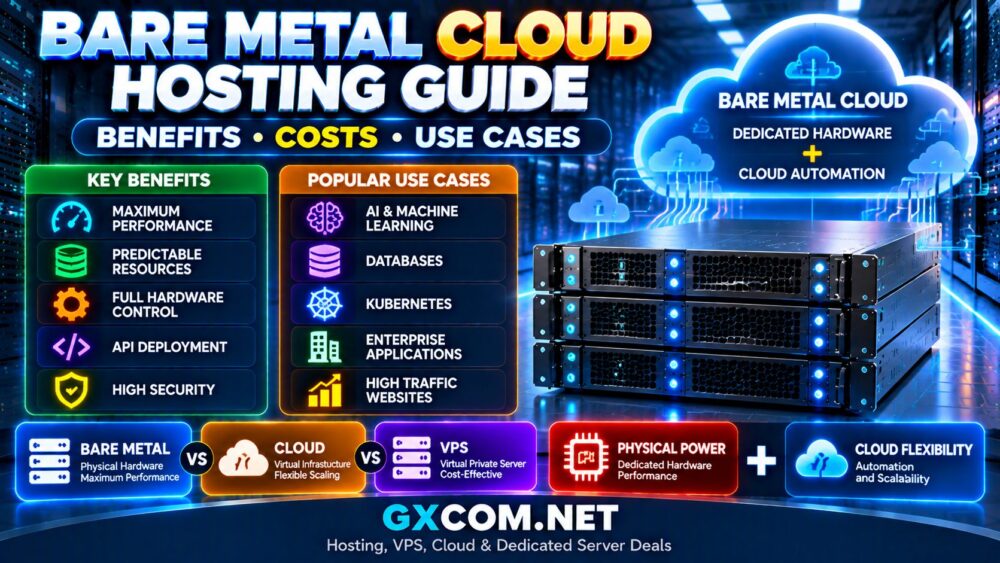
Bare metal cloud hosting combines the performance of dedicated physical servers with the flexibility and automation of modern cloud infrastructure. It allows businesses to access single-tenant hardware while still benefiting from cloud-style provisioning, APIs, automation, and scalable infrastructure management.
Traditional cloud platforms are built primarily around virtual machines running on shared physical servers. While virtualized cloud environments provide excellent flexibility, some workloads require direct hardware access, predictable performance, lower latency, or specialized hardware configurations.
This Bare Metal Cloud Hosting Guide explains what bare metal cloud means, how it differs from traditional cloud hosting, its benefits, costs, and the workloads that benefit most from dedicated physical infrastructure.
What Is Bare Metal Cloud Hosting?
Bare metal cloud hosting provides dedicated physical servers through a cloud-like management platform.
Instead of renting a virtual machine that shares hardware resources with other customers, users receive an entire physical server that can be deployed, configured, and managed through automated cloud tools.
A bare metal cloud environment typically includes:
- Dedicated physical servers
- API-based provisioning
- Automated deployment
- High-performance networking
- Fast NVMe storage
- Custom operating systems
- Infrastructure automation
The goal is to combine bare metal performance with cloud operational flexibility.
Bare Metal Cloud vs Traditional Cloud Hosting
| Feature | Bare Metal Cloud | Traditional Cloud |
|---|---|---|
| Infrastructure | Physical dedicated server | Virtual machines |
| Resource Sharing | No shared compute resources | Shared physical hosts |
| Performance | Highly predictable | Flexible but variable |
| Scaling | Hardware-based | Rapid virtual scaling |
| Customization | Very high | Limited by virtualization |
| Best For | Performance workloads | General cloud applications |
Bare Metal Cloud vs Dedicated Server
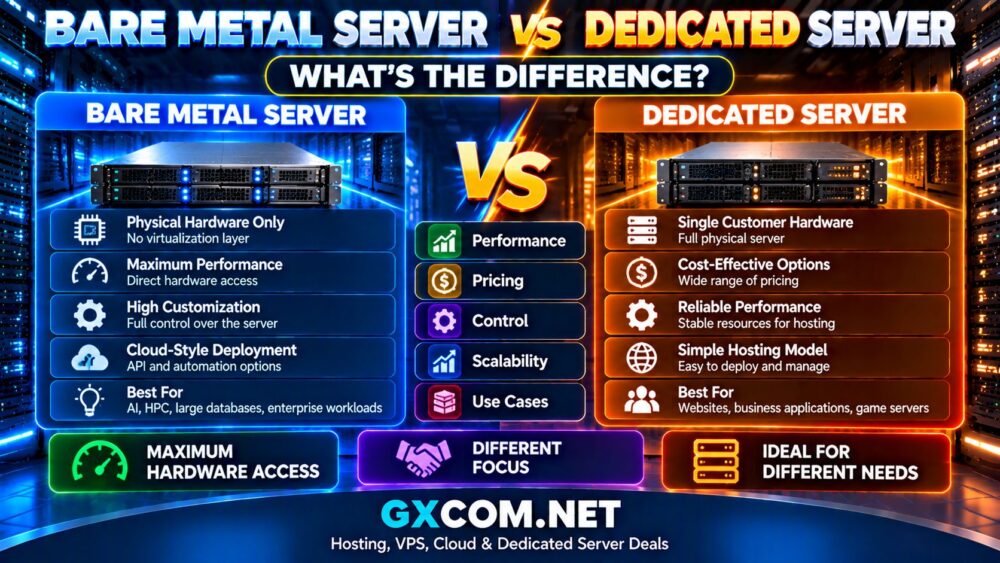
Bare metal cloud and dedicated servers share the same foundation: physical hardware dedicated to one customer.
The difference is mainly the management experience.
| Feature | Bare Metal Cloud | Dedicated Server |
|---|---|---|
| Hardware | Dedicated physical server | Dedicated physical server |
| Deployment | Cloud automation | Traditional provisioning |
| API Access | Common | Less common |
| Scaling | Cloud-oriented workflows | Manual migration |
| Target Users | Developers and enterprises | Businesses and hosting users |
For a detailed comparison, see our Bare Metal Server vs Dedicated Server guide.
How Does Bare Metal Cloud Work?
Bare metal cloud platforms work by connecting physical servers with cloud management systems.
A typical workflow looks like:
- Select a physical server configuration.
- Choose CPU, RAM, storage, and network options.
- Deploy the operating system automatically.
- Configure applications and services.
- Manage infrastructure through dashboard or API.
This approach removes many manual hardware provisioning steps while preserving direct access to physical resources.
Benefits of Bare Metal Cloud Hosting
1. Maximum Performance
The biggest advantage of bare metal cloud is direct hardware access.
Applications do not compete with virtual machines running on the same physical host, which can provide more predictable performance.
This is valuable for:
- High-performance databases
- AI workloads
- Real-time applications
- Large-scale analytics
- Enterprise software
2. Predictable Resource Availability
Virtual cloud environments can experience performance variation depending on host resource usage.
Bare metal provides dedicated:
- CPU resources
- Memory
- Storage devices
- Network capacity
This makes capacity planning easier for demanding applications.
3. Better Performance for Specialized Hardware
Some workloads require hardware that is difficult to optimize in virtualized environments.
Bare metal cloud is commonly used for:
- NVIDIA GPU servers
- AI acceleration
- Machine learning training
- High-speed networking
- Specialized computing
4. Full Operating System Control
Bare metal allows administrators to customize the environment more deeply.
Users can control:
- Operating system configuration
- Storage layout
- Security settings
- Network configuration
- Application stack
5. Cloud Automation
Unlike traditional dedicated hosting, bare metal cloud platforms often provide:
- API deployment
- Infrastructure automation
- Server provisioning
- Monitoring integrations
- Cloud management tools
Bare Metal Cloud Hosting Costs
Bare metal cloud pricing depends on hardware and service requirements.
Main cost factors include:
- CPU model
- Number of cores
- RAM capacity
- NVMe storage
- GPU hardware
- Network bandwidth
- Data center location
- Management services
- Operating system licensing
Typical Bare Metal Cloud Pricing
| Configuration | Typical Use |
|---|---|
| Entry Bare Metal | Websites, applications, testing |
| High RAM Servers | Databases and virtualization |
| GPU Bare Metal | AI and machine learning |
| Enterprise Servers | Large applications and business systems |
Bare metal cloud generally costs more than standard virtual machines because customers receive dedicated physical resources.
However, the higher cost can be justified when performance consistency and hardware control directly affect business results.
Bare Metal Cloud for AI and Machine Learning
AI is one of the fastest-growing use cases for bare metal infrastructure.
Modern AI workloads require:
- NVIDIA GPUs
- Large memory capacity
- Fast NVMe storage
- High-speed networking
- Powerful CPUs
Virtualized environments can introduce limitations for some AI training workloads, especially when maximum GPU performance is required.
Bare metal provides direct access to specialized hardware, making it attractive for AI companies and research organizations.
Bare Metal Cloud for Databases
Database performance depends heavily on CPU, memory, and storage consistency.
Bare metal cloud is commonly used for:
- MySQL
- PostgreSQL
- Microsoft SQL Server
- Oracle databases
- Analytics systems
Large databases benefit from:
- High RAM capacity
- Fast NVMe storage
- Dedicated CPU resources
- Predictable I/O performance
Bare Metal Cloud for Kubernetes
Kubernetes is commonly associated with virtual cloud environments, but many organizations also deploy Kubernetes on bare metal.
Benefits include:
- Lower virtualization overhead
- Predictable performance
- Direct hardware access
- Better resource efficiency
Bare metal Kubernetes can be attractive for companies operating large container platforms.
Bare Metal Cloud for High Traffic Websites
High-traffic websites often require predictable infrastructure.
Bare metal cloud can support:
- Large ecommerce platforms
- Media websites
- SaaS applications
- API platforms
- Online communities
However, hardware alone does not guarantee performance. Application optimization, caching, CDN usage, and database design remain important.
Bare Metal Cloud Security Benefits
Single-tenant hardware can provide additional isolation benefits.
Advantages include:
- No neighboring virtual machines
- Dedicated hardware environment
- Greater security customization
- Custom network controls
However, security still depends on:
- Operating system updates
- Firewall configuration
- Access management
- Application security
- Backup strategy
Bare Metal Cloud Providers
Several companies offer bare metal cloud infrastructure for different markets.
| Provider | Best For |
|---|---|
| OVHcloud | Global bare metal infrastructure |
| IBM Cloud | Enterprise workloads |
| Equinix Metal | Cloud-native deployment |
| Hetzner | Performance-focused budget servers |
| Liquid Web | Managed performance hosting |
See our Best Bare Metal Servers comparison for provider details.
Who Should Use Bare Metal Cloud Hosting?
Bare metal cloud is suitable for organizations that need:
- High-performance infrastructure
- Dedicated physical resources
- Advanced automation
- Custom server configurations
- Predictable application performance
Who Does Not Need Bare Metal Cloud?
Bare metal cloud may be unnecessary for:
- Small websites
- Simple blogs
- Low-traffic applications
- Basic development projects
- Applications that scale easily on VPS platforms
A VPS or traditional cloud server may provide better value for these workloads.
Bare Metal Cloud vs VPS
| Feature | Bare Metal Cloud | VPS |
|---|---|---|
| Hardware | Dedicated physical server | Virtual server |
| Cost | Higher | Lower |
| Performance | Maximum consistency | Depends on host |
| Scaling | Hardware based | Usually easier |
| Best For | Demanding workloads | General applications |
How to Choose a Bare Metal Cloud Provider
- Define workload requirements.
- Select CPU and RAM configuration.
- Evaluate storage performance.
- Check network capacity.
- Compare geographic locations.
- Review automation tools.
- Calculate total monthly cost.
- Consider future growth.
Final Thoughts
Bare metal cloud hosting fills the gap between traditional dedicated servers and virtual cloud infrastructure.
It provides the physical performance and resource isolation of dedicated hardware while adding cloud-style automation, deployment flexibility, and infrastructure management.
For AI workloads, enterprise databases, high-performance applications, and organizations requiring predictable resources, bare metal cloud can provide significant advantages.
However, not every project requires dedicated physical hardware. Smaller websites and applications may achieve better cost efficiency with VPS or traditional cloud servers.
The right choice depends on matching infrastructure to workload requirements, performance expectations, and long-term business goals.