Choosing between fully managed vs semi managed hosting is less about a marketing label and more about who fixes problems when your website goes offline. Both options may include technical assistance, but their responsibilities can differ dramatically. A provider might patch the operating system while leaving WordPress errors, database tuning, and application security to you.
This comparison explains support boundaries, service-level agreements, and realistic ownership costs so businesses can select the right management arrangement before signing a contract.
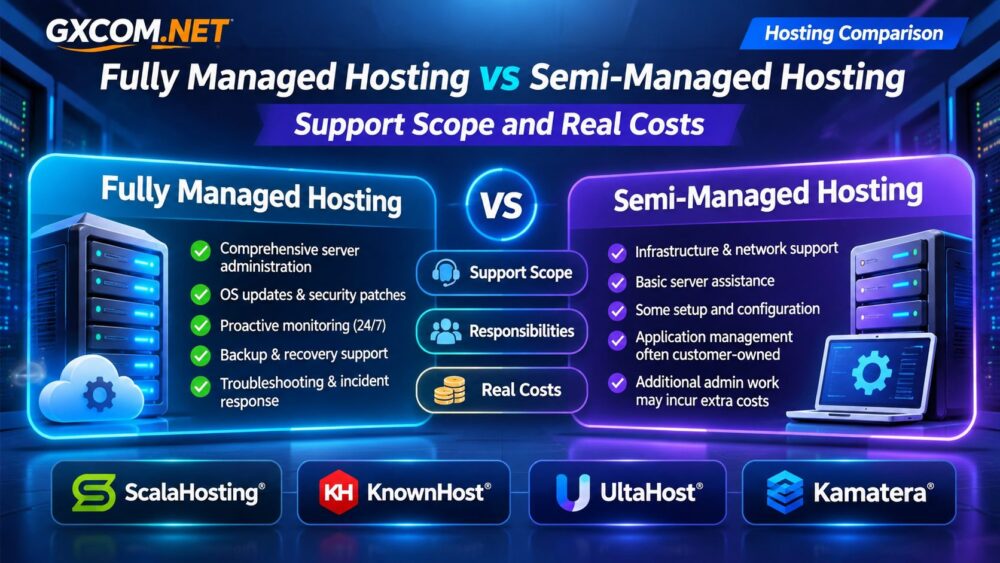
Quick Comparison: Fully Managed vs Semi-Managed Hosting
| Decision Factor | Fully Managed | Semi-Managed |
|---|---|---|
| Server monitoring | Usually proactive | Often limited or optional |
| Operating system updates | Typically included | Varies by plan |
| Application troubleshooting | Sometimes included | Frequently customer-owned |
| Backups and restores | Check exact coverage | Often shared responsibility |
| Monthly price | Usually higher | Often lower initially |
These descriptions are common patterns, not industry-wide guarantees. Neither term has a universal contractual definition. Always compare written service descriptions instead of assuming that “fully managed” means every application issue is covered.
What Does Fully Managed Hosting Actually Cover?
Fully managed hosting generally places more infrastructure administration on the provider. Typical tasks may include operating system maintenance, server monitoring, security updates, service configuration, and incident investigation. Some providers also assist with control panels, web stacks, and migrations.
However, developers may still own application code, plugin compatibility, website content, and third-party integrations. Even a comprehensive managed package may exclude custom scripts or performance work caused by poorly optimized applications.
Ask for a written list of supported software versions and excluded tasks. For broader context, see our Managed vs Unmanaged VPS Comparison.
What Is Semi-Managed Hosting?
Semi-managed hosting occupies the space between provider-administered infrastructure and customer-controlled operations. A host might maintain network connectivity, replace failed hardware, and help with basic server issues while leaving operating system configuration or application management to the customer.
Other plans include initial setup and limited troubleshooting but charge separately for recurring administration. Because coverage varies, “semi-managed” should trigger detailed questions rather than an assumption about what is included.
It can suit agencies with technical staff who want infrastructure assistance without paying for broader ongoing administration.

Support Responsibility Matrix: Who Fixes What?
Before choosing a plan, request a task-by-task responsibility matrix. The following questions expose the gaps most likely to cause expensive delays:
- Operating system: Who installs patches, schedules reboots, and resolves failed updates?
- Web server: Who repairs Apache, Nginx, PHP, or database service failures?
- Applications: Who investigates WordPress plugin conflicts and broken deployments?
- Security: Who handles malware removal, firewall rules, and compromised accounts?
- Backups: Who creates, tests, retains, and restores recovery copies?
- Monitoring: Who receives alerts and takes action outside business hours?
For example, a provider may restore a failed database service but decline to repair corrupted application records. That distinction matters more than the plan name.
Compare Support SLAs, Not Just Response Times
A support SLA may promise an initial reply within a specified period without guaranteeing resolution. Review which incidents qualify as emergencies, whether assistance operates 24/7, and whether application problems are excluded.
Also distinguish infrastructure uptime commitments from application availability. A network can remain operational while a website fails because of software errors. Ask about escalation, maintenance windows, service credits, and incident ownership.
Four Approved Providers Worth Comparing
ScalaHosting: Managed VPS and Control Panel Workflows
ScalaHosting is relevant for businesses evaluating managed VPS services and server administration. Check which operating system, security, control panel, and application tasks its selected plan covers. Confirm whether assistance differs between SPanel and alternative configurations.
KnownHost: Managed Hosting for Business Websites
KnownHost is a candidate for organizations prioritizing hosting support and predictable operations. Examine migration assistance, backup policies, supported applications, and the boundary between server maintenance and website development.
UltaHost: Management Features Across Hosting Plans
UltaHost offers hosting options worth comparing for managed service requirements. Review the exact product tier, monitoring coverage, restoration terms, and whether advanced troubleshooting incurs extra charges.
Kamatera: Cloud Infrastructure With Management Choices
Kamatera is useful when comparing configurable cloud infrastructure with optional management arrangements. Separate the underlying server price from management services, backup features, licensing, and any administrative work retained by your team.
These are research candidates, not a claim that all four sell identically defined fully managed or semi-managed packages.
Real Cost Comparison: Subscription Plus Staff Time
Monthly hosting prices alone understate ownership costs. Consider this hypothetical comparison for one business website:
| Monthly Cost | Fully Managed | Semi-Managed |
|---|---|---|
| Hosting subscription | $95 | $55 |
| Internal admin time | 1 hour | 4 hours |
| Staff cost at $30/hour | $30 | $120 |
| Combined monthly cost | $125 | $175 |
Although semi-managed hosting saves $40 on the subscription, additional staff time makes it $50 more expensive overall in this illustration. Actual workloads, labor rates, and support coverage vary.
Calculate the same figures over twelve months, then add backup storage, control panel licenses, emergency support, and migration work. Our Shared vs Cloud Hosting Cost Guide provides additional infrastructure pricing context.
Backups, Security, and Disaster Recovery
Management labels do not automatically guarantee complete protection. Confirm backup frequency, retention, offsite storage, restoration fees, and recovery testing. Ask whether the host handles compromised websites or only restores server infrastructure.
For recovery planning, review our VPS Snapshot and Backup Recovery Guide. Keep independent copies of critical data even when a provider advertises managed backups.
Which Hosting Model Fits Your Business?
Choose broader management coverage when downtime is costly, internal technical capacity is limited, or continuous monitoring matters. Semi-managed hosting may be suitable when your team already maintains applications, understands Linux administration, and can respond to incidents.
For agencies handling multiple client sites, document which party responds to each type of ticket. If a project needs more configurable infrastructure, compare options in our Managed Cloud Hosting Comparison.
Frequently Asked Questions
Does Fully Managed Hosting Include WordPress Support?
Not necessarily. Some plans cover the server stack but exclude themes, plugins, custom code, or website development. Verify the support policy.
Is Semi-Managed Hosting Always Cheaper?
Its subscription may cost less, but internal administration, emergency support, and downtime can increase total ownership costs.
Can I Upgrade From Semi-Managed to Fully Managed?
Some providers offer management upgrades, but availability, eligibility, and migration requirements depend on the product. Confirm before purchase.
Final Verdict
The right choice between fully managed and semi-managed hosting depends on the work your provider actually performs, not the marketing label. Compare support exclusions, response obligations, security ownership, and staff time before choosing a lower monthly price.
Shortlist ScalaHosting, KnownHost, UltaHost, and Kamatera according to your workload, then request written confirmation of the management tasks included. A clearly defined responsibility agreement is often worth more than an impressive introductory discount.