Choosing storage for a production database involves more than comparing advertised IOPS. A fast disk may deliver excellent query latency but complicate recovery after a server failure. A persistent cloud volume may simplify infrastructure changes while introducing additional latency and storage charges.
This cloud block storage vs local NVMe comparison explains how the two architectures affect MySQL, PostgreSQL, application responsiveness, durability, and total hosting costs. It also helps you identify the right cloud infrastructure for your workload.
Cloud Block Storage vs Local NVMe: Quick Verdict
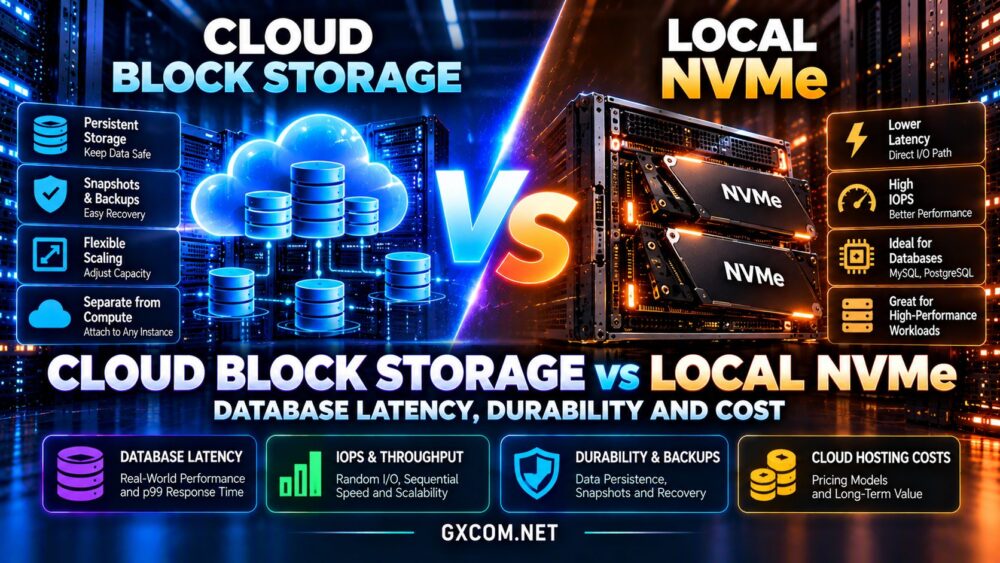
Local NVMe is attractive when consistently low storage latency, high random I/O performance, and predictable hardware access are priorities.
Cloud block storage is attractive when databases need persistent volumes, flexible capacity management, snapshots, and easier separation between compute and storage.
Neither architecture guarantees high availability. Both require appropriate backups, monitoring, and recovery planning.
For a broader infrastructure overview, explore our best cloud hosting services guide.
Cloud Block Storage vs Local NVMe: Key Differences
| Feature | Cloud Block Storage | Local NVMe |
|---|---|---|
| Connection | Remote or distributed storage service | Locally attached SSD |
| Latency | Depends on network and service tier | Typically shorter I/O path |
| IOPS scaling | May support configurable performance | Limited by local hardware |
| Volume persistence | Often independent of compute instance | Depends on platform lifecycle |
| Snapshots | Commonly integrated | Requires platform or backup support |
| Expansion | Often possible without changing compute | May require migration or hardware changes |
| Billing | Capacity and performance charges | Often bundled with server rental |
| Typical strength | Operational flexibility | Low-latency performance |
These are architectural tendencies rather than universal guarantees. Always examine the provider’s actual storage implementation.
Database Latency: Why the I/O Path Matters
Database response time depends on CPU execution, memory caching, locks, network requests, and storage access.
Local NVMe generally offers a shorter path between the application and physical flash storage. Remote block volumes introduce additional software and network components, although well-engineered storage services can still deliver strong performance.
For latency-sensitive databases, compare average latency alongside p95 and p99 results. Occasional slow writes may affect checkout transactions or API responses even when average IOPS looks impressive.
Random Reads and Writes
MySQL and PostgreSQL frequently perform small random operations involving indexes, data pages, and transaction logs.
A storage benchmark focused only on sequential throughput may therefore miss the behavior that matters most.
Test small-block random I/O with realistic queue depths, then validate the results using actual database queries.
Transaction Commit Latency
Durable database transactions may require flushing log records to storage. This makes write latency and correct flush semantics important.
When comparing platforms, examine fsync-related latency and confirm that the storage system honors the durability guarantees expected by your database.
Do not assume that higher advertised IOPS automatically means faster commits.
IOPS, Throughput and Performance Limits
IOPS measures the number of input/output operations completed per second. Throughput measures the volume of data transferred, while latency measures how long individual operations take.

These metrics are related but not interchangeable.
A cloud block volume may have separate limits for provisioned IOPS, throughput, and capacity. The attached virtual machine may impose additional restrictions.
Local NVMe performance depends on the physical SSD, controller, thermal behavior, filesystem, and competition from other workloads.
For both architectures, test sustained performance rather than relying exclusively on short bursts.
Our NVMe VPS vs SSD performance guide explains additional storage metrics relevant to server buyers.
Durability: What Happens When a Server Fails?
One of the biggest differences is the relationship between compute and storage lifecycles.
Many cloud block storage services allow a persistent volume to remain available after its original compute instance is removed, provided the volume itself is retained.
Local NVMe may remain intact after a normal reboot, but some cloud instance-storage products are ephemeral and can lose data when an instance is terminated or its host fails.
A rented dedicated server with local NVMe has different lifecycle characteristics from ephemeral cloud instance storage. These products should not be treated as identical.
Replication Is Not the Same as Backup
A replicated storage system may tolerate certain hardware failures, but replication can also propagate accidental deletions or database corruption.
Snapshots provide useful recovery points, yet snapshot schedules, retention periods, and application consistency vary.
Maintain independent backups and regularly test restoration. For databases, coordinate snapshots with transaction logs or database-native backup procedures when appropriate.
High Availability Requires More Than Storage
Persistent volumes alone do not eliminate application downtime. Compute failures, network interruptions, and database software errors remain possible.
High-availability designs may require replicas, automated failover, and tested recovery procedures.
Choose an architecture based on recovery time objectives and acceptable data loss, not merely a provider’s durability marketing.
MySQL and PostgreSQL: Which Storage Performs Better?
For a small database that fits largely in RAM, storage differences may have limited impact on everyday query response times.
As the working dataset grows beyond available memory, disk access becomes more important.
Local NVMe can be valuable for heavy random I/O, transaction logs, and workloads requiring low write latency.
Cloud block storage may be preferable when operational requirements include easier volume replacement, independent capacity expansion, and persistent storage across compute changes.
Database tuning still matters. Missing indexes, excessive connections, and poorly designed queries can overwhelm either storage architecture.
Cloud Block Storage vs Local NVMe Costs
Compare the total cost of running a database, not just the advertised storage price.
Cloud block storage may charge separately for capacity, provisioned performance, snapshots, and other services. Pricing models vary substantially by provider.
Local NVMe is frequently included in the rental price of a VPS or dedicated server, although backup storage and replication infrastructure can create additional expenses.
Calculate Total Monthly Cost
Include compute rental, usable storage capacity, required IOPS, backup retention, data transfer, and operational management.
For local NVMe, account for the cost of a second server or backup destination if your recovery design requires one.
For cloud block storage, examine whether increasing database throughput requires a more expensive volume tier.
Our cloud hosting vs VPS comparison provides further context on infrastructure pricing and flexibility.
Cloud and Bare Metal Providers to Compare
The best storage architecture depends partly on which infrastructure products are available from your chosen provider.
Vultr: Cloud Compute and Block Storage
Vultr offers cloud compute infrastructure and block storage products. It is worth evaluating when you need independently managed storage volumes alongside virtual machines.
Check the storage tier, regional availability, performance limits, and snapshot options for your intended deployment.
Kamatera: Flexible Cloud Infrastructure
Kamatera is another option for configurable cloud servers and storage resources.
Compare its current disk configurations, backup services, and capacity expansion options rather than assuming every storage product behaves like a separately detachable cloud volume.
Cherry Servers: Local NVMe Bare Metal
Cherry Servers is relevant for database buyers seeking dedicated hardware and local NVMe configurations.
Its bare metal approach may suit workloads that prioritize hardware control and predictable storage access. Verify RAID design, replacement procedures, and available backup services.
OVHcloud: Cloud and Dedicated Alternatives
OVHcloud provides public cloud infrastructure as well as dedicated servers, making it useful for comparing persistent cloud storage with local-disk deployment models.
Confirm current product specifications, regions, and recovery features before purchasing.
For additional infrastructure options, consult our bare metal server providers comparison.
How to Benchmark Storage for a Production Database
Start with representative database size, concurrency, and query patterns.
Use a tool such as fio to measure random I/O latency and sustained throughput, then test the actual application with realistic transaction workloads.
Record p95 and p99 latency, database commit time, CPU utilization, and storage saturation.
Repeat tests under sustained load and during backup operations. Confirm that test settings reflect your production durability requirements.
Finally, perform a controlled recovery exercise to evaluate the operational differences between storage architectures.
Frequently Asked Questions
Is local NVMe faster than cloud block storage?
Local NVMe often has a shorter I/O path and can provide lower latency, but actual results depend on hardware, configuration, and cloud storage performance tiers.
Is cloud block storage safer for databases?
It may offer useful persistence and redundancy features, but neither architecture replaces independent backups and tested recovery procedures.
Does local NVMe lose data after a reboot?
Not necessarily. Persistence depends on whether the product uses durable local disks or ephemeral instance storage.
Can cloud block storage handle PostgreSQL?
Yes. PostgreSQL can run on suitably configured persistent block volumes when performance and durability requirements are met.
Which option is cheaper?
Local NVMe may offer attractive bundled performance, while cloud block storage can reduce operational complexity. Compare full compute, storage, backup, and recovery costs.
Final Verdict: Cloud Block Storage or Local NVMe?
The cloud block storage vs local NVMe decision depends on database performance requirements and operational priorities.
Choose local NVMe when low-latency I/O, dedicated hardware access, and predictable storage performance are central requirements.
Choose cloud block storage when persistent volumes, flexible capacity management, and separation of compute from storage provide greater value.
Compare Vultr, Kamatera, Cherry Servers, and OVHcloud according to the exact storage architecture each offers.
Above all, benchmark realistic database workloads, calculate complete operating costs, and validate recovery before committing production data.