Choosing a hosting provider becomes more complicated when the same company sells shared hosting, virtual private servers, cloud infrastructure, and dedicated hardware. The cheapest product may be sufficient for a business website today, but unsuitable once traffic, applications, and operational requirements increase.
This IONOS Hosting Review compares the provider’s major hosting categories, explains their differences, and evaluates how businesses should approach performance, administration, scalability, and long-term costs.
Rather than treating every IONOS product as interchangeable, we focus on which infrastructure model makes sense for each stage of business growth.
IONOS Hosting Review: Quick Verdict
IONOS is worth considering for businesses seeking website hosting and server infrastructure from a single provider.
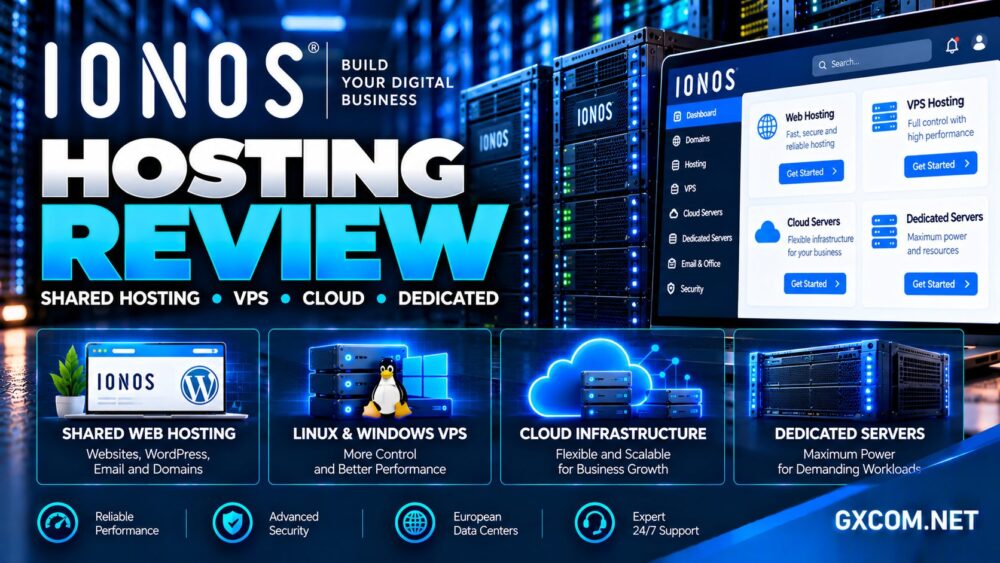
Its portfolio covers conventional web hosting, Linux and Windows VPS plans, configurable cloud servers, and dedicated physical machines. This breadth allows customers to evaluate several deployment models without immediately changing brands.
The main considerations are differences in management responsibility, promotional versus renewal pricing, software licensing, and additional infrastructure charges.
Our verdict: IONOS offers a practical range of hosting solutions, but buyers should select the appropriate product family before comparing individual plans.
IONOS Hosting Products Compared
IONOS serves different customer needs through several infrastructure categories. Each offers a distinct balance of convenience, resource control, and administration.
| Hosting Type | Resource Model | Best For |
|---|---|---|
| Shared Hosting | Shared web hosting environment | Blogs and small business websites |
| VPS Hosting | Virtualized server with root access | Growing applications and developers |
| Cloud Servers | Configurable virtual cloud resources | Flexible infrastructure and business applications |
| Dedicated Servers | Exclusive physical hardware | Resource-intensive and specialized workloads |
The correct choice depends on application requirements, expected traffic, technical expertise, and recovery objectives.
Our best web hosting services comparison provides broader context for evaluating entry-level hosting.
IONOS Shared Hosting: Features and Limitations
IONOS shared hosting is designed for customers who want to publish websites without administering a complete operating system.
Its web hosting products include website storage, SSL certificates, domain-related features, email services, and support for common web applications.
Some current packages advertise NVMe storage, although the exact capacity and resource allocation depend on the product and selected plan.
WordPress and Small Business Websites
Shared hosting is suitable for company websites, portfolios, blogs, and smaller WordPress projects with moderate resource demands.
Customers can focus on content and website administration instead of server-level maintenance.
However, CPU and memory resources remain subject to shared hosting policies. A larger storage allowance does not guarantee stronger performance under sustained application load.
WooCommerce checkout pages, membership systems, and database-intensive plugins can expose these limitations sooner than a simple cached website.
Email and Website Storage
IONOS includes email functionality with various hosting products, but mailbox counts and storage allowances differ by plan.
Businesses should verify whether the included email service supports their expected mailbox capacity, retention requirements, and administrative workflows.
For organizations handling substantial correspondence, dedicated business email may be more appropriate than relying entirely on web hosting mailboxes.
IONOS VPS Hosting: More Control and Responsibility
IONOS VPS hosting provides virtualized servers with root access and support for Linux or Windows environments.

This gives customers more control over installed software, operating system configuration, and application deployment than conventional shared hosting.
VPS hosting is relevant for custom web applications, development environments, private services, and growing websites requiring greater flexibility.
Virtual Resources vs Dedicated Hardware
A VPS operates within virtualized infrastructure. Customers receive defined virtual resources, but they do not own the complete underlying physical server.
CPU behavior, storage performance, and network throughput should be evaluated against the selected plan rather than inferred from the number of virtual cores alone.
Our VPS vs shared hosting guide explains when upgrading makes sense.
Windows VPS and Software Licensing
IONOS supports Windows server options, making it relevant to businesses requiring Microsoft-based applications or remote administration.
However, Windows licensing, optional control panels, and application software can affect the final cost.
Before purchasing, confirm the operating system version, licensing arrangements, available resources, and backup responsibilities.
IONOS Cloud Servers: Flexible Business Infrastructure
IONOS Cloud Servers target customers requiring configurable virtual infrastructure rather than a fixed shared hosting package.
Cloud environments can support application servers, internal business systems, testing environments, and services that need more flexible resource allocation.
The provider’s Cloud Panel includes infrastructure management, monitoring, usage reporting, and cost information.
Depending on the service, customers may also configure supporting resources such as storage, load balancing, and network services.
Cloud Flexibility Has a Cost
Flexible infrastructure can reduce the need to purchase an oversized fixed server, but it also introduces more billing variables.
Compute usage, additional storage, networking services, backups, and software licensing should be included in a realistic monthly estimate.
Businesses should also distinguish between a cloud server and a fully managed application platform. Provisioning infrastructure does not automatically transfer responsibility for application updates or security configuration to the provider.
Our cloud hosting vs VPS comparison explores these differences.
IONOS Dedicated Servers: Physical Resource Control
IONOS dedicated servers provide exclusive access to physical hardware rather than a virtual machine hosted alongside other customers.
Dedicated infrastructure can benefit high-demand applications, specialized software, databases, and workloads requiring predictable access to physical processing resources.
IONOS advertises configurable hardware, RAID options, DDoS protection, and root-level administration for its dedicated server products.
When Dedicated Hardware Makes Sense
Businesses should consider dedicated servers when their workload consistently requires substantial CPU, memory, or storage resources.
They can also be useful when virtualization restrictions or specialized operating system requirements make shared infrastructure unsuitable.
However, physical exclusivity does not eliminate hardware failures or operational complexity.
Administrators still need monitoring, patch management, backups, recovery procedures, and appropriate redundancy.
Our dedicated server hosting guide covers these responsibilities.
Performance: What Should Businesses Actually Measure?
IONOS promotes performance and availability across its hosting portfolio, but no single benchmark can represent every product category.
Shared hosting performance depends on application efficiency and shared resource allocation. VPS performance depends on virtual CPU behavior, memory, storage, and host infrastructure.
Cloud servers introduce additional architectural choices, while dedicated machines depend heavily on their specific processor and storage configuration.
For WordPress, measure uncached page response times, database activity, PHP execution, and resource utilization.
For business applications, monitor transaction latency, peak CPU consumption, memory pressure, and storage I/O.
These measurements provide more useful purchasing evidence than generic claims about server speed.
Security, Backups and Operational Support
IONOS provides security-related features across its products, including SSL support for web hosting and infrastructure protection for server services.
Its Cloud Backup offering supports VPS, cloud servers, and dedicated servers through configurable backup plans.
However, backup storage can involve separate charges, and administrators may need to install an agent and configure schedules.
Businesses should verify backup retention, restoration procedures, encryption options, and recovery costs before relying on any provider-managed service.
Support availability also differs from complete software administration. Root access generally means customers retain substantial responsibility for operating system and application maintenance.
IONOS Pricing and Long-Term Hosting Costs
IONOS frequently advertises introductory discounts for web hosting and selected infrastructure products.
Those promotional rates should not be confused with regular renewal pricing or the complete cost of operating a business application.
For shared hosting, calculate the initial subscription, renewal charges, domain fees, email requirements, and optional services.
For VPS and cloud infrastructure, add operating system licenses, backups, storage, and administration.
For dedicated servers, include hardware configuration, networking options, migration expenses, and the cost of maintaining reliable operations.
Our managed vs unmanaged hosting comparison explains how administration affects total cost.
IONOS vs Other Hosting Providers
IONOS competes with providers serving different customer segments.
Hostinger is relevant to beginners comparing website hosting, WordPress tools, and entry-level VPS options.
HostPapa offers an alternative for small businesses evaluating conventional website hosting and related services.
Kamatera is worth comparing for configurable cloud infrastructure and businesses seeking flexible virtual server resources.
OVHcloud provides another broad infrastructure portfolio, particularly relevant to VPS, cloud, dedicated hardware, and networking requirements.
IONOS stands out through its range of products under one provider, but the best alternative depends on the required management model and workload.
Who Should Choose IONOS?
IONOS shared hosting can suit small business websites and blogs that do not require extensive server customization.
Its VPS products are relevant to developers and businesses seeking operating system control without renting physical hardware.
Cloud servers may fit organizations requiring configurable infrastructure, while dedicated servers are more appropriate for sustained or specialized workloads.
Businesses without technical administrators should carefully evaluate management responsibilities before moving beyond shared hosting.
Frequently Asked Questions
Is IONOS good for small business websites?
IONOS offers shared hosting products suitable for many smaller business websites, provided the selected plan meets storage, email, and performance requirements.
Does IONOS offer Windows VPS hosting?
Yes. IONOS offers VPS configurations supporting Windows, subject to current product availability and licensing terms.
What is the difference between IONOS VPS and cloud servers?
Both use virtual infrastructure, but their product configurations, scaling options, supporting services, and billing arrangements can differ.
Does IONOS provide dedicated servers?
Yes. Its dedicated server lineup provides exclusive physical hardware with configurable resources and root access.
Are IONOS backups always free?
No. Backup features and charges depend on the hosting product. Cloud Backup storage may involve separate billing.
Final Verdict: Is IONOS Hosting Worth It?
This IONOS Hosting Review finds a versatile provider for customers seeking a progression from basic website hosting to VPS, cloud infrastructure, and dedicated hardware.
Its main strength is product breadth, allowing businesses to select different resource and management models within the same hosting ecosystem.
The most important considerations are renewal costs, infrastructure complexity, backup expenses, and the difference between technical support and managed administration.
For smaller websites, compare IONOS with Hostinger and HostPapa. For configurable infrastructure, evaluate Kamatera and OVHcloud alongside IONOS before committing.