Moving a growing business website away from shared hosting often creates a new problem: who will manage the server? A virtual private server offers more control and resources, but operating system updates, security, backups, and troubleshooting can become ongoing responsibilities.
In this ScalaHosting Managed Cloud review, we examine how its managed Cloud VPS platform addresses those challenges, what SPanel offers compared with traditional control panels, how resource isolation works, and whether the overall service makes financial sense for business hosting.
The goal is to separate useful managed infrastructure features from assumptions about performance, security, and cloud availability.
ScalaHosting Managed Cloud Review: Quick Verdict
ScalaHosting is a strong candidate for businesses seeking a managed VPS environment without taking responsibility for every aspect of Linux server administration.
Its advantages include SPanel, adjustable CPU and RAM allocations, NVMe storage, security monitoring, backup management, and access to technical support.
The main considerations are renewal pricing, application-level support boundaries, and the distinction between virtual server isolation and dedicated physical hardware.
Our verdict: ScalaHosting offers a useful middle ground between inexpensive shared hosting and infrastructure that requires extensive self-management.
What Is ScalaHosting Managed Cloud?
ScalaHosting’s Managed Cloud VPS provides a virtual server environment with allocated computing resources and provider-managed infrastructure services.
Unlike conventional shared hosting, where customers operate within a common hosting environment, a VPS gives the customer a separate operating system instance and configurable server resources.
That separation can improve control over software environments and make resource planning more predictable.
However, a VPS is still virtualized infrastructure. Its allocated vCPU resources should not automatically be interpreted as exclusive ownership of physical processor cores.
Managed Cloud VPS also differs from a multi-region high-availability architecture. Automatic failover, geographic redundancy, and application-level scaling require specific designs rather than following automatically from the word “cloud.”
Our cloud hosting vs VPS comparison explains these architectural differences.
SPanel Review: What Can It Replace?
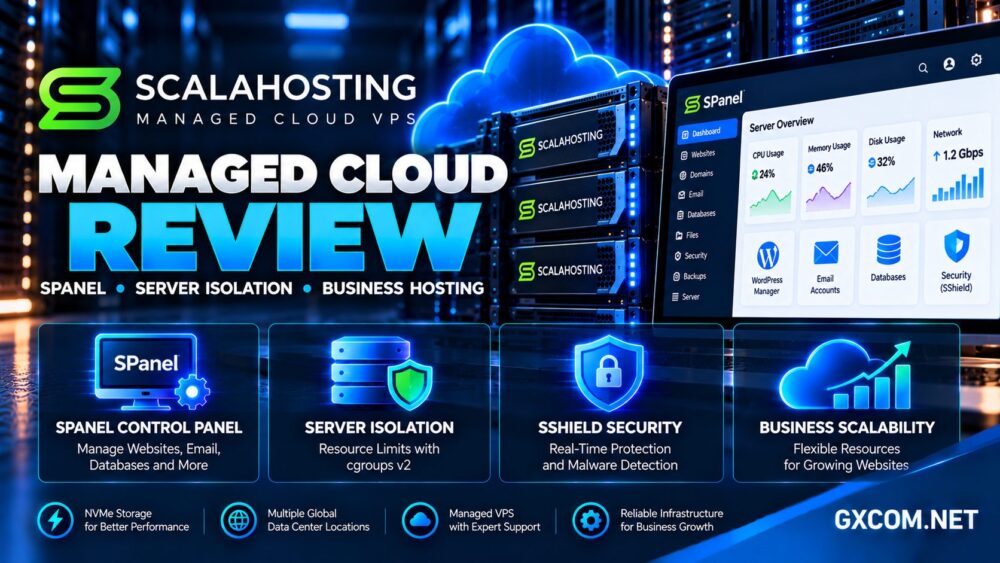
SPanel is ScalaHosting’s hosting control panel for managing websites and cloud VPS services. It provides tools for domains, email accounts, databases, DNS, files, backups, SSL certificates, and server administration.
For website owners familiar with cPanel, the practical question is whether SPanel supports their existing workflow without requiring additional licensing.
Website and Application Management
SPanel includes file management, database administration, PHP configuration, SSH access, Git-related tools, and application installation options.
It also offers WordPress management features that can simplify common maintenance tasks.
Agencies can create separate hosting accounts and define packages, making the platform relevant to businesses managing several customer websites.
SPanel vs cPanel Licensing
SPanel is included with ScalaHosting’s managed VPS offering, avoiding the separate per-account cPanel licensing structure.
This can improve cost predictability for agencies hosting multiple websites.
However, SPanel is not a drop-in replacement for every cPanel extension, automation script, or third-party integration.
Before migrating, verify compatibility with existing billing software, backup processes, email workflows, and administrative tools.
Server Isolation: What Is Actually Separated?
Server isolation is one of the most important technical considerations when upgrading from shared hosting.
ScalaHosting’s virtual servers provide separate operating system environments with assigned resources. Within SPanel, administrators can also configure limits for individual hosting accounts.
Current SPanel documentation describes CPU, memory, disk throughput, disk IOPS, and process limits enforced using Linux cgroups v2.

These controls help prevent one hosted account from consuming unlimited resources on the same VPS.
Resource Limits Are Not Complete Security Isolation
CPU throttling can slow an account that exceeds its configured allocation, while memory and process limits can restrict problematic workloads.
However, ScalaHosting explicitly distinguishes this mechanism from CageFS-style filesystem virtualization.
Account separation still relies on Linux permissions and other security controls. Resource limiting alone does not eliminate every security or performance risk.
Businesses hosting unrelated customers should evaluate both resource controls and their application security requirements.
CPU, RAM and NVMe Storage Performance
ScalaHosting offers configurable CPU, memory, and NVMe storage allocations for its cloud VPS products.
These resources should be selected according to application behavior rather than visitor counts alone.
A cached WordPress website may require relatively little processing during ordinary traffic, while WooCommerce checkout, membership systems, and database-heavy applications generate more dynamic requests.
NVMe storage can help reduce latency for database and file operations, although real performance depends on the complete infrastructure and workload.
For business applications, monitor CPU saturation, memory pressure, PHP workers, database response times, and storage I/O before upgrading.
SShield Security and Backup Management
ScalaHosting includes SShield security monitoring within the SPanel ecosystem. Its purpose is to identify suspicious activity and provide additional protection against common hosting threats.
This is useful, but no security system can guarantee that a website will never be compromised.
WordPress plugins, administrative passwords, vulnerable applications, and incorrectly configured services remain important risks.
SPanel also includes backup management with support for different destinations, including local, remote, and compatible object storage options.
Businesses should verify backup frequency, retention periods, storage charges, and restoration procedures for their selected service.
An independent off-server backup remains valuable even when provider-managed backups are available.
Web Server Options and WordPress Hosting
SPanel supports several web server configurations, including Apache, Nginx-based arrangements, and OpenLiteSpeed.
Commercial LiteSpeed Web Server is also available, but its license may involve an additional charge.
For WordPress, caching configuration and application optimization often matter more than the web server brand alone.
Agencies should test dynamic pages, administrative workflows, checkout operations, and uncached requests instead of relying exclusively on homepage speed tests.
Our managed WordPress vs shared hosting guide helps identify when a more capable environment is justified.
Scaling a Business Website on ScalaHosting
One advantage of cloud VPS infrastructure is the ability to increase CPU, RAM, or storage allocations as requirements change.
ScalaHosting advertises streamlined resource upgrades, allowing businesses to expand their environment without immediately migrating to an entirely different hosting model.
However, adding resources does not automatically fix inefficient applications or database bottlenecks.
Before scaling, identify whether the limitation comes from CPU processing, memory consumption, storage performance, or external dependencies.
Plan maintenance windows where necessary and confirm whether the selected upgrade requires a restart or other service interruption.
Managed Support: What Does the Provider Handle?
Managed hosting can reduce the operational burden of maintaining a server, but the precise support scope matters.
ScalaHosting advertises round-the-clock assistance and managed server services for its managed VPS customers.
Customers should still confirm responsibilities for custom applications, third-party scripts, malware cleanup, email deliverability, and website development.
A hosting provider may maintain the server environment without taking responsibility for every software problem inside a customer’s website.
Our managed vs unmanaged hosting comparison explains the division of responsibilities.
ScalaHosting Pricing and Long-Term Costs
ScalaHosting advertises introductory pricing for managed cloud VPS plans, while renewal rates can be higher.
For business hosting, the regular recurring expense is more important than the initial discount.
Evaluate the total cost of the server, required resource upgrades, optional software licenses, backup storage, and administrative time.
Costs Worth Checking
- Managed VPS subscription and renewal rate
- CPU, RAM, and NVMe storage upgrades
- Optional commercial LiteSpeed licensing
- Backup destinations and additional storage
- Application maintenance and development support
- Migration work and disaster recovery planning
SPanel’s included licensing may reduce control panel expenses, especially for agencies managing multiple accounts.
Nevertheless, the cheapest package is not necessarily the best value if frequent upgrades or support-intensive applications increase total spending.
ScalaHosting vs Other Managed Cloud Providers
Several hosting providers approach business cloud infrastructure differently.
Cloudways focuses on managed cloud application hosting and offers different operating models, including Flexible and Autonomous products. It may appeal to teams prioritizing application-level management.
Kamatera provides configurable cloud servers for customers who need flexible infrastructure choices. Buyers should compare the level of managed support required rather than assuming equivalent administration is included.
Hostinger offers VPS and managed website hosting products, making it relevant to businesses comparing simpler WordPress management with server-level control.
KnownHost provides managed VPS hosting options for customers who prefer conventional managed server services and established control panel workflows.
ScalaHosting’s distinctive proposition is the combination of managed VPS infrastructure and SPanel without a separate standard cPanel license.
Our managed cloud hosting providers comparison examines these purchasing trade-offs.
Who Should Choose ScalaHosting Managed Cloud?
ScalaHosting may suit growing WordPress websites, WooCommerce stores, business applications, and agencies managing multiple customer accounts.
It is particularly relevant when customers want VPS resource flexibility without personally administering every aspect of the server.
Businesses requiring unusual operating system configurations, highly specialized software, or complete root-level customization should confirm compatibility with the managed service.
Organizations requiring automatic multi-region failover should evaluate additional architecture and infrastructure options.
Frequently Asked Questions
Is ScalaHosting Managed Cloud a VPS?
Yes. Its managed cloud offering uses virtual server infrastructure with configurable resources and managed hosting services.
Does ScalaHosting include SPanel?
Yes. SPanel is included with its managed VPS offering and provides website, email, database, security, and account management tools.
Does SPanel provide account resource isolation?
Yes. Current SPanel documentation describes per-account CPU, memory, I/O, and process limits using Linux cgroups v2. This is distinct from complete filesystem virtualization.
Is ScalaHosting suitable for WooCommerce?
It can be suitable when the selected resources match the store’s dynamic workload, database requirements, and traffic patterns.
Can ScalaHosting resources be upgraded?
Yes. ScalaHosting advertises scalable cloud VPS configurations, although upgrade conditions depend on the selected service.
Final Verdict: Is ScalaHosting Managed Cloud Worth It?
This ScalaHosting Managed Cloud review finds a practical hosting option for businesses seeking stronger resource control, simpler administration, and a modern alternative to conventional control panel licensing.
Its most valuable features are SPanel, managed server support, configurable cloud resources, and account-level management tools.
The main purchasing considerations are renewal costs, application support boundaries, and the limits of virtualization-based isolation.
For growing websites and business applications, ScalaHosting deserves consideration alongside Cloudways, Kamatera, Hostinger, and KnownHost. The best choice depends on workload requirements, management expectations, and the total recurring cost.