Running your own multiplayer game server sounds exciting. You can create a private Minecraft world, build a competitive Rust community, or manage an ARK survival experience with your own rules. But before launching a server, there is one important decision to make: should you choose managed game hosting or set everything up yourself?
The debate around managed vs self-hosted game servers is not simply about convenience versus technical knowledge. Your decision affects performance, security, maintenance, flexibility, and the overall cost of keeping a gaming community online.
Both approaches can work well. The better choice depends on your game, player count, technical experience, and how much time you want to spend managing infrastructure.
Understanding Managed and Self-Hosted Game Servers
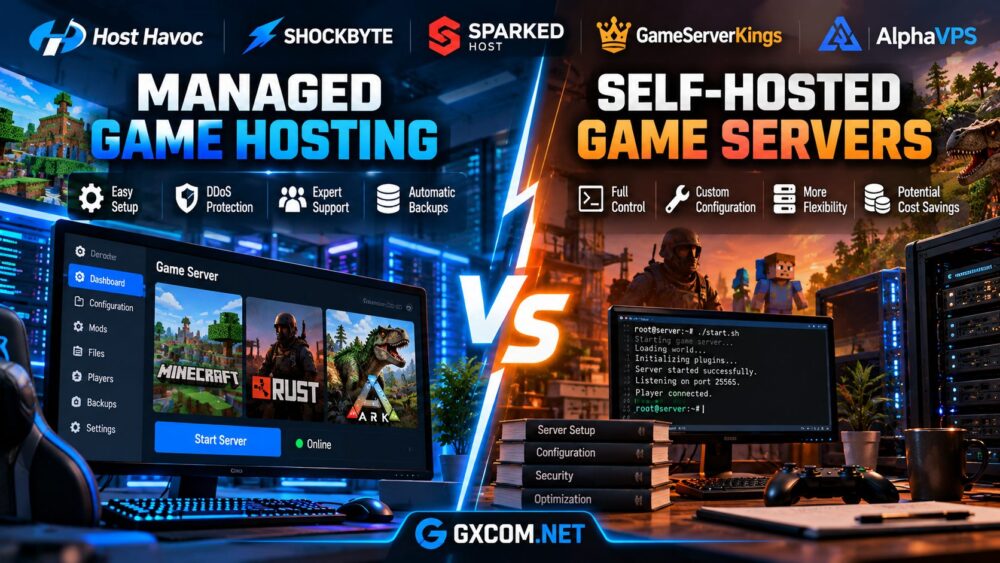
Managed game server hosting means renting a gaming environment from a provider that handles much of the underlying infrastructure. You usually receive a control panel for starting the server, changing settings, installing supported mods, managing files, and monitoring basic resource usage.
Providers may also offer automated deployment, DDoS protection, scheduled backups, and technical support. However, the exact management responsibilities vary between companies and plans.
Self-hosting means installing and administering the game server yourself. This could involve a home computer, a virtual private server, or a dedicated physical server rented from a hosting company.
With self-hosting, you typically control the operating system, game installation, firewall, updates, and backup procedures. That flexibility is valuable, but it also means solving problems without relying on a game-specific managed hosting service.
If you are unfamiliar with the available hosting models, our game server hosting guide explains how different server environments work.
Managed vs Self-Hosted Game Servers: Key Differences
| Feature | Managed Game Hosting | Self-Hosted Server |
|---|---|---|
| Initial setup | Usually quick and guided | Manual installation and configuration |
| Technical knowledge | Beginner-friendly | Moderate to advanced |
| Operating system access | Usually limited | Full access on suitable VPS or dedicated plans |
| Updates and maintenance | Partly managed or automated | Administrator responsibility |
| Customization | Depends on supported features | Greater software flexibility |
| Security | Infrastructure support may be included | Requires more hands-on management |
| Best suited for | Beginners and gaming communities | Experienced administrators |
The differences become more important as your server grows. A small private Minecraft world may need little administration, while a large modded community or multiple Rust instances can require careful resource planning.
Performance: Does Self-Hosting Offer Better Results?
Many players assume a self-hosted server must perform better because it offers greater control. That is not necessarily true.
Game server performance depends primarily on processor capability, available memory, storage responsiveness, network quality, and the game's simulation workload. A properly configured managed server with a modern CPU can outperform a poorly allocated VPS.
For Minecraft, strong single-threaded performance can be especially important. Rust and ARK may place substantial demands on CPU resources, memory, and storage as player activity increases.

Managed hosting providers typically offer predefined resource plans. Self-hosted VPS and dedicated environments may allow greater flexibility, but advertised CPU core counts do not always represent dedicated physical resources.
Before choosing hardware, review our game server hardware requirements guide to understand how player counts, mods, and world complexity affect resource needs.
Setup, Maintenance, and Server Control
Convenience is one of the strongest reasons to choose managed hosting. A game-focused control panel can simplify installation, restarts, configuration changes, and supported mod management. This makes it easier to focus on the gaming community rather than operating system administration.
Self-hosting offers a different advantage: freedom. Administrators can install compatible server software, customize scripts, configure monitoring tools, and manage multiple instances without depending entirely on a provider's game panel.
However, maintaining that freedom takes time. Operating system updates, firewall rules, permissions, software compatibility, and troubleshooting become your responsibility.
For readers interested in the technical process, our multiplayer game server setup guide walks through installation, networking, backups, and ongoing management.
Security, Backups, and Reliability
Security should never be an afterthought, particularly when hosting a public multiplayer community.
Managed hosting may include network-level DDoS mitigation, scheduled backups, and infrastructure monitoring. These features can reduce administrative work, although they do not eliminate the need to manage player permissions, game updates, or community security.
With self-hosting, administrators must configure firewalls, restrict remote access, maintain system patches, and establish a reliable backup strategy. Running a public server from home may also expose limitations involving residential connections, port forwarding, and ISP policies.
Regardless of your hosting model, keep recoverable backups outside the active server and test restoration periodically. A backup that cannot be restored offers little protection.
Which Hosting Model Is More Cost-Effective?
Managed hosting often provides predictable resource packages and convenient administration. Self-hosting may offer more control over resource allocation, but the total cost is not limited to the advertised server fee.
A VPS administrator must consider storage, backup capacity, bandwidth limits, software requirements, and time spent maintaining the environment. Home hosting adds hardware, electricity, connectivity, and potential downtime considerations.
Dedicated hardware can become attractive when operating several busy game instances, but renting an entire physical server may be unnecessary for a small private group.
The most economical solution is the one that meets your actual workload without requiring excessive resources or maintenance.
Recommended Hosting Providers for Different Needs
Once you understand the differences between managed and self-hosted environments, choosing a suitable provider becomes easier. The following options address different gaming requirements rather than offering identical services.
Host Havoc — Managed Hosting for Established Communities
Host Havoc is a relevant choice for administrators seeking managed game hosting across supported multiplayer titles. Its game-focused services and infrastructure options make it worth comparing for communities that prefer straightforward deployment and provider-managed infrastructure.
Shockbyte — Managed Minecraft and Multiplayer Hosting
Shockbyte offers managed hosting for Minecraft and other multiplayer games. Its control-panel approach can appeal to players who want easier setup, server configuration, and routine administration without managing an entire operating system.
Sparked Host — Minecraft Hosting and Modpack Management
Sparked Host is particularly relevant for Minecraft communities. Its hosting environment includes game management tools that can simplify supported modpacks, plugins, files, and server configuration.
GameServerKings — Rust Hosting and Dedicated Infrastructure
GameServerKings deserves consideration for Rust communities and administrators evaluating dedicated game hosting options. It is especially relevant when comparing the convenience of managed Rust hosting with the greater resource control available through dedicated infrastructure.
AlphaVPS — Infrastructure for Self-Managed Servers
AlphaVPS serves a different audience. Its VPS and dedicated server products can provide an environment for technically experienced administrators who want to install and maintain compatible game server software themselves.
Unlike managed game hosting, general-purpose VPS infrastructure does not automatically include a game-specific control panel or managed installation service. Confirm operating system compatibility and resource availability before choosing a plan.
For more options across supported games, explore our best game server hosting providers comparison.
Which Option Should You Choose?
For beginners, casual multiplayer groups, and community owners who value convenience, managed game hosting is usually the more practical starting point. It reduces setup complexity and makes routine server administration easier.

Self-hosting is a stronger fit for developers, experienced administrators, and communities requiring custom software or extensive operating system control. A VPS can be suitable for smaller compatible workloads, while dedicated hardware may offer more predictable resources for demanding environments.
The type of game matters too. Minecraft communities may prioritize modpack support and easy backups, while Rust administrators often focus on CPU performance, network quality, and management flexibility. ARK administrators should verify compatibility with their exact game edition before selecting a service.
Frequently Asked Questions
Is managed game hosting better for beginners?
Generally, yes. Managed hosting usually provides a game-specific control panel and reduces the amount of operating system administration required.
Can a VPS host a multiplayer game server?
Yes, provided the VPS has sufficient CPU, RAM, storage, network capacity, and operating system compatibility for the selected game.
Is self-hosting always cheaper?
No. Self-hosting may reduce certain service costs, but maintenance time, backups, hardware requirements, and network limitations can increase the total expense.
Can I migrate from managed hosting to a self-hosted server?
Many games support migration through compatible world files, saves, and configuration backups. The process depends on the game, software version, and available export options.
Final Verdict
Choosing between managed and self-hosted game servers ultimately comes down to convenience, control, and the demands of your gaming community.
Managed hosting is usually the better choice when you want to launch quickly, minimize infrastructure maintenance, and focus on players. Self-hosting becomes more attractive when customization, operating system access, and technical flexibility matter more.
Rather than choosing solely by advertised specifications, compare the hosting environment against your game requirements, expected player activity, management experience, and long-term operating needs.
The best game server is not necessarily the most powerful or the cheapest. It is the one you can operate reliably while giving your players a consistent multiplayer experience.