AMD EPYC and Intel Xeon are the two dominant processor families in modern x86 server infrastructure.
Both power dedicated servers, cloud platforms, virtualization clusters, databases, AI systems, enterprise applications, and high-performance computing environments. But choosing between them is no longer as simple as comparing clock speed or core count.
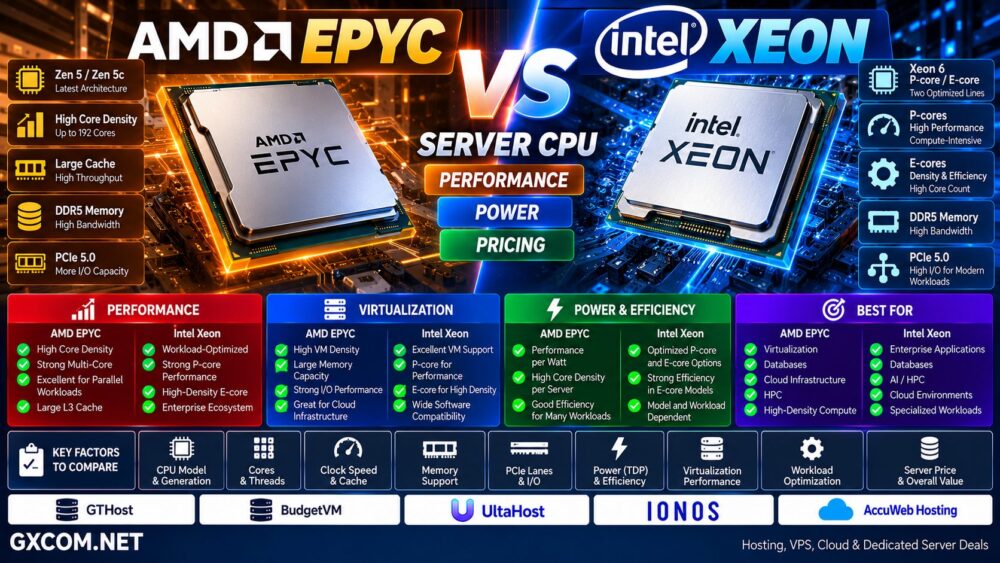
Modern AMD EPYC processors emphasize high core density, memory bandwidth, I/O capacity, and strong performance per server. Intel Xeon processors offer a broad enterprise ecosystem and now separate many workloads between Performance-core and Efficient-core architectures.
In this AMD EPYC vs Intel Xeon comparison, we examine performance, cores, power consumption, memory, virtualization, databases, AI, dedicated-server pricing, and which CPU architecture makes sense for different workloads.
AMD EPYC vs Intel Xeon: Quick Comparison
| Feature | AMD EPYC | Intel Xeon |
|---|---|---|
| Current Server Architecture | Zen 5 / Zen 5c | Xeon 6 P-core / E-core |
| High Core Density | Excellent | Excellent, especially E-core |
| Per-Core Performance | Strong | Strong, especially P-core models |
| Virtualization | Excellent | Excellent |
| Memory-Heavy Workloads | Strong platform capability | Strong platform capability |
| AI Acceleration | CPU + broader AMD ecosystem | Built-in acceleration on supported Xeon platforms |
| Power Efficiency | Workload/model dependent | Workload/model dependent |
| Dedicated Servers | Widely available | Extremely widely available |
| Best Choice | Depends on workload | Depends on workload |
What Is AMD EPYC?
AMD EPYC is AMD's server processor family designed for data centers, cloud computing, virtualization, databases, AI infrastructure, HPC, networking, and enterprise workloads.
Current EPYC 9005 processors use AMD's Zen 5 and Zen 5c architectures.
Depending on the model, the platform can provide very high core counts together with large cache, DDR5 memory, and extensive PCIe connectivity.
This combination makes EPYC particularly attractive when a server needs to support:
- Large numbers of virtual machines
- Containers
- Databases
- Cloud infrastructure
- Web hosting
- HPC
- AI host systems
- Storage-intensive applications
What Is Intel Xeon?
Intel Xeon is Intel's long-established family of enterprise and data-center processors.
Xeon processors are used across dedicated servers, cloud infrastructure, enterprise applications, databases, virtualization, networking, HPC, and AI.
One important development in Xeon 6 is the distinction between two CPU approaches:
Xeon P-core → Performance-oriented workloads
Xeon E-core → Density and efficiency-oriented workloads
This means buyers should no longer treat “Intel Xeon” as one uniform architecture.
The correct Xeon comparison depends heavily on which processor family and workload are being evaluated.
AMD EPYC vs Intel Xeon Performance
There is no universal performance winner across every server workload.
CPU performance depends on:
- Processor generation
- Core architecture
- Core count
- Clock frequency
- Cache
- Memory bandwidth
- NUMA architecture
- Instruction sets
- Software optimization
- Power limits
- Cooling
A 192-core processor should not be compared with a 32-core processor simply because both carry a server CPU brand.
Likewise, more cores do not automatically make a server faster for applications that depend primarily on single-thread or lightly threaded performance.
Core Count ≠ Application Performance.
Core Density: Why It Matters
Core density is particularly important in data centers.
More useful compute capacity per physical server can allow operators to consolidate workloads and reduce the number of machines required.
This can affect:
- Rack space
- Power consumption
- Cooling
- Network ports
- Hypervisor hosts
- Operating costs
AMD EPYC has aggressively pursued high core density. Current EPYC 9005 configurations extend to extremely high core counts.
Intel is pursuing a similar density objective through Xeon 6 E-core processors, while P-core models focus more heavily on performance-oriented workloads.
Dedicated Server Providers Offering AMD and Intel
For hosting buyers, the CPU itself is only part of the decision. The actual dedicated-server package determines whether the hardware represents good value.
Providers such as GTHost, BudgetVM, UltaHost, IONOS, and AccuWeb Hosting are relevant platforms to compare when looking for current dedicated-server configurations.
The important specifications include the exact CPU model, RAM, NVMe storage, bandwidth, port speed, data-center location, IP allocation, management, and monthly price.
| Provider | Server Focus | What to Compare |
|---|---|---|
| GTHost | Dedicated Servers | CPU generation, locations and bandwidth |
| BudgetVM | Dedicated Infrastructure | Hardware-to-price ratio |
| UltaHost | Dedicated / VPS | CPU, management and resources |
| IONOS | Dedicated / Cloud | Business infrastructure and pricing |
| AccuWeb Hosting | Dedicated / VPS | Configuration and management options |
Do not choose a dedicated server from the words “AMD EPYC” or “Intel Xeon” alone. Always identify the exact processor model and generation.
AMD EPYC vs Intel Xeon for Virtualization
Virtualization is one of the most important workloads for high-core-count server CPUs.
A virtualization host needs to divide CPU, RAM, storage, and network resources between multiple virtual machines.
High core density can allow more VM capacity per server:
Physical CPU → Hypervisor → VM 1 + VM 2 + VM 3 + VM 4…
AMD EPYC's large core counts and memory capabilities make it highly attractive for dense virtualization.
Intel Xeon also remains a major virtualization platform, with both P-core and E-core architectures allowing infrastructure designers to optimize for different VM workloads.
However, VM density should never be calculated from CPU cores alone.
RAM and storage I/O frequently become the limiting resources before the processor does.
AMD EPYC vs Intel Xeon for Databases
Database performance depends heavily on the database engine and workload.
Important factors include:
- Per-core performance
- Memory latency
- Memory bandwidth
- Cache
- Storage latency
- NVMe IOPS
- Concurrency
- Database licensing
Highly parallel databases may benefit from large core counts, while latency-sensitive transactional workloads may place greater importance on fast individual cores and memory performance.
Database licensing can also change the economics dramatically when software is licensed per core.
More CPU Cores Can Sometimes Mean More Software Licensing Cost.
AMD EPYC vs Intel Xeon Memory Performance
Modern server CPUs depend increasingly on memory bandwidth.
This matters for:
- Databases
- Analytics
- HPC
- AI
- Virtualization
- In-memory applications
AMD's current EPYC 9005 platform supports a large DDR5 memory subsystem and high memory bandwidth.
Intel Xeon 6 also significantly expands memory bandwidth compared with previous Xeon generations.
For memory-intensive workloads, compare the complete server platform rather than CPU core count alone.
AMD EPYC vs Intel Xeon PCIe and I/O
PCIe capacity matters increasingly because modern servers may connect:
- NVMe drives
- GPUs
- High-speed network adapters
- Storage controllers
- AI accelerators
- DPUs
High I/O capacity can therefore be as important as CPU performance in storage servers, GPU servers, AI infrastructure, and virtualization hosts.
Before purchasing a dedicated server for these workloads, verify not only the processor specification but also how the server motherboard exposes its PCIe capacity.
AMD EPYC vs Intel Xeon Power Consumption
Server power efficiency cannot be determined from TDP alone.
A 500W CPU that completes twice as much useful work as a 300W processor may provide better performance per watt for a particular workload.
The relevant metric is closer to:
Useful Work / Power Consumed
rather than:
Lowest TDP = Most Efficient.
For data centers, power efficiency affects both electricity consumption and cooling requirements.
Why Server Consolidation Changes Power Economics
Imagine an older infrastructure requiring four physical servers.
If one modern high-density server can safely consolidate the same workloads, the organization may reduce:
- CPU power
- Memory systems
- Motherboards
- Power supplies
- Network ports
- Cooling
- Rack space
This is why processor efficiency should be evaluated at the server or rack level rather than by CPU wattage alone.
AMD EPYC vs Intel Xeon Pricing
CPU list price is rarely the most useful metric for a hosting customer.
Dedicated-server buyers normally pay for a complete package:
CPU + RAM + NVMe + Network + Bandwidth + IPs + Data Center + Support
A server containing a more expensive processor can still offer better overall value if the provider prices the package aggressively.
Conversely, an older CPU can become poor value when the monthly rental price is too close to newer hardware.
CPU MSRP ≠ Dedicated Server Value.
New EPYC vs Older Xeon: Avoid This Comparison Trap
One of the most common mistakes in hosting comparisons is comparing a modern AMD EPYC processor against a much older Intel Xeon generation.
That comparison may accurately describe two particular hosting plans, but it does not establish a general AMD-versus-Intel conclusion.
Always compare:
Similar Generation + Similar Class + Similar Workload
For example, comparing a current high-end EPYC against a decade-old Xeon says much more about processor age than CPU brand.
AMD EPYC vs Intel Xeon for Web Hosting
Both platforms can provide excellent web-hosting performance.
For WordPress and conventional web hosting, CPU frequency and per-core performance can sometimes matter more than having extremely large core counts.
A web server should therefore be selected according to:
Traffic → PHP Workers → Database → CPU → RAM → Storage → Network
A 128-core server is not automatically better for a WordPress site than a smaller server with faster cores and an appropriately optimized software stack.
AMD EPYC vs Intel Xeon for Game Servers
Many game-server workloads are sensitive to per-core performance and latency.
That can make high-frequency CPUs attractive even when they have fewer total cores.
Before choosing EPYC or Xeon for game hosting, determine whether the game engine can efficiently use large numbers of CPU cores.
For some workloads:
Fewer Fast Cores > Many Slower Cores.
AMD EPYC vs Intel Xeon for AI Servers
In many AI servers, the CPU is not the primary accelerator.
The server may instead rely on NVIDIA, AMD, or other GPUs for the main training or inference workload.
The CPU still matters because it handles:
- Data preparation
- Storage I/O
- Networking
- GPU feeding
- System processes
- Virtualization
Intel Xeon 6 includes CPU-level AI acceleration technologies, while AMD EPYC provides high core density, memory bandwidth, and I/O capabilities suitable for hosting accelerator-heavy systems.
For GPU servers, CPU selection should therefore be made together with GPU count, PCIe topology, memory, storage, and network requirements.
AMD EPYC vs Intel Xeon for HPC
HPC is too broad to choose a CPU from brand alone.
Different workloads may prioritize:
- Floating-point throughput
- Vector processing
- Memory bandwidth
- Core density
- Interconnect performance
- Accelerators
- Per-core speed
Benchmark the actual scientific or engineering workload whenever possible.
Vendor benchmark claims should also be checked carefully because test configurations, compiler settings, CPU counts, and power limits can materially affect results.
Which Dedicated Server Providers Fit Different Workloads?
For high-density virtualization, databases, hosting, and multi-core workloads, current AMD EPYC dedicated servers from providers such as GTHost, UltaHost, IONOS, BudgetVM, and AccuWeb Hosting are worth comparing when appropriate configurations are available.
Intel Xeon remains extremely common across dedicated-server inventories and can be particularly attractive where specific enterprise software, high-frequency models, established infrastructure, or Intel-specific acceleration features matter.
The better buying process is:
Workload → CPU Model → RAM → NVMe → Network → Bandwidth → Location → Monthly Price.
Do not reverse that process by choosing AMD or Intel first and only then deciding what the server needs to do.
AMD EPYC vs Intel Xeon for Single-Socket Servers
Modern high-core-count CPUs have made single-socket servers increasingly powerful.
A single CPU can provide enough cores, memory capacity, and I/O for workloads that historically required two processors.
Single-socket designs can reduce:
- Platform complexity
- NUMA complexity
- Power consumption
- Hardware cost
- Software licensing in some cases
AMD EPYC has been particularly influential in making high-capacity single-socket servers attractive.
However, dual-socket systems remain relevant where extremely large compute or memory configurations are required.
AMD EPYC vs Intel Xeon: Security
Both AMD and Intel include hardware security technologies designed for modern enterprise infrastructure.
Security capabilities may include hardware-rooted protections, memory encryption, trusted execution technologies, and confidential-computing features depending on the processor and platform.
But CPU security features are only one layer.
Server security still depends on:
- Firmware updates
- Operating-system patches
- Hypervisor security
- Access control
- Network configuration
- Application security
- Monitoring
Secure CPU Features ≠ Secure Server by Default.
AMD EPYC vs Intel Xeon: Pros and Cons
| AMD EPYC | Intel Xeon | |
|---|---|---|
| Core Density | Very strong | Very strong with E-core models |
| High Performance Cores | Zen 5 models | P-core models |
| Virtualization | Excellent | Excellent |
| Memory / I/O | Strong | Strong |
| Enterprise Ecosystem | Mature | Extremely mature |
| AI / Acceleration | Workload dependent | Integrated acceleration on supported models |
| Availability | Widely available | Extremely widely available |
| Best Choice | Model and workload dependent | Model and workload dependent |
Consider AMD EPYC If…
- You need very high core density
- You run dense virtualization
- You need substantial memory bandwidth
- You need extensive PCIe connectivity
- You run highly parallel workloads
- You want to consolidate multiple older servers
- You find an EPYC dedicated server with strong price-to-performance
Consider Intel Xeon If…
- Your software is optimized or certified for a specific Xeon platform
- You need strong per-core performance from suitable P-core models
- You want high-density E-core infrastructure
- You use Intel-specific acceleration technologies
- Your existing infrastructure is standardized on Intel
- A Xeon server offers better total configuration value
Questions to Ask Before Choosing a Server CPU
- What exact CPU model is installed?
- Which generation is it?
- How many physical cores are included?
- What are the base and boost frequencies?
- How much cache is available?
- How much RAM does the server support?
- What memory configuration is installed?
- How many NVMe drives are included?
- What RAID options are available?
- What network port speed is included?
- How much monthly bandwidth is provided?
- Does software licensing depend on core count?
- What benchmarks represent your actual workload?
- What is the complete monthly server price?
AMD EPYC vs Intel Xeon Server: Which Should You Choose?
AMD EPYC and Intel Xeon both provide powerful server platforms, but their increasingly diverse product families make brand-level comparisons less useful than they once were.
AMD EPYC is particularly attractive for high core density, virtualization, memory-intensive infrastructure, and workloads that can take advantage of large amounts of parallel compute.
Intel Xeon offers both performance-oriented P-core and density-oriented E-core architectures, allowing different Xeon platforms to target very different workloads.
The most important rule is therefore:
AMD vs Intel Is Not the Benchmark.
Exact CPU vs Exact CPU on Your Workload Is the Benchmark.
Avoid making a server decision from core count, clock speed, TDP, or brand alone.
Use this decision path:
Workload → CPU Architecture → Core Performance → Core Density → Memory → I/O → Power → Software Licensing → Server Price → Total Cost.
The better server CPU is the one that delivers the required application performance and capacity at the most appropriate total infrastructure cost.