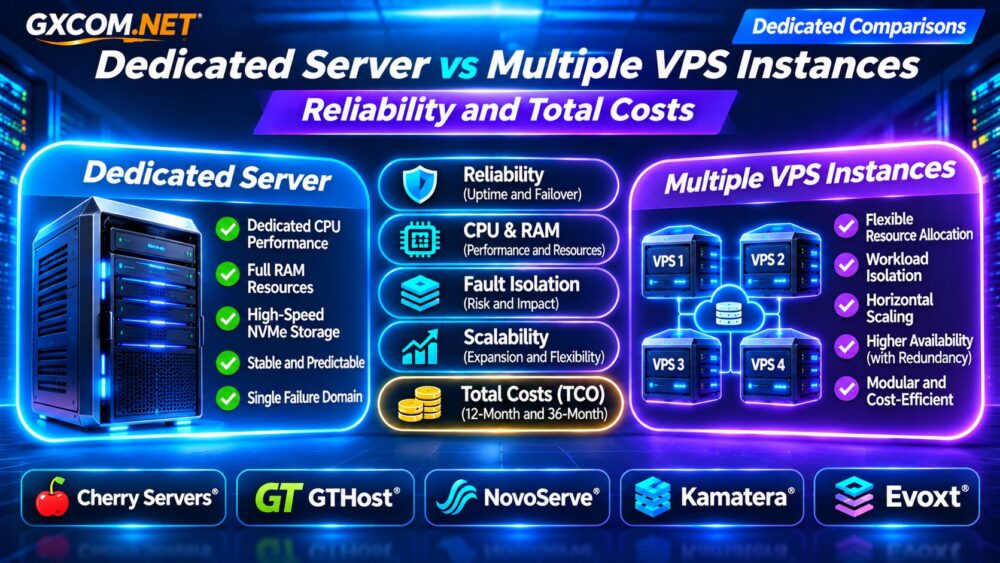
Choosing between a dedicated server vs colocation is fundamentally a decision about hardware ownership, operational responsibility, and long-term infrastructure costs. Dedicated hosting lets businesses rent physical servers, while colocation allows them to place their own equipment inside a third-party data center.
Both approaches can deliver dedicated hardware resources, but their financial commitments differ significantly. This guide compares upfront investment, monthly fees, power, bandwidth, maintenance, and three-year total cost of ownership (TCO).
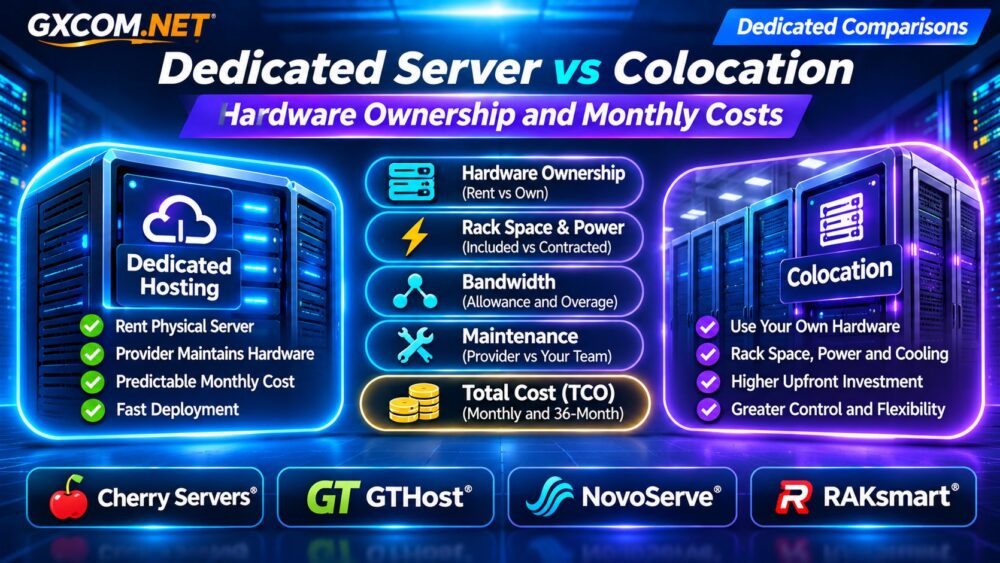
Dedicated Server vs Colocation: Quick Comparison
| Factor | Dedicated Server | Colocation |
|---|---|---|
| Hardware ownership | Hosting provider | Customer |
| Initial hardware purchase | Usually unnecessary | Required |
| Rack space | Included in hosting arrangement | Purchased or contracted |
| Power and cooling | Generally bundled | Contract-dependent charges |
| Hardware replacement | Provider responsibility | Customer responsibility |
| Hardware customization | Limited to available options | Greater flexibility |
| Financial structure | Primarily recurring fees | Capital investment plus recurring fees |
Neither model automatically includes operating system administration, application support, or disaster recovery.
What Is Dedicated Server Hosting?
Dedicated hosting provides exclusive use of a physical server owned or supplied by the hosting company. Customers select available processors, RAM, storage, and network configurations, then pay recurring rental fees.
The provider typically handles failed hardware components and data center infrastructure. Operating system updates, backups, and application maintenance depend on whether the plan is managed or unmanaged.
Dedicated hosting is attractive when businesses need predictable hardware access without purchasing equipment or arranging physical repairs.
For background, read our Dedicated Server Hosting Explained.
What Is Server Colocation?
Colocation means placing customer-owned servers in a commercial data center. The facility supplies contracted rack space, electricity, cooling, physical security, and network connectivity.
The customer remains responsible for purchasing compatible hardware, replacing failed components, maintaining warranties, and planning equipment refreshes.
Some facilities provide remote-hands services, allowing technicians to perform approved physical tasks. These services may involve hourly charges, minimum fees, or separate service agreements.
Colocation provides greater hardware ownership and customization, but requires more operational planning.
Hardware Ownership: Control vs Responsibility
Ownership is the biggest structural difference. Dedicated server customers generally rent equipment and return access when the contract ends. Colocation customers retain their physical assets, subject to contractual conditions and outstanding obligations.

Owned hardware can support specialized network cards, unusual storage configurations, or company-specific security requirements. However, replacement parts, warranties, and end-of-life disposal become customer responsibilities.
Rental customers avoid much of that hardware lifecycle management, although available configurations may be more restrictive.
Monthly Costs: Rack Space, Power, and Bandwidth
A dedicated server quote commonly combines hardware rental, facility expenses, and an included network allowance. Additional charges may apply for management, backups, software licenses, or traffic overages.
Colocation contracts may separate rack units, power allocation, bandwidth, cross-connects, IP addresses, and remote-hands work.
Important questions include:
- Is power billed by allocated capacity or measured consumption?
- Does the contract include redundant power feeds?
- Are bandwidth charges based on traffic volume or committed capacity?
- What are the installation, cross-connect, and remote-hands fees?
- What happens when equipment exceeds its contracted power allocation?
Compare complete written quotes rather than advertised starting prices.
Dedicated Server vs Colocation: 36-Month Cost Example
Consider one production server over three years. The following figures are hypothetical and are not current market quotations.
| Expense | Dedicated Rental | Colocation |
|---|---|---|
| Hardware purchase | $0 | $4,000 |
| Monthly infrastructure | $190 | $105 |
| 36-month infrastructure total | $6,840 | $3,780 |
| Setup and replacement allowance | $0 | $600 |
| 36-month total | $6,840 | $8,380 |
In this illustration, dedicated rental costs $1,540 less over 36 months. The colocation calculation excludes any residual resale value, while both scenarios exclude equivalent administration and application expenses.
At the assumed monthly rates, colocation’s $4,600 initial hardware and maintenance commitment would be recovered through $85 monthly savings after approximately 55 months, ignoring financing, refreshes, and changing operating costs.
Actual break-even periods depend heavily on server specifications, electricity requirements, contract terms, and hardware resale value.
Maintenance, Remote Hands, and Downtime
When rented hardware fails, the hosting provider normally handles physical replacement under its service agreement. Recovery time still depends on spare parts, support procedures, and available redundancy.
With colocation, the customer must arrange compatible replacement hardware. Remote-hands technicians may assist, but the provider does not necessarily diagnose or repair customer-owned equipment.
Neither model guarantees application uptime. Backups, monitoring, replication, and recovery testing remain essential.
Our Unmanaged Server Security Checklist covers important operational safeguards.
Four Dedicated Server Providers to Compare
Before committing capital to colocation, compare rental alternatives from established infrastructure providers.
Cherry Servers: Configurable Bare Metal
Cherry Servers is worth evaluating for database systems, application infrastructure, and workloads needing dedicated physical resources. Review available processors, RAM, storage options, network allowances, and hardware support conditions.
GTHost: Dedicated Infrastructure Rental
GTHost is a candidate for businesses prioritizing rented physical servers. Compare deployment locations, hardware specifications, traffic allowances, and upgrade procedures against your intended colocation configuration.
NovoServe: Network-Intensive Deployments
NovoServe is relevant when network capacity and data transfer are important purchasing factors. Evaluate available dedicated server configurations, geographic suitability, bandwidth policies, and service responsibilities.
RAKsmart: Regional Dedicated Server Options
RAKsmart can be considered when comparing dedicated infrastructure across different locations. Check current hardware availability, network quality, management arrangements, and total monthly charges.
These are dedicated hosting candidates, not verified colocation recommendations. Confirm current offerings directly before purchasing.
When Does Colocation Make Financial Sense?
Colocation becomes more attractive when businesses already own suitable servers, need specialized hardware, or can distribute facility and operational expenses across multiple machines.
It may also suit organizations with established procurement processes, spare-parts inventories, and experienced infrastructure teams.
However, a single server with modest power requirements may not justify the initial investment and operational complexity.
When Is Dedicated Hosting the Better Choice?
Dedicated rental is often preferable when a business wants predictable monthly spending, rapid hardware deployment, and provider-managed physical replacement.
It can also reduce the financial risk of purchasing equipment that may become obsolete before its expected service life ends.
Compare rental configurations using our Bare Metal Server Comparison.
Frequently Asked Questions
Is Colocation Cheaper Than Dedicated Hosting?
Not automatically. Colocation can become economical over longer periods, but hardware purchases, power, network charges, and maintenance must be included.
Who Owns the Server in Colocation?
The customer normally owns the equipment. The data center provides contracted facility and connectivity services.
Does Colocation Include Server Management?
Usually not by default. Operating system administration and application support require internal expertise or separate services.
Final Verdict
Choose dedicated hosting when predictable rental expenses, hardware replacement, and deployment flexibility matter most. Consider colocation when hardware ownership, customization, and long-term utilization justify the capital investment.
Compare Cherry Servers, GTHost, NovoServe, and RAKsmart as dedicated rental alternatives. Then calculate at least three years of ownership costs, including hardware, electricity, networking, maintenance, and operational risk.
For broader architecture decisions, see our Dedicated vs Cloud Server Comparison.