Choosing between an AMD GPU server and an NVIDIA GPU server has become an important infrastructure decision for artificial intelligence, machine learning, large language models, inference, and high-performance computing.
NVIDIA has built a mature AI ecosystem around CUDA and accelerators such as H100, A100, and L40S. AMD, meanwhile, has expanded its Instinct portfolio and ROCm software platform, with MI300X becoming a notable option for memory-intensive AI and large language model workloads.
So how does an AMD GPU Server vs NVIDIA GPU Server comparison look in practice?
There is no single answer for every workload. GPU memory, software compatibility, model optimization, provider availability, scalability, and total computing cost can matter as much as raw accelerator performance.
This guide compares AMD and NVIDIA GPU servers across the factors that matter most when building modern AI infrastructure.
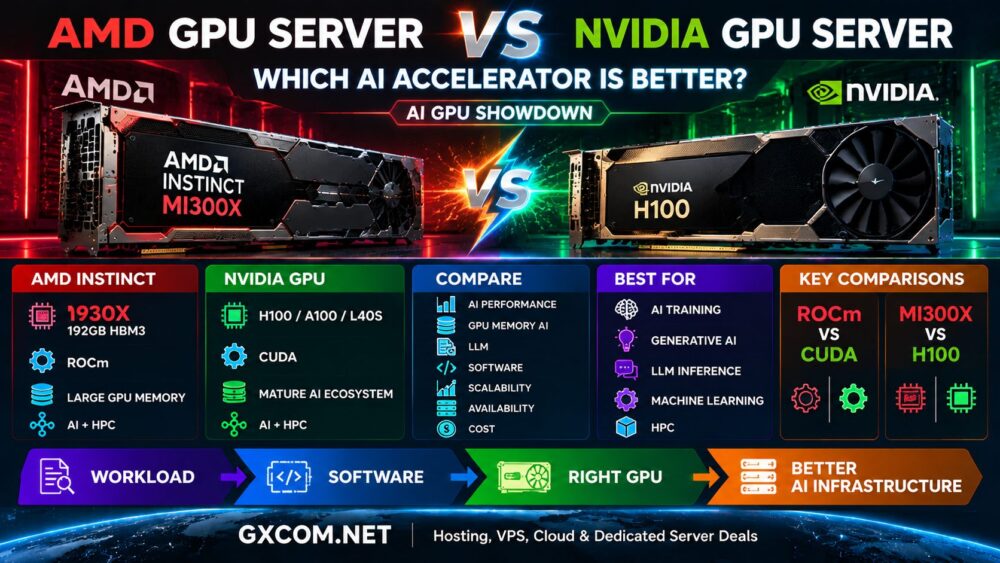
AMD vs NVIDIA GPU Servers at a Glance
| Factor | AMD GPU Server | NVIDIA GPU Server |
|---|---|---|
| Major AI GPUs | AMD Instinct | H100, A100, L40S and others |
| Software Platform | ROCm | CUDA |
| AI Ecosystem | Growing | Highly established |
| Large-Model Focus | Strong | Strong |
| HPC | Strong | Strong |
| Provider Availability | More limited | Generally broader |
| Best Choice | Workload dependent | Workload dependent |
AMD GPU Servers Explained
AMD's data center GPU strategy centers on the Instinct accelerator family. These GPUs are designed for artificial intelligence, scientific computing, machine learning, and HPC rather than conventional desktop graphics.
Important AMD Instinct platforms include MI300X and earlier MI250-series accelerators, alongside newer generations as AMD continues expanding its data center roadmap.
AMD GPU servers can be used for:
- Large language models
- Generative AI
- AI inference
- Machine learning
- Scientific computing
- High-performance computing
- Data analytics
For a broader look at AMD's accelerator family, see our
Best AMD GPU Servers
comparison.
NVIDIA GPU Servers Explained
NVIDIA GPU servers have become widely adopted across AI infrastructure because of the combination of powerful data center accelerators and the mature CUDA software ecosystem.
Popular NVIDIA options include:
- H100 for demanding AI and large-model workloads
- A100 for established machine-learning environments
- L40S for AI inference and graphics workloads
- RTX-class GPUs for development, rendering, and lower-cost AI computing
The NVIDIA ecosystem also includes extensive libraries, development tools, frameworks, and optimized software used throughout the AI industry.
See our
Best NVIDIA GPU Servers
guide for a deeper look at NVIDIA server options.
AMD MI300X vs NVIDIA H100
One of the most relevant comparisons in high-end AI infrastructure is AMD Instinct MI300X versus NVIDIA H100.
| Factor | AMD MI300X | NVIDIA H100 |
|---|---|---|
| Primary Focus | AI / LLM / HPC | AI / LLM / HPC |
| Software Ecosystem | ROCm | CUDA |
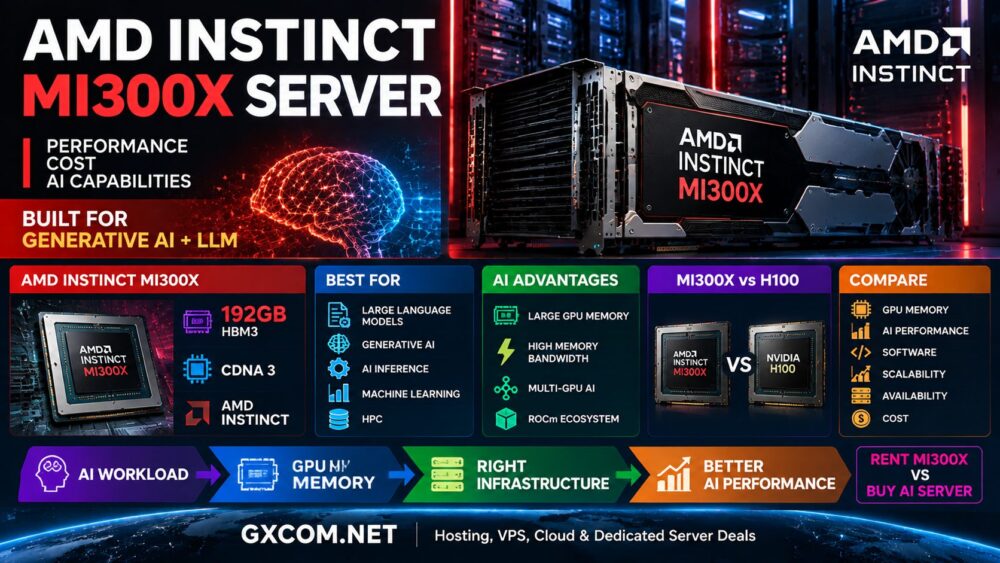
| Memory | 192GB HBM3 | Depends on H100 configuration |
| Large Language Models | Strong fit | Strong fit |
| Provider Availability | More limited | Generally broader |
| Software Maturity | Growing rapidly | Highly established |
MI300X's 192GB HBM3 capacity is particularly relevant for memory-intensive large-model workloads. H100, meanwhile, benefits from NVIDIA's established AI software environment and broad infrastructure availability.
The right choice depends on the model and software stack rather than one specification alone.
For more information about AMD's accelerator, read our
AMD Instinct MI300X Server
guide.
ROCm vs CUDA
The most important difference between AMD and NVIDIA may not be the physical GPU. It may be the software ecosystem.
AMD ROCm
ROCm is AMD's open software platform for GPU computing. It provides libraries, compilers, development tools, and integrations for AI and HPC workloads.
ROCm support has expanded considerably as AMD invests more heavily in AI infrastructure.
NVIDIA CUDA
CUDA is NVIDIA's established parallel computing platform and has been used across AI, machine learning, scientific computing, and GPU development for many years.
A large amount of AI software has historically been developed and optimized around CUDA.
Why Software Compatibility Matters
Moving an application from NVIDIA to AMD is not always as simple as replacing one GPU with another.
Before choosing a platform, verify:
- AI framework support
- Model compatibility
- Required libraries
- Container compatibility
- Operating system support
- Custom CUDA dependencies
- ROCm optimization
A GPU with excellent hardware specifications can still be the wrong choice if the application cannot efficiently use it.
AMD vs NVIDIA for Large Language Models
LLMs place enormous demands on GPU memory, memory bandwidth, compute performance, storage, and multi-GPU communication.
AMD MI300X is particularly interesting because of its large accelerator memory capacity. This can be useful for models where memory is a major constraint.
NVIDIA H100 and related infrastructure remain widely deployed for LLM training and inference, supported by an extensive CUDA-based AI ecosystem.
For LLM infrastructure, compare:
- Model size
- GPU memory
- Context length
- Training vs inference
- Precision
- Batch size
- Multi-GPU scaling
- Framework optimization
AMD vs NVIDIA for AI Training
AI training can require sustained GPU utilization over long periods, making performance and scaling efficiency extremely important.
NVIDIA benefits from a mature training ecosystem and broad software support. AMD Instinct provides an alternative for organizations prepared to deploy and optimize ROCm-based environments.
Rather than selecting a GPU based on vendor alone, organizations should benchmark representative training workloads whenever possible.
AMD vs NVIDIA for AI Inference
Inference can produce a different result from training because memory capacity, throughput, latency, and cost per request may become more important than peak training performance.
AMD's high-memory accelerators can be attractive for large-model inference, while NVIDIA offers a broad selection of GPUs for different inference requirements.
For example, an organization may not require H100-class infrastructure if a less expensive NVIDIA accelerator can efficiently serve its production model.
AMD vs NVIDIA GPU Memory
GPU memory is one of the most important specifications for modern AI workloads.
Insufficient VRAM can prevent a model from running efficiently regardless of GPU compute performance.
Memory requirements depend on:
- Model parameters
- Precision
- Context window
- Batch size
- Training or inference
- Optimization techniques
MI300X's large memory capacity gives AMD an important option for memory-intensive workloads, while NVIDIA provides multiple accelerator configurations across different performance tiers.
AMD vs NVIDIA for HPC
Both AMD Instinct and NVIDIA data center GPUs are used for high-performance computing.
HPC workloads can include:
- Scientific simulations
- Climate modeling
- Physics
- Engineering
- Computational research
- Large-scale numerical processing
The complete server architecture matters heavily in HPC. CPU performance, memory, interconnects, storage, networking, and software optimization should be evaluated alongside the GPU.
AMD vs NVIDIA GPU Server Availability
Availability can significantly influence infrastructure decisions.
NVIDIA GPUs are offered by a wide range of cloud platforms, GPU specialists, hosting providers, and dedicated server companies.
Platforms such as GPU Mart, Database Mart, RunPod, Vast.ai, and DigitalOcean illustrate the broad range of NVIDIA-oriented GPU hosting models available, from dedicated GPU infrastructure to flexible cloud GPU services.
AMD Instinct availability is generally more selective. Organizations considering AMD should confirm the exact accelerator model, region, billing structure, and software environment before designing production infrastructure around a provider.
AMD vs NVIDIA GPU Server Cost
It is tempting to compare AMD and NVIDIA using only the advertised hourly GPU price, but this can produce misleading conclusions.
Total AI infrastructure cost can include:
- GPU rental
- CPU resources
- System RAM
- NVMe storage
- Network traffic
- Multi-GPU infrastructure
- Software engineering
- Management and support
- Power and cooling for owned hardware
Performance per dollar also depends on how quickly a workload completes.
A cheaper GPU that requires substantially more processing time may not produce a lower total project cost.
See our
AI Server Cost Guide
for a broader cost breakdown.
AMD vs NVIDIA for Cloud GPU Infrastructure
| Consideration | AMD | NVIDIA |
|---|---|---|
| Cloud Availability | Growing | Broad |
| AI Software | ROCm | CUDA |
| LLM Infrastructure | Strong options | Strong options |
| Provider Choice | More selective | Extensive |
| Migration Consideration | ROCm compatibility | CUDA compatibility |
Cloud rental can be particularly useful when evaluating AMD versus NVIDIA because teams can benchmark workloads before purchasing expensive physical infrastructure.
Our
GPU Server Rental
guide explains the differences between hourly, monthly, cloud, and dedicated GPU deployment.
When Does an AMD GPU Server Make Sense?
AMD GPU infrastructure deserves consideration when:
- Your workload is validated for ROCm.
- Large GPU memory is important.
- You are evaluating alternatives to CUDA-centric infrastructure.
- AMD Instinct performs well for your actual workload.
- The provider and configuration meet your scaling requirements.
When Does an NVIDIA GPU Server Make Sense?
NVIDIA infrastructure may be particularly practical when:
- Your application depends heavily on CUDA.
- You need broad provider availability.
- Your software stack is already optimized for NVIDIA.
- You require a wide choice of GPU performance tiers.
- You want access to a mature AI development ecosystem.
AMD vs NVIDIA GPU Server Decision Guide
| Priority | What to Evaluate |
|---|---|
| Large GPU Memory | Compare actual model memory requirements |
| Existing CUDA Application | Migration effort and ROCm compatibility |
| LLM Inference | Memory, throughput and cost per workload |
| AI Training | Framework support and scaling performance |
| HPC | Application-specific benchmarks |
| Lowest Total Cost | Performance per dollar, not GPU price alone |
Common AMD vs NVIDIA Comparison Mistakes
Comparing Only Specifications
Theoretical specifications do not automatically translate into identical application performance.
Ignoring Software
ROCm and CUDA compatibility can determine whether a migration is simple, difficult, or impractical.
Ignoring GPU Memory
A faster accelerator may still be unsuitable if the model cannot fit efficiently into available memory.
Comparing Only Hourly Price
Total cost depends on utilization, workload duration, storage, bandwidth, engineering time, and scaling efficiency.
Final Thoughts
The AMD GPU Server vs NVIDIA GPU Server decision is ultimately a workload and ecosystem decision rather than a simple brand comparison.
AMD Instinct, particularly high-memory platforms such as MI300X, provides an increasingly important option for large language models, generative AI, inference, and HPC. ROCm also gives developers a growing alternative GPU computing ecosystem.
NVIDIA remains deeply established across AI infrastructure through CUDA, a broad accelerator portfolio, mature software support, and extensive provider availability.
Before choosing either platform, benchmark your actual models, verify software compatibility, calculate GPU memory requirements, compare infrastructure availability, and estimate total computing cost.
The better AI accelerator is the one that delivers the required performance, memory capacity, software compatibility, scalability, and cost efficiency for your specific workload.