Linux remains one of the most popular operating system choices for dedicated servers because it combines flexibility, performance, security, and extensive software support without requiring a commercial operating system license for most distributions.
But choosing the Best Linux Dedicated Server Hosting Providers requires more than comparing CPU cores and monthly prices. Hardware generation, RAM, NVMe storage, bandwidth, data center location, remote management, Linux distribution support, and server management policies can all affect the real value of a dedicated server.
This guide compares Hetzner, OVHcloud, Liquid Web, InMotion Hosting, IONOS, and InterServer for Linux dedicated hosting. We also explain which hardware specifications matter, which Linux distributions to consider, and when dedicated Linux hosting makes more sense than a VPS or cloud server.
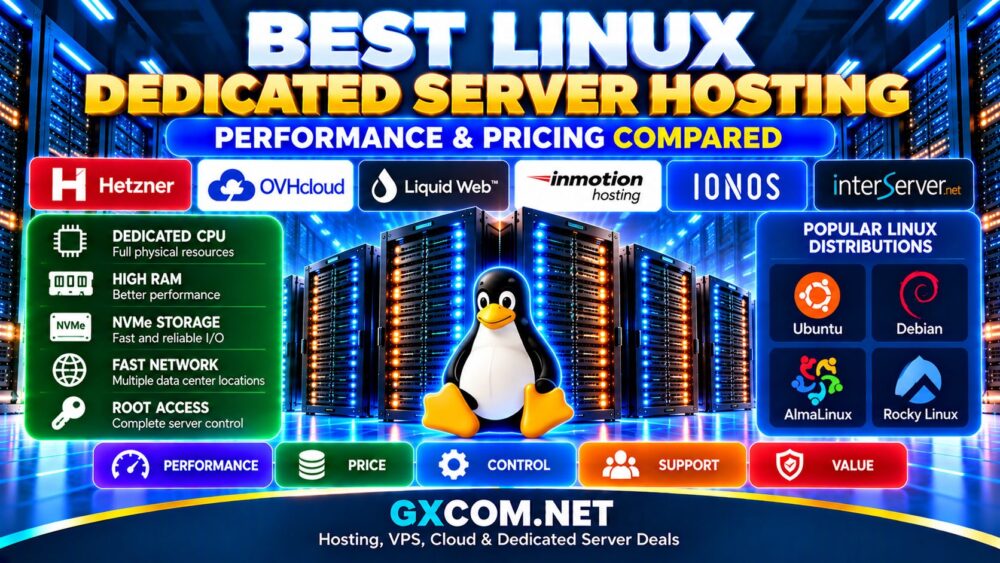
Best Linux Dedicated Server Hosting Providers Compared
| Provider | Best For | Linux Options | Management |
|---|---|---|---|
| Hetzner | Price-to-performance | Multiple Linux distributions | Primarily self-managed |
| OVHcloud | Infrastructure and network choice | Multiple Linux distributions | Mostly self-managed |
| Liquid Web | Managed Linux servers | Popular server distributions | Managed options |
| InMotion Hosting | Business hosting | Linux-based dedicated hosting | Managed services available |
| IONOS | Affordable entry-level servers | Linux server options | Varies by service |
| InterServer | Flexible US servers | Multiple Linux choices | Self-managed and support options |
Dedicated server pricing and available configurations change frequently. Compare the exact CPU, RAM, storage, bandwidth, operating system, management level, and data center before purchasing.
1. Hetzner – Best Linux Dedicated Server for Price-to-Performance
Hetzner is a strong option for developers, system administrators, hosting companies, and infrastructure teams that are comfortable managing Linux themselves.
Its dedicated server portfolio includes Intel and AMD hardware, while its Server Auction can provide access to previous-generation machines at lower prices.
Why Hetzner Works Well for Linux
- Strong hardware-to-price ratio
- Intel and AMD server options
- NVMe and SSD configurations
- Linux installation options
- Root-level administration
- Server Auction for budget hardware
- Useful rescue and administration tools
Hetzner is particularly attractive when your team already understands Linux administration and does not need a hosting company to manage every software component.
Developers running web applications, databases, containers, virtualization, CI/CD systems, or private infrastructure can obtain considerable hardware resources without paying for unnecessary management.
2. OVHcloud – Best for Linux Infrastructure Flexibility
OVHcloud operates a broad dedicated server portfolio ranging from budget-oriented bare metal to higher-performance infrastructure designed for demanding business workloads.
Linux users can deploy dedicated infrastructure for websites, applications, virtualization, databases, game servers, development environments, and other workloads requiring physical resources.
Why Consider OVHcloud?
- Wide range of dedicated hardware
- Multiple Linux operating system choices
- Different server families for different workloads
- NVMe and SSD configurations
- Multiple data center regions
- DDoS protection
- Root-level control
OVHcloud is especially useful when you want to choose infrastructure based on workload rather than purchasing a generic dedicated server configuration.
Budget-conscious Linux administrators can also examine OVHcloud's lower-cost server ranges when the newest processor generation is not required.
3. Liquid Web – Best for Managed Linux Dedicated Hosting
Not every business wants to maintain Linux entirely in-house. Liquid Web focuses heavily on managed hosting and is better suited to organizations that want dedicated hardware while receiving more assistance with server administration.
Why Consider Liquid Web?
- Managed dedicated hosting
- Linux server expertise
- Server monitoring
- Security-oriented management features
- Business-focused support
- Dedicated hardware configurations
Liquid Web will generally not compete with unmanaged providers purely on the lowest hardware price. Its value proposition is different: businesses pay more to reduce the amount of day-to-day infrastructure management handled internally.
If your company values technical assistance more than obtaining the cheapest possible bare metal server, a managed Linux environment can make financial sense.
4. InMotion Hosting – Best for Business Linux Dedicated Hosting
InMotion Hosting is another option for businesses that prefer a more traditional hosting provider rather than a bare metal infrastructure marketplace.
Its dedicated hosting services combine physical server resources with hosting-oriented support and management features.
Why Consider InMotion Hosting?
- Linux-focused hosting environment
- Dedicated physical resources
- Managed hosting options
- NVMe storage on selected configurations
- Business hosting features
- Technical support
This makes InMotion particularly relevant for agencies, ecommerce businesses, growing websites, and companies moving from shared hosting or VPS infrastructure to dedicated hardware.
5. IONOS – Best for Affordable Linux Dedicated Servers
IONOS offers dedicated server configurations that can appeal to buyers who want a relatively inexpensive path into physical server hosting.
Some budget configurations use established processor generations rather than the newest server CPUs. This can significantly reduce the monthly cost while still providing dedicated hardware.
Why Consider IONOS?
- Affordable entry configurations
- Linux operating system options
- Dedicated CPU and memory
- SSD and NVMe options on selected servers
- Suitable for websites and applications
- Multiple infrastructure products for future expansion
Always check the exact processor model before ordering. An older Xeon server can be perfectly adequate for many websites and development environments, but CPU generation matters when applications require strong single-core performance.
6. InterServer – Best for Flexible Linux Dedicated Servers in the US
InterServer is worth considering when you need dedicated Linux infrastructure in the United States and want a broad selection of hardware configurations.
Its inventory can include Intel Xeon and AMD-based servers, with storage and memory configurations suitable for different workloads.
Why Consider InterServer?
- US data center options
- Multiple hardware configurations
- Linux server support
- SSD and NVMe options
- Root access
- DDoS protection
- Budget and higher-performance configurations
InterServer can be particularly interesting for developers and businesses whose users are primarily located in North America.
Why Choose Linux for a Dedicated Server?
Linux gives server administrators extensive control over the operating environment while keeping operating system licensing costs low.
Major advantages include:
- No commercial OS license required for many distributions
- Strong server performance
- Low operating system overhead
- Extensive command-line administration
- Powerful automation capabilities
- Broad web hosting software support
- Container and virtualization ecosystems
- Large open-source software ecosystem
Linux is widely used with Apache, Nginx, PHP, MySQL, MariaDB, PostgreSQL, Docker, Kubernetes tools, Redis, Node.js, Python, and many other server technologies.
Which Linux Distribution Should You Choose?
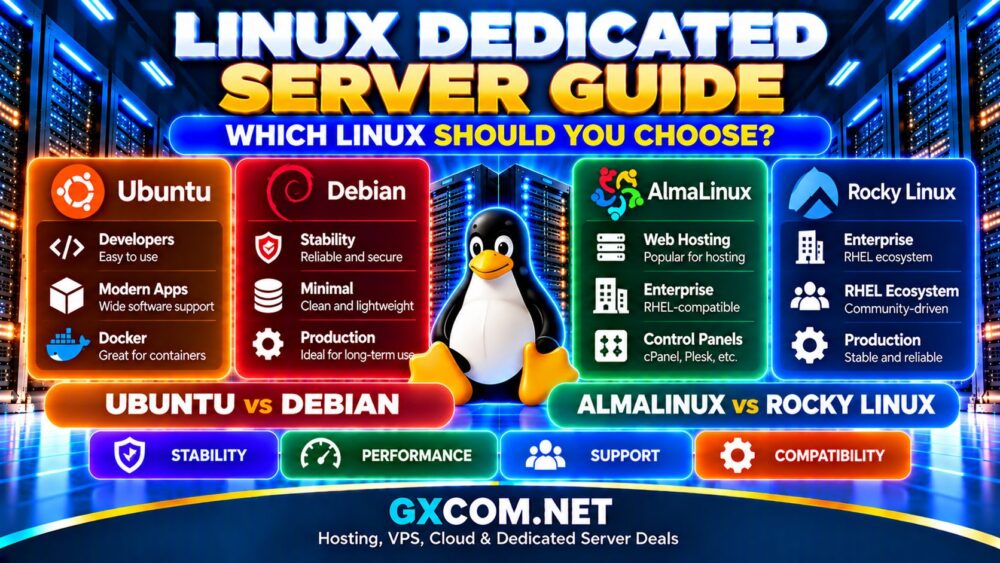
Ubuntu Server
Ubuntu is a practical choice for developers and businesses because of its extensive documentation, large community, broad software compatibility, and Long Term Support releases.
Debian
Debian emphasizes stability and conservative package management. It is frequently chosen by experienced administrators who prefer a minimal and predictable server environment.
AlmaLinux
AlmaLinux is popular in hosting environments that prefer an enterprise-oriented Linux distribution compatible with the broader Red Hat ecosystem.
Rocky Linux
Rocky Linux is another enterprise-oriented option commonly considered for web hosting, control panels, and business server deployments.
There is no universally best Linux distribution. The right choice depends on application compatibility, administrator experience, software lifecycle requirements, and the tools your organization already uses.
Managed vs Unmanaged Linux Dedicated Hosting
One of the most important decisions is whether you want to administer Linux yourself.
| Feature | Managed Linux Server | Unmanaged Linux Server |
|---|---|---|
| OS Administration | Provider assistance | Customer |
| Updates | Often provider-assisted | Customer |
| Monitoring | Often included | Customer configures |
| Security | Management assistance | Customer responsibility |
| Technical Skill Required | Lower | Higher |
| Management Cost | Higher | Lower |
Experienced Linux administrators may prefer unmanaged infrastructure because they can control the entire software stack and avoid paying for administration they do not need.
Businesses without an infrastructure team should consider the real cost of administration before choosing solely on monthly server price. Our Managed vs Unmanaged Dedicated Server guide explains this tradeoff in more detail.
How Much Does Linux Dedicated Server Hosting Cost?
Linux dedicated hosting prices vary considerably because you are primarily paying for hardware, networking, infrastructure, and possibly management rather than Linux itself.
Major cost factors include:
- CPU model and generation
- Number of cores and threads
- RAM capacity
- ECC memory
- NVMe, SSD, or HDD storage
- RAID configuration
- Network speed
- Included bandwidth
- Data center location
- IPv4 addresses
- Control panel licenses
- Server management
Self-managed Linux servers can reduce software and management expenses, but administrator time should still be considered part of the total cost.
What Hardware Matters Most for Linux Dedicated Hosting?
CPU
Do not judge a processor by core count alone. CPU generation, architecture, clock speed, cache, and workload behavior all influence real performance.
High-frequency CPUs can be useful for workloads sensitive to single-thread performance, while high-core-count processors are attractive for virtualization, containers, compilation, and parallel applications.
RAM
Memory is particularly important for databases, virtualization, caching, and large application environments.
Buying excessive RAM does not automatically improve performance, so size the server around realistic workload requirements and future growth.
NVMe Storage
NVMe storage can significantly improve I/O-heavy workloads such as databases, ecommerce platforms, virtualization, and applications that process many small files.
SATA SSD remains suitable for many general hosting workloads, while HDD storage can still provide economical capacity for backups and archives.
Network
Compare:
- Port speed
- Included traffic
- Bandwidth limits
- Overage policies
- Network routing
- DDoS protection
- Data center location
Linux Dedicated Server vs VPS
A Linux VPS and Linux dedicated server can run many of the same applications, but the infrastructure underneath them is different.
| Feature | Linux Dedicated Server | Linux VPS |
|---|---|---|
| Infrastructure | Physical server | Virtual machine |
| Resources | Physical machine resources | Virtual allocation |
| Hardware Control | Greater | More limited |
| Scaling | Hardware-dependent | Usually easier |
| Starting Cost | Higher | Lower |
| Best For | Resource-intensive workloads | Small to medium workloads |
A VPS is often more economical when your application uses relatively little CPU and memory. Dedicated hardware becomes more attractive when resource usage is consistently high or greater physical infrastructure control is required.
See our Dedicated Server vs VPS comparison before deciding whether your workload actually requires bare metal.
Linux Dedicated Server Security
Linux can provide a secure server environment, but the operating system does not secure itself.
Administrators should consider:
- SSH key authentication
- Disabling unnecessary services
- Firewall configuration
- Regular security updates
- Application patching
- Log monitoring
- Intrusion prevention tools
- Backup automation
- Off-server backup storage
Security responsibility is particularly important with unmanaged dedicated hosting because the provider may not maintain the software environment for you.
Our Unmanaged Dedicated Server Guide explains the responsibilities that come with operating your own server.
Best Linux Dedicated Server for Web Hosting
Linux remains an excellent platform for WordPress, WooCommerce, PHP applications, hosting control panels, and custom web stacks.
For web hosting, prioritize balanced hardware rather than purchasing the largest possible CPU.
A typical production environment may benefit from:
- Modern multi-core CPU
- Sufficient RAM for databases and caching
- NVMe storage
- Reliable backup storage
- Strong network connectivity
- DDoS protection
Best Linux Dedicated Server for Databases
Database workloads can benefit significantly from dedicated resources, particularly when datasets or query volumes become too demanding for smaller VPS environments.
Fast NVMe storage, sufficient RAM, a capable CPU, and proper database configuration are generally more important than simply selecting the server with the highest number of cores.
Best Linux Dedicated Server for Docker and Containers
Dedicated Linux hardware can also provide a flexible foundation for Docker and container-based infrastructure.
Administrators can control the host operating system, networking, storage, kernel settings, and resource allocation without depending on a traditional shared hosting environment.
For container-heavy workloads, prioritize CPU cores, RAM, fast storage, and reliable networking.
How to Choose a Linux Dedicated Server Provider
Before ordering, compare providers using a consistent checklist:
- Identify the CPU performance your application requires.
- Estimate realistic RAM usage.
- Choose NVMe, SSD, or HDD based on workload.
- Calculate bandwidth requirements.
- Select a data center close to important users.
- Confirm your preferred Linux distribution is supported.
- Check rescue console and remote management options.
- Decide between managed and unmanaged hosting.
- Calculate backup and licensing costs.
- Compare the complete monthly cost.
For a broader comparison beyond Linux-specific hosting, see our Best Dedicated Server Hosting Providers guide.
Which Linux Dedicated Server Provider Should You Choose?
Hetzner is particularly attractive for experienced administrators looking for strong price-to-performance and self-managed infrastructure. OVHcloud provides a broad range of bare metal options and can suit users who want multiple server families and geographic choices.
Liquid Web is better aligned with businesses that value managed Linux support, while InMotion Hosting provides a more traditional business hosting experience.
IONOS deserves consideration when entry cost matters, and InterServer is particularly relevant for buyers looking for flexible Linux dedicated hardware in the United States.
The right provider ultimately depends on whether your priority is price, hardware performance, geographic location, technical support, or server management.
Final Thoughts
The best Linux dedicated server provider is not necessarily the provider offering the cheapest server or the largest number of CPU cores.
Start with your workload. Determine the CPU performance, memory, storage, network capacity, geographic location, and management level you actually need. Then compare providers using those requirements rather than headline specifications.
Linux gives experienced administrators enormous flexibility and can reduce operating system licensing costs, while dedicated hardware provides resources and infrastructure control that a smaller virtual server may not offer.
For developers, hosting companies, SaaS businesses, database workloads, container infrastructure, and high-traffic websites, a well-selected Linux dedicated server can provide a powerful foundation without paying for resources or management services you do not need.