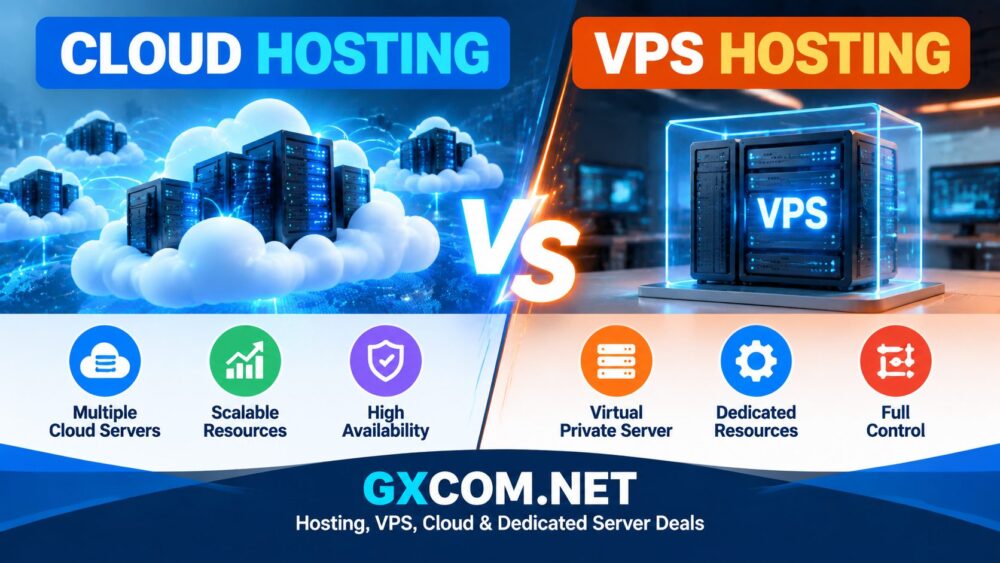
Choosing the right hosting solution is an important decision for websites, applications, and growing online businesses. Two popular options are Cloud Hosting and VPS Hosting. Both provide better performance and control compared with traditional shared hosting, but they are designed for different needs.
The main difference between Cloud Hosting and VPS Hosting is how resources are managed. Cloud hosting uses multiple connected servers to provide flexibility and scalability, while VPS hosting creates an isolated virtual server environment with dedicated resources.
Understanding the differences between Cloud Hosting vs VPS Hosting can help you choose the right infrastructure based on performance requirements, budget, technical skills, and future growth plans.
What Is Cloud Hosting?
Cloud Hosting uses a network of multiple servers to provide website and application resources. Instead of depending on one physical machine, cloud infrastructure distributes workloads across interconnected servers.
This architecture improves reliability and allows businesses to increase resources quickly when traffic grows.
Cloud Hosting is commonly used for:
- Business websites
- Ecommerce stores
- SaaS applications
- High-traffic platforms
- Growing online businesses
What Is VPS Hosting?
VPS Hosting (Virtual Private Server Hosting) uses virtualization technology to divide one physical server into multiple isolated virtual servers.
Each VPS receives dedicated resources such as CPU, RAM, and storage, providing better performance and control compared with shared hosting.
VPS Hosting is popular among:
- Developers
- Website owners needing more control
- Small businesses
- Custom applications
- Growing websites
Cloud Hosting vs VPS Hosting: Key Differences
| Feature | Cloud Hosting | VPS Hosting |
|---|---|---|
| Infrastructure | Multiple connected servers | One physical server divided into virtual servers |
| Scalability | Highly flexible and easy to scale | Limited by physical server resources |
| Performance | Consistent during traffic changes | Stable dedicated resources |
| Reliability | Higher redundancy | Depends on physical server availability |
| Control | Flexible cloud management | More traditional server control |
| Cost | Usually based on resource usage | Often fixed monthly pricing |
Performance Comparison: Cloud Hosting vs VPS Hosting
Both Cloud Hosting and VPS Hosting provide better performance than shared hosting, but their architecture creates different advantages.
Cloud Hosting can handle changing workloads more efficiently because resources come from multiple servers. This makes it suitable for websites with unpredictable traffic spikes.
VPS Hosting provides guaranteed resources, making it a good option for projects that need consistent performance and more control over the server environment.
Businesses looking for flexible cloud infrastructure can explore
Best Cloud Hosting Solutions
for different website and application requirements.
Scalability: Which Hosting Solution Is Better?
Scalability is one of the biggest differences between Cloud Hosting and VPS Hosting.
Cloud Hosting allows users to increase resources quickly without migrating servers. This makes it ideal for businesses experiencing rapid growth.
VPS Hosting can also be upgraded, but scaling usually depends on the available resources of the physical server.
Security Comparison
Both solutions can provide strong security when properly configured.
VPS Hosting offers isolation from other users on the same physical server. Users have more control over security settings and server configurations.
Cloud Hosting benefits from distributed infrastructure and often includes advanced security options such as monitoring, backups, and network protection.
Cloud Hosting vs VPS Hosting Cost
Pricing depends on resources, provider features, and management requirements.
Cloud Hosting Costs
- Flexible pay-as-you-grow pricing
- Suitable for changing workloads
- May become expensive with high resource usage
VPS Hosting Costs
- Predictable monthly pricing
- Good value for fixed workloads
- Requires more technical management
Cloud Hosting vs VPS Hosting: Which One Should You Choose?
Choose Cloud Hosting If:
- You need easy scalability
- Your traffic changes frequently
- You run business-critical applications
- You want higher infrastructure flexibility
Choose VPS Hosting If:
- You need dedicated resources
- You want more server control
- Your workload is predictable
- You have technical experience
Cloud Hosting vs VPS Hosting for Websites
For small business websites, blogs, and ecommerce platforms, Cloud Hosting provides easier growth and better flexibility.
For developers and businesses requiring customized environments, VPS Hosting provides more control over server settings.
Cloud Hosting vs VPS Hosting for Applications
Applications often require reliable resources, flexible scaling, and strong performance.
Cloud Hosting is commonly preferred for applications that need automatic scaling, while VPS Hosting works well for projects requiring dedicated environments.
Businesses comparing different cloud infrastructure options can also review
Cloud VPS Hosting
to understand another flexible hosting approach.
Final Thoughts
Cloud Hosting and VPS Hosting are both powerful alternatives to shared hosting, but they solve different problems.
Cloud Hosting is ideal for businesses that need scalability, flexibility, and high availability. VPS Hosting is better suited for users who need dedicated resources and greater server control.
Before choosing a hosting solution, consider your website traffic, application requirements, technical skills, and future growth plans. Selecting the right infrastructure can help your online business achieve better performance and reliability.