Google Cloud has become a major platform for websites, applications, data analytics and artificial intelligence, but its enormous service catalog can make choosing the right infrastructure difficult. In this Google Cloud Hosting Review 2026, we examine performance, pricing, Compute Engine, storage, networking, AI capabilities and the features that matter when deciding whether Google Cloud is right for your project.
Unlike traditional web hosting, Google Cloud Platform (GCP) is a complete cloud infrastructure ecosystem. Instead of purchasing one hosting package, customers can combine virtual machines, storage, databases, networking, Kubernetes and AI services according to their requirements.
That flexibility makes Google Cloud attractive to developers, SaaS businesses and AI teams. It also creates a steeper learning curve than conventional shared or managed hosting.
Last updated: September 2026. Google Cloud pricing, machine availability and regional services can change. Verify current configurations and costs before deployment.
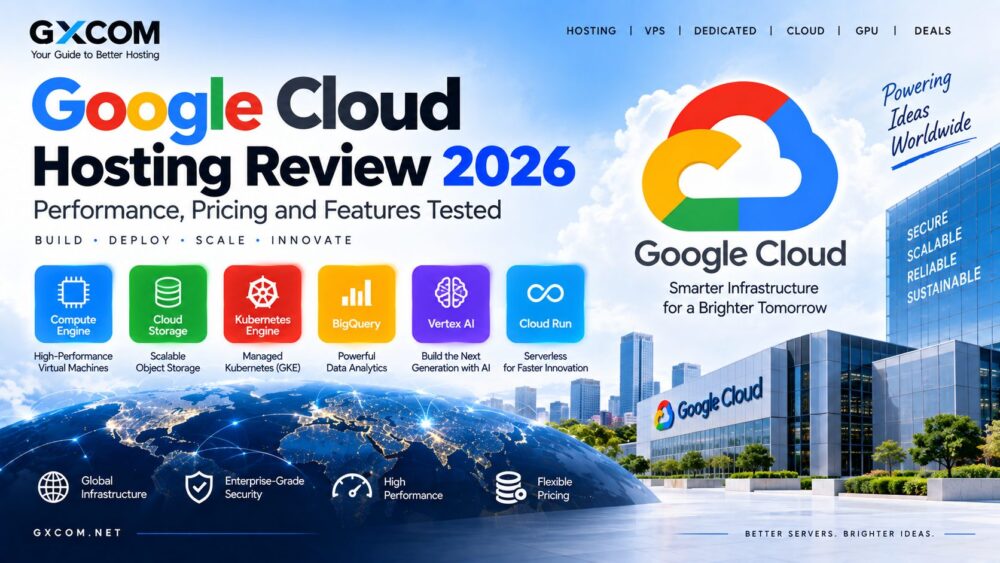
Google Cloud Hosting Review 2026: Quick Overview
| Feature | Google Cloud |
|---|---|
| Main Compute Platform | Compute Engine |
| Object Storage | Cloud Storage |
| Kubernetes | Google Kubernetes Engine (GKE) |
| Data Analytics | BigQuery |
| AI Platform | Vertex AI |
| Serverless | Cloud Run / Cloud Functions |
| Best For | Developers, AI, analytics and scalable applications |
| Main Drawback | Complex pricing and learning curve |
What Is Google Cloud Hosting?
Google Cloud is Google's cloud computing platform. It provides infrastructure and managed services that allow customers to build websites, applications, databases, analytics platforms and AI systems.
Important Google Cloud products include:
- Compute Engine – configurable virtual machines.
- Cloud Storage – scalable object storage.
- Google Kubernetes Engine – managed Kubernetes infrastructure.
- BigQuery – serverless data warehouse and analytics platform.
- Cloud Run – managed application and container execution.
- Vertex AI – Google's platform for building and deploying AI applications.
This makes GCP significantly more flexible than a conventional hosting account.
Google Cloud Hosting Performance Tested: What Matters?
There is no single Google Cloud server configuration that represents overall GCP performance. Compute Engine offers multiple machine families designed for different workloads.
Performance depends on factors such as:
- Machine family
- vCPU allocation
- Memory
- Storage configuration
- Region
- Network tier
- Application optimization
Google Cloud provides general-purpose, compute-optimized, memory-optimized, storage-optimized and accelerator-optimized machine families, allowing infrastructure to be matched more closely to the workload.
For website hosting, this means users should avoid judging Google Cloud purely by a single benchmark. The configuration selected has a major influence on performance.
Google Compute Engine Review
Compute Engine is the core virtual machine service within Google Cloud and is the closest equivalent to a conventional cloud VPS.
Users can configure:
- Virtual CPUs
- Memory
- Operating systems
- Storage
- Networking
- GPUs on supported configurations
This level of control is useful for developers and businesses that need customized infrastructure rather than a predefined hosting package.
For users comparing GCP with other infrastructure platforms, our AWS vs Google Cloud vs Azure comparison provides a broader look at the three major hyperscale cloud ecosystems.
Google Cloud Storage
Cloud Storage provides object storage for websites, applications, backups, media and large datasets.
It can be used for:
- Static website assets
- Backups
- Application data
- Media storage
- Data archives
- AI datasets
Google offers different storage classes so organizations can balance availability, access frequency and cost.
Google Cloud Networking and Global Infrastructure
One of Google Cloud's major advantages is access to Google's global infrastructure.
Google Cloud organizes infrastructure into regions and zones, allowing customers to place workloads closer to users or design applications across multiple locations.
For international applications, location selection can affect latency, availability and regulatory requirements.
Businesses should therefore select a region based on users and application architecture rather than automatically choosing the geographically nearest data center.
Google Cloud Pricing Explained
Google Cloud uses usage-based pricing across many of its services. The final cost depends on the infrastructure configuration and resources consumed.
Potential charges can include:
- Compute
- Storage
- Network traffic
- IP addresses
- Databases
- Load balancing
- Snapshots
- Managed services
This flexibility allows infrastructure to scale with demand, but it also means that estimating the final bill can be more difficult than comparing fixed-price VPS plans.
Google Cloud Discounts and Cost Optimization
Google Cloud provides several mechanisms that can reduce compute costs depending on workload characteristics and commitments.
For example, eligible Compute Engine resources can benefit from sustained use discounts, while committed use discounts may provide lower pricing when customers commit to qualifying resource usage.
Spot VMs can provide substantially discounted compute capacity for workloads that can tolerate interruptions.
The important lesson is that the advertised price of a virtual machine is only one part of total cloud cost.
Google Cloud vs Traditional VPS Hosting
| Feature | Google Cloud | Traditional VPS |
|---|---|---|
| Pricing | Usage-based | Usually fixed monthly |
| Scalability | Extensive | More limited |
| Services | Large cloud ecosystem | Mainly server hosting |
| Management | More complex | Usually simpler |
| Best For | Applications and scalable infrastructure | Websites and predictable workloads |
Users wanting a simple monthly server may find a conventional Cloud VPS easier to budget and manage.
Google Cloud for WordPress Hosting
WordPress can run on Google Cloud, including on Compute Engine-based infrastructure.
The platform can support high-performance WordPress environments, but it requires more infrastructure knowledge than most managed WordPress hosts.
Google Cloud may make sense when a WordPress deployment requires:
- Custom infrastructure
- Advanced scaling
- Cloud database integration
- Global networking
- Integration with other GCP services
For a small blog or business website, conventional WordPress hosting may be easier and more predictable.
Google Kubernetes Engine
Google Kubernetes Engine is one of the most important products for development teams running containerized applications.
GKE provides managed Kubernetes infrastructure and integrates with the broader Google Cloud ecosystem.
It is particularly relevant for:
- Microservices
- SaaS platforms
- Containerized applications
- Development teams
- Cloud-native infrastructure
Google Cloud for AI and Machine Learning
AI is one of the strongest reasons to consider Google Cloud in 2026.
Vertex AI provides tools for building, training and deploying machine learning and generative AI applications, while Google Cloud also offers GPU and accelerator infrastructure for demanding workloads.
This makes GCP particularly interesting for organizations working with:
- Machine learning
- Generative AI
- Large language models
- Data analytics
- AI application development
However, organizations primarily interested in raw GPU capacity should also compare specialized AI servers because specialist GPU providers may use different pricing and capacity models.
Google Cloud vs AWS
AWS and Google Cloud both provide extensive cloud infrastructure, but their ecosystems and product strengths differ.
AWS has an exceptionally broad cloud service portfolio and a long history in infrastructure-as-a-service. Google Cloud has particularly strong positioning around data analytics, Kubernetes, AI and Google's broader technology ecosystem.
Neither platform is automatically cheaper or faster for every workload.
If AWS is also on your shortlist, read our AWS Hosting Review 2026 before making a decision.
Google Cloud Security
Google Cloud provides identity management, encryption, networking controls, monitoring and other security technologies.
Cloud security is still a shared responsibility.
Depending on the service used, customers may remain responsible for areas such as:
- Operating system updates
- User permissions
- Application security
- Firewall configuration
- Data access
- Backup strategy
Security therefore depends not only on Google's infrastructure but also on how customers configure and operate their cloud environment.
Google Cloud Hosting Pros & Cons
| Pros | Cons |
|---|---|
| Flexible cloud infrastructure | Higher learning curve than traditional hosting |
| Strong AI and machine learning ecosystem | Pricing can be difficult to estimate |
| Excellent Kubernetes integration | May be excessive for simple websites |
| Advanced analytics tools | Cloud configuration requires technical knowledge |
| Global infrastructure | Multiple services can complicate cost management |
Who Should Consider Google Cloud Hosting?
Google Cloud is particularly suitable for:
- Developers
- SaaS companies
- AI startups
- Data-intensive applications
- Cloud-native businesses
- Organizations using Kubernetes
- Enterprises requiring scalable infrastructure
Users mainly looking for inexpensive hosting for a basic website may find a conventional hosting or VPS provider easier to manage.
Google Cloud Hosting Review 2026: Final Verdict
Our Google Cloud Hosting Review 2026 shows a platform designed for far more than basic website hosting. Compute Engine provides flexible virtual machines, while GKE, BigQuery, Cloud Storage and Vertex AI create a much broader infrastructure ecosystem.
Google Cloud is especially compelling for development teams working with cloud-native applications, analytics, Kubernetes and artificial intelligence. Its flexibility and scalability are major strengths, but the trade-offs are complexity and less predictable billing than a fixed-price hosting plan.
For smaller websites, a traditional VPS or managed host may be simpler. For developers and businesses building scalable applications, Google Cloud deserves serious consideration alongside AWS and Microsoft Azure.
Before deploying production infrastructure, use Google's pricing tools to estimate compute, storage, networking and managed-service costs for your actual workload.