Choosing between bare metal and virtualized hosting can shape the performance, reliability, and operating costs of a multiplayer community. Both architectures can run demanding games, but they allocate hardware resources differently.
This bare metal vs virtualized game servers comparison explains CPU isolation, virtualization overhead, memory, storage, networking, and total ownership costs. It also helps Minecraft, Rust, ARK, and other server administrators choose infrastructure without paying for unnecessary capacity.
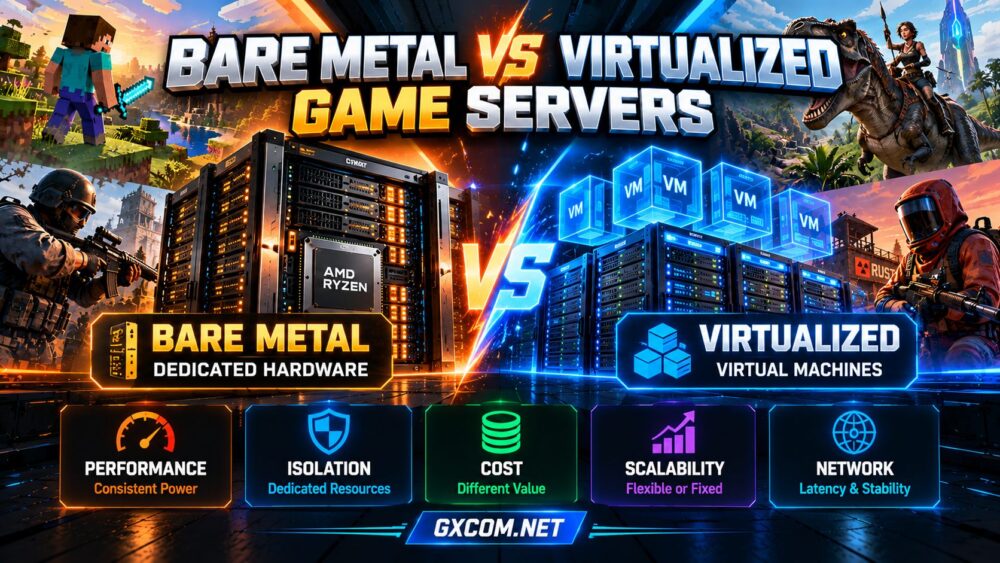
What Is the Difference Between Bare Metal and Virtualized Game Servers?
A bare metal server gives one customer access to an entire physical machine. Its processor, memory, and local storage are not divided among unrelated virtual machines.
A virtualized server runs inside a virtual machine managed by a hypervisor. Several virtual machines may share the same physical host, although providers can reserve or dedicate particular resources.
Neither architecture automatically guarantees excellent gameplay. Hardware generation, resource allocation, network quality, and server configuration remain important.
| Feature | Bare Metal | Virtualized Server |
|---|---|---|
| Physical hardware | Exclusive machine | Usually shared host |
| CPU isolation | Physical processor access | Depends on allocation |
| Scaling | Hardware changes may be required | Often easier to resize |
| Management | Frequently self-managed | Self-managed or managed |
| Cost structure | Whole-machine commitment | Smaller resource allocations available |
1. CPU Performance and Resource Contention
Many multiplayer games depend heavily on a main simulation thread. Strong single-thread performance can therefore matter more than simply increasing the number of cores.
On bare metal, the customer controls the physical processor’s available resources. This removes competition from unrelated customer virtual machines, although the game itself may still encounter CPU bottlenecks.
Virtualized servers can perform extremely well when hosts are appropriately provisioned. Problems arise when CPU scheduling, excessive contention, or inconsistent resource guarantees create unpredictable processing delays.
Ask whether advertised vCPUs represent shared processing time, reserved capacity, or dedicated physical cores. These descriptions are not interchangeable.
Our high-frequency CPUs for game servers guide explains how processor characteristics influence gameplay workloads.
2. How Much Does Virtualization Overhead Matter?
Modern virtualization technology can operate with relatively low overhead, especially when hardware virtualization features are available and the host is configured properly.

However, overhead varies by workload, hypervisor, storage architecture, and network configuration. It should not be represented as one universal percentage.
For lightly loaded servers, the difference may be insignificant. For large communities approaching processing limits, predictable CPU scheduling and resource isolation can become more valuable.
Measure actual game tick performance and peak resource consumption rather than assuming that physical hardware always wins.
3. RAM, NVMe Storage, and Isolation
Bare metal typically provides direct control over installed memory and local drives. Administrators can configure storage layouts, backup strategies, and operating systems around their workloads.
Virtual machines receive assigned memory and virtual disks. Their performance depends on the underlying storage system, allocation policies, and other activity on the host.
NVMe branding alone does not establish consistent disk performance. Check whether storage is local or network-backed, whether performance limits apply, and how snapshots affect operations.
For heavily modified worlds or frequent saves, test loading times and disk latency alongside CPU usage.
Hardware isolation also differs from security isolation: exclusive hardware reduces some shared-host risks, but it does not eliminate software vulnerabilities or administrator mistakes.
4. Network Latency and DDoS Protection
Bare metal does not automatically deliver lower ping than a VPS. Routing, data center location, network congestion, and provider connectivity often matter more than the virtualization layer.
Compare packet loss, jitter, sustained throughput, transfer allowances, and DDoS mitigation. A fast advertised port cannot guarantee stable gameplay across every route.
For practical measurements, read our VPS network performance for gaming guide.
5. Scaling and Operational Flexibility
Virtualized hosting is attractive when communities need to start small and increase resources gradually. Many VPS platforms support plan upgrades, although resizing may require downtime or migration.
Bare metal offers substantial dedicated capacity but can be less flexible when changing processors, memory, or storage. Hardware upgrades may involve provisioning another machine.
For multiple game instances, containers or virtual machines can also run on privately controlled bare-metal hardware. This combines exclusive physical infrastructure with logical separation between workloads.
Choose an architecture that supports your expected growth rather than purchasing maximum capacity immediately.
6. Compare the Real Cost of Ownership
A virtualized server generally offers a lower entry commitment because customers purchase a portion of a machine’s resources.
Bare metal may offer better value when a community consistently uses substantial CPU, memory, and storage capacity. However, idle hardware can make a dedicated machine unnecessarily expensive.
Include operating-system licensing, backup storage, management time, control panels, DDoS services, and bandwidth policies when comparing offers.
Our game server hosting costs guide covers additional recurring expenses.
7. Hosting Providers Worth Comparing
AlphaVPS is an infrastructure-oriented candidate for administrators considering self-managed virtual servers. Verify its current products, resource guarantees, locations, and network terms before ordering.
GameServerKings and DoomHosting are game-hosting alternatives to investigate when convenient deployment and game-specific administration matter more than controlling an entire physical machine.
ScalaCube can also be evaluated for managed game hosting, particularly when setup simplicity and supported game configurations are priorities.
These providers represent different product categories. Confirm whether a selected plan is bare metal, a VPS, or a managed game instance; never infer physical exclusivity from the word “dedicated” alone.

8. Which Architecture Fits Your Community?
Choose virtualized hosting when your player population is modest, workloads fluctuate, or flexible upgrades are more important than exclusive hardware.
Consider bare metal when multiple demanding instances operate continuously, resource contention must be minimized, or advanced infrastructure control is essential.
Before committing, estimate peak player counts, mod requirements, CPU utilization, backup frequency, and administration responsibilities.
See our dedicated game server requirements guide for additional capacity planning.
Frequently Asked Questions
Is Bare Metal Always Faster Than a Gaming VPS?
No. A modern, well-provisioned VPS can outperform older bare-metal hardware. Compare actual processors, resource guarantees, and game performance.
Can Virtualized Servers Run Modded Minecraft or Rust?
Yes, provided the allocated CPU, RAM, storage, and network resources meet the workload’s requirements.
Does Bare Metal Provide Better Security?
It offers physical resource exclusivity, but security still depends on patching, access controls, network protection, and responsible administration.
Which Option Is More Affordable?
Virtualized hosting often costs less for smaller workloads. Bare metal may become economical when dedicated resources are consistently utilized.
Final Verdict
The right choice in bare metal vs virtualized game servers depends on workload consistency, resource isolation, scaling needs, and total cost.
Start with measurable requirements, compare equivalent hardware, and validate performance under realistic player loads. Exclusive hardware is valuable when your community needs it—not simply because it sounds more powerful.