Choosing the right server infrastructure is an important decision for businesses, developers and growing online platforms. Two common options are cloud servers and dedicated servers.
Both provide significantly more resources and control than traditional hosting, but they are designed for different workloads.
A Cloud Server vs Dedicated Server comparison involves more than hardware specifications. Performance, scalability, pricing models, management requirements and future growth all influence the right choice.
This guide compares cloud servers and dedicated servers to help businesses understand which infrastructure model fits their requirements.
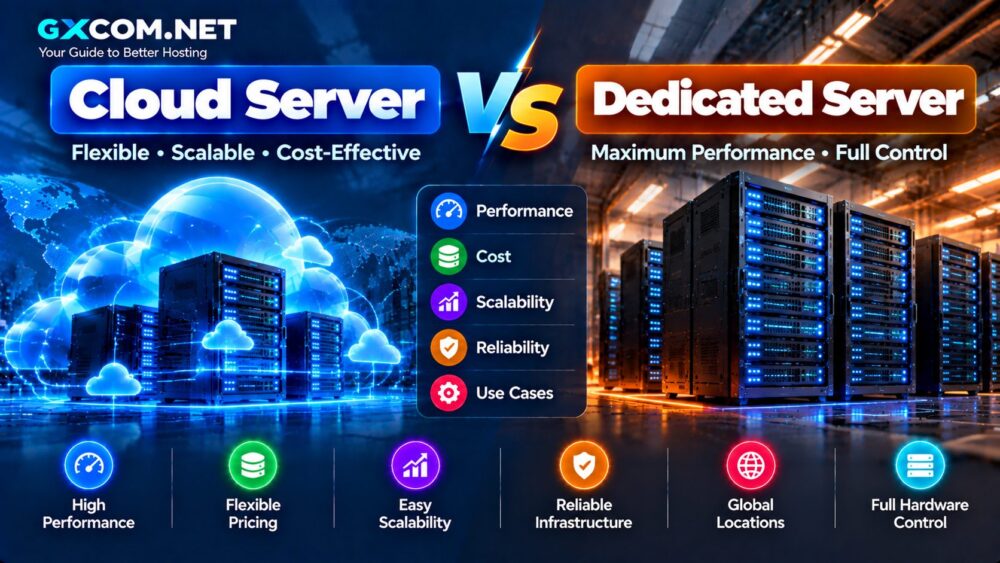
Cloud Server vs Dedicated Server Quick Comparison
| Feature | Cloud Server | Dedicated Server |
|---|---|---|
| Infrastructure | Virtualized cloud environment | Entire physical server |
| Resources | Flexible virtual resources | Dedicated physical hardware |
| Scalability | Highly flexible | Requires hardware upgrades |
| Performance | Strong and configurable | Maximum hardware performance |
| Pricing | Usage-based or flexible plans | Fixed hardware rental |
| Best For | Growing applications and businesses | High-performance workloads |
What Is a Cloud Server?
A cloud server is a virtual machine running on cloud infrastructure.
Instead of relying on one physical machine, cloud servers use pools of computing resources including:
- CPU capacity
- RAM
- Storage systems
- Network resources
- Virtualization technology
Cloud servers are commonly used for:
- Web applications
- SaaS platforms
- Business websites
- Databases
- Development environments
- AI and data workloads
The main advantage of cloud servers is flexibility. Resources can usually be adjusted without replacing physical hardware.
What Is a Dedicated Server?
A dedicated server provides an entire physical server exclusively for one customer.
Unlike cloud servers, there is no virtualization layer sharing the hardware with other virtual machines.
A dedicated server provides:
- Full physical hardware access
- Dedicated CPU resources
- Dedicated RAM
- Dedicated storage
- Complete server control
Dedicated servers are often used for:
- Large databases
- High-traffic websites
- Enterprise applications
- Gaming servers
- Large-scale processing workloads
Cloud Server vs Dedicated Server Architecture
Cloud Server Architecture
Cloud Infrastructure

Compute Resources
        |
Virtual Server Instance
        |
Application
The cloud platform manages the underlying hardware pool while users operate their virtual server environment.
Dedicated Server Architecture
Physical Server

CPU
RAM
Storage
        |
Application
The customer receives the entire physical machine.
Performance Comparison
Performance is one of the biggest factors when choosing between cloud servers and dedicated servers.
Cloud Server Performance
Modern cloud servers can deliver excellent performance through:
- High-performance CPUs
- NVMe storage
- Fast networking
- Flexible resource allocation
Cloud platforms allow users to select different instance types depending on workload requirements.
Dedicated Server Performance
Dedicated servers provide direct access to physical hardware.
Advantages include:
- No virtual machine overhead
- Dedicated hardware resources
- Predictable performance
- Maximum customization
For workloads requiring consistent maximum hardware performance, dedicated servers can provide significant advantages.
Cloud Server vs Dedicated Server Scalability
Scalability is where cloud servers usually have the strongest advantage.
Cloud Server Scaling
Cloud platforms typically allow users to:
- Increase CPU resources
- Add RAM
- Expand storage
- Create additional instances
- Deploy servers in new regions
This makes cloud servers suitable for businesses with changing workloads.
Dedicated Server Scaling
Dedicated servers have physical hardware limitations.
Scaling often requires:
- Hardware upgrades
- Migration to another server
- Additional machines
- Infrastructure planning
Dedicated servers can scale through adding more servers, but the process is generally less flexible than cloud environments.
Cost Comparison
The pricing models of cloud servers and dedicated servers are different.
| Cost Factor | Cloud Server | Dedicated Server |
|---|---|---|
| Billing | Hourly or monthly options | Usually monthly rental |
| Initial Cost | Lower entry point | Higher commitment |
| Resource Expansion | Flexible upgrades | Hardware replacement |
| Unused Capacity | Can adjust resources | Pay for entire machine |
Cloud servers can be cost-efficient because businesses can adjust resources according to demand.
Dedicated servers may provide better value when workloads consistently require maximum hardware resources.
Cloud Server vs Dedicated Server for Websites
Both options can host websites, but the suitable choice depends on traffic and technical requirements.
Cloud Servers Are Suitable For:
- Growing websites
- International websites
- Dynamic applications
- Ecommerce platforms
- SaaS products
Dedicated Servers Are Suitable For:
- Very high traffic websites
- Large databases
- Resource-heavy applications
- Specialized software environments
Many modern businesses choose cloud servers first because they provide easier scaling during growth periods.
Cloud Server vs Dedicated Server for Ecommerce
Ecommerce platforms require reliable infrastructure because slow performance can affect user experience and sales.
Cloud servers provide:
- Flexible scaling during campaigns
- Multiple deployment regions
- Cloud backup options
- Easy resource upgrades
Dedicated servers provide:
- Consistent hardware resources
- Maximum customization
- High-performance environments
The better choice depends on traffic patterns and application architecture.
Cloud Server vs Dedicated Server for Developers
Developers often prefer cloud servers because of:
- Fast deployment
- API access
- Automation tools
- Multiple regions
- Easy testing environments
Dedicated servers are useful when developers need:
- Specific hardware configurations
- Maximum resource isolation
- Specialized computing environments
Reliability and Availability
Cloud servers are designed around distributed infrastructure and commonly provide features such as:
- Snapshots
- Backup systems
- Multiple regions
- Flexible recovery options
Dedicated servers can also provide excellent reliability when operated in professional data centers with proper redundancy.
Neither solution automatically guarantees perfect uptime. Provider infrastructure, application design and maintenance practices remain important.
Security Comparison
Both cloud servers and dedicated servers can be secure when properly configured.
Cloud server security usually includes:
- Firewall controls
- Access management
- Network security tools
- Backup options
Dedicated server security advantages include:
- Physical hardware isolation
- Complete environment control
- Custom security configurations
Cloud Server vs Dedicated Server: Which Is Better?
The answer depends on workload requirements.
Choose Cloud Servers If You Need:
- Flexible scaling
- Lower entry costs
- Fast deployment
- Multiple regions
- Changing resource requirements
Choose Dedicated Servers If You Need:
- Maximum hardware performance
- Full physical resources
- Specialized configurations
- Consistent heavy workloads
Common Mistakes When Choosing Server Infrastructure
Choosing Too Much Hardware
Many businesses pay for resources they do not actually use.
Ignoring Future Growth
A server should support future expansion, not only current requirements.
Comparing Only Monthly Price
Performance, management, backup and scalability also affect total cost.
Ignoring Technical Requirements
Dedicated servers often require stronger system administration skills.
Cloud Server vs Dedicated Server: Final Thoughts
Cloud servers and dedicated servers both provide powerful infrastructure, but they solve different problems.
Cloud servers offer flexibility, scalability and easier resource management, making them suitable for many modern applications and growing businesses.
Dedicated servers provide maximum physical hardware control and consistent performance for demanding workloads.
Before choosing between them, evaluate your application requirements, traffic patterns, budget and future growth plans.
For most growing digital businesses, cloud infrastructure provides a flexible foundation, while dedicated servers remain valuable for specialized high-performance workloads.