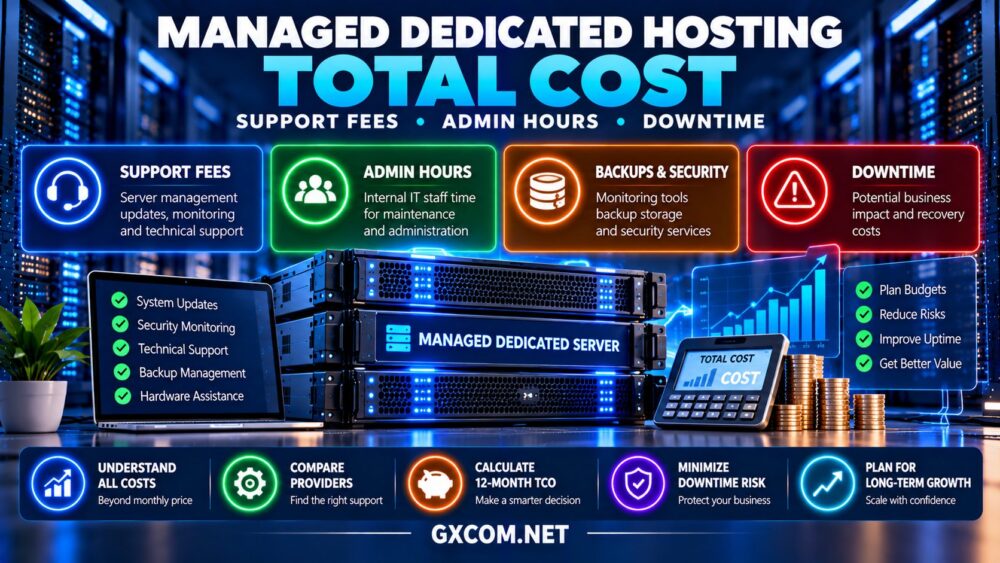
Managed dedicated hosting for SaaS can reduce the operational burden of running subscription applications, but the word “managed” does not guarantee complete application support. Some providers monitor hardware and operating systems, while others offer additional database administration, security maintenance, or incident response.
For SaaS companies, the right hosting contract depends on uptime requirements, database complexity, internal engineering capacity, and growth forecasts. This guide explains what to expect from managed dedicated servers, which services require confirmation, and how to compare long-term costs.
What Is Managed Dedicated Hosting for SaaS?
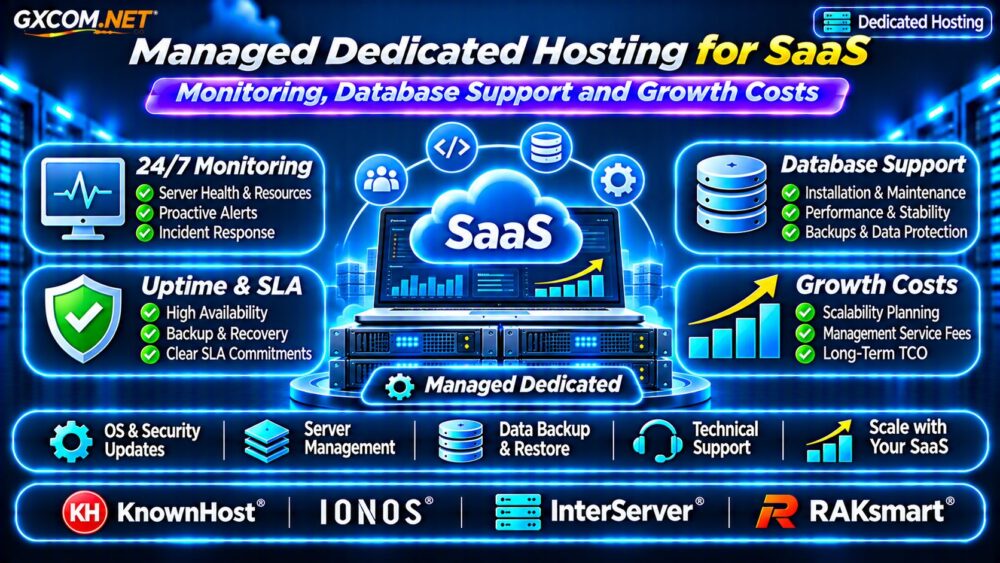
Managed dedicated hosting combines exclusive physical server resources with a defined set of administration services. The provider may handle operating system updates, security patches, monitoring, and selected recovery tasks.
Unlike shared hosting, the customer receives a physical server dedicated to its workloads. However, dedicated hardware alone does not deliver automatic failover, unlimited scaling, or application-level maintenance.
Service boundaries differ substantially. A hosting company may manage Linux or Windows while excluding custom SaaS code, third-party integrations, and database query optimization.
Before buying, compare this service model with the hardware-focused approach in our Best Dedicated Servers for SaaS Applications Guide.
24/7 Monitoring: What Should Be Included?
Monitoring is one of the strongest reasons to purchase managed infrastructure. Nevertheless, continuous data collection and continuous human response are different services.
A useful managed plan should define how the provider detects incidents, notifies customers, and responds to actionable alerts.
| Monitoring Area | Questions to Ask |
|---|---|
| Hardware | Are disk, RAID, temperature, and power faults monitored? |
| Operating system | Are CPU, memory, filesystem, and service failures tracked? |
| Application | Are HTTP checks and SaaS endpoints included? |
| Database | Are replication, connections, and query latency monitored? |
| Incident response | Who investigates alerts outside business hours? |
Request written escalation procedures and distinguish alert acknowledgment from actual resolution. Even with managed hosting, SaaS teams should retain independent application telemetry and external availability checks.
Database Support: Where Managed Hosting Stops
Database performance directly affects SaaS response times, billing operations, and customer experience. Yet managed database support is often narrower than buyers expect.

Basic Database Administration
A provider might install a supported database engine, apply approved updates, restart services, and monitor basic availability. These activities are useful but do not necessarily include schema design, indexing, or slow-query investigation.
Advanced Database Operations
Replication, failover, point-in-time recovery, performance tuning, and major-version migrations require specialized expertise. Confirm whether these services are included, billed separately, or entirely customer-managed.
Ask who owns backup consistency, encryption keys, database credentials, and restoration testing. A successful backup job does not prove that an application can be recovered within its required time window.
Managed vs Unmanaged Dedicated Hosting
Unmanaged servers can offer more administrative control and potentially lower recurring fees, but customers assume greater responsibility for monitoring, patching, and incident handling.
Managed hosting may reduce routine operational work, although application development and business continuity planning usually remain shared responsibilities.
For a broader explanation of responsibility boundaries, see our Managed vs Unmanaged Hosting Comparison.
SaaS Uptime, SLAs and Recovery Planning
Availability commitments must be evaluated alongside recovery capabilities. A network uptime guarantee does not automatically cover database corruption, deployment errors, or failures inside custom applications.
Examine SLA exclusions, measurement methods, service credits, hardware replacement procedures, and escalation channels. Service credits are not equivalent to compensation for lost SaaS revenue.
Define recovery time objectives (RTO) and recovery point objectives (RPO) before selecting backup and replication services.
Our Snapshot Backup and Recovery Guide explains why independent restore planning remains essential.
Four Managed Dedicated Hosting Providers to Compare
The following approved providers are candidates for SaaS infrastructure procurement. Management coverage, dedicated product availability, and support terms must be verified for each quotation.
KnownHost: Managed Service Scope
KnownHost is a useful comparison candidate for businesses prioritizing hosting administration and technical support. Ask which dedicated configurations are available and whether database maintenance, monitoring, and emergency assistance are included.
IONOS: Enterprise Infrastructure Planning
IONOS deserves consideration when SaaS applications require physical server resources and predictable infrastructure budgeting. Compare dedicated hardware, management options, backup services, and documented response procedures.
InterServer: Hardware and Management Costs
InterServer provides another comparison point for balancing server rental against operational services. Request an itemized quotation covering the operating system, monitoring, backups, security maintenance, and support boundaries.
RAKsmart: Regional Deployment Requirements
RAKsmart may be relevant when geographic deployment and configurable dedicated infrastructure influence the decision. Confirm whether the required management services are offered for the selected server and location.
Do not assume identical support levels across products marketed by the same provider. Compare signed service descriptions rather than promotional labels.
Managed Dedicated Hosting Growth Costs
Growing SaaS platforms consume more compute resources, database memory, storage, bandwidth, and operational attention. A fixed server rental may therefore represent only part of the expansion budget.
Consider a hypothetical monthly model:
- Dedicated hardware: $180.
- Management and monitoring: $60.
- Backups and additional storage: $35.
- External monitoring and security tools: $25.
The illustrative total is $300 monthly, or $10,800 over three years before migration, upgrades, taxes, and unexpected expenses. These figures are assumptions, not provider quotations.
If growth requires a second node, database replication, or load balancing, costs may rise faster than customer counts. Estimate infrastructure spending per active customer and review capacity quarterly.
When Should SaaS Companies Upgrade?
Consider additional infrastructure when optimized applications consistently experience CPU saturation, database latency, memory pressure, or insufficient recovery capacity.
Do not upgrade simply because traffic increases. First examine inefficient queries, caching, background jobs, and application architecture.
For alternatives involving elastic infrastructure, review our Dedicated vs Cloud Server Comparison.
Managed Dedicated Hosting Buying Checklist
- Obtain a written responsibility matrix for operating systems, databases, and applications.
- Confirm monitoring coverage, alert escalation, and response hours.
- Verify backup retention, restore testing, RTO, and RPO.
- Request complete hardware, licensing, and management pricing.
- Review upgrade paths, cancellation terms, and migration assistance.
Frequently Asked Questions
Does Managed Dedicated Hosting Include Database Optimization?
Not automatically. Some services cover installation and availability only. Advanced query tuning and replication may require separate agreements.
Is Managed Dedicated Hosting Better Than Cloud Hosting?
It depends on workload stability, scaling requirements, support coverage, and cost. Neither architecture guarantees better uptime without appropriate design.
Can Managed Hosting Eliminate the Need for DevOps?
Usually not. SaaS teams remain responsible for application behavior, releases, customer data policies, and business-specific recovery decisions.
Final Verdict
Managed dedicated hosting for SaaS is most valuable when documented monitoring, administration, and incident response reduce operational risk at a sustainable cost.
Compare KnownHost, IONOS, InterServer, and RAKsmart using verified service scopes, realistic growth projections, and total operating expenses. Choose the contract that supports your application requirements rather than relying on the word “managed.”