Comparing managed hosting vs server management services is essential when a business needs reliable infrastructure without maintaining every server itself. Both approaches provide technical assistance, but they differ in who owns the hosting environment, handles incidents, and accepts responsibility when something breaks.
Managed hosting typically combines infrastructure and defined administration services under one provider. Third-party server management allows businesses to retain existing VPS, cloud, or dedicated servers while hiring specialists to maintain them.
This guide compares support coverage, service-level agreements (SLAs), response times, and total operating costs to help you choose the right model.
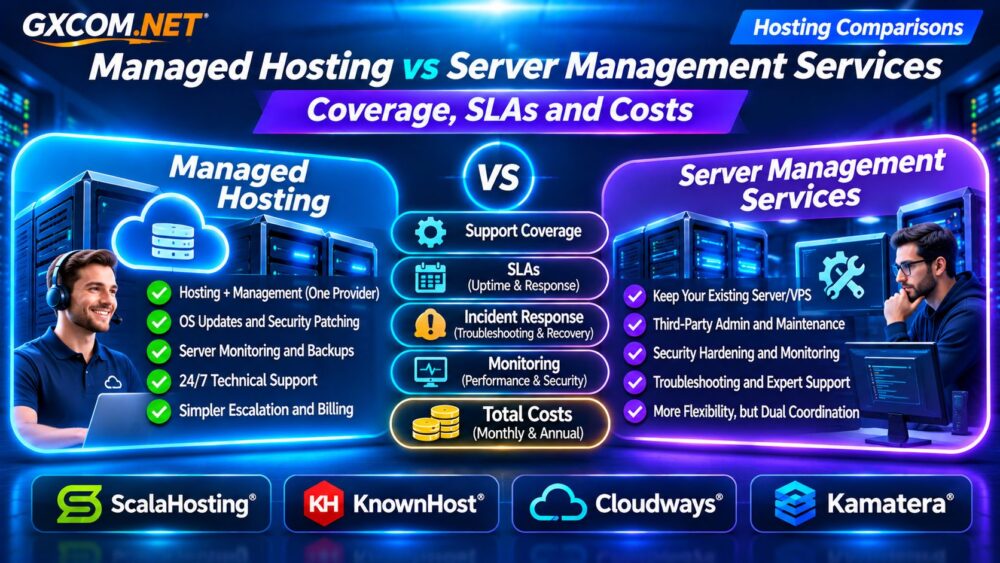
Managed Hosting vs Server Management Services: Quick Comparison
| Factor | Managed Hosting | Third-Party Management |
|---|---|---|
| Infrastructure provider | Usually same company | Separate hosting company |
| Server administration | Included within plan scope | Separate service agreement |
| Hardware incidents | Hosting provider | Infrastructure provider |
| Monitoring | Plan-dependent | Contract-dependent |
| Root access | May be restricted | Depends on server and agreement |
| Billing | Often consolidated | Usually separate invoices |
| Incident coordination | Potentially simpler | Requires coordination |
Neither model guarantees unlimited support. Written service boundaries matter more than marketing labels.
What Does Managed Hosting Actually Include?
Managed hosting combines server resources with provider-defined operational assistance. Depending on the product, coverage may include operating system updates, supported web services, security configuration, monitoring, and troubleshooting.
Some plans include migration assistance, control panels, or backup tools. Others charge separately for these features.
Application development, plugin conflicts, custom scripts, and business-specific databases may remain outside standard support.
Before purchasing, request a task-level support list rather than relying on the phrase “fully managed.”
Our Managed Cloud Hosting Providers Comparison examines additional managed infrastructure options.
What Are Third-Party Server Management Services?
Third-party management companies administer servers hosted elsewhere. A business might rent an unmanaged VPS or dedicated server, then contract a separate specialist for updates, monitoring, security hardening, and incident response.
This arrangement can preserve existing infrastructure and provide access to expertise without migrating applications.
However, the management company cannot necessarily replace failed physical hardware, resolve upstream network outages, or change restrictions imposed by the hosting provider.
Businesses should verify supported operating systems, control panels, access requirements, and escalation procedures before signing a management contract.
Support Coverage: Who Fixes What?
The most important purchasing question is which party owns each operational responsibility.

| Task | Managed Hosting | Separate Management |
|---|---|---|
| Physical hardware failure | Host | Host |
| OS security updates | Check plan | Check contract |
| Web server configuration | Often supported | Often supported |
| Application debugging | Often excluded | Often excluded |
| Backup restoration | Check plan | Check contract |
| Network routing incidents | Host | Host coordination required |
A separate management provider may diagnose a network problem but still depend on the infrastructure company to resolve it. This division can delay recovery unless escalation responsibilities are clearly documented.
Understanding Hosting SLAs and Response Times
An SLA may describe service availability, support response targets, service credits, or maintenance exclusions. These commitments are not interchangeable.
For example, a 99.9% monthly uptime target corresponds to approximately 43 minutes of permitted downtime in a 30-day month. It does not necessarily promise restoration within 43 minutes.
Similarly, a 15-minute initial response target means a support team aims to acknowledge or begin handling a request. It does not guarantee resolution in that period.
Review four separate commitments:
- Infrastructure availability and excluded incidents.
- Initial support response by severity level.
- Escalation and restoration procedures.
- Service credits, limitations, and claim requirements.
When using two vendors, determine which SLA applies to each component. Neither company’s commitment automatically covers the other’s failures.
Security, Monitoring, and Backup Responsibilities
Both approaches require explicit ownership of patching, firewall rules, access controls, and recovery procedures.
Ask whether monitoring covers only server availability or also disk capacity, database health, suspicious logins, and application failures.
Backup frequency should reflect business requirements. A nightly backup may be insufficient for an application processing transactions throughout the day.
Define recovery time objectives (RTO) and recovery point objectives (RPO), then test restoration rather than assuming snapshots guarantee recovery.
Our VPS Snapshot and Backup Recovery Guide explains these distinctions.
Monthly Costs: One Provider vs Two Contracts
Compare complete operating expenses rather than advertised management fees. Consider this hypothetical monthly example:
| Expense | Managed Hosting | Separate Management |
|---|---|---|
| Server infrastructure | $95 | $45 |
| Management service | Included | $65 |
| Backups and monitoring | $15 | $20 |
| Internal coordination | $15 | $30 |
| Monthly total | $125 | $160 |
| Annual total | $1,500 | $1,920 |
These figures are illustrative, not current supplier quotations. Internal coordination assumes allocated staff time.
In this example, integrated managed hosting saves $420 annually. Results can reverse when a business already owns suitable infrastructure, negotiates multi-server management rates, or needs specialist administration unavailable from its host.
Include migration fees, software licensing, emergency labor, backups, and renewal pricing when calculating total cost of ownership.
Four Approved Hosting Providers to Evaluate
ScalaHosting: Integrated Managed VPS
ScalaHosting is a candidate for businesses seeking VPS infrastructure with supported server management. Compare management scope, control panel options, backups, and resource upgrades before selecting a plan.
KnownHost: Managed Server Support
KnownHost is relevant when established hosting support and server administration are priorities. Confirm which maintenance tasks, operating systems, and troubleshooting scenarios are included.
Cloudways: Managed Cloud Application Platform
Cloudways offers an application-oriented managed cloud approach. It may suit website teams seeking simplified operations, but businesses requiring unusual system-level configurations should verify platform restrictions.
Kamatera: Flexible Cloud Infrastructure
Kamatera is worth evaluating when businesses want configurable cloud resources and must decide how administration will be handled. Confirm management eligibility, support coverage, and additional charges for the selected configuration.
These are infrastructure purchasing candidates, not four interchangeable independent server management agencies. Compare written service terms before making a decision.

When Should You Choose Managed Hosting?
Integrated managed hosting often makes sense when an organization wants consolidated billing, fewer vendors, and a clear escalation path for supported infrastructure issues.
It can be especially attractive for smaller businesses without dedicated system administrators.
However, verify whether application-level support and specialized configurations are available before migrating an established environment.
When Is Separate Server Management Better?
Third-party management may be preferable when a business already operates suitable servers, needs specialist expertise, or wants to retain freedom to change infrastructure providers.
It can also support organizations managing servers across multiple vendors, provided the management contract explicitly covers those environments.
For additional context, see our Managed vs Unmanaged VPS Comparison.
Frequently Asked Questions
Is Server Management Included With Every VPS?
No. Many VPS products are unmanaged, and managed plans differ significantly in their included responsibilities.
Does a 24/7 Support SLA Guarantee Fast Repairs?
No. Support availability, initial response, and incident resolution are separate commitments.
Can I Keep My Existing VPS and Hire Management?
Often yes, if the management company supports the operating system, access model, and hosting environment.
Final Verdict
Choose managed hosting when simplified vendor coordination and integrated infrastructure support are priorities. Consider separate server management when retaining existing hardware, specialized expertise, or provider flexibility delivers greater value.
Compare ScalaHosting, KnownHost, Cloudways, and Kamatera according to your workload, support requirements, and actual total costs. Before purchasing, document who handles incidents, backups, security updates, and escalation.
For security planning, consult our Unmanaged Server Security Checklist.