A discounted game server can look affordable at checkout but become considerably more expensive after its introductory period ends. For Minecraft, Rust, ARK, and other multiplayer communities, recurring hosting expenses can affect whether a server remains sustainable.
Understanding game server hosting renewal costs means comparing more than the first invoice. Renewal rates, resource upgrades, backups, billing cycles, and migration expenses all influence long-term value.
This guide explains how to calculate ownership costs, identify potential surprises, and compare hosting providers without relying on temporary promotional prices.
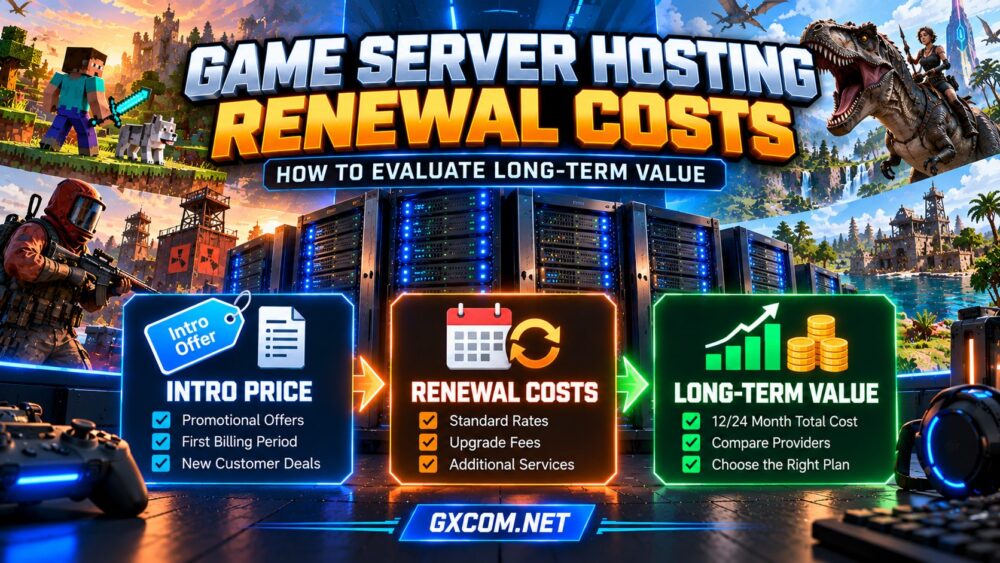
1. Understand Introductory Pricing vs Renewal Pricing
Some hosting promotions apply only to the first billing period. Others require longer commitments, specific coupon codes, or new-customer eligibility.
Before purchasing, distinguish three figures: the introductory charge, the standard recurring rate, and any optional services added during checkout.
Not every provider increases prices at renewal. However, assuming that a promotional rate continues indefinitely can lead to inaccurate budgeting.
Check the order summary, applicable terms, and customer dashboard. If renewal pricing remains unclear, request written confirmation from support.
2. Calculate the Real 12-Month and 24-Month Cost
Compare hosting plans over the same period rather than focusing on their advertised monthly equivalents.
Use this calculation:
Total hosting cost = introductory charges + subsequent recurring charges + setup fees + required add-ons + anticipated upgrade expenses.
For a twelve-month comparison, calculate every payment expected during those twelve months. Repeat the process over twenty-four months to identify offers that become less attractive after promotional periods expire.
Annual prepayment may reduce the effective monthly cost, but it also increases upfront commitment and potential refund exposure.
Our game server hosting costs guide explains the broader cost structure of multiplayer infrastructure.
3. Watch for Common Additional Charges
Game hosting invoices may include optional or usage-based expenses beyond the advertised base plan. Availability and billing policies vary by provider.
| Cost Category | What to Verify |
|---|---|
| Backups | Included storage, retention, restoration fees |
| CPU and RAM upgrades | New recurring rate and upgrade rules |
| Additional storage | Capacity limits and expansion pricing |
| Network transfer | Allowances, fair-use rules, overage charges |
| Server locations | Regional pricing differences |
| Dedicated IP addresses | Availability and recurring charges |
| Management services | Support scope and optional administration |
These are potential billing categories, not claims that every hosting company charges for them. Compare the exact configuration you intend to purchase.

4. Account for Player Growth and Resource Upgrades
A small community may initially operate comfortably on an entry-level plan. As player counts, world complexity, and modifications increase, the server may require additional memory, stronger CPU performance, or more storage.
Ask whether upgrades are prorated, whether changing plans removes existing discounts, and whether moving to a different hardware tier requires migration.
For large modded communities, a slightly more expensive plan with adequate headroom may offer better value than repeated emergency upgrades.
However, avoid paying for resources you cannot realistically use. Review actual utilization before expanding.
5. Compare Managed Hosting, VPS, and Dedicated Servers
Different hosting models distribute costs and responsibilities differently.
Managed game hosting may include convenient installation tools and game-specific support. A gaming VPS offers greater operating-system control but generally requires more technical administration. Dedicated hardware provides exclusive physical resources, often with a larger financial commitment.
Management time also has value. A lower infrastructure bill may not be economical if frequent maintenance consumes hours that could be spent running your community.
Read our managed vs self-hosted game servers comparison before choosing a hosting model.
6. Evaluate Providers Using the Same Checklist
When comparing game-hosting offers, review equivalent configurations, regions, billing terms, and support responsibilities.
Host Havoc and Sparked Host are approved game-hosting options worth evaluating for supported titles, resource packages, upgrade flexibility, and current renewal terms.
GameServerKings and Godlike.Host are additional candidates for comparing game-focused hosting, administration features, and available configurations.
Do not assume that any provider automatically offers the lowest renewal rate or includes every optional feature. Confirm current prices and contract conditions directly before purchasing.
For wider selection criteria, see our game hosting provider selection guide.
7. Consider Migration and Switching Costs
Changing providers can reduce recurring expenses, but migration introduces operational work and potential downtime.
Before switching, check whether you can export world files, plugin configurations, player records, and backups. Verify the destination’s game-version compatibility and available storage.
Some migrations require overlapping subscriptions while both servers remain active. DNS changes, player notifications, and testing also take time.
Keep a verified backup before cancellation, and do not terminate the original service until the replacement works correctly.
Our game server backup strategies guide explains how to protect essential data during transitions.
8. Decide Whether to Renew or Switch
Do not change providers solely because another company advertises a lower introductory rate. Compare the cost after that promotion expires, along with reliability, support, and migration effort.
Renewing may be preferable when the existing server performs well, billing is transparent, and moving offers limited savings.
Switching may make sense when recurring costs exceed your budget, necessary upgrades are disproportionately expensive, or persistent service problems remain unresolved.
Use our game server hosting deals comparison to explore alternative purchasing options.

Game Server Renewal Checklist
- Confirm the standard renewal rate and billing date.
- Check whether discounts expire or require eligibility.
- Review backup, storage, bandwidth, and IP charges.
- Calculate total costs over twelve and twenty-four months.
- Verify upgrade pricing and resource limitations.
- Read cancellation, refund, and automatic-renewal terms.
- Estimate migration work before switching providers.
- Save written confirmation of important billing conditions.
Frequently Asked Questions
Do Game Server Hosting Prices Always Increase at Renewal?
No. Some plans renew at their original rate, while promotional offers may expire. Review the provider’s specific billing terms.
Is Annual Game Server Hosting Cheaper?
It can reduce the effective monthly rate, but savings depend on the offer. Consider upfront payment, cancellation rights, and refund restrictions.
Can Upgrading Remove My Promotional Discount?
Potentially. Discount eligibility and upgrade billing rules vary. Confirm the new recurring amount before changing plans.
Should I Switch Hosts to Get a New Customer Deal?
Only when expected savings justify migration effort, potential downtime, and any changes in performance or support quality.
Final Verdict: Prioritize Long-Term Value
The best approach to game server hosting renewal costs is to evaluate the complete service lifecycle, not just the checkout discount.
Compare equivalent plans, calculate realistic recurring expenses, and verify renewal conditions before committing. Sustainable hosting value comes from predictable billing, suitable resources, and reliable service.