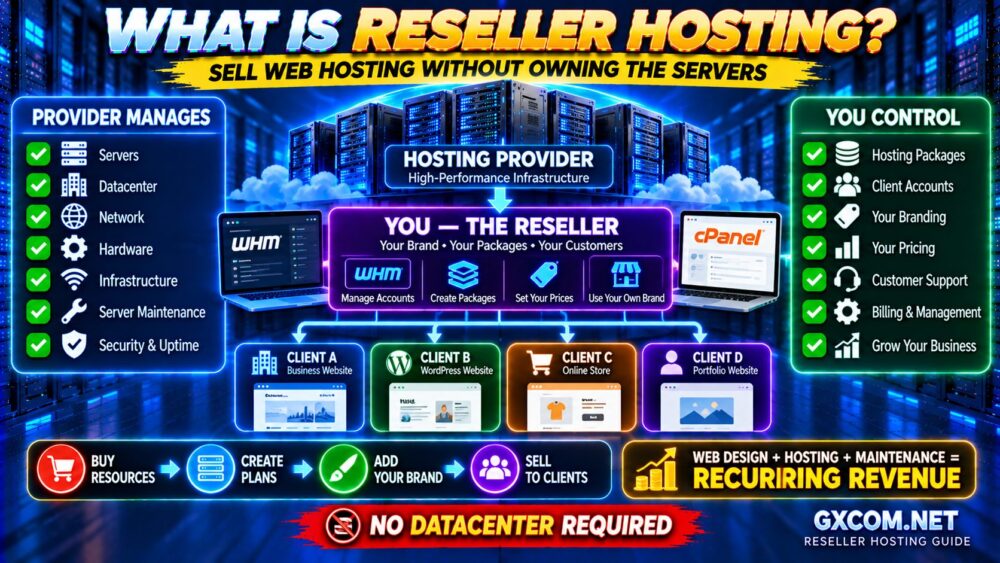
Reseller hosting lets you buy hosting resources from a larger hosting company and then sell hosting services to your own customers.
Instead of building a datacenter, buying servers and operating an entire hosting platform yourself, you use infrastructure provided by an established hosting company.
You then create hosting packages, allocate resources to customers, manage accounts and charge your own prices.
This makes reseller hosting particularly attractive to web designers, developers, digital agencies and entrepreneurs who want to offer web hosting without operating physical server infrastructure.
But reseller hosting is not simply “buy hosting cheap and sell it for more.”
You need to understand resource limits, customer management, billing, technical support, backups, security and the real cost of operating a hosting business.
This guide explains what reseller hosting is, how it works, what it costs, its advantages and disadvantages, and who should actually use it.
What Is Reseller Hosting?
Reseller hosting is a hosting model where a customer purchases hosting resources from a provider and redistributes those resources among multiple client accounts.
The basic structure looks like this:
HOSTING PROVIDER
↓
RESELLER ACCOUNT
↓
YOUR HOSTING PACKAGES
↓
YOUR CUSTOMERS
The upstream hosting company operates the underlying server infrastructure.
You operate the customer-facing hosting business.
Depending on the reseller platform, you may be able to:
- Create individual hosting accounts
- Define storage limits
- Set bandwidth allowances
- Manage domains
- Create hosting packages
- Control customer accounts
- Use your own branding
- Set your own prices
- Provide customer support
The exact features depend on the provider and reseller plan.
How Does Reseller Hosting Work?
Imagine that a hosting company gives your reseller account access to a pool of resources.
For example, your account may include a certain amount of:
- Storage
- Bandwidth
- Hosting accounts
- Email resources
- CPU and memory capacity
- Backup functionality
You then divide those resources among your customers.
For example:
RESELLER HOSTING PLAN
↓
CLIENT A — Business Website
CLIENT B — WordPress Blog
CLIENT C — Portfolio
CLIENT D — Local Business Site
Each client can receive an independent hosting account rather than sharing your own personal hosting login.
This account separation is one of the major reasons reseller hosting is useful for agencies managing multiple customer websites.
Reseller Hosting vs Regular Web Hosting
Regular web hosting is primarily designed to host your own websites.
Reseller hosting is designed to manage hosting for other customers.
| Feature | Regular Web Hosting | Reseller Hosting |
|---|---|---|
| Main purpose | Host your websites | Host client websites |
| Separate client accounts | Usually limited | Core feature |
| Create hosting packages | Usually no | Usually yes |
| Sell hosting | Not primary purpose | Yes |
| White-label options | Usually no | Often available |
| Client management | Limited | Designed for it |
If you only operate one or two personal websites, normal web hosting may be simpler.
If you manage websites for multiple paying customers, reseller hosting becomes much more useful.
What Is White-Label Reseller Hosting?
White-label hosting allows you to present hosting services under your own business identity rather than prominently displaying the upstream hosting company's brand.
Depending on the provider, white-label functionality may include:
- Custom nameservers
- Your company branding
- Branded customer interfaces
- Custom hosting packages
- Your own domain
The customer relationship can therefore look like:
YOUR AGENCY
↓
YOUR HOSTING BRAND
↓
YOUR CUSTOMER
while the underlying infrastructure is still operated by another hosting company.
This is especially useful for web agencies that want hosting to appear as part of their own service package.
What Are WHM and cPanel in Reseller Hosting?
Many traditional reseller hosting environments use WHM and cPanel.
WHM
WHM, or WebHost Manager, is commonly used by the reseller to manage hosting accounts and packages.
Depending on the environment, WHM can allow you to:
- Create customer accounts
- Suspend accounts
- Define hosting packages
- Set quotas
- Manage domains
- Control account-level features
cPanel
cPanel is generally the interface used by individual hosting customers.
A typical structure is:
YOU → WHM
↓
CREATE CLIENT ACCOUNT
↓
CLIENT → cPanel
Not every reseller hosting platform uses cPanel/WHM. Some providers use proprietary control panels or alternative hosting management systems.
When comparing plans, check whether the control panel is included or adds an additional cost.
Who Actually Owns the Server?
In conventional reseller hosting, you usually do not own or directly manage the physical server.
The upstream provider generally handles:
- Physical hardware
- Datacenter
- Network infrastructure
- Power and cooling
- Core server platform
- Hardware maintenance
You typically focus on:
- Hosting packages
- Customer accounts
- Pricing
- Billing
- Customer relationships
- First-line support
The exact responsibility boundary varies significantly between providers.
Always check what the upstream host actually supports before selling services to customers.
How Do You Make Money With Reseller Hosting?
The basic business model is straightforward.
You pay for reseller infrastructure and sell smaller hosting packages to multiple customers.
Conceptually:
CUSTOMER REVENUE
−
HOSTING COST
−
SOFTWARE COST
−
SUPPORT COST
−
OTHER BUSINESS COSTS
=
PROFIT
But the strongest reseller hosting businesses often do not compete purely on hosting price.
Instead, they bundle hosting with higher-value services such as:
- Website design
- WordPress maintenance
- Security
- Backups
- Website updates
- SEO
- Email management
- Technical support
This changes the business from:
“SELL CHEAP HOSTING”
to:
“SELL AN ONGOING WEBSITE SERVICE.”
That distinction can have a major impact on profitability.
How Much Does Reseller Hosting Cost?
Reseller hosting costs vary widely depending on resources, control panel licensing, account limits, management and included features.
Instead of focusing on one advertised monthly price, evaluate the complete cost structure.
Potential costs include:
- Reseller hosting subscription
- Control panel licensing
- Billing software
- Backup storage
- Domain reseller services
- Security tools
- Customer support
- Payment processing
- Business email
- Website and marketing costs
This is why:
RESELLER PLAN PRICE ≠ TOTAL BUSINESS COST.
Why Renewal Pricing Matters
Hosting promotions can make the first billing period look inexpensive.
But reseller hosting is usually a long-term business service.
Your customers may stay for years.
That means you should understand:
- Introductory price
- Renewal price
- Billing term
- Upgrade cost
- Additional account costs
- Control panel costs
- Backup costs
Your business model should still make sense after promotional pricing ends.
BUILD YOUR MARGINS AROUND SUSTAINABLE COSTS, NOT TEMPORARY DISCOUNTS.
What Resources Matter in Reseller Hosting?
Storage and bandwidth are easy to advertise, but they are not the only resources that affect customer websites.

Pay attention to:
- CPU allocation
- RAM limits
- Disk I/O
- IOPS
- Processes
- Concurrent connections
- Inodes
- PHP workers
- Number of accounts
A reseller plan can offer large amounts of storage while still limiting website performance through CPU or I/O policies.
MORE DISK SPACE ≠ MORE HOSTING PERFORMANCE.
Can You Create Your Own Hosting Plans?
One of the main benefits of reseller hosting is the ability to create packages for different customer types.
For example:
| Package | Example Customer | Positioning |
|---|---|---|
| Starter | Portfolio / Small Blog | Basic hosting |
| Business | Local Business | More resources and backups |
| WordPress | WordPress Website | Managed updates and optimization |
| Agency Plus | Larger Client | Higher resources and priority support |
The names, prices and exact features are yours to define within the limitations of the upstream reseller plan.
Reseller Hosting for Web Designers
Web designers are among the strongest use cases for reseller hosting.
Imagine that you build 20 websites for customers.
Without reseller hosting, each client might independently purchase hosting from a different provider.
You could end up dealing with:
- 20 hosting companies
- 20 billing systems
- Different control panels
- Different support teams
- Different server environments
With reseller hosting, you can centralize much of that infrastructure.
The workflow becomes:
DESIGN WEBSITE
↓
CREATE CLIENT HOSTING ACCOUNT
↓
DEPLOY WEBSITE
↓
CHARGE RECURRING HOSTING / MAINTENANCE FEE
This can turn one-time web design customers into recurring service customers.
Reseller Hosting for Digital Agencies
Digital agencies often provide multiple services:
- Web design
- SEO
- Advertising
- Content
- Website maintenance
Hosting can become another recurring component of the client relationship.
Instead of sending the customer elsewhere after building the website, the agency can provide:
DESIGN + HOSTING + MAINTENANCE + SUPPORT
This creates a more complete service ecosystem and can increase customer retention.
Reseller Hosting for Freelancers
Freelancers who manage multiple websites can also benefit.
It may be easier to maintain client sites when they share:
- A familiar control panel
- A consistent hosting environment
- A centralized account structure
- Similar backup processes
However, once you sell hosting to clients, you also accept additional responsibility.
If a customer's website goes offline, they are likely to contact you first—not the upstream provider.
Reseller Hosting for Entrepreneurs
It is possible to launch a standalone hosting business using reseller hosting.
This has a much lower infrastructure barrier than operating your own servers.
But the hosting market is highly competitive.
Competing only on price against large hosting companies can be difficult.
A stronger strategy is often to target a niche.
Examples might include:
- Hosting for local businesses
- Hosting for designers
- Hosting for a specific CMS
- Hosting for a specific industry
- Hosting bundled with maintenance
NICHE + SERVICE + SUPPORT can be a stronger differentiator than simply offering another generic hosting plan.
Advantages of Reseller Hosting
1. Low Infrastructure Barrier
You do not need to build a datacenter or purchase physical servers to begin selling hosting.
2. Recurring Revenue
Hosting is normally billed repeatedly, creating the possibility of recurring revenue.
3. Centralized Client Management
Multiple customer hosting accounts can be managed through one reseller environment.
4. Your Own Pricing
You can create packages and determine how much customers pay.
5. White-Label Branding
Suitable platforms can allow hosting to become part of your own brand.
6. Easy Service Bundling
Hosting can be combined with design, development, maintenance and other services.
7. No Physical Server Management
The upstream provider handles the underlying infrastructure in conventional reseller hosting.
Disadvantages of Reseller Hosting
1. You Depend on the Upstream Provider
If the upstream infrastructure experiences problems, your customers may experience problems too.
2. You Become the Customer's First Contact
Customers may expect you to solve hosting, website, email and DNS problems.
3. Resources Are Still Limited
A reseller plan has resource boundaries even if the marketing emphasizes large storage or bandwidth allocations.
4. Margins Can Be Smaller Than Expected
Software, payment processing, support and customer acquisition can reduce profit.
5. Scaling May Require Migration
A growing reseller business may eventually need a more powerful reseller plan, VPS, cloud environment or dedicated server.
Reseller Hosting vs Shared Hosting
Both can use shared infrastructure, but they solve different problems.
SHARED HOSTING:
“I need somewhere to host my website.”
RESELLER HOSTING:
“I need to create and manage hosting accounts for customers.”
If your goal is simply hosting your own website, reseller hosting is usually unnecessary.
For a broader infrastructure comparison, see our Shared Hosting vs VPS guide.
Reseller Hosting vs VPS
A VPS gives you a virtual server environment with more control over the operating system and server software.
Reseller hosting generally provides less server-level control but simplifies customer account management.
| Feature | Reseller Hosting | VPS |
|---|---|---|
| Server administration | Usually provider-managed | Depends on plan |
| Client account management | Built for it | Requires setup/software |
| Root access | Usually no | Often yes |
| Technical complexity | Lower | Higher |
| Server customization | Limited | Much greater |
| Best for beginners | Generally easier | Depends on management |
A reseller business that outgrows conventional reseller hosting may eventually consider managed VPS or dedicated infrastructure.
If you are comparing server management responsibilities, our Managed vs Unmanaged VPS guide explains the difference.
Reseller Hosting vs Dedicated Server
A dedicated server gives you access to an entire physical server.
That provides much greater infrastructure control and resource capacity, but also introduces greater cost and administrative responsibility.
Traditional reseller hosting is usually the easier entry point.
A typical growth path can look like:
RESELLER HOSTING
↓
LARGER RESELLER PLAN
↓
MANAGED VPS / CLOUD
↓
DEDICATED SERVER
There is no reason to operate dedicated infrastructure before your customer base and workloads justify it.
What Should You Look for in a Reseller Hosting Provider?
Before buying, compare more than the headline price.
Look at:
- Number of client accounts
- Storage allocation
- Bandwidth
- CPU and RAM policies
- Disk I/O limits
- Control panel
- White-label functionality
- Custom nameservers
- SSL
- Backups
- Security
- Migration assistance
- Support scope
- Datacenter locations
- Upgrade path
- Renewal cost
The best reseller host is not necessarily the company offering the most disk space.
RELIABILITY + SUPPORT + RESOURCE QUALITY + MANAGEMENT TOOLS usually matter much more to your customers.
Reseller Hosting Providers to Consider
A number of established hosting companies offer reseller-oriented hosting or agency-focused infrastructure.
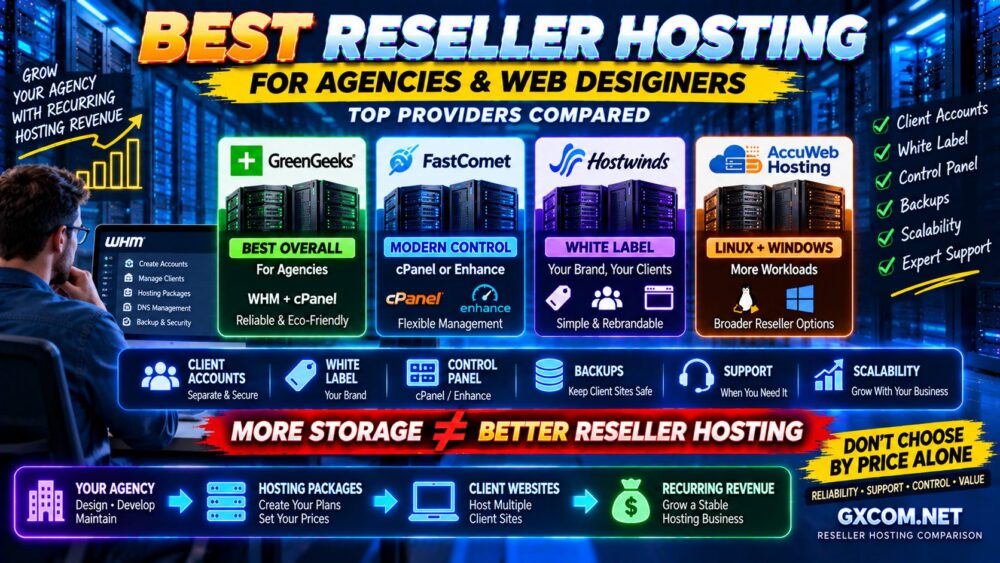
Depending on your requirements, providers such as ScalaHosting, GreenGeeks, Hostwinds, FastComet and AccuWeb Hosting may be relevant when comparing reseller hosting options.
Features can differ significantly between providers.
One provider may emphasize traditional cPanel/WHM reseller hosting, while another may structure its offering around managed cloud resources or agency tools.
Therefore, do not choose based only on the phrase “reseller hosting.”
Compare the actual account limits, control panel, backup policy, white-label features, support boundaries and long-term cost.
Does Reseller Hosting Include Customer Billing?
Not necessarily.
A reseller control panel manages hosting accounts, but running a hosting business can also require a billing system.
Billing software may handle:
- Customer signup
- Invoices
- Recurring payments
- Service activation
- Suspension
- Renewals
- Customer records
Some reseller plans may bundle or integrate billing software, while others require you to purchase or configure it separately.
This is an important cost to check before launching a hosting business.
Who Provides Technical Support to Your Customers?
This is one of the most important questions in reseller hosting.
In many reseller arrangements:
CUSTOMER
↓
YOU
↓
UPSTREAM HOSTING PROVIDER
Your customer contacts you.
If the issue relates to upstream infrastructure and you cannot resolve it, you contact the hosting provider.
This means 24/7 upstream support does not automatically mean the provider directly supports your customers.
Some reseller services may offer additional support arrangements, but never assume this is included.
How Many Customers Can You Host?
The answer depends on both the reseller plan and the workloads of your customers.
Ten lightweight brochure websites can require fewer resources than one busy ecommerce store.
Do not calculate capacity only from storage.
Think in terms of:
CUSTOMERS × WORKLOAD × TRAFFIC × RESOURCE USAGE
Monitor resource consumption and leave enough capacity for traffic spikes.
Should You Oversell Reseller Hosting?
Overselling means allocating more theoretical resources to customer plans than the amount expected to be used simultaneously.
This can work when usage patterns are predictable and the platform allows it.
But aggressive overselling can create:
- Resource contention
- Slow websites
- Customer complaints
- Account limitations
- Support problems
A sustainable reseller business should prioritize customer experience over maximizing the number of accounts on a plan.
SELLING CAPACITY ≠ DELIVERING PERFORMANCE.
Is Reseller Hosting Profitable?
It can be.
But profitability depends on much more than the difference between wholesale hosting cost and customer price.
The complete equation is closer to:
REVENUE
− Hosting
− Software
− Payment Fees
− Support
− Marketing
− Refunds
− Administration
=
REAL PROFIT
Reseller hosting tends to make the most strategic sense when hosting complements an existing service business.
A web agency that already has customers may have a much easier route to profitability than a new hosting company starting with zero customers.
Our upcoming Is Reseller Hosting Profitable? guide examines this business model in more detail.
Who Should Use Reseller Hosting?
Reseller hosting is particularly suitable for:
Web Designers
Sell hosting alongside websites and create recurring revenue after the design project ends.
Web Development Agencies
Centralize client hosting and offer ongoing maintenance.
Digital Marketing Agencies
Bundle hosting with SEO, advertising, content and website services.
Freelancers
Manage multiple customer websites in a more organized environment.
Entrepreneurs
Launch a hosting service without investing in physical infrastructure.
IT Service Companies
Add hosting to an existing portfolio of technology services.
Who Should NOT Use Reseller Hosting?
Reseller hosting may not make sense if:
- You only host one personal website
- You do not want to support customers
- You need root-level server customization
- You run highly specialized applications
- Your workloads require dedicated infrastructure
- You do not want responsibility for billing or customer relationships
For a normal website owner, conventional web hosting is usually simpler.
You can compare mainstream options in our Best Hosting Providers guide.
Reseller Hosting Checklist: What to Check Before You Buy
- ✓ How many customer accounts can I create?
- ✓ Is the service genuinely white-label?
- ✓ Can I use custom nameservers?
- ✓ Which control panel is included?
- ✓ Are control panel licenses included in the price?
- ✓ What CPU and memory limits apply?
- ✓ What are the I/O and inode limits?
- ✓ Are backups included?
- ✓ How long are backups retained?
- ✓ Is SSL included?
- ✓ Is email hosting included?
- ✓ Is billing software included?
- ✓ Who supports my customers?
- ✓ Can I easily upgrade?
- ✓ What is the renewal cost?
If a provider cannot clearly answer these questions, investigate further before moving customer websites onto the platform.
Reseller Hosting FAQ
What is reseller hosting?
Reseller hosting is a service that allows you to purchase hosting resources from an upstream provider and create hosting accounts or packages for your own customers.
How does reseller hosting work?
The hosting provider operates the underlying infrastructure. You receive a reseller account that allows you to divide hosting resources among customer accounts, manage packages and sell hosting under your own business model.
Can I make money with reseller hosting?
Yes, reseller hosting can generate recurring revenue, but profitability depends on customer pricing, infrastructure costs, software, support, payment processing and customer acquisition. It is often particularly effective when bundled with web design or maintenance services.
Do I need technical knowledge for reseller hosting?
You do not necessarily need to be a Linux system administrator, but you should understand domains, DNS, email, SSL, websites, backups and common hosting problems if you will be supporting customers.
Do I need my own server?
No. Traditional reseller hosting uses infrastructure operated by an upstream hosting provider. This is one of the main reasons it is easier to start than operating your own server platform.
Can customers see my upstream hosting provider?
White-label reseller hosting can reduce or remove visible upstream branding, but the degree of white labeling depends on the provider and configuration.
Is reseller hosting the same as shared hosting?
No. Shared hosting is mainly designed for hosting your own websites. Reseller hosting provides tools for creating and managing separate customer hosting accounts.
Is reseller hosting better than VPS?
Neither is universally better. Reseller hosting is easier for managing multiple customer hosting accounts, while VPS hosting provides greater server-level control. Your technical skills and business model determine which is more appropriate.
Can I host WordPress sites with reseller hosting?
Yes, many reseller hosting environments support WordPress. Check PHP versions, database resources, caching, backups, security and per-account resource limits before choosing a plan.
What happens if I outgrow reseller hosting?
You can potentially upgrade to a larger reseller package, managed VPS, cloud platform or dedicated server depending on the provider and your technical requirements.
Final Verdict: Is Reseller Hosting Worth It?
Reseller hosting can be an excellent way to provide hosting services without building your own infrastructure.
It is particularly valuable for:
WEB DESIGNERS
AGENCIES
FREELANCERS
IT SERVICE COMPANIES
because these businesses already manage customer websites and can naturally add hosting as a recurring service.
The business model is straightforward:
BUY HOSTING RESOURCES
↓
CREATE CLIENT ACCOUNTS
↓
ADD YOUR BRAND
↓
BUNDLE SERVICES
↓
CHARGE RECURRING FEES
But successful reseller hosting is not simply about buying the cheapest wholesale plan.
Your customers ultimately care about:
FAST WEBSITES.
RELIABLE SERVICE.
WORKING BACKUPS.
GOOD SUPPORT.
Choose an upstream provider that helps you deliver those things consistently.
YOU DON'T NEED TO OWN THE SERVER TO BUILD A HOSTING BUSINESS.