A powerful VPS is not much use if a traffic attack can knock your website, application or game server offline.
That is why DDoS protection should be part of the buying decision when choosing VPS hosting for public-facing workloads.
However, not every provider means the same thing by “DDoS protected.” Some include network-level mitigation with every VPS, while others combine filtering with firewalls or additional security controls. Protection against application-layer attacks may still require a CDN, WAF and rate limiting.
In this guide, we compare some of the best DDoS protected VPS providers and explain what to look for before choosing one.
Do not choose by RAM and CPU alone. Compare the protection around the server too.
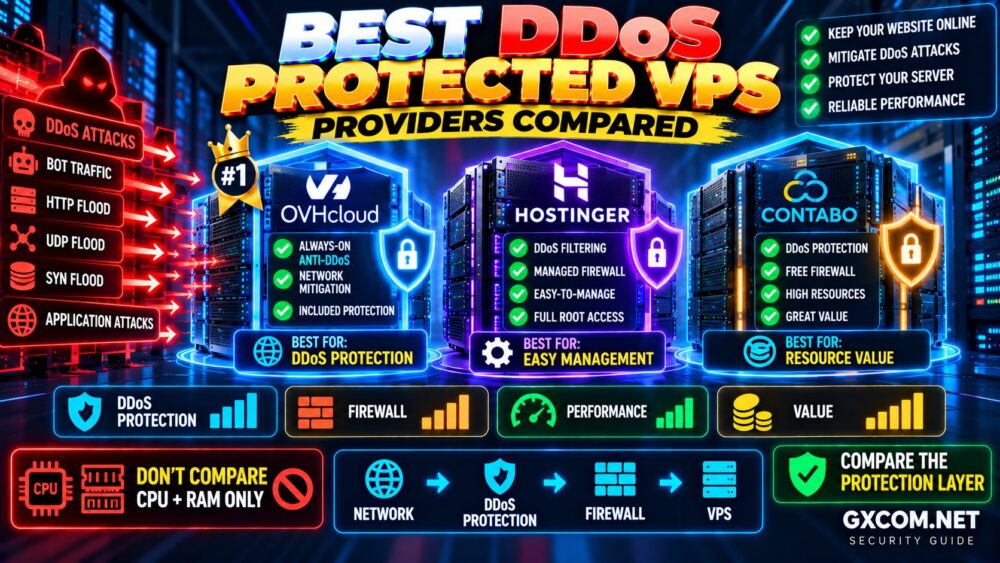
Best DDoS Protected VPS Providers at a Glance
| Provider | DDoS Protection | Firewall | Best For |
|---|---|---|---|
| OVHcloud | Integrated, always-on mitigation | Network/security controls | DDoS-focused infrastructure |
| Hostinger | Wanguard DDoS filtering | Managed firewall | Easy-to-manage VPS |
| Contabo | Always-on DDoS protection | Free network-level firewall | High resources for the price |
GXCOM.NET Pick: OVHcloud stands out when DDoS mitigation itself is one of the primary buying requirements. Hostinger is attractive for users who want simpler VPS administration, while Contabo is compelling when resource allocation and value are major priorities alongside included protection.
What Is a DDoS Protected VPS?
A DDoS protected VPS is a virtual private server hosted behind infrastructure designed to detect, filter or mitigate malicious traffic intended to overwhelm the service.
Protection can operate at several layers:
- Network-level attack detection
- Traffic filtering and scrubbing
- Provider firewalls
- Connection controls
- Application-layer filtering
- CDN and WAF protection
The important point is that these technologies are not interchangeable.
A provider may offer strong network-level DDoS mitigation while still expecting you to secure the web application yourself.
For a complete defensive strategy, read our How to Prevent DDoS Attacks guide.
1. OVHcloud — Best Overall for DDoS-Focused VPS Hosting
OVHcloud is one of the strongest candidates when DDoS protection is a major reason for choosing a VPS provider.
The company includes Anti-DDoS protection with its VPS services and describes the protection as continuously active and automatically mitigated.
Its DDoS-protected VPS offering emphasizes:
- Always-on protection
- Automatic attack mitigation
- Protection integrated with VPS hosting
- No additional charge for the standard VPS protection
- Network security monitoring
OVHcloud also provides a Network Security Dashboard for supported services, allowing customers to see information related to detected attacks and mitigation activity.
Why OVHcloud Stands Out
The biggest advantage is that DDoS mitigation is not positioned merely as an optional afterthought. It is integrated into the VPS infrastructure.
This makes OVHcloud particularly interesting for:
- Public websites
- APIs
- Online communities
- Internet-facing applications
- Projects with elevated DDoS exposure
There is an important distinction for game hosting: specialized Game DDoS Protection is associated with OVHcloud's Game Dedicated Servers rather than ordinary VPS products. A standard VPS should not be assumed to provide every game-specific mitigation feature.
Best for: Users who put network-level DDoS mitigation near the top of their VPS requirements.
2. Hostinger — Best for Easy VPS Management With DDoS Protection
Hostinger combines VPS security features with a management experience aimed at making self-managed VPS hosting more approachable.
Its current VPS platform lists:
- Wanguard DDoS filtering
- Managed firewall
- SSH key management
- VPS monitoring
- Full root access
That combination makes Hostinger attractive for website owners and developers who want DDoS filtering without giving up an accessible control panel.
Why Hostinger Stands Out
Security is integrated with the wider VPS management environment rather than requiring users to build everything from scratch.
This is particularly useful for users moving from shared hosting to VPS hosting for the first time.
Hostinger can be a good fit for:
- WordPress websites
- Web applications
- Development environments
- Small business websites
- Users wanting straightforward VPS administration
However, DDoS filtering does not eliminate the need to secure the operating system and applications.
Follow our VPS Security Best Practices after deploying any self-managed VPS.
Best for: Users who want a balance of VPS usability, security controls and DDoS filtering.
3. Contabo — Best Value for High-Resource VPS With Included Protection
Contabo is particularly attractive to users who prioritize large resource allocations while still wanting network protection included with the server.
Its current VPS and VDS portfolio includes DDoS protection, and Contabo also provides a network-level firewall that can be configured through its Customer Control Panel.
Depending on the selected product line, Contabo focuses heavily on providing substantial CPU, RAM and storage resources for the price.
Why Contabo Stands Out
The combination is particularly appealing when your workload needs:
- More RAM
- More storage
- Multiple CPU cores
- High-bandwidth workloads
- DDoS protection without buying a separate security add-on
The Contabo Firewall operates at the network level and can be managed separately from the guest operating system firewall.
This creates a useful layered architecture:
Internet → DDoS Protection → Contabo Firewall → VPS Firewall → Application
Best for: Resource-heavy workloads where price-to-resource ratio remains a major buying factor.
OVHcloud vs Hostinger vs Contabo for DDoS Protection
| Feature | OVHcloud | Hostinger | Contabo |
|---|---|---|---|
| DDoS Protection Included | Yes | Yes | Yes |
| Automatic/Always-On Focus | Strong | Filtering included | Always-on protection |
| Firewall Tools | Yes | Managed firewall | Free network firewall |
| Ease of Management | Moderate | Excellent | Good |
| Resource Value | Good | Good | Excellent |
| Best Use Case | DDoS-sensitive workloads | Websites and general VPS | Resource-heavy VPS workloads |
No provider wins every category.
The right choice depends on whether your priority is maximum emphasis on DDoS mitigation, easier VPS management or resource value.
How to Choose a DDoS Protected VPS
Do not compare DDoS VPS hosting using CPU and RAM alone.
Before buying, evaluate the following factors.
1. Is DDoS Protection Included?
Check whether mitigation is included with the VPS plan or requires an additional paid service.
Also check whether the provider specifies limitations or conditions.
2. Is Protection Always On?
Always-on systems continuously inspect or mitigate traffic, while other systems may activate protection only after an attack is detected.
If uptime during attacks is especially important, understand how activation works before purchasing.
3. What Types of Attacks Are Covered?
Network-level protection and application-layer protection are different.
Ask whether the provider's protection primarily covers:
- Volumetric attacks
- Protocol attacks
- Connection floods
- Application-layer HTTP attacks
Do not assume that the phrase “DDoS protection” automatically covers every attack vector.
4. Is There a Firewall?
A provider-level firewall lets you reduce unwanted traffic before it reaches the VPS operating system.
You should still configure the host firewall inside Linux.
A strong setup may look like:
Provider Firewall → Linux Firewall → Application
5. What Happens During a Large Attack?
Read the provider's current terms and documentation.
Important questions include:
- Is mitigation automatic?
- Are there protection limits?
- Can an IP be temporarily blocked?
- Is attack information available?
- What support is available during an incident?
6. Where Is the VPS Located?
DDoS protection does not make latency irrelevant.
Select a server region reasonably close to your users when possible.
A protected server on the wrong continent may remain online while still providing poor latency to your audience.
7. Does the VPS Have Enough Resources?
DDoS protection cannot compensate for an undersized VPS.
Your workload still needs enough:
- CPU
- RAM
- NVMe/SSD storage
- Bandwidth
- Application capacity
If the server is slow under legitimate traffic, use our Slow Server Troubleshooting Guide before assuming the problem is a DDoS attack.
DDoS Protection Does Not Replace a CDN or WAF
This is one of the most important distinctions when purchasing a protected VPS.
Provider-level mitigation is especially important for network attacks, but websites and APIs can also face application-layer attacks.
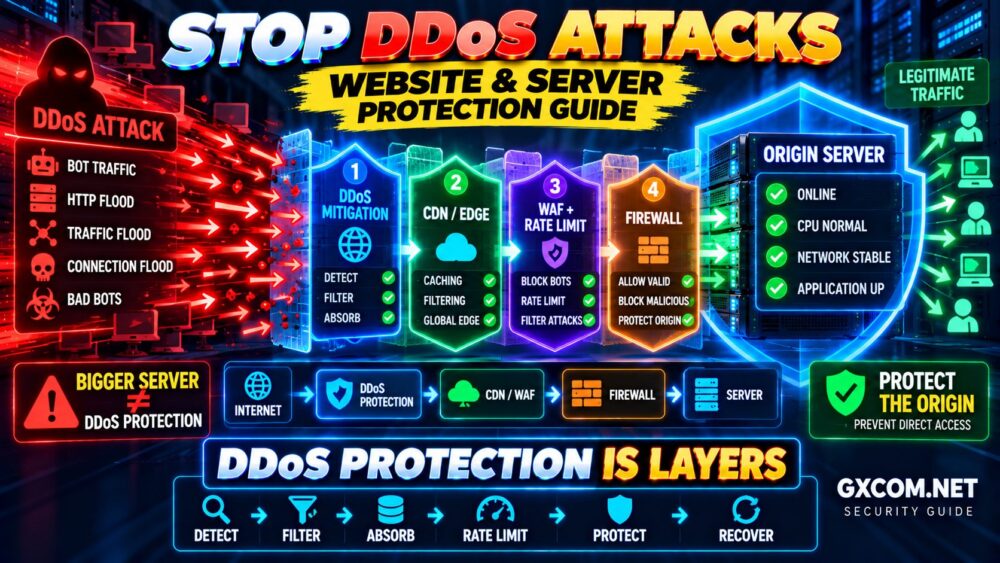
A more complete architecture can look like:
Internet
↓
DDoS Mitigation
↓
CDN / Edge
↓
WAF + Rate Limiting
↓
Provider Firewall
↓
VPS Firewall
↓
Application
DDoS Protection Is Layers.
Do You Need a DDoS Protected VPS?
It is particularly worth considering for:
- E-commerce websites
- SaaS applications
- APIs
- Online communities
- Public services
- Game-related infrastructure
- Websites where downtime directly affects revenue
For a personal test server with no important public service, advanced mitigation may be less important than price or development flexibility.
But for production infrastructure, DDoS resilience should be evaluated alongside performance, backups, network quality and support.
Cheap DDoS Protected VPS vs Premium VPS
A cheap VPS with included DDoS protection can provide excellent value, but do not choose based only on the lowest advertised monthly price.
Compare the total package:
VPS Price
+
DDoS Protection
+
Firewall
+
Backups
+
Bandwidth
+
Support
=
REAL VALUE
A slightly more expensive VPS may be the better deal if important security and network features are already included.
Can You Add DDoS Protection to Any VPS?
You can add application and edge protection to many VPS deployments using reverse proxies, CDNs, WAFs and rate limiting.
However, large volumetric attacks are best mitigated upstream.
If the hosting provider's network becomes saturated before traffic reaches your server, software installed inside the VPS cannot solve the upstream bottleneck.
That is why provider infrastructure matters.
Common Mistakes When Choosing a DDoS Protected VPS
Choosing Only by the Advertised Protection Label
Read what the protection actually includes.
Assuming DDoS Protection Means Complete Security
DDoS mitigation does not replace SSH security, software updates, firewalls or application security.
Ignoring Layer 7 Protection
A network-protected VPS can still suffer from expensive HTTP requests or API abuse.
Ignoring Server Location
Security does not eliminate latency.
Buying More CPU Instead of Better Protection
A bigger VPS cannot absorb an attack that saturates its upstream network connection.
Bigger Server ≠ Better DDoS Protection.
Best DDoS Protected VPS FAQ
What is the best VPS provider for DDoS protection?
OVHcloud is a strong choice when integrated, always-on DDoS mitigation is one of the primary buying requirements. Hostinger is attractive for easier VPS management with built-in filtering, while Contabo combines included protection with strong resource value.
Does Hostinger VPS include DDoS protection?
Yes. Hostinger currently lists Wanguard DDoS filtering and managed firewall functionality among its VPS security features.
Does Contabo include DDoS protection?
Yes. Contabo currently includes DDoS protection with its VPS/VDS products and also provides firewall functionality for additional network-level control.
Does OVHcloud VPS include DDoS protection?
Yes. OVHcloud includes Anti-DDoS protection with VPS hosting and describes mitigation as automatic and continuously active.
Is a DDoS protected VPS enough for WordPress?
It is a useful infrastructure layer, but WordPress sites should also use application security, caching, updates and appropriate edge protection such as a CDN/WAF when required.
Can a firewall stop all DDoS attacks?
No. A firewall can filter unwanted traffic, but a large attack may saturate network capacity before traffic reaches the server. Upstream mitigation is required for those scenarios.
Final Verdict
There is no single best DDoS protected VPS for every workload.
Choose OVHcloud if integrated DDoS mitigation is one of your highest priorities.
Choose Hostinger if you want a user-friendly VPS platform combining DDoS filtering, firewall management and straightforward server administration.
Choose Contabo if you want substantial VPS resources for the money while retaining included DDoS protection and firewall controls.
Whichever provider you choose, do not stop at the infrastructure layer.
PROVIDER DDoS PROTECTION
↓
CDN / WAF
↓
FIREWALL
↓
SERVER SECURITY
↓
APPLICATION SECURITY
↓
MONITORING & RECOVERY
CHOOSE THE RIGHT VPS.
THEN BUILD SECURITY IN LAYERS.