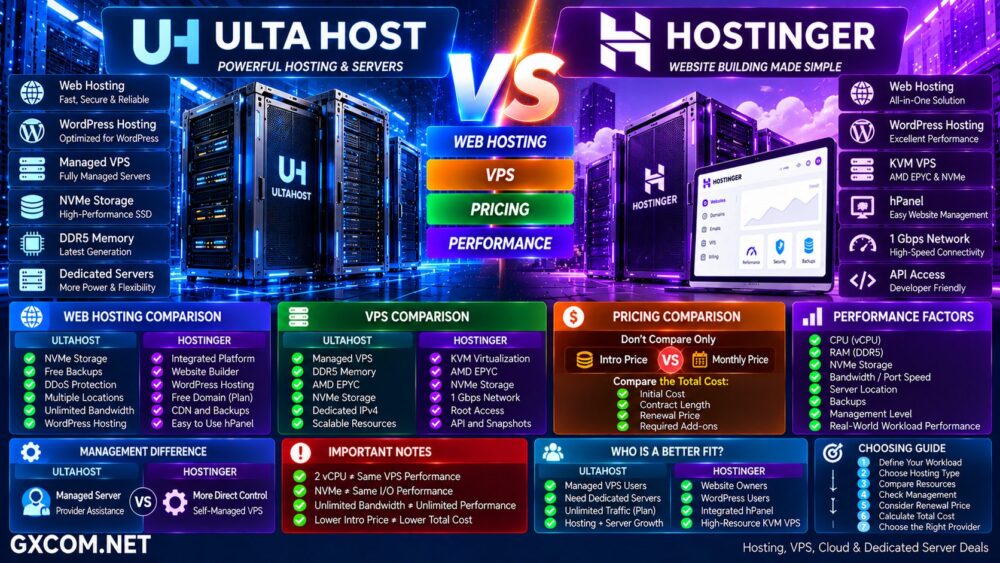
RackNerd and VPSServer both provide virtual servers for developers, websites, applications, self-hosted services, and business workloads, but they approach VPS hosting from different directions.
RackNerd is particularly well known for aggressively priced KVM VPS deals, including annual promotional plans, while also offering regular VPS, Windows VPS, dedicated servers, and other infrastructure services.
VPSServer takes a more cloud-oriented approach, allowing customers to configure virtual servers with different CPU, RAM, NVMe storage, operating systems, and billing options.
That creates an important difference for buyers:
RackNerd → Low-Cost KVM VPS + Annual Deals + Fixed Resources
VPSServer → Flexible Cloud VPS + Configurable Resources + Hourly or Monthly Billing
In this RackNerd vs VPSServer comparison, we examine VPS pricing, CPU and RAM, storage, bandwidth, locations, billing flexibility, Windows support, scalability, and the factors that can affect real-world performance.
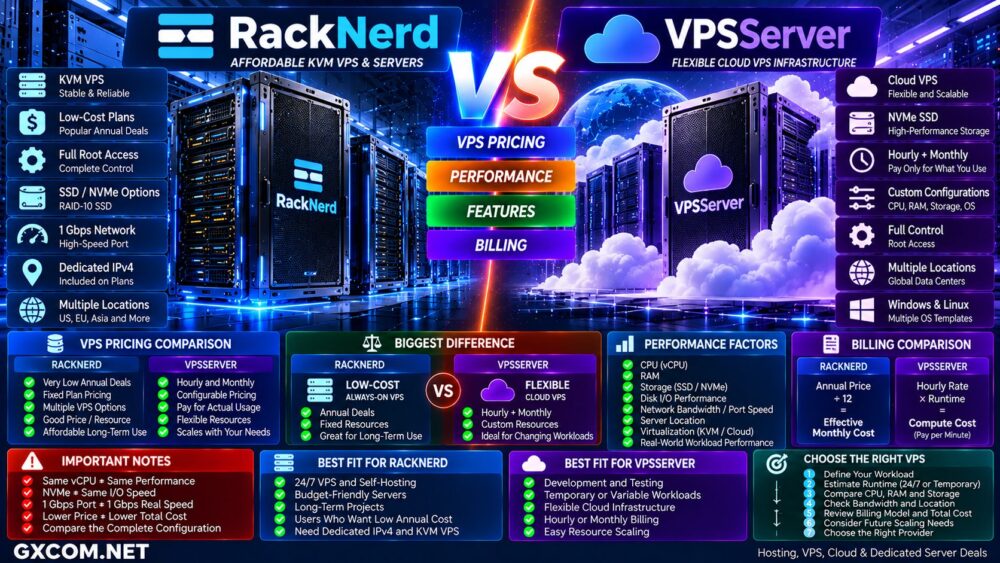
RackNerd vs VPSServer: Quick Comparison
| Feature | RackNerd | VPSServer |
|---|---|---|
| Primary VPS Model | KVM VPS | Cloud VPS / Cloud Server |
| Storage | RAID-10 SSD; NVMe on selected VPS | NVMe SSD |
| Billing | Monthly and strong annual specials | Monthly or hourly |
| Hourly VPS | Not the main model | Yes |
| Root Access | Yes | Yes |
| Public IPv4 | Included on current KVM plans | Single public IP included in current calculator pricing |
| Network | 1 Gbps on current KVM VPS | Plan and configuration dependent |
| Windows | Dedicated Windows VPS product | Windows options available depending on configuration |
| Dedicated Servers | Yes | Cloud-focused comparison |
| Best Fit | Budget-focused long-running VPS | Flexible cloud workloads |
RackNerd Overview
RackNerd provides VPS hosting, dedicated servers, shared hosting, colocation, and related infrastructure services.
Its standard KVM VPS platform currently includes:
- KVM virtualization
- Full root access
- RAID-10 SSD storage
- 1 Gbps network port
- Dedicated IPv4 address
- Defined monthly bandwidth
- Multiple data center locations
- VPS management control panel
RackNerd also operates a separate promotional VPS lineup where annual pricing can be substantially lower than its conventional monthly plans.
That pricing model is important because RackNerd should not be evaluated only from its standard VPS page.
For budget buyers, the specials can materially change the comparison.
VPSServer Overview
VPSServer is structured more like a configurable cloud infrastructure platform.
Instead of concentrating primarily on fixed promotional VPS packages, customers can select resources such as:
- vCPU
- RAM
- NVMe SSD storage
- Operating system
- Traffic requirements
- Additional services
VPSServer currently supports both monthly and hourly server pricing.
Its hourly servers are billed per minute, making the platform particularly relevant to workloads that do not need to run continuously.
RackNerd → Buy Capacity Cheaply
VPSServer → Consume Capacity Flexibly
RackNerd vs VPSServer Pricing
Pricing is probably the most important difference between these providers, but comparing the cheapest advertised number can be misleading.
RackNerd's promotional VPS plans are frequently billed annually.
For example, its current specials include configurations ranging from small 1 GB VPS instances through larger 8 GB plans, with the annual payment converted into a very low effective monthly cost.
VPSServer currently advertises configurable cloud servers starting from a low monthly rate, while also providing hourly billing for temporary deployments.
These are fundamentally different pricing models.
Annual VPS Price ÷ 12 = Effective Monthly Cost
versus:
Hourly Rate × Actual Runtime = Cloud VPS Compute Cost
If your server will run 24/7 for an entire year, annual VPS pricing can be attractive.
If you only need a server for development, testing, temporary projects, or changing workloads, flexible hourly billing can reduce unused capacity.
Compare RackNerd and VPSServer Before Ordering
Instead of selecting the provider with the lowest headline price, match the billing model to the workload.
| Workload | RackNerd | VPSServer |
|---|---|---|
| 24/7 Small VPS | Annual specials worth comparing | Monthly plan worth comparing |
| Temporary Development | Possible, but fixed billing | Hourly billing is useful |
| Self-Hosting | Strong use case | Strong use case |
| Windows VPS | Dedicated Windows VPS lineup | Check current OS configuration |
| Flexible Cloud Deployment | Traditional VPS approach | Core platform strength |
| Dedicated Server Upgrade | Available | Different infrastructure path |
Always compare the final CPU, RAM, storage, bandwidth, operating system, location, IP allocation, billing period, and add-ons before ordering.
RackNerd vs VPSServer VPS Resources
A VPS should never be compared by RAM alone.
A useful resource comparison includes:
- vCPU count
- CPU generation
- CPU allocation
- RAM
- Storage technology
- Storage capacity
- Bandwidth
- Port speed
- IPv4
- Virtualization
- Server location
RackNerd's regular KVM VPS plans currently scale from small entry-level configurations through larger plans with more CPU, RAM, SSD storage, and monthly transfer.
Its promotional VPS lineup uses different resource combinations, so buyers should compare the specific promotion rather than assuming every RackNerd VPS uses identical specifications.
VPSServer allows CPU, RAM, NVMe storage, and other requirements to be configured through its cloud server platform.
Same RAM ≠ Same VPS.
RackNerd vs VPSServer Storage
Storage is one of the clearest technical differences to check carefully.
RackNerd's standard KVM VPS currently uses RAID-10 protected SSD storage, while its separate AMD Ryzen VPS products use NVMe storage.
VPSServer advertises NVMe SSD storage across its current cloud server platform.
NVMe can provide significantly lower latency and higher throughput than older storage interfaces, but the storage label alone does not guarantee application performance.
Actual disk performance also depends on:
- Host storage architecture
- IOPS limits
- Node utilization
- RAID configuration
- Filesystem
- Application I/O pattern
For a deeper explanation, read our
NVMe VPS vs SSD VPS comparison.
RackNerd vs VPSServer Performance
There is no reliable basis for saying that every RackNerd VPS is faster than every VPSServer instance, or vice versa.
Performance varies according to the selected server, host hardware, CPU allocation, storage, location, virtualization environment, and workload.
For CPU-intensive workloads, test:
- Single-core performance
- Multi-core performance
- Sustained CPU performance
For websites and databases, also test:
- Disk I/O
- Database latency
- Uncached page response
- Concurrent requests
For network-heavy applications, measure:
- Latency
- Packet loss
- International routing
- Sustained throughput
vCPU Count ≠ CPU Performance.
RackNerd vs VPSServer Bandwidth
RackNerd's current KVM VPS plans use defined monthly transfer allocations with 1 Gbps network ports.
Its promotional VPS plans also advertise 1 Gbps ports, while monthly transfer allowances vary by package.
VPSServer's current cloud pricing includes traffic allowances depending on the selected plan and configuration, with additional traffic available separately.
When comparing bandwidth, examine:
- Included monthly traffic
- Port speed
- Additional traffic price
- Network routing
- Data center location
- Actual application throughput
1 Gbps Port ≠ Guaranteed 1 Gbps Throughput.
RackNerd vs VPSServer Billing Flexibility
This is one of the most meaningful differences between the two providers.
RackNerd's strongest value propositions often come from annual promotional plans.
That works well when you already know the server will remain online.
VPSServer's hourly option changes the economics for temporary infrastructure.
Consider a development environment that only needs to run during a project.
With a fixed annual server, unused time is already paid for.
With usage-oriented cloud infrastructure, terminating the instance can reduce future compute charges, subject to any persistent resources or other services that remain billable.
Always-On Workload → Compare Long-Term VPS Pricing
Temporary Workload → Compare Usage-Based Pricing
RackNerd vs VPSServer for Linux VPS
Both providers can support common Linux server workloads.
Typical use cases include:
- Web servers
- WordPress
- Docker
- VPN
- Development environments
- Automation
- Databases
- Self-hosted applications
RackNerd's KVM VPS provides full root access and supports common Linux distributions.
VPSServer similarly allows customers to deploy cloud servers with operating-system choices appropriate for different workloads.
For Linux users, the decision is more likely to depend on pricing, resources, storage, location, and billing flexibility than the operating system itself.
RackNerd vs VPSServer for Windows VPS
Windows deserves a separate comparison because licensing can materially affect VPS pricing.
RackNerd currently operates a dedicated AMD Ryzen Windows VPS product using NVMe storage and offers Windows Server choices in the ordering process.
Its Windows VPS configurations include administrator and Remote Desktop access.
VPSServer also supports Windows-oriented cloud server deployments depending on the selected configuration and license.
Before purchasing either platform for Windows, compare:
- Windows Server version
- License cost
- RAM
- vCPU
- NVMe or SSD capacity
- Remote Desktop
- Bandwidth
- Total monthly cost
For a broader OS comparison, see our
Linux VPS vs Windows VPS comparison.
RackNerd vs VPSServer for Websites
Both platforms can host websites, but a VPS requires more administration than conventional shared hosting.
A VPS can be useful when you need:
- Root access
- Custom PHP configuration
- Custom web server
- Docker
- More database control
- Multiple applications
- Dedicated server environment
But moving from shared hosting to VPS does not automatically make a website faster.
A poorly configured VPS can perform worse than a well-optimized managed hosting environment.
More Control ≠ Automatic Performance.
RackNerd vs VPSServer for Developers
Developers may find the billing model more important than small differences in advertised resources.
RackNerd can make sense for persistent development infrastructure where a low annual cost provides a server that remains available continuously.
VPSServer's hourly model can be useful for temporary testing environments, short projects, staging servers, and infrastructure that is regularly created and removed.
A useful workflow is:
Deploy → Test → Measure → Keep or Destroy.
RackNerd vs VPSServer for Self-Hosting
Self-hosting workloads often run continuously.
Examples include:
- n8n
- VPN servers
- Monitoring tools
- Personal cloud applications
- Git services
- Automation platforms
- Small databases
- Docker stacks
For workloads that remain online 24/7 but use relatively modest resources, a low-cost annual VPS can produce attractive economics.
However, cloud VPS flexibility can become valuable if the workload changes frequently or requires rapid resource adjustments.
RackNerd vs VPSServer Scalability
The two providers approach scaling differently.
With a conventional VPS, scaling commonly means moving to a larger package or provisioning another server.
A cloud-oriented environment is generally designed around more flexible resource selection and deployment.
That does not mean every application requires cloud scalability.
A small website or self-hosted application running comfortably on 2 GB RAM may gain little from a more complex cloud architecture.
For more information, see our
Cloud VPS vs Traditional VPS comparison.
RackNerd vs VPSServer Server Locations
Location can directly affect latency.
RackNerd currently operates VPS infrastructure across multiple locations in North America, Europe, and Asia.
VPSServer also operates a geographically distributed cloud infrastructure.
The correct location is not necessarily the data center closest to you.
It should usually be close to the majority of your users or to the external systems your application communicates with.
User → Network Route → Server Location → Latency
RackNerd vs VPSServer Security and Backups
VPS customers should understand that infrastructure security and application security are different responsibilities.
VPSServer currently highlights DDoS mitigation, firewall functionality, backups, and monitoring across its cloud server platform.
RackNerd provides infrastructure and server control, while exact backup and security features depend on the selected product.
Regardless of provider, VPS users should plan for:
- Operating-system updates
- SSH security
- Firewall configuration
- Application updates
- Independent backups
- Monitoring
- Access control
Never treat provider-level infrastructure protection as a substitute for securing the operating system and applications.
RackNerd vs VPSServer: Pros and Trade-Offs
| Area | RackNerd | VPSServer |
|---|---|---|
| VPS Model | Traditional KVM VPS | Cloud-oriented VPS |
| Budget Deals | Strong annual specials | Low-entry configurable cloud plans |
| Hourly Billing | Not the main focus | Yes |
| Storage | SSD / selected NVMe products | NVMe |
| Windows VPS | Dedicated Ryzen Windows product | Available by configuration |
| Long-Running Small VPS | Annual deals can be attractive | Monthly model available |
| Temporary Servers | Less billing flexibility | Hourly billing advantage |
| Dedicated Server Path | Broad dedicated portfolio | More cloud-oriented platform |
Consider RackNerd If…
- You want a low-cost VPS that runs continuously
- You are comfortable paying annually for a promotion
- You want KVM virtualization and full root access
- You value high included transfer on selected specials
- You need a dedicated IPv4 address
- You want a possible upgrade path to dedicated servers
- You want a dedicated Windows VPS product
Consider VPSServer If…
- You want hourly or monthly billing
- You regularly create temporary servers
- You prefer configurable cloud resources
- You want NVMe storage
- Your infrastructure requirements change frequently
- You need a cloud-oriented deployment model
- You want to reduce commitment for short-lived workloads
Questions to Ask Before Choosing RackNerd or VPSServer
- Will the VPS run 24/7?
- Do you prefer annual, monthly, or hourly billing?
- How many vCPUs do you need?
- How much RAM is required?
- Do you need NVMe storage?
- How much monthly traffic will you use?
- Do you need a 1 Gbps port?
- Do you need Windows Server?
- Is the Windows license included?
- Which data center is closest to your users?
- Do you need automated backups?
- Do you need rapid scaling?
- Will you need a dedicated server later?
- What is the total annual infrastructure cost?
RackNerd vs VPSServer: Which VPS Fits Your Workload?
RackNerd and VPSServer can both provide VPS infrastructure, but their pricing and deployment models target somewhat different requirements.
RackNerd is particularly interesting for users seeking inexpensive, persistent KVM VPS infrastructure. Its annual specials can reduce the effective monthly cost substantially when a server will remain online throughout the year.
VPSServer takes a more cloud-oriented approach. Monthly and hourly billing, configurable resources, and NVMe-based cloud servers can be useful when workloads are temporary, variable, or regularly redeployed.
The correct comparison is therefore not simply:
Which VPS Has the Lowest Advertised Price?
Instead use:
Workload → Runtime → CPU/RAM → Storage → Bandwidth → Location → Billing Model → Total Cost.
For an always-on server, calculate the complete annual cost. For temporary cloud workloads, calculate the actual hours used plus storage, traffic, licenses, backups, and other applicable services.
That gives a much more meaningful RackNerd vs VPSServer comparison than comparing two headline VPS prices that may represent very different products.