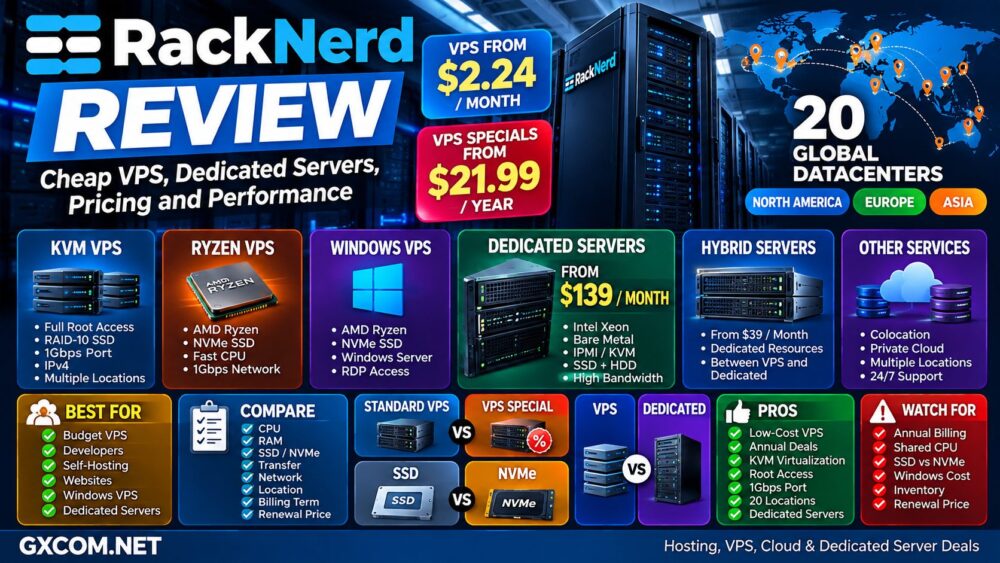
RackNerd has built a strong following among budget-conscious VPS users by combining low-cost KVM virtual servers, frequent annual VPS specials, dedicated servers, multiple global locations, and infrastructure aimed at developers, self-hosters, website owners, and small businesses.
The headline prices can be particularly attractive. RackNerd currently advertises standard VPS hosting from around $2.24 per month, while promotional annual VPS packages can reduce the effective monthly cost even further.
But cheap VPS hosting should never be judged by price alone. CPU allocation, RAM, storage technology, network transfer, virtualization, server location, renewal pricing, and workload performance all matter.
In this RackNerd Review, we examine RackNerd VPS hosting, current VPS specials, AMD Ryzen and Windows VPS options, dedicated servers, pricing, infrastructure, locations, performance considerations, and the main pros and cons before buying.
RackNerd Review: Quick Overview
| Feature | RackNerd |
|---|---|
| KVM VPS | Yes |
| Cheap VPS Specials | Yes |
| Annual VPS Plans | Yes |
| AMD Ryzen VPS | Yes |
| Windows VPS | Yes |
| Dedicated Servers | Yes |
| Hybrid Servers | Yes |
| Colocation | Yes |
| Root Access | Yes |
| 1Gbps VPS Port | Yes |
| Global Datacenters | 20 |
| 24/7 Support | Yes |
| Best For | Budget VPS, developers, self-hosting, websites and dedicated infrastructure |
What Is RackNerd?
RackNerd is an Infrastructure-as-a-Service provider offering virtual servers, dedicated servers, hybrid infrastructure, colocation, private cloud, and related hosting services.
Its product portfolio currently includes:
- KVM VPS
- AMD Ryzen VPS
- Windows VPS
- Hybrid Servers
- Dedicated Servers
- Colocation
- Private Cloud
RackNerd is especially visible in the budget VPS market because it frequently offers annual KVM VPS packages at prices substantially below many conventional month-to-month VPS plans.
RackNerd VPS Hosting
RackNerd VPS uses KVM virtualization, providing customers with a virtualized server environment and full root administrative access.
Standard KVM VPS features currently include:
- KVM virtualization
- Full root access
- RAID-10 SSD storage
- 1Gbps network port
- Dedicated IPv4 address
- Multiple operating systems
- Multiple datacenter locations
- Server control panel
Users can start, stop, reinstall, reset, and access the console for their virtual server through the management interface.
This makes RackNerd more suitable for users comfortable administering their own server than beginners looking for conventional fully managed shared hosting.
RackNerd VPS Pricing
RackNerd has two pricing stories worth understanding: its standard VPS plans and its frequently promoted VPS specials.
Standard KVM VPS currently starts at approximately $2.24 per month, while higher-resource configurations increase according to CPU, RAM, storage, and transfer allocation.
However, some of the most interesting RackNerd pricing appears on its Specials page, where VPS packages are billed annually.
RackNerd Cheap VPS Specials
At the time of this review, RackNerd lists promotional KVM VPS configurations such as:
| RAM | vCPU | Storage | Transfer | Price |
|---|---|---|---|---|
| 1 GB | 1 vCPU | 20 GB SSD | 3 TB | $21.99/year |
| 2 GB | 2 vCPU | 35 GB SSD | 5 TB | $35.99/year |
| 4 GB | 3 vCPU | 60 GB SSD | 7 TB | $59.99/year |
| 6 GB | 6 vCPU | 100 GB SSD | 12 TB | $89.99/year |
| 8 GB | 7 vCPU | 150 GB SSD | 20 TB | $119.99/year |
These promotional configurations include a 1Gbps network port, root access, IPv4, KVM virtualization, and deployment across supported locations.
Promotional inventory and pricing can change, so customers should always verify the current checkout price and renewal terms before ordering.
Why Is RackNerd VPS So Cheap?
Annual billing is one reason some RackNerd offers appear unusually inexpensive when converted into an effective monthly price.
For example, a $21.99 annual VPS works out to less than $2 per month when the annual payment is divided by twelve.
That does not mean it should be compared directly with every $2 monthly VPS on the market.
Customers should compare:
- Billing period
- CPU allocation
- RAM
- SSD or NVMe storage
- Monthly transfer
- Port speed
- Datacenter
- IPv4
- Backup options
- Renewal pricing
Low Monthly Equivalent ≠ Month-to-Month Billing.
RackNerd KVM VPS
KVM is a full virtualization technology commonly used by VPS providers.
Compared with container-based virtualization, KVM gives each virtual machine its own operating-system environment and provides flexibility for custom server configurations.
RackNerd currently supports common Linux distributions including Ubuntu, Debian, and AlmaLinux on promotional KVM VPS plans.
Custom ISO installation is also available by request for applicable configurations.
RackNerd AMD Ryzen VPS
RackNerd also offers AMD Ryzen-based VPS products for workloads where stronger per-core performance and NVMe storage may be useful.
Published Ryzen configurations use AMD Ryzen processors and NVMe SSD storage rather than the standard SSD configuration found on many conventional RackNerd VPS plans.
This type of VPS can be more relevant for:
- CPU-sensitive web applications
- Game servers
- Development environments
- Databases
- Performance-sensitive websites
However, availability can be limited. Customers should check live inventory rather than assuming every Ryzen configuration is continuously available.
SSD vs NVMe at RackNerd
Storage technology is an important distinction when comparing RackNerd plans.
Many standard and promotional KVM VPS packages use RAID-10 SSD storage, while selected Ryzen VPS products use NVMe SSD.
| Storage | Typical RackNerd Product | Best For |
|---|---|---|
| SSD RAID-10 | Standard / promotional KVM VPS | General hosting and budget workloads |
| NVMe SSD | Selected Ryzen VPS | Storage-sensitive workloads |
NVMe can provide higher storage performance, but storage technology alone does not determine total application speed.
CPU, memory, caching, database configuration, and application design remain important.
RackNerd Windows VPS
RackNerd also offers Windows VPS based on AMD Ryzen and NVMe storage.
Current published configurations provide Windows Server options, Administrator access, and Remote Desktop connectivity.
Windows VPS is relevant for:
- Remote Desktop
- Windows applications
- .NET environments
- Windows development
- Remote business software
Current Windows VPS plans are substantially more expensive than RackNerd's low-cost Linux specials, so buyers should not assume that the headline cheap VPS pricing applies to Windows.
RackNerd VPS Network
RackNerd advertises 1Gbps network ports across its standard VPS platform.
But a 1Gbps port should not be interpreted as a guarantee that every workload will continuously transfer data at 1Gbps.
Actual throughput can depend on:
- Server load
- Network congestion
- Remote destination
- Routing
- Protocol overhead
- Application behavior
- Monthly transfer allowance
1Gbps Port ≠ Guaranteed 1Gbps Application Throughput.
RackNerd Datacenter Locations
RackNerd currently lists 20 global datacenter locations across North America, Europe, and Asia.
Locations include:
- Los Angeles
- San Jose
- Seattle
- Utah
- Chicago
- Dallas
- New York
- New Jersey
- Atlanta
- Tampa
- Miami
- Ashburn
- Montreal
- Toronto
- London
- Amsterdam
- Strasbourg
- Frankfurt
- Dublin
- Singapore
Not every product or server configuration is necessarily available in every datacenter.
Always check the order page for current inventory before choosing infrastructure based on a specific location.
Which RackNerd Location Should You Choose?
The best location is usually the datacenter closest to the majority of the application's users, unless there are specific routing, regulatory, or infrastructure requirements.
For example, a website serving primarily U.S. West Coast and Asian visitors may benefit from testing Los Angeles, San Jose, or Seattle.
Applications serving European users may instead consider London, Amsterdam, Frankfurt, Dublin, or Strasbourg.
User → Datacenter → Network Route → Latency → Application Experience.
RackNerd Dedicated Servers
RackNerd's Dedicated Servers provide physical bare-metal infrastructure rather than virtualized VPS resources.
Current dedicated server features include:
- Full root access
- Remote power reboot
- IPMI / KVM access
- SSD and HDD options
- Linux
- Windows
- FreeBSD
- Custom ISO support
- DDoS-protected network
- 24/7 support
RackNerd states that bare-metal deployments are typically completed within 48 hours and often on the same day, depending on inventory.
RackNerd Dedicated Server Pricing
RackNerd currently advertises dedicated servers from approximately $139 per month.
Published configurations range from single-processor Intel Xeon systems to dual-processor servers, high-memory virtualization nodes, and large storage servers.
| Example CPU | RAM | Storage | Bandwidth | Price |
|---|---|---|---|---|
| Xeon E3-1230 v2 | 16 GB | 480 GB SSD | 35 TB @ 1Gbps | $139/mo |
| Xeon E3-1270 v3 | 32 GB | 2 × 1 TB SSD | 35 TB @ 1Gbps | $169/mo |
| Dual Xeon E5-2650 v2 | 64 GB | 1 TB SSD | 100 TB @ 1Gbps | $199/mo |
These configurations and prices can change with inventory, so they should be treated as current examples rather than permanent pricing.
RackNerd VPS vs Dedicated Server
| Factor | RackNerd VPS | Dedicated Server |
|---|---|---|
| Infrastructure | Virtualized | Physical bare metal |
| Starting Cost | Very low | Much higher |
| Root Access | Yes | Yes |
| Physical CPU | Shared underlying hardware | Dedicated to customer |
| Deployment | Instant on many plans | Inventory dependent |
| IPMI | No physical IPMI | Yes |
| Best For | Budget and general workloads | Sustained heavy workloads |
For many websites and development environments, a VPS provides better economics.
Dedicated infrastructure becomes more relevant when a workload genuinely requires physical resources, large memory configurations, substantial storage, virtualization, or sustained CPU performance.
Read our
Dedicated Server vs VPS
comparison for more information.
RackNerd Hybrid Servers
RackNerd also markets Hybrid Servers as an intermediate infrastructure option.
These products are designed around dedicated resources while maintaining a deployment model closer to virtual infrastructure.
RackNerd currently advertises Hybrid Servers from approximately $39 per month.
They can be worth comparing when a customer needs more predictable resources than an entry-level VPS but does not yet require a full physical dedicated server.
RackNerd Performance
There is no single meaningful “RackNerd performance” number because the company sells several very different infrastructure types.
Performance depends on:
- CPU generation
- CPU allocation
- Shared vs dedicated resources
- RAM
- SSD vs NVMe
- RAID configuration
- Network routing
- Datacenter
- Application optimization
A low-cost annual KVM VPS should therefore not be expected to behave exactly like a Ryzen NVMe VPS or physical dedicated server.
Have We Independently Benchmarked RackNerd?
This review evaluates RackNerd using current published product specifications, pricing, infrastructure information, and provider documentation.
Unless GXCOM.NET explicitly publishes a benchmark methodology and measured test results, provider specifications should not be interpreted as independent GXCOM.NET performance testing.
For production workloads, useful tests include:
- Single-core CPU performance
- Multi-core CPU performance
- Disk IOPS
- Disk latency
- Network throughput
- Database performance
- Application response time
- Sustained CPU load
RackNerd for WordPress
RackNerd VPS can run WordPress, but users should understand the difference between a VPS and managed WordPress hosting.
With a VPS, the customer may be responsible for:
- Web server installation
- PHP configuration
- Database management
- Security updates
- Firewall configuration
- Backups
- WordPress optimization
Experienced administrators can build an efficient WordPress stack, but beginners may find managed hosting easier.
RackNerd for Developers and Self-Hosting
The combination of low annual pricing, KVM virtualization, root access, IPv4, and multiple locations makes RackNerd particularly interesting for experimentation and self-hosted applications.
Possible uses include:
- Development servers
- Small websites
- Monitoring tools
- Personal cloud applications
- VPN servers
- Git services
- Testing environments
- Automation tools
Resource requirements and applicable terms should always be checked for the intended workload.
RackNerd vs Contabo
RackNerd and Contabo both attract budget-focused VPS buyers, but their product positioning differs.
RackNerd is particularly notable for inexpensive annual VPS specials and a wide choice of datacenter locations, while Contabo is well known for offering large RAM and storage allocations at aggressive price points.
The correct comparison should consider CPU performance, RAM, storage, bandwidth, location, billing cycle, and the workload itself.
See our
Contabo VPS Review
for a detailed look at Contabo.
RackNerd vs Cloud Clusters
Both providers can appeal to customers searching for affordable U.S.-focused VPS infrastructure, but their pricing models, locations, storage allocations, and product ecosystems differ.
RackNerd provides a much broader geographic footprint, while customers should compare individual plan resources and network requirements before choosing either provider.
Read our
Cloud Clusters VPS Review
for another budget VPS option.
RackNerd Pros and Cons
| Pros | Watch For |
|---|---|
| Very low-cost annual VPS specials | Best offers may require annual payment |
| KVM virtualization | Budget VPS uses shared underlying CPU resources |
| Full root access | Server administration requires technical knowledge |
| 1Gbps VPS network ports | Port speed is not guaranteed application throughput |
| 20 global datacenter locations | Product inventory varies by location |
| SSD RAID-10 storage | Not every VPS includes NVMe |
| Ryzen NVMe options | Availability can be limited |
| Windows VPS available | Windows costs more than cheap Linux specials |
| Dedicated servers available | Dedicated hardware costs substantially more |
| 24/7 support | Unmanaged workloads still require customer administration |
Who Should Consider RackNerd?
RackNerd is particularly relevant for:
- Budget VPS buyers
- Developers
- Linux users
- Self-hosting enthusiasts
- Small websites
- Testing environments
- Users wanting annual VPS deals
- Windows VPS users
- Businesses needing dedicated servers
- Customers requiring multiple geographic locations
Who May Prefer an Alternative?
Users who need a fully managed beginner-oriented hosting environment may prefer a conventional managed hosting provider.
Likewise, workloads requiring large hyperscale cloud ecosystems, advanced managed databases, serverless platforms, or specialized enterprise cloud services may be better matched to a broader cloud platform.
RackNerd's strongest positioning remains infrastructure value: affordable VPS hosting, frequent promotions, dedicated servers, and a growing global datacenter footprint.
Is RackNerd Good Value?
RackNerd can offer strong value when the workload matches the resources being sold.
The annual VPS specials are particularly attractive for users who need inexpensive always-on virtual machines and are comfortable paying in advance.
However, price should never be the only metric.
A useful comparison formula is:
CPU + RAM + Storage + Transfer + Location + Billing Term + Renewal Price = Real VPS Value.
For performance-sensitive applications, also consider the CPU platform and whether NVMe storage is available.
RackNerd Review: Final Thoughts
RackNerd occupies an interesting position in the hosting market because it combines extremely affordable promotional VPS plans with a much broader infrastructure portfolio that includes Ryzen VPS, Windows VPS, hybrid servers, dedicated servers, private cloud, and colocation.
Its annual KVM VPS specials are likely to be the main attraction for budget-conscious developers and self-hosting users. Full root access, IPv4, 1Gbps network ports, KVM virtualization, and multiple deployment locations provide substantial flexibility for the price.
RackNerd's 20-location footprint also gives customers more geographic choice than many smaller budget VPS providers.
The main consideration is understanding exactly what is being purchased. A low-cost annual SSD VPS, Ryzen NVMe VPS, Windows VPS, and physical dedicated server are fundamentally different products.
Cheapest VPS ≠ Best VPS for Every Workload.
Before ordering, follow this path:
Workload → CPU + RAM → SSD / NVMe → Transfer → Location → Billing Term → Renewal Price → VPS / Dedicated → Total Value.