Bare metal servers and dedicated servers are two terms that are often used interchangeably in the hosting industry. Both provide customers with an entire physical server instead of sharing hardware resources through virtualization.
However, the two concepts are not always marketed in the same way. Bare metal infrastructure usually emphasizes direct hardware access, cloud-like deployment, automation, and high-performance workloads, while traditional dedicated servers are commonly associated with website hosting, business applications, and general-purpose server rental.
Understanding the difference between Bare Metal Server vs Dedicated Server can help you choose the right infrastructure for AI workloads, databases, enterprise applications, high-traffic websites, virtualization, and other performance-sensitive projects.
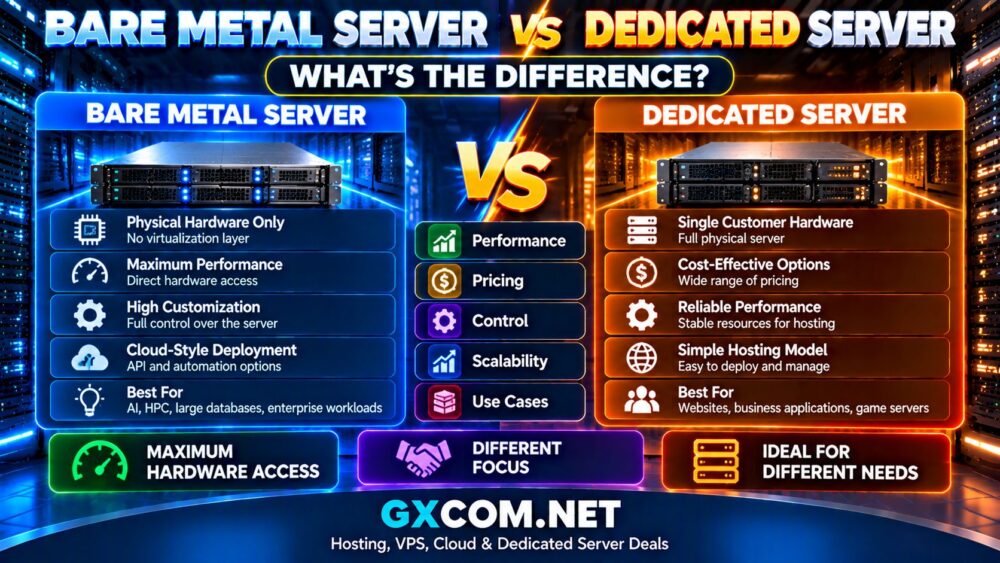
Bare Metal Server vs Dedicated Server: Quick Comparison
| Feature | Bare Metal Server | Dedicated Server |
|---|---|---|
| Physical Hardware | Single customer | Single customer |
| Virtualization Layer | Usually no hypervisor layer | May support virtualization |
| Performance | Maximum hardware access | High physical performance |
| Main Focus | Cloud infrastructure and high-performance workloads | General hosting and business applications |
| Deployment | Often automated and API-driven | Traditional provisioning |
| Customization | Very high | High |
| Typical Users | Developers, enterprises, AI companies | Businesses, websites, applications |
What Is a Bare Metal Server?
A bare metal server is a physical machine dedicated entirely to one customer without the virtualization layer commonly found in cloud environments.
The customer has direct access to the server's physical CPU, memory, storage, and networking resources.
Typical bare metal characteristics include:
- Dedicated physical CPU resources
- No shared virtual machine layer
- High-performance storage options
- Large RAM configurations
- Fast network connectivity
- Hardware-level customization
- Automation through APIs
Bare metal servers are commonly used for workloads where predictable performance and direct hardware access are important.
What Is a Dedicated Server?
A dedicated server is a physical server rented exclusively by one customer.
Unlike VPS hosting, where multiple virtual machines share one physical host, dedicated hosting gives the customer full access to the machine.
Common dedicated server uses include:
- Web hosting
- Ecommerce websites
- Business applications
- Databases
- Game servers
- Private applications
- Development environments
Dedicated servers have existed for decades and remain one of the most common forms of high-performance hosting.
Are Bare Metal Servers and Dedicated Servers the Same?
Technically, both are physical servers assigned to one customer.
The difference is mainly related to positioning, deployment model, and target users.
A traditional dedicated server usually focuses on renting a machine:
- Select hardware
- Install operating system
- Deploy applications
- Manage the server
Bare metal platforms often add cloud-style capabilities:
- Automated provisioning
- API deployment
- Infrastructure automation
- Cloud integrations
- Rapid server deployment
Bare Metal vs Dedicated Server Performance
Because both use physical hardware, raw performance can be very similar.
The biggest performance factors are usually:
- CPU generation
- Processor architecture
- RAM speed
- Storage technology
- Network quality
- Application optimization
A newer dedicated server can outperform an older bare metal server, and a well-configured bare metal server can outperform a poorly configured dedicated server.
The label alone does not determine performance.
CPU Comparison: Bare Metal vs Dedicated
Both platforms may use similar processors:
- AMD EPYC
- Intel Xeon
- AMD Ryzen
- Intel Core processors
For CPU selection, focus on:
- CPU generation
- Single-core performance
- Multi-core performance
- Core count
- Power efficiency
A server with fewer modern cores can outperform a server with more older cores depending on the workload.
RAM and Storage Differences
Both bare metal and dedicated servers can offer large amounts of RAM and storage.
Common configurations include:
- 16GB–64GB RAM for smaller workloads
- 128GB+ RAM for databases and virtualization
- NVMe SSD storage for performance applications
- Large HDD storage for archives and backups
Storage technology often has a bigger impact on user experience than the server category itself.
A modern NVMe server can feel significantly faster than an older machine using traditional drives.
Bare Metal Server vs Dedicated Server Pricing
Pricing depends on:
- CPU model
- RAM capacity
- Storage type
- Bandwidth
- Data center location
- Management services
- Operating system licensing
Budget dedicated servers are often cheaper because providers use standardized hardware configurations and older inventory.
Bare metal cloud platforms may cost more because they provide automation, flexible deployment, APIs, and enterprise infrastructure features.
Bare Metal Server Advantages
1. Maximum Hardware Control
Bare metal gives administrators direct access to physical resources without virtualization overhead.
2. Predictable Performance
Because resources are not shared with virtual machines, performance is generally more consistent.
3. Ideal for High Performance Computing
Bare metal is commonly used for:
- AI training
- Machine learning
- Scientific computing
- Large databases
- Real-time applications
4. Cloud Integration
Many bare metal platforms provide API-based deployment and integration with modern cloud workflows.
Dedicated Server Advantages
1. Simple Hosting Model
Dedicated servers are straightforward:
- Rent hardware
- Install operating system
- Run applications
2. More Affordable Options
Traditional dedicated servers often provide excellent hardware value, especially for websites and business applications.
3. Wide Provider Availability
Thousands of hosting providers offer dedicated servers in different locations and price ranges.
4. Suitable for General Applications
Dedicated servers work well for:
- Web hosting
- WordPress
- Business software
- Databases
- Game servers
Bare Metal Server vs Dedicated Server for Websites
Most websites do not require bare metal infrastructure.
A dedicated server is often enough for:
- High traffic websites
- Ecommerce platforms
- Large WordPress websites
- Membership websites
Bare metal becomes more attractive when websites are combined with:
- Large databases
- Complex applications
- Real-time processing
- High-performance requirements
Bare Metal vs Dedicated Server for AI Workloads
AI and machine learning are major reasons companies choose bare metal infrastructure.
AI workloads often require:
- NVIDIA GPUs
- High CPU performance
- Large memory capacity
- Fast NVMe storage
- High bandwidth networking
Direct hardware access can improve performance consistency for GPU-intensive applications.
Bare Metal vs Dedicated Server for Databases
Database workloads benefit from predictable resources.
Bare metal and dedicated servers can both support:
- MySQL
- PostgreSQL
- Microsoft SQL Server
- Enterprise databases
The best choice depends on:
- Database size
- Transaction volume
- Storage requirements
- RAM requirements
Bare Metal vs Cloud Server
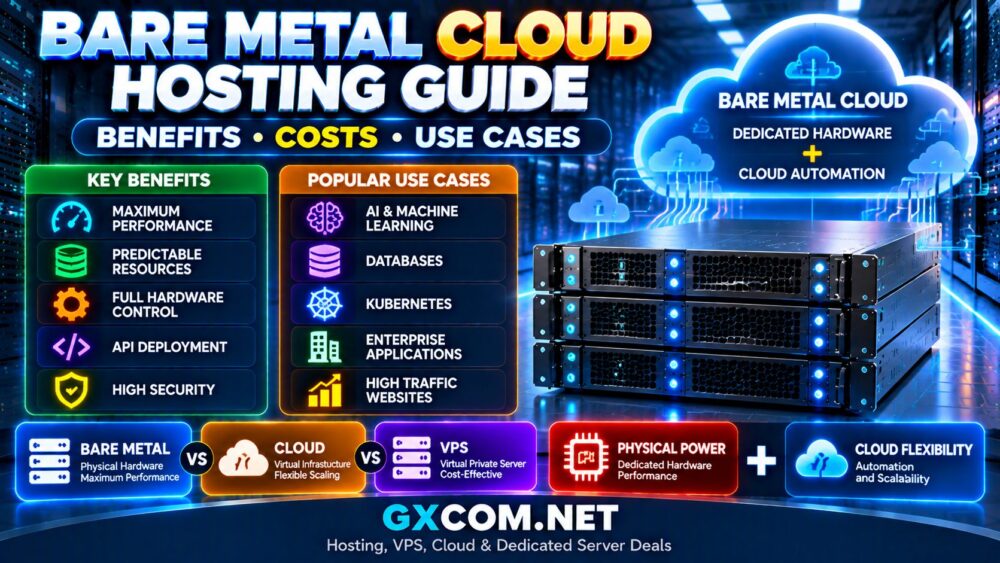
Bare metal is different from traditional cloud servers.
| Feature | Bare Metal | Cloud Server |
|---|---|---|
| Hardware | Physical server | Virtual machine |
| Scaling | Hardware-based | Fast software scaling |
| Performance | Consistent | Flexible |
| Cost Model | Fixed resource cost | Usage-based options |
Who Should Choose Bare Metal?
Bare metal is ideal for:
- AI companies
- Large databases
- High-performance computing
- Enterprise applications
- Game infrastructure
- Cloud providers
- Developers requiring full control
Who Should Choose Dedicated Servers?
Dedicated servers are usually better for:
- Business websites
- Ecommerce platforms
- Hosting companies
- Applications needing predictable resources
- Private servers
- Small and medium enterprises
Bare Metal Server vs Dedicated Server: Which One Should You Choose?
Choose a bare metal server if you need:
- Maximum hardware performance
- Cloud-style automation
- AI or HPC capabilities
- Advanced infrastructure control
Choose a dedicated server if you need:
- Reliable physical hosting
- Lower cost
- General-purpose applications
- Simple server management
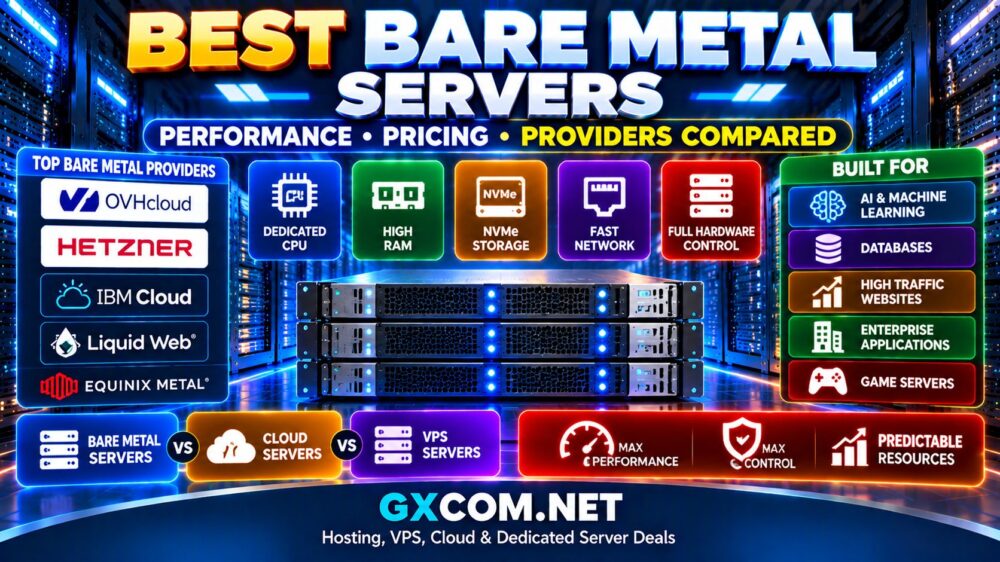
For provider options, read our Best Bare Metal Servers comparison.
Final Thoughts
Bare metal servers and dedicated servers share the same foundation: a physical machine dedicated to one customer.
The difference is mainly in how providers package and deliver the infrastructure.
Dedicated servers remain an excellent choice for websites, applications, and businesses that need reliable physical resources at predictable prices.
Bare metal servers are designed for users who require maximum performance, automation, cloud integration, and specialized workloads such as AI, high-performance computing, and enterprise databases.
The best choice depends on your workload, technical requirements, budget, and future growth plans.