A dedicated server may look affordable when you compare monthly rental prices. But the advertised price rarely tells the whole story.
Bandwidth overages, software licenses, backup storage, additional IP addresses, managed support, and setup charges can all affect what you actually spend. Even a low-cost server can become expensive if its network limits or support policies do not match your workload.
That is why businesses should evaluate dedicated server total cost of ownership (TCO), not just the starting price.
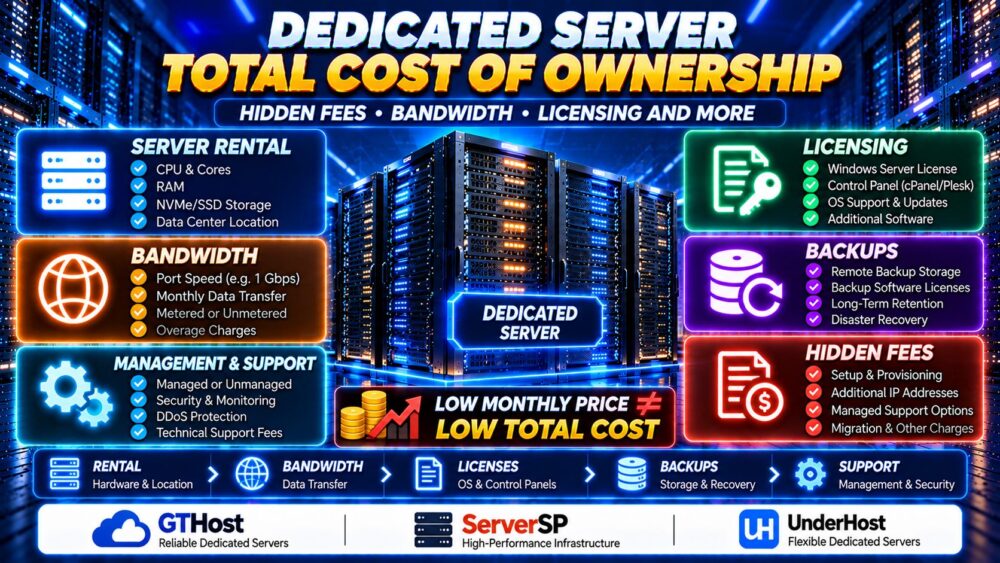
LOW MONTHLY PRICE ≠ LOW TOTAL COST.
This guide explains the most common dedicated server hidden costs, how bandwidth and licensing affect your budget, and how to compare providers using a practical TCO calculation.
What Is Dedicated Server Total Cost of Ownership?
Dedicated server total cost of ownership is the combined cost of renting, operating, managing, protecting, and maintaining a dedicated hosting environment over a defined period.
Unlike purchasing physical equipment for an on-premises data center, renting a dedicated server usually places hardware ownership and physical facility responsibilities with the hosting provider. However, the customer may still pay for administration, software, data protection, and other operating requirements.
A practical dedicated hosting TCO calculation includes:
- Base server rental
- Setup and provisioning fees
- Bandwidth and data transfer charges
- Additional IP addresses
- Operating system and control panel licenses
- Backup storage and disaster recovery
- Managed support or internal administration
- Security services and monitoring
- Migration and configuration costs
- Potential downtime and recovery expenses
For a general introduction to dedicated infrastructure, see our Dedicated Server Hosting Guide.
Dedicated Server TCO Formula
Use the following formula to estimate your hosting budget:
Total Cost of Ownership = One-Time Costs + Recurring Hosting Costs + Operating Costs + Estimated Variable Costs
For a 12-month planning period:
12-Month TCO = Setup Fees + Migration Costs + 12 × Monthly Recurring Costs + Estimated Variable Charges + Contingency
Recurring costs can include the server rental, software licenses, backup services, support, and monitoring. Variable charges may include bandwidth overages, additional storage, or paid support work.
Contingency is a planning allowance, not a fee charged by every provider.
Illustrative Dedicated Server TCO Example
The following amounts are hypothetical budgeting figures. They are not current prices or quotations from any hosting provider.
| Cost Component | Illustrative Amount |
|---|---|
| Base server rental | $80/month |
| Operating system or control panel licensing | $20/month |
| Remote backup service | $15/month |
| Monitoring or security add-ons | $10/month |
| Estimated variable charges | $10/month |
| One-time setup and migration | $150 |
| Estimated 12-month TCO | $1,770 |
In this example, the base rental represents only $960 of the estimated $1,770 annual cost.
The difference illustrates why comparing two dedicated server plans by advertised rental alone can be misleading.
1. Base Dedicated Server Rental: What Are You Paying For?
The base rental usually covers access to a dedicated physical server with an agreed hardware configuration and network connection.
However, providers may differ in how they package CPU resources, memory, storage, network capacity, and service features.
Before comparing prices, confirm:
- CPU model, generation, and core count
- RAM capacity and upgrade options
- SSD or NVMe storage capacity
- RAID configuration and available drive bays
- Network port speed
- Included monthly data transfer
- Data center location
- Hardware replacement and support policies
A server with an older CPU, limited storage redundancy, or restrictive bandwidth may have a lower rental price but a higher effective cost for your workload.
2. Dedicated Server Bandwidth Costs: Port Speed vs Data Transfer
Bandwidth is one of the most frequently misunderstood dedicated server pricing components.
Two servers may advertise a 1 Gbps network port while offering very different data transfer allowances and billing rules.
What Does a 1 Gbps Port Mean?
A 1 Gbps port describes the nominal maximum interface speed. It does not guarantee that your application will continuously achieve 1 Gbps of real-world throughput.
Actual performance depends on routing, congestion, hardware, protocol overhead, and other network conditions.
1 GBPS PORT ≠ UNLIMITED DATA TRANSFER.
Metered Bandwidth vs Unmetered Bandwidth
Metered plans include a specified data transfer allowance or usage-based billing model.
Unmetered plans generally do not bill by the amount of data transferred through a defined port, but they may still have port speed limits, acceptable use policies, and traffic management conditions.
Unlimited and unmetered are not necessarily interchangeable terms.
What Happens When You Exceed Your Bandwidth Allowance?
Depending on the provider and contract, excess traffic may result in:

- Additional data transfer charges
- Reduced connection speed
- Temporary service restrictions
- A requirement to upgrade the network package
Ask whether traffic is billed by transferred volume, committed bandwidth, or another measurement method such as 95th percentile usage.
How Much Data Can a 1 Gbps Connection Transfer?
At a theoretical continuous rate of 1 Gbps over 30 days, the transferred data would be approximately 324 TB in decimal units, before accounting for real-world limitations.
This is a mathematical upper-bound illustration, not a promise of available monthly transfer or achievable application throughput.
For websites with large downloads, video delivery, backups, or high traffic volumes, bandwidth terms may be more important than a small difference in server rental.
3. Operating System and Software Licensing Fees
Software licensing can significantly affect dedicated server total cost, particularly when using commercial operating systems or hosting control panels.
Linux Dedicated Servers
Many Linux distributions can be installed without a separate operating system license fee.
However, commercial enterprise support, specialized management software, and selected security tools may involve additional charges.
Windows Dedicated Server Licensing
Windows Server licensing may be included in the provider's quoted price or billed separately.
The total depends on the provider's licensing model, the Windows Server edition, applicable licensing terms, and any additional access or software requirements.
Never assume that a dedicated server advertised with Windows support includes every required Microsoft license.
For a more detailed explanation, read our Windows Dedicated Server Cost and Licensing Guide.
Hosting Control Panel Costs
Popular control panels such as cPanel, Plesk, and DirectAdmin may involve recurring license fees.
Costs can depend on the product, account limits, server type, and license package.
Also consider whether your selected control panel requires additional maintenance, compatible operating system versions, or paid support.
4. Additional IP Address Charges
Dedicated servers commonly include at least one public IP address, but the allocation and billing model vary.
Additional IPv4 addresses may involve:
- Monthly recurring charges
- One-time allocation fees
- IP justification requirements
- Subnet setup or routing conditions
IPv6 availability and allocation policies may differ from IPv4.
If your infrastructure requires multiple IP addresses, verify the complete cost and provider policies before deployment.
5. Backup Storage and Disaster Recovery Costs
Backups are essential for business continuity, but they are not automatically included with every dedicated server plan.
Backup-related expenses may include:
- Remote backup storage
- Backup software licenses
- Additional storage drives
- Backup data transfer
- Long-term retention
- Restoration assistance
- Disaster recovery infrastructure
Local RAID can improve resilience against certain drive failures, but it is not a substitute for independent backups.
RAID ≠ BACKUP.
When calculating TCO, include the cost of restoring service, not just storing backup files.
6. Managed vs Unmanaged Dedicated Server Costs
Management responsibility is another major difference between dedicated server offers.
Unmanaged Dedicated Hosting
Unmanaged hosting generally leaves operating system administration, updates, firewall rules, monitoring, and backup configuration to the customer.
The rental price may be lower, but your business still needs technical expertise and administration time.
That labor has an economic cost even if no separate invoice appears.
Managed Dedicated Hosting
Managed services may include selected operating system maintenance, technical support, monitoring, security configuration, or backup assistance.
However, the management scope varies by provider and plan.
Some services, particularly application troubleshooting and advanced recovery work, may remain outside standard support.
To understand the differences, see our Managed Dedicated vs Unmanaged Dedicated</a comparison.
7. Setup Fees, Migration Costs and Contract Terms
One-time charges can make a seemingly affordable server more expensive during the first year.
Potential costs include:
- Server provisioning or setup
- Custom hardware configuration
- Operating system installation
- Website or application migration
- Database migration
- Control panel migration
- Additional technical assistance
Contract terms matter too.
A lower advertised monthly rate may depend on a longer billing commitment, while a monthly plan may offer more flexibility.
Before ordering, confirm renewal pricing, cancellation requirements, refund policies, and any applicable taxes or payment processing charges.
8. Security, DDoS Protection and Monitoring Costs
Dedicated server security extends beyond installing a firewall.
Depending on the workload, your budget may need to cover:
- Network DDoS mitigation
- Web application firewall services
- Vulnerability scanning
- Endpoint or malware protection
- Centralized log management
- External uptime monitoring
- Incident response assistance
Some providers bundle selected security features. Others charge separately or limit coverage to certain attack types.
Always review the actual service description rather than assuming that terms such as secure hosting or DDoS protected cover every threat.
9. Comparing Dedicated Server Providers by Total Cost
When evaluating providers, request comparable quotations using the same hardware, traffic, licensing, backup, and support requirements.
GTHost — Check the Complete Server Quote
GTHost is one option to evaluate when comparing dedicated server configurations and deployment requirements.
Review the quoted hardware, data center location, included traffic, setup terms, additional IP pricing, and optional services.
The key question is not simply which server has the lowest listed rental, but which configuration delivers the resources you need at a predictable total cost.
ServerSP — Compare Infrastructure and Network Terms
ServerSP is another provider worth including in a dedicated infrastructure comparison.
When requesting a quote, confirm the applicable network allowances, port speed, software licensing, management responsibilities, and any additional service fees.
Do not assume that features advertised for a provider's cloud VPS products also apply to its dedicated server offerings.
UnderHost — Review Add-Ons and Management Scope
UnderHost can also be evaluated for dedicated server requirements.
Before ordering, verify the current server configuration, available IP resources, backup options, technical support scope, and contract conditions.
Compare the complete checkout total and written service terms rather than relying on the headline price alone.
Best practice: Use the same requirements checklist for every provider to make the comparison fair.
10. Dedicated Server TCO Comparison Checklist
| Cost Category | Provider A | Provider B |
|---|---|---|
| Base monthly rental | Check | Check |
| Setup fees | Check | Check |
| CPU, RAM and storage | Check | Check |
| Network port speed | Check | Check |
| Included monthly transfer | Check | Check |
| Bandwidth overage rules | Check | Check |
| Additional IP costs | Check | Check |
| OS and panel licensing | Check | Check |
| Backup and restoration | Check | Check |
| Managed support | Check | Check |
| Security add-ons | Check | Check |
| Renewal and cancellation terms | Check | Check |
Use a 12-month or 24-month planning horizon to compare offers consistently.
For additional options to evaluate, visit our Affordable Dedicated Server Deals guide.
11. How to Reduce Dedicated Server TCO Without Sacrificing Performance
Reducing total cost does not always mean buying the cheapest hardware.
- Right-size CPU and RAM: Choose resources based on measured workload requirements.
- Estimate realistic bandwidth: Use traffic analytics and account for growth.
- Avoid unnecessary licenses: Choose software that matches operational needs.
- Review backup architecture: Balance recovery requirements with storage and retention costs.
- Compare management options: Include internal administration time in your budget.
- Evaluate network location: Consider latency, routing quality, and transfer costs.
- Check upgrade policies: Understand migration costs before selecting a configuration.
- Review renewal terms: Avoid decisions based only on introductory offers.
A well-matched server can offer better value than a cheaper configuration that requires frequent upgrades or additional services.
Dedicated Server Total Cost FAQ
What is included in dedicated server total cost of ownership?
TCO includes server rental, setup, bandwidth, licenses, backups, management, security, migration, and other operating costs over a defined period.
Are dedicated server bandwidth charges included?
Some plans include a fixed transfer allowance, while others use unmetered or usage-based billing. Always check the contract and overage rules.
Does a 1 Gbps dedicated server include unlimited bandwidth?
No. Port speed and monthly data transfer allowances are separate specifications. A 1 Gbps port does not automatically provide unlimited transfer.
Do Linux dedicated servers require license fees?
Many Linux distributions do not require a separate operating system license fee, but commercial support, control panels, and specialized software may cost extra.
Is Windows Server licensing included?
It depends on the provider and selected plan. Confirm the applicable licensing model and any additional software or access requirements.
Are dedicated server backups free?
Not necessarily. Some providers offer optional backup storage or managed backup services with additional charges.
Is unmanaged dedicated hosting always cheaper?
Not always. It may have a lower rental cost, but internal administration, security maintenance, and recovery work can increase total operating expenses.
How should I compare dedicated server prices?
Compare equivalent hardware, network allowances, software licensing, backup requirements, management services, and contract terms over the same period.
Final Verdict: Compare Total Cost, Not Just Monthly Rental
Dedicated server pricing becomes much easier to understand when every cost is evaluated together.
A low monthly rental may be attractive, but bandwidth limits, software licenses, backup requirements, support policies, and setup charges can change the real value of the offer.
Before choosing between GTHost, ServerSP, UnderHost, or another provider, request a complete quotation and calculate your expected 12-month TCO.
SERVER RENTAL + BANDWIDTH + LICENSES + BACKUPS + SUPPORT = REAL OPERATING COST.
The best dedicated server deal is not necessarily the cheapest advertised server. It is the configuration that meets your workload requirements with predictable costs, dependable infrastructure, and a manageable level of operational risk.