Cherry Servers is a cloud infrastructure provider with a particularly strong focus on bare metal and dedicated servers. Its platform combines single-tenant physical hardware with cloud-style features such as automated deployment, hourly billing, APIs, private networking, IP KVM access, and flexible storage and network configurations.
The dedicated server lineup includes AMD Ryzen, AMD EPYC, Threadripper Pro, and other server-class hardware designed for workloads ranging from high-frequency applications to virtualization, databases, high-performance computing, and large-scale infrastructure.
Unlike a conventional VPS, Cherry Servers bare metal gives customers direct access to physical server resources without sharing the CPU or running the workload inside a provider-controlled virtualization layer.
In this Cherry Servers Dedicated Server Review, we examine its bare metal infrastructure, AMD Ryzen and EPYC servers, pricing, NVMe storage, network capacity, deployment, global locations, support, performance considerations, and the major pros and cons to consider before ordering.
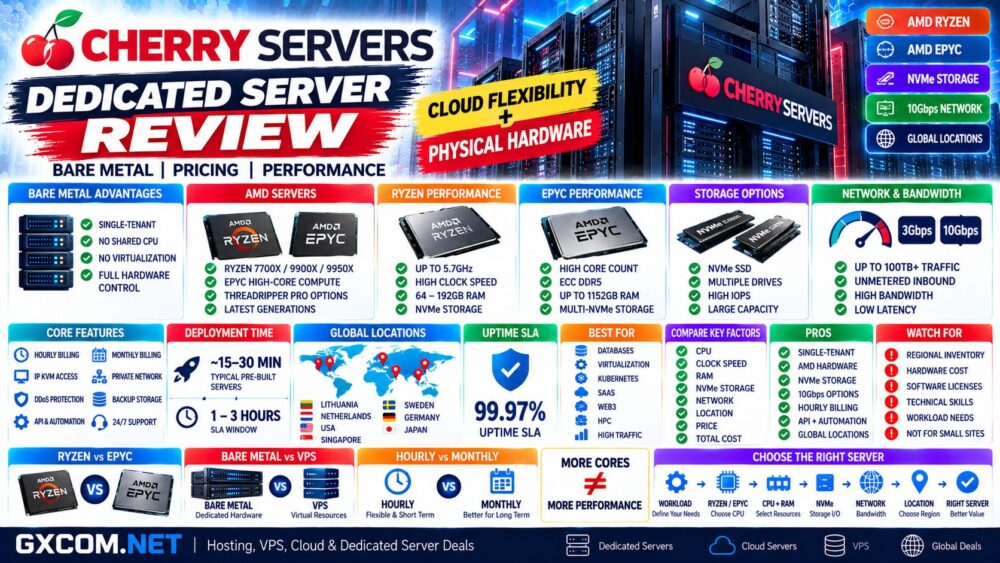
Cherry Servers Dedicated Server Review: Quick Overview
| Feature | Cherry Servers |
|---|---|
| Infrastructure | Single-Tenant Bare Metal |
| AMD Ryzen | Yes |
| AMD EPYC | Yes |
| Threadripper Pro | Yes |
| Physical CPU Cores | Up to 128 on current AMD lineup |
| RAM | Up to 1152GB on current AMD configurations |
| NVMe | Yes |
| Storage | Multiple NVMe configurations |
| Network | Up to 10Gbps on applicable servers |
| Traffic | 30–100TB+ depending on configuration |
| Inbound Traffic | Unmetered on applicable dedicated configurations |
| Hourly Billing | Yes |
| Monthly Billing | Yes |
| Annual Billing | Yes |
| IP KVM | Yes |
| Private Network | Yes |
| DDoS Protection | Included |
| Backup Storage | Available; current servers can include 100GB |
| Support | 24/7 |
| Best For | Databases, virtualization, SaaS, Web3, HPC and demanding applications |
What Are Cherry Servers Dedicated Servers?
Cherry Servers dedicated servers are physical, single-tenant machines provisioned through a cloud-style infrastructure platform.
The customer receives the server's physical resources rather than a virtual allocation of CPU and RAM.
That means:
- No shared CPU
- No provider virtualization overhead
- Direct physical server resources
- Hardware-level control
- Dedicated RAM
- Local NVMe storage
- Private networking
- IP KVM remote management
This infrastructure model is often described as bare metal.
The interesting part of Cherry Servers is that it combines bare-metal hardware with features normally associated with cloud platforms, including automated provisioning, hourly billing, APIs, flexible networking, and infrastructure automation.
Cherry Servers Bare Metal vs Traditional Dedicated Hosting
Traditional dedicated hosting often involves selecting a server, waiting for manual provisioning, and managing it as an isolated physical machine.
Cherry Servers moves closer to a bare-metal cloud model.
| Factor | Cherry Servers Bare Metal | Traditional Dedicated Hosting |
|---|---|---|
| Physical Hardware | Dedicated | Dedicated |
| Virtualization | None required | None required |
| Hourly Billing | Available | Less common |
| Automated Deployment | Yes | Provider dependent |
| API | Yes | Provider dependent |
| Private Networking | Yes | Provider dependent |
| IP KVM | Yes | Usually available |
| Cloud Integration | Strong | Varies |
This approach can be useful when you want dedicated hardware without giving up cloud-style infrastructure management.
Cherry Servers Dedicated Server Pricing
Dedicated server pricing varies substantially according to CPU generation, core count, memory, storage, network capacity, location, and billing term.
Current AMD Ryzen servers provide a useful view of the lower and middle portions of the platform.
| Server | CPU | RAM | Storage | Current Starting Price* |
|---|---|---|---|---|
| AMD Ryzen 7700X | 8 Cores / 16 Threads | 64GB | 2 × 1TB NVMe | $158.13/mo |
| AMD Ryzen 9900X | 12 Cores / 24 Threads | 96GB | 2 × 1TB NVMe | $194.92/mo |
| AMD Ryzen 9950X | 16 Cores / 32 Threads | 128GB | 2 × 1TB NVMe | $347.08/mo |
*Published prices and availability can change. Always verify the current configuration and billing term before ordering.
These Ryzen configurations currently include up to 10Gbps networking and 100TB of monthly traffic on applicable plans.
Cherry Servers AMD Ryzen Performance
Ryzen servers are particularly interesting when applications benefit from high per-core clock speed.
Current Ryzen configurations reach boost frequencies as high as 5.7GHz.
That makes them relevant for workloads such as:
- Game servers
- Real-time applications
- Web applications
- Trading applications
- Web3 validator nodes
- Databases
- Development environments
For example, the Ryzen 9950X currently provides 16 physical cores, 32 threads, 128GB RAM by default, up to 192GB RAM, and NVMe storage.
However, a high clock speed does not automatically make Ryzen the correct CPU for every workload.
Applications requiring very large memory capacity or much higher core counts may be better suited to EPYC.
Cherry Servers AMD EPYC Servers
AMD EPYC occupies the higher end of the Cherry Servers dedicated server portfolio.
Current EPYC configurations can provide:
- High physical core counts
- ECC memory
- DDR4 or DDR5 depending on generation
- Large RAM capacities
- Multiple NVMe disks
- 3Gbps or 10Gbps networking depending on server
- Large monthly traffic allocations
These characteristics make EPYC particularly relevant for:
- Virtualization
- Large databases
- Containers
- Data analytics
- Enterprise applications
- HPC
- AI-related CPU workloads
- Large-scale hosting
Example Cherry Servers EPYC Pricing
Current pricing illustrates how widely bare-metal costs can vary according to generation and hardware.
| CPU | Cores / Threads | RAM | Network | Current Monthly Price* |
|---|---|---|---|---|
| EPYC 7443P | 24 / 48 | 64GB | 10Gbps | $197.73 |
| EPYC 4564P | 16 / 32 | 192GB DDR5 | 10Gbps | $303.03 |
| EPYC 9255 | 24 / 48 | 192GB DDR5 | 3Gbps | $537.03 |
| EPYC 9274F | 24 / 48 | 384GB DDR5 | 10Gbps | $782.73 |
| EPYC 9375F | 32 / 64 | 384GB DDR5 | 3Gbps | $1,157.13 |
| EPYC 9575F | 64 / 128 | 384GB DDR5 | 10Gbps | $1,580.67 |
*These are published prices observed at the time of review. Promotions, annual billing, location, inventory, RAM, storage, and other configuration choices can change the effective price.
This table also demonstrates why comparing dedicated servers by CPU core count alone is misleading.
Ryzen vs EPYC: Which Should You Choose?
| Factor | AMD Ryzen | AMD EPYC |
|---|---|---|
| Main Strength | High clock speed | Core count and scalability |
| Typical Cores | Lower | Higher |
| Memory Capacity | Lower | Much higher |
| ECC | Configuration dependent | Server-class ECC |
| Best For | Latency-sensitive workloads | Parallel and enterprise workloads |
| Virtualization | Moderate deployments | Strong fit |
| Databases | High-frequency workloads | Large-memory workloads |
The useful decision is not simply Ryzen vs EPYC.
It is:
Workload → Core Count → Clock Speed → RAM → Storage I/O → Network → Right CPU.
NVMe Storage
NVMe storage is prominent throughout Cherry Servers' modern bare-metal portfolio.
Current configurations range from relatively simple dual-NVMe setups to servers capable of supporting multiple drives and very large total storage capacities.
For example, selected EPYC configurations support more than 1TB of RAM and tens of terabytes of NVMe storage.
NVMe can be particularly valuable for:
- Databases
- Virtual machines
- Containers
- High-traffic websites
- Analytics
- Application servers
- Data processing
But storage capacity and storage performance are different metrics.
Buyers should consider drive count, RAID configuration, endurance, redundancy, workload IOPS, and backup strategy rather than looking only at total terabytes.
Up to 1152GB RAM
Large-memory configurations are one of the strongest reasons to move from ordinary VPS infrastructure to enterprise bare metal.
Several current EPYC platforms can be configured with up to 1152GB of DDR5 ECC memory.
That amount of RAM is relevant for specialized workloads such as:
- Large in-memory databases
- Dense virtualization
- Analytics
- Enterprise applications
- Scientific computing
- Large caching layers
Most workloads do not need 1TB of RAM, however.
Oversized memory increases infrastructure cost without improving an application that cannot use it.
Cherry Servers Network Performance
Networking is another strong area of Cherry Servers bare metal.
Current AMD servers can provide uplinks ranging from several gigabits per second to 10Gbps depending on configuration.
Many current configurations include 100TB of free outbound traffic per month and unmetered inbound traffic.
That combination can be useful for:
- High-traffic applications
- Content delivery
- Large backups
- Data processing
- Replication
- Web3 infrastructure
- Virtualization platforms
However, a 10Gbps port should not be confused with a guarantee that every application will continuously transfer data at 10Gbps.
Actual throughput depends on network paths, remote endpoints, protocol overhead, storage, CPU, and workload design.
10Gbps Port ≠ 10Gbps Application Performance.
100TB Monthly Traffic
Many current Ryzen and EPYC dedicated servers include 100TB of monthly outbound traffic.
This is considerably more than the transfer included with many conventional VPS products.
Incoming traffic is unmetered on applicable dedicated configurations.
Bandwidth-heavy users should still verify the exact allowance of the selected server because Cherry Servers documentation indicates that free traffic can vary between approximately 30TB and 200TB depending on the product.
How Fast Does Cherry Servers Deploy Bare Metal?
Deployment speed is one of Cherry Servers' distinguishing features.
Its current AMD bare-metal pages advertise automated deployment in approximately 15 minutes for available pre-built hardware.
Individual product pages describe typical automated deployment windows of around 15–30 minutes.
The formal Cherry Servers SLA is more conservative and states that dedicated servers have an estimated preparation time of 1–3 hours after payment is processed and the order is confirmed.
This distinction matters.
Think of 15–30 minutes as a typical automated provisioning target for suitable in-stock configurations, while the SLA provides a broader official preparation window.
Hourly vs Monthly Billing
Cherry Servers offers hourly billing on dedicated bare-metal infrastructure, which is less common than hourly billing for virtual cloud instances.
This can be useful for:
- Temporary compute
- Performance testing
- Development
- Short projects
- Data processing
- Infrastructure migration
For a server expected to run continuously, monthly or annual billing may provide better economics depending on the configuration and current discount.
The useful comparison is:
Hourly Rate × Expected Utilization vs Fixed-Term Price.
Annual Billing Discounts
Selected dedicated servers offer reduced effective monthly pricing when customers commit to annual billing.
For example, current EPYC product pages can show annual rates below the equivalent twelve-month total of month-to-month billing.
The exact discount varies by server and promotion.
A longer commitment should therefore be considered only after confirming that the workload and location are likely to remain stable.
IP KVM and Remote Server Control
Cherry Servers provides IP KVM access for bare-metal server management.
This is important because a dedicated server can occasionally become unreachable through its normal operating-system network interface.
IP KVM allows administrators to perform tasks such as:
- Remote console access
- Troubleshooting boot problems
- Operating system installation
- Network troubleshooting
- Low-level server administration
This provides a level of hardware control that conventional VPS customers generally do not receive.
Operating Systems
Current Cherry Servers dedicated server options include several operating systems and self-installation methods.
Available choices can include:
- Ubuntu
- Debian
- AlmaLinux
- openSUSE
- Windows Server
- VMware ESXi
- Custom installation through IP KVM
- iPXE deployment
Available versions and licensing can change, particularly for commercial software such as Windows and virtualization products.
Private Networking
Each applicable Cherry Servers dedicated server can be connected through private networking.
This allows multiple machines to communicate without routing internal traffic over the public internet.
A typical architecture could be:
Internet → Load Balancer → Web Servers → Private Network → Database Server.
Private networking becomes particularly useful for multi-server applications, Kubernetes, database clusters, virtualization, and distributed infrastructure.
DDoS Protection
Cherry Servers includes network-level DDoS mitigation designed to protect against common attack vectors.
This is useful for internet-facing infrastructure, but DDoS protection should not be treated as complete application security.
Customers still need appropriate:
- Firewall rules
- Operating-system updates
- Application security
- Authentication
- Monitoring
- Backups
Backup Storage
Current dedicated server configurations can include 100GB of backup storage, with additional capacity available.
This is useful because RAID and multiple local disks are not substitutes for independent backups.
For important workloads, maintain copies outside the primary physical server.
A sensible backup strategy may include:
Local Redundancy + Provider Backup + Independent Off-Site Backup.
Cherry Servers Data Center Locations
Cherry Servers has expanded its bare-metal infrastructure beyond its original Lithuanian footprint.
Current AMD server availability spans locations including:
- Lithuania
- Netherlands
- United States
- Singapore
- Sweden
- Germany
- Japan on selected configurations
Not every processor is available in every location.
For example, one CPU may have inventory in Chicago and Amsterdam while another may be available in Frankfurt, Tokyo, or Singapore.
Always check live inventory before designing infrastructure around a specific CPU and region.
Cherry Servers Support
Cherry Servers provides 24/7 technical support through email, live chat, and phone.
Current AMD dedicated server information also advertises around-the-clock engineering support and rapid response.
Customers receive a personal account manager as a single point of contact for account and infrastructure requirements.
This can be particularly useful for larger bare-metal deployments where hardware, networking, storage, and location decisions become more complex.
Cherry Servers Uptime SLA
Cherry Servers currently publishes a 99.97% uptime SLA for its platform.
That is an infrastructure availability commitment under the provider's service terms rather than a guarantee that every application hosted on a dedicated server will achieve exactly the same uptime.
Application uptime also depends on:
- Operating system
- Application architecture
- Database availability
- DNS
- Customer configuration
- Redundancy
- Backups
Mission-critical systems should therefore be designed for redundancy rather than relying entirely on one physical machine.
Have We Independently Benchmarked Cherry Servers?
This review analyzes Cherry Servers using currently published hardware specifications, pricing, network information, infrastructure documentation, and platform features.
Unless GXCOM.NET explicitly publishes benchmark methodology and measured results, provider specifications and published benchmark figures should not be interpreted as independent GXCOM.NET performance testing.
For production infrastructure, benchmark your actual workload.
Useful measurements include:
- CPU performance
- Database queries per second
- NVMe IOPS
- Storage latency
- Network throughput
- Application response time
- Virtual machine density
- Powerful workload-specific metrics
Cherry Servers Bare Metal vs VPS
| Factor | Cherry Servers Bare Metal | Typical VPS |
|---|---|---|
| CPU | Physical dedicated CPU | Usually shared vCPU |
| RAM | Physical dedicated memory | Virtual allocation |
| Virtualization Layer | None required | Yes |
| Hardware Control | High | Limited |
| Large RAM | Strong | More expensive / limited |
| Hourly Billing | Available | Common |
| Deployment | Minutes to hours | Usually minutes |
| Entry Cost | Higher | Lower |
For smaller workloads, a VPS can provide much better economics.
Bare metal becomes more compelling when sustained CPU performance, large memory, NVMe I/O, network capacity, or hardware-level control is required.
See our
Dedicated Server vs VPS
guide for a broader comparison.
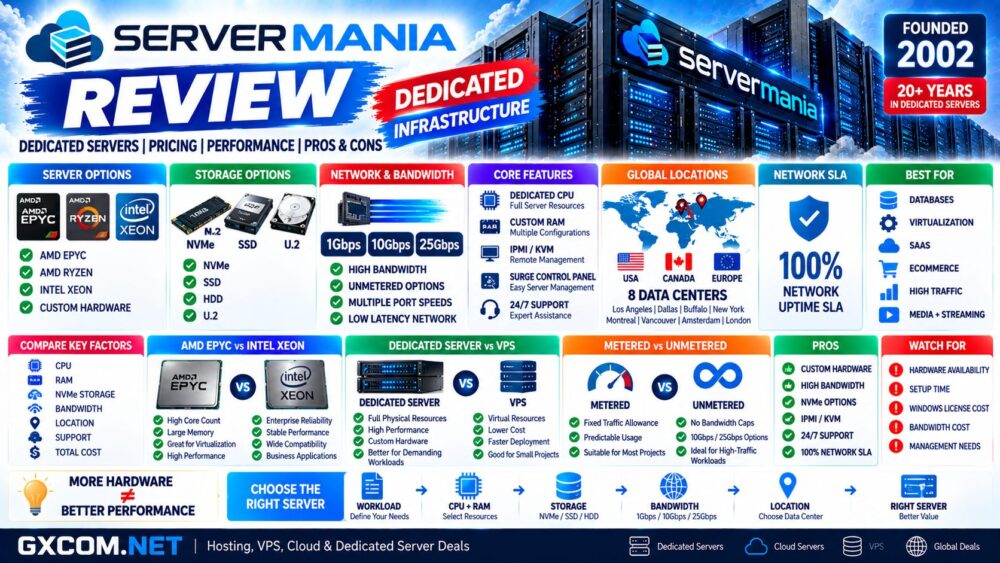
Cherry Servers vs ServerMania
Cherry Servers and ServerMania both provide dedicated infrastructure, but their platforms have different strengths.
| Factor | Cherry Servers | ServerMania |
|---|---|---|
| Dedicated Servers | Yes | Yes |
| Bare-Metal Cloud Model | Strong focus | Dedicated infrastructure focus |
| Hourly Bare Metal | Yes | Product dependent |
| AMD EPYC | Yes | Yes |
| AMD Ryzen | Yes | Yes |
| NVMe | Yes | Yes |
| High-Bandwidth Options | Yes | Strong focus |
| API / Automation | Strong focus | Available infrastructure tools |
| Best Fit | Cloud-style bare metal | Custom dedicated infrastructure |
The appropriate provider depends on CPU availability, region, network requirements, billing model, management needs, and the total configured price.
Cherry Servers Pros and Cons
| Pros | Cons |
|---|---|
| Single-tenant physical hardware | Higher entry cost than VPS |
| AMD Ryzen and EPYC options | Hardware inventory varies by location |
| High-frequency and high-core-count CPUs | Some configurations are expensive |
| Large RAM configurations | Not every CPU is globally available |
| NVMe storage | Dedicated infrastructure requires technical skills |
| Up to 10Gbps networking | OS and software licenses may add cost |
| Large monthly traffic allowances | Deployment is not as instant as a typical VPS |
| Hourly billing | Hourly bare metal can become expensive at continuous utilization |
| IP KVM and private networking | Single-server deployments still need redundancy planning |
| 24/7 support | — |
Who Should Consider Cherry Servers Dedicated Servers?
Cherry Servers bare metal is particularly relevant for:
- Developers
- DevOps teams
- SaaS applications
- Databases
- Virtualization
- Kubernetes
- Game servers
- Web3 infrastructure
- Validator nodes
- High-traffic applications
- Data analytics
- HPC
- Enterprise workloads
The strongest use case is a workload that can genuinely benefit from dedicated physical resources.
Who May Prefer an Alternative?
Small websites, lightweight applications, development servers, and low-traffic projects usually do not need dedicated bare-metal infrastructure.
A VPS may provide enough CPU, RAM, and storage for a fraction of the cost.
Likewise, workloads requiring instant elasticity across hundreds of temporary instances may fit conventional public cloud infrastructure better.
For other physical-server options, see our
Bare Metal Server Providers
comparison.
Is Cherry Servers Good for High-Performance Workloads?
Cherry Servers offers several characteristics relevant to performance-sensitive infrastructure: dedicated physical CPUs, high-frequency Ryzen processors, high-core-count EPYC processors, large ECC memory configurations, NVMe storage, and multi-gigabit networking.
However, the fastest hardware is not automatically the best configuration.
A database may need RAM and storage IOPS, while a game server may care more about single-thread CPU speed. A virtualization platform may prioritize core count and memory capacity.
That is why server selection should begin with the workload rather than the largest specification.
More Cores ≠ More Performance for Every Workload.
Is Cherry Servers Good Value?
Cherry Servers is most interesting from a value perspective when cloud-style flexibility and physical hardware are both important.
The ability to rent bare metal hourly can reduce commitment for temporary workloads, while monthly and annual billing provide alternatives for continuously running infrastructure.
Large traffic allowances, NVMe storage, IP KVM, private networking, DDoS protection, backup storage, and support should also be included when comparing the total cost against another provider.
The useful calculation is:
CPU + RAM + NVMe + Network + Traffic + Location + Billing Term + Support = Total Infrastructure Value.
Cherry Servers Dedicated Server Review: Final Thoughts
Cherry Servers combines the performance and control of traditional dedicated servers with several characteristics normally associated with cloud infrastructure.
Its current bare-metal lineup ranges from high-clock-speed AMD Ryzen systems to large AMD EPYC configurations with hundreds of gigabytes of ECC memory, multiple NVMe drives, and multi-gigabit networking.
Hourly billing, automated provisioning, APIs, private networking, IP KVM, DDoS protection, and global infrastructure make the platform particularly relevant for developers and infrastructure teams that want physical hardware without returning to a completely traditional dedicated-hosting model.
The main trade-offs are cost and complexity. Bare metal costs substantially more than entry-level VPS infrastructure, inventory varies by location, and customers need enough technical knowledge to manage dedicated systems effectively.
For workloads that actually require sustained CPU performance, large memory capacity, NVMe storage, high bandwidth, or physical hardware control, Cherry Servers offers a broad range of configurations.
Before ordering, use this decision path:
Workload → Ryzen / EPYC → CPU → RAM → NVMe → Network → Location → Hourly / Monthly → Total Cost.