Moving from a virtual private server to dedicated hardware can solve resource contention, but it also introduces decisions about physical processors, storage redundancy, network traffic, and server administration. The right provider should offer more than impressive hardware specifications.
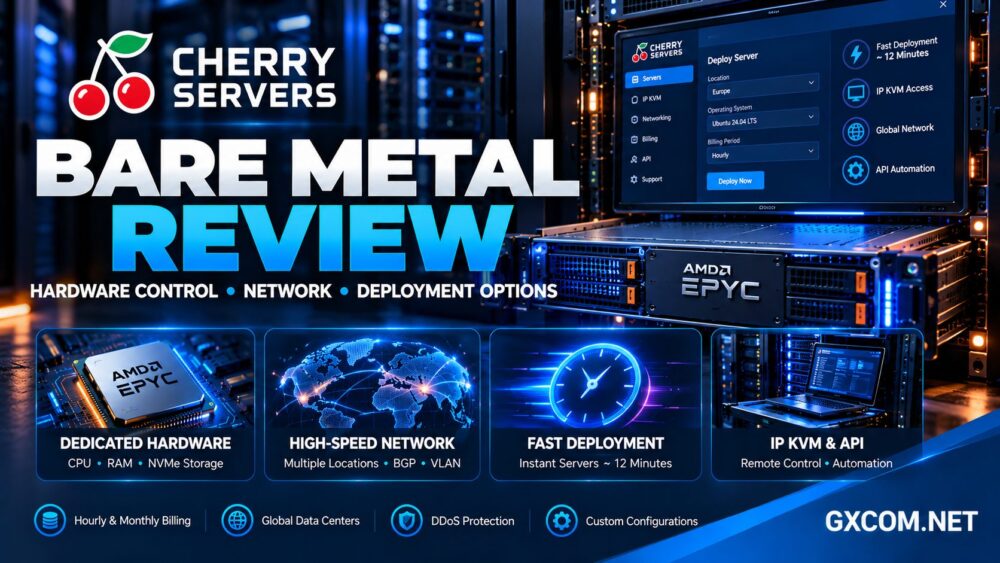
In this Cherry Servers Bare Metal review, we examine hardware control, deployment options, networking, billing flexibility, and the practical value of renting single-tenant infrastructure.
Cherry Servers combines traditional dedicated server capabilities with cloud-style provisioning and automation. Its portfolio includes preconfigured instant servers, customizable dedicated machines, and specialized infrastructure for demanding workloads.
However, not every configuration offers identical locations, hardware options, or traffic allowances. Understanding these differences is essential before ordering.
Cherry Servers Bare Metal Review: Quick Verdict
Cherry Servers is a strong candidate for developers, infrastructure teams, and businesses that need physical hardware without the procurement and maintenance responsibilities of owning servers.
Its main advantages include single-tenant resources, automated deployment, IP KVM access, API integration, private networking, and flexible billing periods.
The principal trade-off is operational responsibility. Dedicated hardware gives administrators more control, but operating system security, application maintenance, backups, and capacity planning still require attention.
Our assessment: Cherry Servers is particularly attractive when dedicated compute resources and infrastructure automation matter more than the simplicity of fully managed hosting.
What Makes Cherry Servers Different from a VPS?
A conventional VPS runs as a virtual machine on a physical host. Depending on the provider and product, CPU resources, storage infrastructure, and networking may be shared among multiple customers.
Cherry Servers’ bare metal products instead provide physical server hardware allocated to a single customer. This gives administrators direct access to the machine’s available processor cores, memory, and installed storage.
Single tenancy can be useful for databases, virtualization hosts, game servers, and applications requiring predictable resource access.
Nevertheless, dedicated hardware does not automatically guarantee superior application performance. Processor generation, disk configuration, software optimization, and network routing remain important.
Our dedicated server vs VPS comparison explains when the additional control justifies the operational complexity.
Instant Servers vs Custom Dedicated Servers
Cherry Servers offers different deployment models designed around speed and hardware flexibility.
| Option | Primary Advantage | Best Fit |
|---|---|---|
| Instant Bare Metal | Preconfigured hardware and automated provisioning | Rapid deployments, testing, production applications |
| Custom Dedicated | Broader hardware selection and tailored configurations | Specialized databases, virtualization, demanding infrastructure |
| GPU Infrastructure | Accelerator-oriented physical hardware | AI, rendering, and compatible compute workloads |
Instant Bare Metal Deployment
Cherry Servers documents an average provisioning time of approximately 12 minutes for its prebuilt instant servers across available regions.
This makes the product relevant for temporary environments, development pipelines, and infrastructure teams that want physical resources without waiting for a conventional manual installation process.
Actual delivery depends on stock, location, and the selected server configuration. Custom hardware requests may require additional preparation.
Custom Hardware Configurations
Custom dedicated servers offer greater choice in processors, memory capacity, and storage layouts. Cherry Servers advertises configurations using modern AMD EPYC and other processor platforms.
These systems can accommodate memory-intensive databases, virtualization clusters, and applications that benefit from substantial physical core counts.
Before ordering, confirm the available chassis, drive slots, supported upgrades, and replacement procedures. Hardware expansion is not always as immediate as increasing resources on a cloud VM.

Hardware Control: CPU, RAM and NVMe Storage
One of the strongest reasons to choose bare metal is access to the entire physical server rather than an allocated portion of a shared host.
Cherry Servers offers configurations spanning different CPU generations, memory capacities, and storage arrangements. Some systems emphasize high core counts, while others prioritize stronger per-core performance.
Businesses evaluating physical infrastructure for the first time can read our dedicated server hosting guide to understand hardware isolation, server administration, and the responsibilities involved in renting an entire machine.
For virtualization and parallel workloads, physical core count and memory capacity are important. For latency-sensitive applications, processor frequency and application behavior may matter more.
NVMe storage is available across relevant server configurations, although drive count, capacity, and supported RAID layouts vary.
Administrators should distinguish physical drive redundancy from backup protection. RAID can improve availability during certain drive failures but does not protect against accidental deletion or compromised applications.
Our bare metal server comparison provides additional criteria for evaluating hardware value across providers.
Remote Server Control and Operating Systems
Cherry Servers includes remote administration capabilities such as IP KVM access, allowing operators to interact with a server console even when normal network access is unavailable.
This is valuable for troubleshooting boot failures, configuring operating systems, and recovering from incorrect firewall settings.
The provider also supports operating system deployment options including popular Linux distributions, with additional software and installation choices depending on the hardware.
Some configurations list Windows Server or virtualization software. Licensing and compatibility should be confirmed for the exact server before checkout.
Advanced users can explore custom installation methods and automation tools, while teams without dedicated administrators should consider the additional management workload.
Network Quality, Bandwidth and Private Connectivity
Network specifications are another important part of this Cherry Servers review.
Selected dedicated servers advertise high-speed uplinks, including multi-gigabit and 10 Gbps configurations. However, a 10 Gbps network port does not guarantee continuous 10 Gbps transfer speeds.
Actual throughput depends on the destination, upstream routing, congestion, server configuration, and traffic policies.
Understanding Monthly Traffic Allowances
Cherry Servers documents separate traffic policies for different products and billing arrangements. Fixed-term plans include specified transfer allowances, while hourly servers may receive proportionally calculated traffic limits.
The provider measures outbound traffic for relevant bandwidth accounting. Additional charges may apply when included allowances are exceeded.
Importantly, advertised traffic allowances can differ by server generation, configuration, and commercial offer. Buyers should rely on the allowance displayed for their exact order.
Private Networking and BGP
Cherry Servers provides private networking features, including virtual LAN connectivity between compatible infrastructure resources.
Its documentation also references networking capabilities such as local BGP for appropriate use cases.
These tools can support multi-server applications, internal database connections, and more advanced routing designs. Availability and configuration requirements should be checked before deployment.
API Automation and Infrastructure Deployment
Cherry Servers supports ordering and managing infrastructure through its client portal and API.
Automation is valuable for DevOps teams building repeatable environments, deploying temporary capacity, or integrating physical servers into existing provisioning workflows.
Infrastructure-as-code processes can reduce manual configuration mistakes, but teams should still validate operating system images, access controls, and post-deployment security.
For workloads requiring frequent creation and deletion of environments, automated bare metal provisioning can offer more flexibility than traditional dedicated server ordering.
Hourly, Monthly and Annual Billing
Cherry Servers offers hourly, monthly, and annual billing options for eligible dedicated server products.
Hourly billing can suit load testing, temporary development projects, and short-term compute requirements. Monthly billing is easier to budget for continuously running production services.
Annual commitments may offer better effective rates but reduce flexibility if hardware requirements change.
Compare the full cost of the selected processor, memory, storage, traffic, software licenses, and optional services rather than relying on a headline hourly rate.
Our affordable dedicated server deals guide explains how to assess hardware specifications and long-term hosting costs.
Backups, Security and Technical Support
Cherry Servers advertises backup storage options, network-level DDoS protection, and round-the-clock technical assistance for its dedicated infrastructure.
However, available backup storage does not automatically mean a complete managed backup strategy. Administrators remain responsible for scheduling backups, testing restoration, and protecting application data.
Similarly, network-level DDoS protection should not be confused with comprehensive application security or guaranteed mitigation of every attack.
Customers should clarify which tasks are covered by infrastructure support and which remain their responsibility.
Our managed vs unmanaged dedicated server guide explains how administration responsibilities influence operating costs.
Cherry Servers vs Other Bare Metal Providers
Cherry Servers is not the only provider worth evaluating when purchasing dedicated hardware.
GTHost may appeal to buyers prioritizing rapid dedicated server deployment and straightforward hardware selection. Compare locations, storage configurations, and traffic terms.
ServerMania deserves consideration for businesses evaluating dedicated infrastructure, customized hardware, and managed service requirements.
NovoServe is another relevant alternative for customers comparing dedicated server infrastructure across European and US deployment options.
Each provider serves somewhat different requirements. Compare processor generation, network quality, replacement policies, provisioning time, and complete recurring costs before choosing.
Who Should Choose Cherry Servers?
Cherry Servers is particularly suitable for experienced Linux administrators, DevOps teams, virtualization operators, database-heavy applications, and businesses that want physical infrastructure with automated provisioning.
Its dedicated hardware can also support self-managed multiplayer game servers where CPU performance and predictable resource access matter.
It may be less suitable for beginners seeking fully managed website hosting or customers who need effortless resource scaling without considering physical hardware limits.
Frequently Asked Questions
Does Cherry Servers provide real dedicated hardware?
Yes. Its bare metal products allocate physical server hardware to a single customer rather than providing an ordinary shared-host VPS.
How quickly can Cherry Servers deploy a server?
The provider documents an average deployment time of approximately 12 minutes for prebuilt instant servers. Actual timing varies by availability and configuration.
Does Cherry Servers support hourly billing?
Yes. Eligible dedicated servers offer hourly billing alongside longer billing periods. Traffic and resource charges should be reviewed before ordering.
Does Cherry Servers offer IP KVM?
Yes. Remote console access is among its advertised dedicated server management features.
Is Cherry Servers suitable for production databases?
It can be suitable when the selected hardware, storage redundancy, backup strategy, and administration practices meet the application’s requirements.
Final Verdict: Is Cherry Servers Worth It?
This Cherry Servers Bare Metal review finds a capable infrastructure provider for buyers who want single-tenant hardware, remote server control, flexible deployment, and cloud-style automation.
Its most compelling advantage is the combination of physical resource ownership at the rental level and comparatively flexible provisioning.
Before ordering, verify exact hardware availability, outbound traffic allowances, management responsibilities, and total billing commitments.
For technically experienced teams that need more control than a conventional VPS provides, Cherry Servers deserves a place on the dedicated server shortlist.