Vultr has evolved from a developer-focused VPS provider into a much broader cloud infrastructure platform. Customers can now deploy traditional Cloud Compute instances, dedicated-CPU workloads, VX1 virtual machines, bare metal servers, Kubernetes clusters and GPU infrastructure from a large global network. In this Vultr Review 2026, we examine Cloud VPS performance, pricing, NVMe storage, global locations and the features that matter when deciding whether Vultr is the right cloud provider.
Vultr remains particularly attractive to developers and businesses that want infrastructure without navigating the enormous service catalogs and complex pricing models associated with hyperscale clouds. Deployment is straightforward, hourly billing is transparent, and users can move from a small virtual machine to considerably more powerful infrastructure as their requirements grow.
However, not every Vultr compute product works the same way. Shared Cloud Compute, High Performance instances, Optimized Cloud Compute and the newer VX1 platform target different workloads.
Last updated: September 2026. Vultr prices, regional availability and configurations can change. Check the current deployment console before purchasing infrastructure.
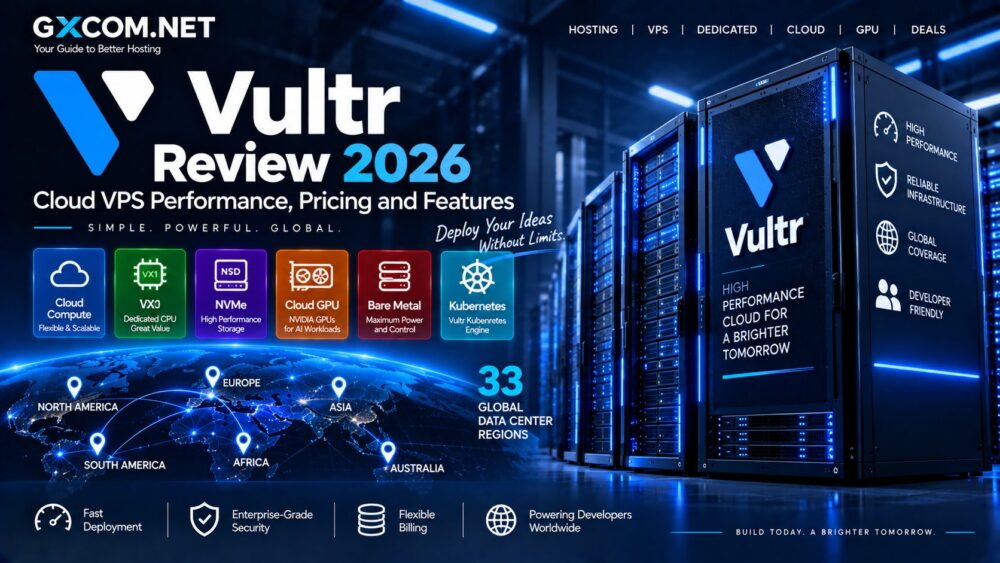
Vultr Review 2026: Quick Overview
| Feature | Vultr |
|---|---|
| Primary Products | Cloud Compute, VX1, Optimized Compute, Cloud GPU and Bare Metal |
| Global Infrastructure | 33 cloud data center regions |
| Processors | AMD EPYC and Intel options depending on product |
| Storage | SSD and NVMe options |
| Billing | Hourly with product-specific monthly caps |
| Automation | API, CLI and Terraform support |
| Kubernetes | Vultr Kubernetes Engine |
| GPU | Dedicated NVIDIA Cloud GPU options |
| Best For | Developers, websites, SaaS, applications and cloud infrastructure |
What Is Vultr?
Vultr is a cloud infrastructure provider offering virtual machines and related cloud services across a global network.
Although the company is still widely associated with VPS hosting, calling Vultr only a VPS provider no longer accurately describes its platform.
Its infrastructure now includes:
- Cloud Compute
- VX1 Cloud Compute
- Optimized Cloud Compute
- Cloud GPU
- Bare Metal
- Kubernetes
- Managed Databases
- Block and Object Storage
- Load Balancers
- Networking services
This allows customers to build considerably more complex infrastructure than a conventional VPS hosting account.
For readers comparing virtual-server options specifically, our VPS hosting section covers the wider market.
Vultr Cloud Compute
Cloud Compute is Vultr’s general-purpose virtual machine product.
Shared CPU instances are suitable for workloads that do not need permanently dedicated CPU resources. Typical applications include websites, blogs, development environments, smaller databases and lightweight business applications.
Vultr currently separates several compute characteristics within this area.
Standard Cloud Compute provides balanced resources, while High Frequency instances emphasize faster clock speeds and NVMe storage. High Performance configurations use newer Intel Xeon or AMD EPYC processors with NVMe storage.
This makes it possible to choose infrastructure according to workload instead of treating every VPS as essentially identical.
Vultr VX1 Cloud Compute
One of the most important additions to Vultr in 2026 is VX1.
VX1 is positioned as cost-efficient x86 cloud compute for web, application and data-tier workloads. It uses AMD infrastructure and dedicated CPU resources rather than the burst-oriented shared CPU model associated with basic Cloud Compute.
Potential workloads include:
- Web servers
- SaaS applications
- APIs and microservices
- Databases
- ERP systems
- Analytics
- Development environments
VX1 can also boot from Vultr Block Storage while using local NVMe storage for high-speed temporary workloads.
This separation of compute from persistent boot storage can be useful when infrastructure needs to be reprovisioned without treating the VM itself as the permanent location of important data.
Vultr Performance
There is no meaningful single benchmark for all Vultr servers because the platform contains several CPU and storage architectures.
Performance depends on the selected plan.
Important variables include:
- Shared vs dedicated CPU
- AMD vs Intel processor
- CPU generation
- Clock speed
- NVMe vs conventional SSD
- Available memory
- Application optimization
- Server location
For low-traffic websites, a shared CPU instance may provide sufficient performance at lower cost.

Databases, busy ecommerce sites, application servers and sustained compute workloads can benefit from dedicated CPU or optimized configurations.
Vultr High Performance Cloud VPS
Vultr’s High Performance instances use newer AMD EPYC or Intel Xeon processors together with NVMe storage.
The combination is useful when applications depend on both CPU and storage performance.
Potential workloads include:
- High-traffic websites
- WordPress
- Application servers
- Databases
- Game servers
- Development workloads
Users specifically looking for storage-oriented VPS options can also explore our NVMe VPS section.
Vultr Pricing in 2026
Pricing remains an important part of any Vultr Review 2026, but comparing Vultr plans requires understanding the billing model.
Vultr charges server infrastructure hourly rather than forcing every compute deployment into a fixed long-term contract.
There is also a monthly billing cap.
For most server types—including Cloud Compute, Optimized Cloud Compute and Bare Metal—the monthly cap is based on 672 hours. Cloud GPU uses a 730-hour monthly cap.
This means a server used temporarily can be charged according to its deployment time, while a continuously running instance does not continue accumulating unlimited hourly charges beyond the applicable monthly cap.
There is one important detail: simply powering off a Vultr instance does not stop billing.
The resources remain reserved. To stop compute charges for a server, the instance needs to be destroyed.
Is Vultr Pricing the Same Worldwide?
Vultr aims to maintain predictable global pricing, but customers should not assume every configuration costs exactly the same in every region.
Regional operating costs, power, bandwidth, hardware availability, taxes and compliance requirements can affect pricing.
The safest comparison is therefore to select the intended region first and check the actual deployment price.
Vultr Global Data Center Locations
Global infrastructure is one of Vultr’s strongest features.
Vultr currently operates cloud infrastructure across 33 regions spanning North America, Europe, Asia, Australia, South America, Africa and the Middle East.
Locations include major markets such as:
- Los Angeles
- Silicon Valley
- New Jersey
- London
- Frankfurt
- Amsterdam
- Paris
- Milan
- Tokyo
- Seoul
- Singapore
- Sydney
- Mumbai
- São Paulo
- Johannesburg
The wide geographic footprint makes it easier to place applications close to their intended users.
However, individual Vultr products are not necessarily available in every location. VX1, Bare Metal and GPU infrastructure can have more limited regional availability than standard compute.
Vultr NVMe Storage
Storage performance can have a major effect on real-world VPS responsiveness.
Vultr’s higher-performance compute products make extensive use of NVMe storage, while VX1 can combine high-performance Block Storage with locally attached NVMe.
NVMe is especially useful for:
- Databases
- WordPress sites
- Ecommerce applications
- API servers
- Development environments
- Data-intensive applications
Vultr also provides separate storage products when applications require persistent capacity beyond the instance’s local disk.
Vultr Backups and Snapshots
Vultr provides automatic backup and snapshot capabilities, but users should understand the difference.
A snapshot is useful for capturing an instance state before major changes or for creating similar servers.
Automated backups provide a more convenient recurring recovery mechanism.
Neither should replace a properly designed application-level backup strategy for business-critical data.
Important databases and websites should maintain independent backups whenever practical.
Vultr Networking and DDoS Protection
Vultr’s infrastructure includes networking tools for building more complex cloud architectures.
Available capabilities include private networking, reserved IPs, load balancing and firewall functionality.
The platform also includes DDoS protection capabilities, although customers remain responsible for application-level security and correct server configuration.
A cloud provider can protect infrastructure from certain network attacks, but it cannot compensate for vulnerable application code, weak passwords or outdated CMS installations.
Vultr Kubernetes Engine
Vultr Kubernetes Engine, or VKE, provides managed Kubernetes orchestration.
One notable pricing characteristic is that Vultr does not charge separately for the managed control plane.
Customers instead pay for resources used by the cluster, including worker nodes, load balancers and storage.
This can make VKE useful for development teams that want Kubernetes without manually operating the control plane.
Vultr Cloud GPU
Vultr has expanded beyond CPU cloud infrastructure into GPU computing.
Cloud GPU instances provide dedicated NVIDIA GPU resources for workloads such as:
- Artificial intelligence
- Machine learning
- High-performance computing
- Visual computing
- Virtual desktop infrastructure
GPU availability depends on region and configuration.
For readers specifically comparing AI infrastructure, our GPU providers section covers specialized alternatives such as Lambda, RunPod and Vast.ai.
Vultr API and Terraform
Vultr is not limited to manual deployments through a web control panel.
Infrastructure can be provisioned and managed through APIs, CLI tools and Terraform, which is important for development teams operating repeatable environments.
Automation makes it possible to integrate Vultr into CI/CD pipelines and infrastructure-as-code workflows instead of configuring every server manually.
Vultr for WordPress Hosting
Vultr can run WordPress very effectively, particularly when paired with a suitable High Performance instance and optimized software stack.
However, Vultr is infrastructure rather than a conventional fully managed WordPress hosting company.
Users are generally responsible for areas such as:
- Server administration
- WordPress updates
- Security configuration
- Backups
- Performance optimization
Users wanting provider-managed WordPress operations may prefer conventional WordPress hosting.
Vultr vs DigitalOcean
Vultr and DigitalOcean are frequently compared because both provide developer-friendly cloud infrastructure with straightforward VM deployment.
DigitalOcean has built a strong developer ecosystem around Droplets and managed cloud services. Vultr differentiates itself through its large geographic footprint and wide range of compute products, including dedicated CPU, VX1, Bare Metal and GPU infrastructure.

The better platform depends on region, workload and surrounding services rather than brand alone.
Read our DigitalOcean VPS Review for a closer comparison.
Vultr Pros & Cons
| Pros | Cons |
|---|---|
| 33 global cloud regions | Not every product is available in every region |
| Multiple compute architectures | Many instance types can complicate selection |
| AMD and Intel options | Unmanaged infrastructure requires technical knowledge |
| NVMe storage options | Stopped servers continue to incur charges |
| Hourly billing | Regional pricing can vary |
| API and Terraform support | Backups and additional services increase total cost |
| GPU and Bare Metal available | May be excessive for users wanting simple shared hosting |
Who Should Consider Vultr?
Vultr is particularly relevant for users who want flexible cloud infrastructure with broad geographic coverage.
Good candidates include:
- Developers
- SaaS companies
- Website owners
- Application developers
- Agencies
- DevOps teams
- Businesses deploying international applications
- AI teams requiring GPU infrastructure
Who May Prefer an Alternative?
Beginners who simply want a website online without administering Linux may be better served by managed hosting.
Organizations deeply dependent on proprietary AWS, Azure or Google Cloud services may also find migration to a simpler infrastructure provider impractical.
Likewise, specialized AI workloads should compare Vultr Cloud GPU against dedicated AI cloud platforms before making a decision.
Vultr Review 2026: Final Verdict
Our Vultr Review 2026 shows a provider that has grown far beyond its original reputation as a simple VPS platform.
Its strengths include a large global infrastructure footprint, several compute architectures, NVMe storage, straightforward deployment, hourly billing and an increasingly broad ecosystem covering Kubernetes, databases, storage, bare metal and GPU computing.
The addition of VX1 in 2026 also gives Vultr another option for customers prioritizing predictable x86 compute economics for web, application and data workloads.
The main limitation is that infrastructure flexibility comes with management responsibility. Users should understand Linux administration, security, backups and resource sizing unless another management layer is placed on top of Vultr.
For developers and businesses looking for a flexible alternative to larger hyperscale clouds, Vultr remains a cloud provider worth comparing—especially when global location choice and straightforward infrastructure deployment are priorities.