Choosing between a Dedicated Server vs Cloud Server is an important decision for businesses that need reliable hosting infrastructure. Both solutions provide more power and flexibility than traditional shared hosting, but they use very different approaches to delivering computing resources.
A dedicated server provides an entire physical machine reserved for one customer, while a cloud server runs on a distributed cloud infrastructure that allows flexible resource allocation and scaling.
The right choice depends on your workload, performance requirements, budget, scalability needs and management preferences.
This guide compares dedicated servers and cloud servers across performance, pricing, scalability, reliability, security and real-world use cases.
Last updated: September 20, 2026. Server specifications and pricing vary by provider. Always compare current configurations before purchasing.
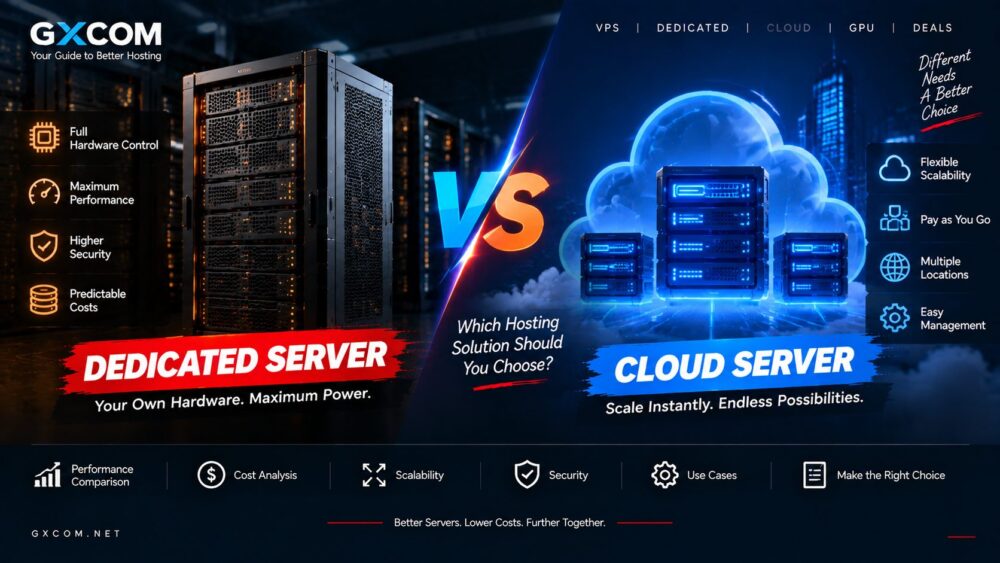
Dedicated Server vs Cloud Server: Quick Comparison
| Feature | Dedicated Server | Cloud Server |
|---|---|---|
| Infrastructure | Single physical server | Virtual cloud infrastructure |
| Performance | Maximum predictable performance | Flexible performance |
| Scalability | Hardware-based upgrades | Rapid resource scaling |
| Cost Model | Fixed monthly pricing | Flexible usage pricing |
| Resource Isolation | Complete hardware isolation | Virtual isolation |
| Best For | High-performance workloads | Dynamic applications |
What Is a Dedicated Server?
A dedicated server is a physical machine allocated exclusively to one customer.
The customer receives complete access to the server hardware, including CPU cores, RAM, storage devices and network resources.
Because no other customers share the physical hardware, dedicated servers provide consistent performance and maximum control.
Common dedicated server workloads include:
- Enterprise websites
- Large databases
- Gaming servers
- High-traffic applications
- Business-critical systems
- Custom software platforms
What Is a Cloud Server?
A cloud server is a virtual machine hosted on a cloud computing platform.
Unlike a traditional physical server, cloud servers operate across interconnected infrastructure that allows providers to allocate computing resources dynamically.
Cloud servers are designed for flexibility, allowing users to quickly create, resize, clone or remove instances according to demand.
Common cloud server workloads include:
- Web applications
- SaaS platforms
- Development environments
- Testing systems
- Scalable online services
Performance Comparison: Dedicated Server vs Cloud Server
Performance is one of the biggest differences between dedicated servers and cloud servers.
A dedicated server provides direct access to physical hardware. CPU resources, memory and storage are reserved entirely for one customer.
This makes dedicated servers attractive for workloads requiring consistent high performance.
Cloud servers use virtualization and distributed infrastructure. Although modern cloud platforms can deliver excellent performance, resources are shared across a larger infrastructure environment.
For applications requiring maximum hardware performance, dedicated servers often provide stronger predictability.
For applications requiring flexibility and rapid scaling, cloud servers provide important advantages.
Hardware Resources Comparison
Dedicated servers provide fixed physical hardware:
- Dedicated CPU
- Dedicated RAM
- Physical storage
- Reserved network capacity
Cloud servers provide virtual resources:
- Virtual CPU allocation
- Adjustable RAM
- Cloud storage options
- Flexible network configuration
The choice depends on whether your priority is maximum hardware ownership or operational flexibility.
Cost Comparison: Dedicated Server vs Cloud Server
Cost is another major difference between these two infrastructure models.
Dedicated servers usually use predictable monthly pricing because customers rent a physical machine for a fixed period.
Cloud servers often use flexible pricing models based on allocated resources or usage.
| Solution | Cost Advantage | Best For |
|---|---|---|
| Dedicated Server | Predictable monthly cost | Stable long-term workloads |
| Cloud Server | Pay for flexible resources | Changing workloads |
A dedicated server can become more cost-effective when running a constant high-resource workload.
A cloud server can reduce costs when resources are only needed temporarily or change frequently.
Scalability Comparison
Scalability is where cloud servers usually have a significant advantage.
Cloud platforms allow users to increase CPU, RAM or storage quickly without replacing physical hardware.
This makes cloud servers suitable for businesses experiencing unpredictable traffic growth.
Dedicated servers scale differently. Increasing capacity may require upgrading hardware, moving to another server or adding additional machines.
However, dedicated infrastructure provides stable performance once configured correctly.
Reliability and Availability
Cloud servers are designed around distributed infrastructure. Many cloud platforms provide redundancy options, snapshots, automated backups and multiple availability zones.
Dedicated servers rely on the reliability of the physical machine and data center environment.
A well-managed dedicated server can be highly reliable, but redundancy often requires additional planning, such as backup servers or failover systems.
Security Comparison
Both dedicated servers and cloud servers can provide strong security when properly configured.
Dedicated servers offer physical isolation because no other customer uses the same hardware.
This can be important for organizations with strict compliance requirements.
Cloud platforms provide advanced security tools including:
- Network firewalls
- Access controls
- Private networking
- Snapshots
- Identity management
Security depends heavily on server configuration, monitoring and operational practices.
Dedicated Server vs Cloud Server for Websites
For many websites, cloud servers provide excellent flexibility.
Businesses launching new websites or applications often prefer cloud infrastructure because resources can grow as traffic increases.
Large websites with predictable high traffic may choose dedicated servers because they require consistent hardware performance.
Explore our dedicated servers section for more infrastructure comparisons.
Dedicated Server vs Cloud Server for Business Applications
Business applications often require reliability, security and predictable performance.
Dedicated servers are commonly selected for:
- Large databases
- ERP systems
- Internal business applications
- Resource-intensive software
Cloud servers are often preferred for:
- SaaS platforms
- Distributed applications
- Rapid development projects
- Global services
Dedicated Server vs Cloud Server for AI Workloads
AI workloads require careful infrastructure selection.
Standard cloud servers without GPU acceleration are usually not suitable for intensive machine learning training.
Businesses running AI workloads often compare dedicated GPU servers with cloud GPU platforms.
Explore our GPU server deals section for accelerated computing solutions.
Management Differences
Both dedicated and cloud servers can be managed or unmanaged.
Unmanaged environments require users to handle:
- Operating system updates
- Security configuration
- Software installation
- Monitoring
Managed solutions provide additional support but usually increase monthly costs.
When Should You Choose a Dedicated Server?
A dedicated server is suitable when you need:
- Maximum hardware performance
- Complete resource control
- Physical isolation
- Predictable workloads
- Custom server configurations
Dedicated servers are commonly chosen by enterprises and applications where consistent performance matters more than instant scalability.
When Should You Choose a Cloud Server?
A cloud server is suitable when you need:
- Rapid scaling
- Flexible resource allocation
- Multiple deployment locations
- Short-term infrastructure
- Development flexibility
Cloud infrastructure is especially useful for applications where demand changes frequently.
Dedicated Server vs Cloud Server: Which One Should You Choose?
| Choose Dedicated Server If | Choose Cloud Server If |
|---|---|
| You need maximum performance | You need flexible scaling |
| You want physical hardware isolation | You need rapid deployment |
| Your workload is predictable | Your workload changes frequently |
| You require custom hardware | You need multiple locations |
Neither solution is universally better. The right choice depends on your application requirements, growth plans and infrastructure strategy.
Dedicated Server vs Cloud Server: Final Checklist
The Dedicated Server vs Cloud Server comparison comes down to performance versus flexibility.
Dedicated servers provide maximum hardware control and predictable performance, while cloud servers provide scalability, agility and flexible resource management.
Businesses should evaluate current requirements, future growth, technical expertise and total operating costs before choosing infrastructure.
GXCOM.NET will continue publishing hosting comparisons to help users select the right server solution.