Renting a dedicated server should mean knowing exactly what hardware you receive, how network traffic is handled, and when the machine will be ready. Those questions become especially important when a hosting provider sells both physical dedicated servers and virtualized products described as hybrid dedicated hosting.
DediXLAB offers dedicated server, hybrid server, and VPS services across multiple geographic markets. Its product portfolio includes Intel Xeon-based configurations, Windows and Linux operating systems, and network options intended for applications requiring more control than ordinary shared hosting.
In this DediXLAB Bare Metal Server Review, we examine hardware options, dedicated versus hybrid resource allocation, bandwidth policies, deployment expectations, and total ownership costs. We also compare Cherry Servers, NovoServe, and ServerMania for buyers considering alternative infrastructure.
Editorial note: This review is based on published product information and contractual terms. GXCOM has not independently benchmarked DediXLAB hardware or verified the availability of individual dedicated-server configurations.
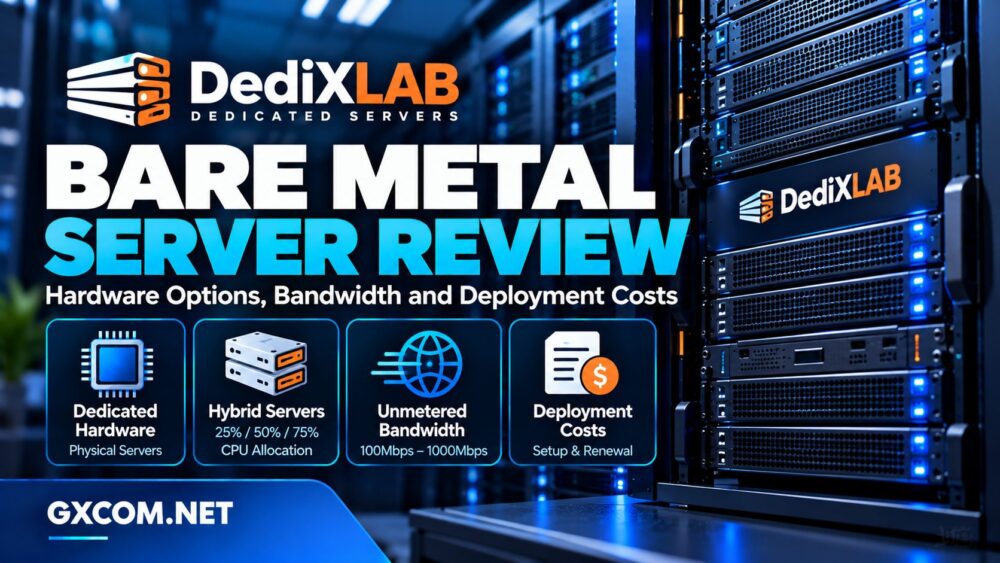
DediXLAB Hosting Overview
DediXLAB markets physical dedicated servers alongside hybrid dedicated products and virtual private servers. Its website advertises services across North America, Europe, and Asia, although available hardware and locations vary by product.
The distinction between these services is essential. A conventional bare metal server assigns an entire physical machine to one customer. A hybrid dedicated server can reserve a substantial portion of a physical host while still using virtualization and sharing the underlying machine.
For businesses that need predictable hardware access, this difference can affect performance, isolation, software licensing, and future expansion.
Dedicated Server Versus Hybrid Dedicated Server
DediXLAB describes hybrid dedicated hosting as a combination of physical-server infrastructure and virtualization technology. Its published hybrid configurations include defined CPU resource allocations rather than unrestricted ownership of the entire host.
Some hybrid offerings specify at least 25%, 50%, or 75% of host CPU power. That is different from receiving all physical processor cores exclusively.
What Full Bare Metal Allocation Means
A true bare metal server should provide exclusive use of the physical CPU, installed memory, and assigned local storage. The customer generally controls the operating system and can deploy a virtualization platform if supported by the hardware.
Hybrid hosting may still be appropriate for applications needing more resources than a typical VPS. However, buyers should request confirmation of the product’s actual isolation model before paying.
Our bare metal server providers comparison explains how dedicated hardware differs from other infrastructure options.
Hardware Options: CPU, RAM, and Storage
DediXLAB’s published hybrid configurations reference Intel Xeon E5-2650 v4 processors, with different allocations of CPU power and memory. Other product pages reference enterprise Dell or Hewlett Packard systems and additional Intel Xeon generations.
These specifications demonstrate the provider’s hardware range, but they should not be treated as proof that every current bare metal offer uses the same components.
CPU Generation and Workload Fit
Processor model matters as much as core count. An older Xeon with many cores can behave differently from a newer processor offering stronger single-thread performance, memory bandwidth, and efficiency.
For web applications and databases, ask for the exact CPU model, physical core count, clock characteristics, and supported virtualization features.
For hybrid products, also confirm how the advertised CPU percentage is enforced and whether neighboring workloads can affect performance.

Memory and Upgrade Flexibility
Published hybrid options range from modest RAM allocations to substantially larger configurations. Memory-intensive databases and virtualization environments may benefit from higher capacity, but the upgrade path matters.
Ask whether RAM can be increased without migrating to another physical host. On a fully dedicated server, upgrades may require scheduled maintenance or replacement hardware.
RAID Storage and Data Protection
DediXLAB advertises SSD and SATA RAID-10 configurations for selected hybrid services. RAID-10 combines mirroring and striping, potentially improving fault tolerance and disk performance.
However, RAID is not an independent backup. Accidental deletion, malware, filesystem corruption, and major infrastructure failures can still cause data loss.
Buyers should distinguish physical disk capacity from usable RAID capacity and confirm whether storage is locally attached, virtualized, or separately allocated.
Bandwidth: What Does Unmetered Traffic Include?
Networking is another important purchasing consideration. DediXLAB’s hybrid server pages advertise unmetered connections with port-speed options ranging from 100Mbps to 1000Mbps.
Unmetered generally describes traffic accounting, not unlimited transfer speed. A 100Mbps port cannot transmit data at the same rate as a 1Gbps connection, even if neither service imposes a fixed monthly transfer quota.
Port Speed Versus Guaranteed Throughput
Before ordering, determine whether the advertised connection is dedicated, shared, or subject to fair-use policies. Ask about upstream capacity, network congestion, and any restrictions on sustained usage.
Applications serving large downloads, backups, or streaming content should also investigate routing quality and packet loss.
Geographic Location
DediXLAB lists services in countries including the United States, Canada, the United Kingdom, the Netherlands, Germany, Singapore, and Hong Kong.
Not every product is necessarily available in every location. Confirm the exact facility and network route for the hardware being purchased.
A server close to customers can reduce latency, but geographic proximity alone does not guarantee strong international connectivity.
Deployment Time and Server Provisioning
DediXLAB promotes fast activation across its website. Selected hybrid configurations publish setup estimates ranging from minutes to several hours.
However, its formal service terms state that activation depends on technical availability, payment confirmation, required verification, and order complexity. Services are typically activated within one working day, although actual times can vary.
Buyers should therefore avoid assuming that every physical dedicated server will be delivered immediately.
Questions to Ask Before Deployment
- Is the selected physical server currently in stock?
- Will the provider install the requested operating system?
- Does deployment require identity or business verification?
- Are remote console and rescue tools included?
- Is there an additional setup or configuration charge?
For production migrations, arrange delivery before canceling existing infrastructure. Leave enough time to test networking, storage, security, and application compatibility.
Operating Systems and Management
DediXLAB advertises Windows, Linux, and BSD operating system choices for selected services. Root or administrator access can provide flexibility for custom applications, hosting control panels, and virtualization software.
Customers should verify whether operating system installation, licensing, patching, and ongoing administration are included in the selected contract.
The provider also advertises server management services. Confirm the scope of support, including monitoring, backups, security updates, and incident response.
For organizations comparing administration responsibilities, our managed versus unmanaged dedicated server guide provides a useful framework.
Deployment Costs and Renewal Terms
The advertised rental fee is only one component of dedicated-server spending. Hardware upgrades, software licensing, managed support, backups, additional IP addresses, and network requirements can increase total cost.
DediXLAB’s published terms describe recurring subscriptions that renew automatically unless canceled according to the applicable notice requirements.
Its terms generally require cancellation at least seven calendar days before renewal. Late cancellation can create additional billing consequences, particularly for business customers.
Before ordering, confirm the selected billing cycle, renewal price, cancellation deadline, and whether the quoted hardware remains available throughout the contract.
Our bare metal server pricing guide explains how to calculate hardware, bandwidth, and operational expenses.
Best Workloads for DediXLAB
DediXLAB may appeal to businesses requiring configurable infrastructure, Windows or Linux environments, and regional deployment options.
Suitable workloads may include game hosting, web applications, database services, development environments, and smaller virtualization projects.
For sustained compute-intensive workloads, prioritize full physical hardware allocation. For applications with moderate CPU demand but substantial memory requirements, a hybrid configuration may be worth comparing.
Buyers should select infrastructure according to actual resource usage rather than product labels.
DediXLAB Alternatives: Cherry Servers, NovoServe, and ServerMania
Cherry Servers: Dedicated Infrastructure Flexibility
Cherry Servers is worth evaluating for dedicated hardware and infrastructure deployment flexibility. Compare processor generations, available locations, storage configurations, and management capabilities.
It may suit teams that require clearly defined physical resources and more extensive infrastructure automation.
NovoServe: Network-Intensive Dedicated Hosting
NovoServe deserves consideration for bandwidth-intensive applications. Compare network-port options, traffic policies, geographic availability, and the cost of sustained data transfer.
Network-heavy buyers should evaluate actual routing requirements rather than focusing exclusively on CPU and RAM.
ServerMania: Dedicated Servers for Business Applications
ServerMania offers dedicated infrastructure worth comparing for business applications, databases, and virtualization workloads.
Review processor choices, memory capacity, support arrangements, and deployment timelines before selecting a configuration.
For additional alternatives, see GXCOM’s bare metal server comparison.
Final Verdict: Is DediXLAB Worth Considering?
DediXLAB offers an interesting mix of dedicated and hybrid infrastructure, multiple operating system choices, and regional hosting options.
Its main purchasing challenge is product clarity. Buyers must distinguish full physical dedicated servers from virtualized hybrid configurations, verify hardware specifications, and understand network and billing conditions.
Consider DediXLAB when the selected service matches your resource requirements and the provider confirms hardware allocation, deployment timing, and recurring charges in writing.
Compare Cherry Servers, NovoServe, and ServerMania when dedicated hardware transparency, network capacity, or infrastructure flexibility are higher priorities.
Frequently Asked Questions
Is every DediXLAB hybrid server bare metal?
No. DediXLAB describes hybrid servers as virtualized environments with allocated portions of physical hardware. Confirm full-server exclusivity separately.
Does DediXLAB offer unmetered bandwidth?
Selected hybrid plans advertise unmetered traffic with defined port speeds. Exact terms depend on the ordered service.
How quickly are servers deployed?
Some products advertise rapid setup, but formal terms allow for availability checks, verification, and varying provisioning times.
Does RAID-10 replace backups?
No. RAID can improve resilience against certain disk failures, but independent backups remain necessary.
What should I verify before purchasing?
Confirm physical hardware allocation, CPU model, RAM, storage, bandwidth terms, operating system licensing, deployment time, and renewal conditions.