Should you rent an AMD EPYC server with more cores and memory channels, or choose a high-frequency AMD Ryzen dedicated server at a potentially lower cost? The answer depends on whether your applications need faster individual threads or greater infrastructure capacity.
This AMD EPYC vs AMD Ryzen dedicated server comparison examines virtualization, clock speed, memory bandwidth, PCIe expansion, storage, and hosting value. It also explains how to evaluate providers without paying for hardware your workload cannot use.
AMD EPYC vs AMD Ryzen: Quick Verdict
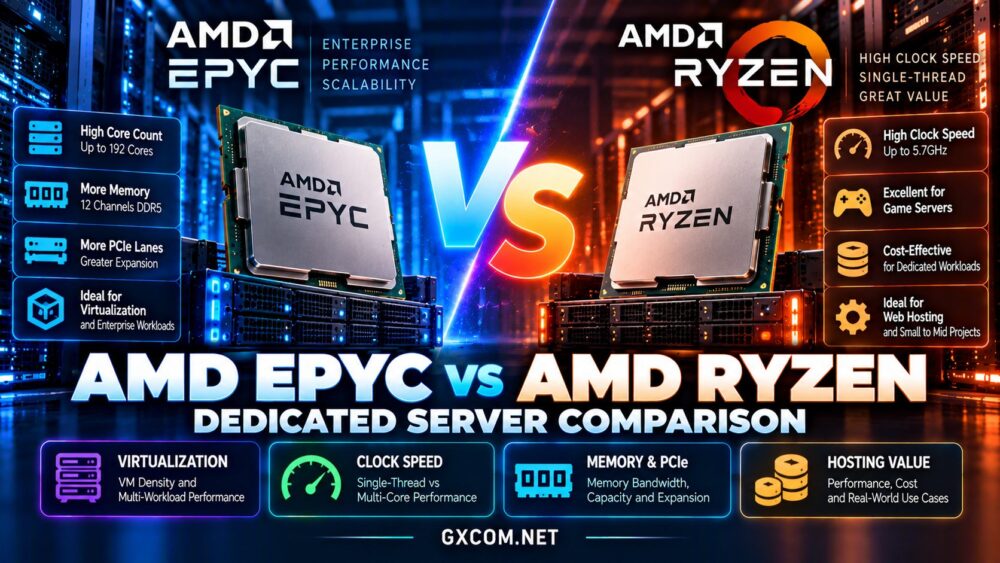
AMD Ryzen is often a compelling choice for game servers, latency-sensitive applications, smaller databases, and dedicated workloads that benefit from strong single-thread performance.
AMD EPYC is generally better suited to dense virtualization, large databases, enterprise storage, and applications requiring substantial memory capacity or PCIe connectivity.
Our recommendation: Choose Ryzen when a limited number of fast cores meets your needs. Choose EPYC when memory capacity, virtual machine density, or expansion requirements justify a server-class platform.
For additional hardware options, explore our bare metal server providers guide.
AMD EPYC vs Ryzen Dedicated Server Specifications
| Feature | AMD Ryzen | AMD EPYC |
|---|---|---|
| Primary market | Desktop and performance-focused systems | Enterprise and data center servers |
| Core counts | Up to 16 in Ryzen 9000 desktop lineup | Up to 192 in EPYC 9005 lineup |
| Clock-speed focus | High boost frequencies | Varies from high-frequency to high-density models |
| Memory channels | Two on Ryzen 9 9950X | Twelve on EPYC 9005 |
| PCIe connectivity | More limited CPU-direct expansion | Substantially greater expansion capacity |
| Virtualization | Suitable for smaller VM deployments | Designed for larger-scale consolidation |
| Typical advantage | Fast individual workloads | Scalability and aggregate throughput |
These are family-level distinctions. Processor generation, cooling, motherboard design, and server configuration can change actual performance.
Clock Speed: Is Ryzen Faster Than EPYC?
Ryzen processors are attractive for workloads where a few fast threads determine application responsiveness.
For example, AMD lists the Ryzen 9 9950X with sixteen cores and a maximum boost clock of 5.7GHz. This makes it relevant to game hosting, real-time services, and applications with limited parallelism.
However, maximum boost frequency is not guaranteed sustained all-core speed. Thermal limits, processor power settings, and workload characteristics affect operating frequency.
EPYC Can Also Deliver High Frequencies
EPYC is not exclusively a low-clock-speed platform. AMD offers frequency-optimized server processors alongside high-core-count models.
A modern high-frequency EPYC may outperform an older Ryzen processor in particular applications. Comparing brand families without identifying exact CPU models is therefore misleading.
For a single-thread-sensitive application, compare measured latency and sustained per-core performance rather than advertised GHz alone.
Virtualization: KVM, Proxmox and VM Density
Virtualization is where EPYC’s platform capabilities become particularly valuable.
Both processor families support AMD virtualization technologies and can run compatible hypervisors. Ryzen can be suitable for a small Proxmox host, development laboratory, or private application environment.
However, a virtualization platform hosting dozens of active machines needs more than processor cores.

Each virtual machine consumes memory, storage bandwidth, network capacity, and scheduling resources. Adding vCPUs without sufficient supporting infrastructure can reduce performance consistency.
Why EPYC Fits Larger Virtualization Hosts
EPYC platforms provide higher potential core counts, more memory channels, and greater expansion capability.
These characteristics help operators consolidate many workloads onto fewer physical servers, provided sufficient RAM and storage performance are available.
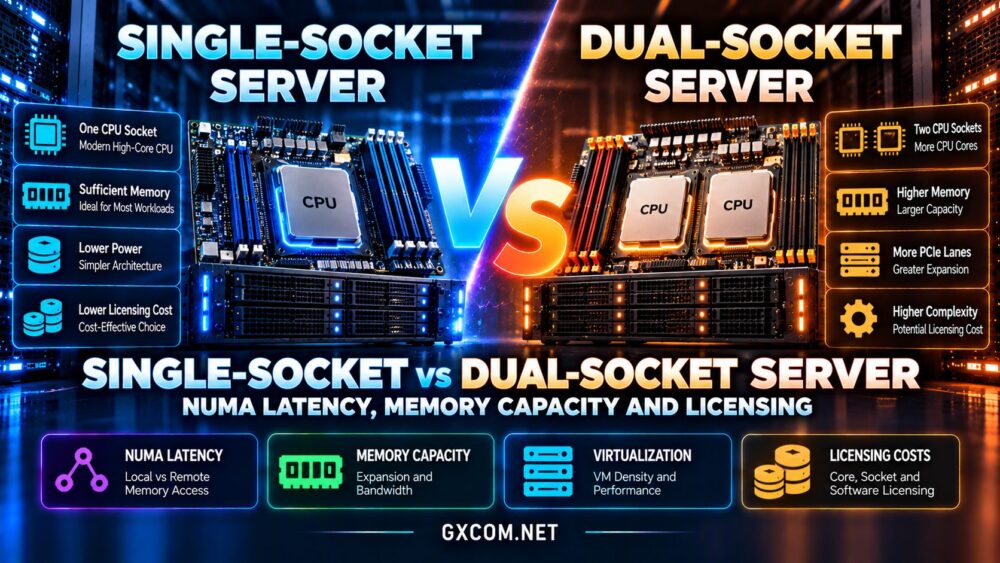
Large EPYC systems may also expose multiple NUMA domains. Incorrect CPU and memory placement can increase latency, so virtualization administrators should understand NUMA topology.
Virtualization verdict: Ryzen is practical for smaller deployments; EPYC offers more room for growth and consolidation.
Memory Bandwidth and RAM Capacity
Memory architecture is a major difference between these processor families.
The Ryzen 9 9950X supports dual-channel DDR5 memory. EPYC 9005 processors support twelve DDR5 memory channels per socket.
More channels can provide greater aggregate memory bandwidth when the system is populated correctly and applications generate sufficient demand.
This matters for large databases, analytics, virtualization, and memory-intensive scientific workloads.
Nevertheless, an EPYC server with poorly populated memory channels may fail to deliver its potential bandwidth.
Buyers should request details about installed DIMMs, channel population, memory capacity, and supported ECC configurations.
Does Ryzen Support ECC?
Some Ryzen processors support ECC memory, but practical operation depends on motherboard and firmware support.
Do not assume that every Ryzen dedicated server has validated ECC protection simply because the processor supports it.
For production systems requiring strict memory reliability, verify the complete server platform.
PCIe Lanes, NVMe Storage and Expansion
Modern dedicated servers may require multiple NVMe drives, high-speed network adapters, and accelerator cards.
Ryzen platforms offer enough connectivity for many compact servers, but CPU-direct PCIe resources are comparatively limited.
EPYC platforms provide considerably greater PCIe expansion, making them attractive for storage-heavy systems and specialized infrastructure.
However, additional PCIe lanes do not automatically improve application speed. Performance depends on the connected devices and how effectively workloads use them.
For storage architecture decisions, read our bare metal server comparison.
Gaming, Databases and Web Hosting
Game Servers and Real-Time Applications
Many game server workloads depend heavily on a limited number of threads. A high-frequency Ryzen dedicated server can therefore offer excellent value.
Measure game tick stability, latency, and CPU utilization under realistic player loads. More EPYC cores will not necessarily improve a game engine that cannot use them.
Large Databases and Analytics
EPYC becomes attractive when database performance depends on substantial RAM, parallel queries, or high aggregate memory bandwidth.
For a smaller transactional database, a fast Ryzen processor may remain entirely adequate.
Hosting Multiple Websites
A Ryzen server can host many websites when aggregate demand remains manageable.
EPYC offers greater consolidation potential for providers operating numerous isolated accounts, containers, or virtual servers.
Capacity planning should include peak usage, not just average CPU utilization.
Dedicated Server Providers to Compare
Hardware specifications matter, but provider infrastructure determines the final hosting experience.
Cherry Servers: EPYC and Ryzen Bare Metal
Cherry Servers offers both AMD Ryzen and EPYC dedicated server configurations, making it a useful starting point for comparing different processor architectures within one hosting platform.
Its catalog includes high-frequency Ryzen options and larger EPYC systems. Check live availability, RAM, NVMe configurations, deployment regions, and traffic allowances.
Our Cherry Servers bare metal review examines additional infrastructure considerations.
ServerMania: Enterprise AMD Infrastructure
ServerMania advertises AMD EPYC dedicated servers for virtualization, databases, and enterprise applications. It also offers AMD Ryzen-based dedicated hosting options.
Compare processor generation, memory limits, storage choices, and management services before selecting a configuration.
GTHost: Additional Dedicated Server Options
GTHost is another provider to include when comparing dedicated server availability and deployment locations.
Verify the exact AMD processor model and configuration in current inventory rather than assuming that every location offers the same hardware.
Bacloud: European Infrastructure Alternative
Bacloud provides another dedicated hosting option for buyers evaluating European infrastructure.
Check available processors, memory, storage, network policies, and upgrade terms before comparing its offers with EPYC or Ryzen systems elsewhere.
AMD EPYC vs Ryzen Hosting Costs
EPYC servers often command higher rental prices when configured with large core counts, extensive memory, and enterprise-grade components.
Ryzen can provide better value for applications that need fast cores but cannot use extensive memory or I/O capacity.
However, comparing rental prices alone ignores infrastructure efficiency.
One larger EPYC server may consolidate workloads previously distributed across several smaller machines. Conversely, separating applications across multiple Ryzen servers may improve fault isolation.
Calculate monthly rental costs alongside software licensing, backup storage, bandwidth, migration effort, and operational risk.

Some software licenses are based on cores or other resource metrics, making higher-core-count systems potentially more expensive to operate.
Explore our affordable dedicated server deals guide for additional purchasing considerations.
How to Benchmark EPYC and Ryzen Fairly
Compare actual server configurations using the same operating system, application versions, and workload.
Measure single-thread latency, sustained multicore throughput, database response times, and storage performance.
For virtualization, track VM density, memory pressure, CPU scheduling delays, and NUMA-related behavior.
Repeat tests during sustained load. Short synthetic benchmarks cannot establish long-term performance consistency.
Frequently Asked Questions
Is AMD EPYC better than Ryzen for dedicated servers?
EPYC is generally better for high-density virtualization and memory-intensive workloads. Ryzen can be more economical for smaller, high-frequency applications.
Is Ryzen suitable for Proxmox?
Yes. A compatible Ryzen server can run Proxmox, although available memory and expansion capacity may limit larger deployments.
Does EPYC always have lower clock speeds?
No. AMD offers high-frequency EPYC models. Compare specific processors rather than generalizing across product families.
Which CPU is better for game hosting?
High-frequency Ryzen processors are often attractive for game servers with limited thread scaling, but actual performance depends on the game.
Does EPYC support more RAM than Ryzen?
Modern EPYC platforms generally support substantially larger memory configurations and more memory channels than mainstream Ryzen desktop platforms.
Final Verdict: AMD EPYC or AMD Ryzen?
The AMD EPYC vs AMD Ryzen dedicated server decision comes down to workload characteristics and total hosting value.
Choose Ryzen for high-frequency applications, smaller dedicated workloads, and cost-sensitive deployments with modest memory requirements.
Choose EPYC for dense virtualization, large databases, extensive storage connectivity, and enterprise applications requiring greater scalability.
Compare Cherry Servers, ServerMania, GTHost, and Bacloud using actual processor models and complete server specifications.
The best dedicated server is the one that meets measurable performance requirements without leaving expensive resources unused.