A small Minecraft server for friends and a busy Rust community have very different hosting requirements. One may run comfortably on a virtual private server, while the other could benefit from an entire physical machine. Choosing the wrong environment can lead to unnecessary spending, inconsistent performance, or frustrating server management.
When comparing a gaming VPS vs dedicated server, the important differences are not simply RAM and CPU core counts. Resource sharing, processor speed, network quality, administrative control, and the cost of scaling all influence the multiplayer experience.
This guide explains how both hosting models work, where their performance differs, and when upgrading from a gaming VPS to dedicated hardware makes financial and technical sense.
Gaming VPS vs Dedicated Server: What's the Difference?
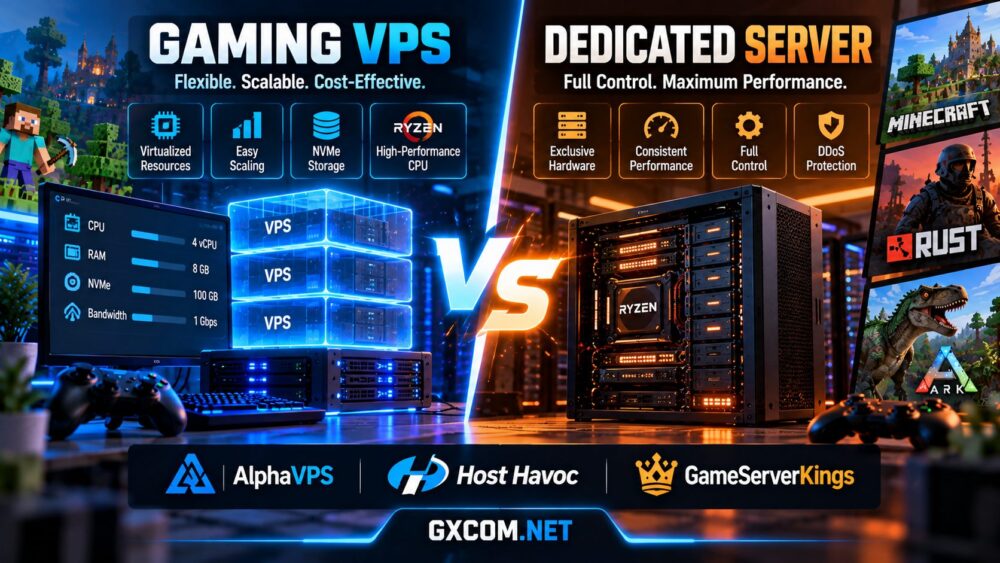
A gaming VPS is a virtual machine running on a physical server shared with other virtual machines. A hypervisor allocates virtual CPUs, memory, storage, and network resources to each instance. You typically receive administrator or root access, allowing you to install compatible game server software and configure the operating system.
A dedicated game server, in the infrastructure sense, is an entire physical machine reserved for one customer. Its CPU, RAM, and local storage are not shared with unrelated tenants, giving the administrator more direct control over resource allocation.
There is an important distinction: game hosting companies also use the term “dedicated game server” for a game instance that runs continuously. Such a service does not necessarily include an exclusive physical machine. Always verify whether a plan provides virtualized hosting, managed game hosting, or genuine bare-metal hardware.
| Feature | Gaming VPS | Dedicated Server |
|---|---|---|
| Hardware | Virtualized, shared physical host | Exclusive physical machine |
| CPU resources | Shared or reserved, depending on plan | Physical CPU resources allocated to one customer |
| RAM | Allocated virtual memory | Installed physical memory |
| Administrative access | Usually root/admin | Usually root/admin |
| Scaling | Often easier to resize | May require hardware changes or migration |
| Initial cost | Generally lower | Generally higher |
| Best suited for | Small to medium workloads | Demanding or multiple game servers |
Performance: CPU Speed Matters More Than Core Count
Game servers frequently depend on fast individual CPU cores. Minecraft's main simulation workload, for example, can be sensitive to single-thread performance, while busy Rust and ARK environments may demand substantial CPU time and memory.
On a VPS, virtual CPUs share the underlying processor with other workloads unless the provider offers genuinely dedicated or reserved CPU resources. Heavy activity elsewhere on the physical host can introduce inconsistent processing times.
A dedicated machine avoids competition from unrelated tenants on the same hardware. However, that does not automatically make it faster. A modern Ryzen-based VPS can outperform an older dedicated server for workloads that rely heavily on single-core speed.
Before comparing plans, check CPU generation, clock behavior, memory allocation, and whether the provider limits sustained CPU usage. Our game server hardware requirements guide explains how these resources affect multiplayer workloads.
For administrators running several game instances, dedicated hardware becomes more attractive because CPU and memory can be distributed across multiple servers without competing with other hosting customers.

RAM, NVMe Storage, and Network Latency
Memory requirements vary by game, player count, map size, and installed modifications. A lightweight private server may need relatively little RAM, while large modded worlds and heavily populated survival servers can consume much more.
Fast NVMe storage helps with world saves, loading, backups, and other disk-intensive operations. Still, NVMe alone cannot compensate for insufficient CPU resources or overloaded memory.
Network location is equally important. A powerful server hosted far from most players may deliver a worse experience than a modest server located nearby. Compare actual latency, packet loss, network routing, and DDoS protection rather than relying only on advertised port speed.
Public gaming communities should pay particular attention to network protection. Some VPS providers include DDoS mitigation, while others offer it as an optional service. Dedicated server packages also vary, so confirm protection before purchasing.
Control, Security, and Server Management
Both VPS and dedicated servers commonly provide operating system access. Administrators can install compatible game software, configure firewalls, manage updates, and deploy custom monitoring or automation tools.
A VPS is often easier to provision, reinstall, and resize. Dedicated hardware offers greater control over the physical machine's resources, although upgrades may require downtime or migration.
Neither option is automatically a managed game hosting service. If you rent general-purpose infrastructure, you are usually responsible for installing the game, maintaining security, applying patches, and restoring backups.
For players who prefer a ready-to-use control panel, our managed vs self-hosted game servers comparison explains the trade-offs between convenience and technical flexibility.
Cost Comparison: When Is Dedicated Hosting Worth It?
Gaming VPS plans generally offer a lower entry cost because physical infrastructure is shared among customers. This makes them appealing for experimentation, private communities, and projects that may grow gradually.
Dedicated servers cost more because the customer reserves an entire machine. In return, they may provide greater resource consistency and enough capacity to host several game instances.
However, the lowest advertised price is not necessarily the lowest operating cost. Compare CPU allocation, memory, storage, bandwidth, backup services, DDoS protection, operating system licensing, and renewal terms.
Dedicated hosting may become more economical when several separate VPS instances would otherwise be required. Conversely, renting a large physical server for a lightly used Minecraft world can leave most of the hardware idle.
The sensible approach is to estimate your current workload, allow reasonable growth capacity, and upgrade only when actual resource usage justifies the additional expense.
Which Hosting Model Works Best for Minecraft, Rust, and ARK?
Minecraft: A gaming VPS can be a practical starting point for a smaller Java Edition community, particularly when it offers modern CPUs and sufficient RAM. Large modpacks, complex automation, or multiple connected servers may justify dedicated resources. Our Minecraft server RAM requirements guide can help estimate memory needs.
Rust: CPU performance, memory, storage responsiveness, and DDoS protection become increasingly important as maps, plugins, and player activity grow. Smaller communities may use suitable VPS infrastructure, while large or multiple Rust servers can benefit from dedicated hardware.
ARK: Resource requirements depend heavily on whether you host ARK: Survival Evolved or ARK: Survival Ascended. Larger worlds, clusters, and demanding configurations can favor dedicated infrastructure. Verify the specific game's supported operating systems and server requirements before selecting a plan.
Hosting Providers Worth Considering
The following infrastructure providers serve different gaming needs. They should be compared according to CPU resources, available locations, management requirements, and whether you need virtualized or dedicated hardware.
AlphaVPS — Ryzen VPS for Self-Managed Game Servers
AlphaVPS offers Ryzen-based VPS infrastructure with KVM virtualization, NVMe storage, and root access. Its Ryzen product line is relevant to technically experienced administrators who want to deploy compatible Minecraft servers or other game workloads requiring strong individual CPU performance.
Remember that a general-purpose VPS is not the same as managed Minecraft or Rust hosting. Administrators must configure the operating system, install game software, and maintain the environment themselves. Check whether the selected plan includes suitable DDoS protection.
Host Havoc — Ryzen VPS and Dedicated Infrastructure
Host Havoc provides Ryzen VPS, dedicated servers, and separate managed game hosting services. This product range makes it useful for communities evaluating different levels of control and infrastructure capacity.
Its dedicated server options include modern AMD Ryzen processors and game management panel capabilities. Compare the available configuration and management arrangements before deciding whether you need an entire machine.
GameServerKings — Dedicated Hardware for Growing Communities
GameServerKings offers managed game hosting alongside bare-metal dedicated servers. Its dedicated infrastructure is particularly relevant to Rust administrators and communities that need to operate multiple game instances.
Customers can evaluate full hardware control or supported game-panel management, depending on the selected service. This flexibility is useful when moving beyond a single shared game hosting plan.
For a broader comparison of physical server infrastructure, see our best dedicated game servers guide.

When Should You Upgrade from a Gaming VPS?
Moving to dedicated hardware makes sense when performance problems persist despite appropriate game optimization and sufficient VPS resources. Common warning signs include repeated CPU contention, limited upgrade options, memory pressure, and the need to operate multiple demanding instances.
Monitor CPU usage, game tick performance, memory consumption, storage latency, and network stability before making a decision. A configuration problem or inefficient plugin may cause lag even on powerful hardware.
For administrators who want to understand installation and maintenance before upgrading, our multiplayer game server setup guide covers the practical responsibilities involved.
Frequently Asked Questions
Is a gaming VPS good enough for Minecraft?
Yes, for many small and medium-sized communities. Choose a plan with adequate RAM, fast CPU performance, and sufficient storage. Large modded networks may need more resources.
Does a dedicated server always have lower latency?
No. Geographic location, routing, network congestion, and connection quality affect latency more directly than whether the server is virtualized.
Can I host multiple games on one VPS?
Yes, if the operating system supports the games and sufficient resources are available. However, competing workloads can reduce performance.
Is a dedicated server easier to manage?
Not necessarily. Dedicated infrastructure often requires as much system administration as a VPS unless a suitable managed service is included.
Final Verdict: Gaming VPS or Dedicated Server?
For smaller communities, experimental projects, and administrators working with a limited budget, a gaming VPS is often the most practical starting point. It provides operating system control and flexible resource options without requiring an entire physical machine.
A dedicated server becomes more attractive when consistent resource availability, demanding multiplayer workloads, or multiple game instances justify the additional investment.
The best decision comes from matching real game requirements with CPU performance, memory capacity, network quality, and management responsibilities. Start with the infrastructure your community needs today, then scale when measurable demand supports the upgrade.