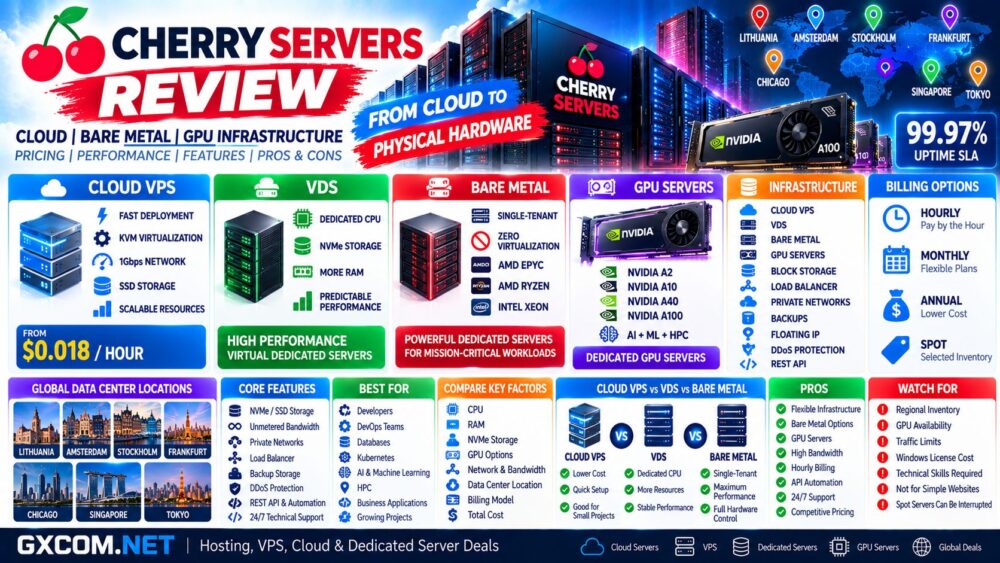
Cherry Servers is a European cloud infrastructure provider offering an unusually broad mix of virtual servers, virtual dedicated servers, bare metal, GPU servers, storage, networking, and automation tools from a single platform.
Instead of focusing only on conventional VPS hosting, Cherry Servers is designed for developers, infrastructure teams, businesses, AI workloads, databases, Kubernetes, high-performance computing, and projects that may eventually need to move from virtualized compute to dedicated physical hardware.
The platform also offers flexible billing. Depending on the infrastructure product and availability, customers can choose hourly, monthly, annual, and selected spot-server options.
In this Cherry Servers review, we compare its cloud VPS, VDS, bare metal servers, GPU infrastructure, pricing, storage, network capacity, global locations, billing options, API capabilities, support, and the main pros and cons you should consider before deploying a workload.
Cherry Servers Review: Quick Overview
| Feature | Cherry Servers |
|---|---|
| Cloud VPS | Yes |
| Virtual Dedicated Servers | Yes |
| Bare Metal | Yes |
| Dedicated GPU Servers | Yes |
| NVIDIA GPUs | Yes |
| AMD / Intel Servers | Yes |
| NVMe | Available depending on server type |
| Hourly Billing | Yes |
| Monthly / Annual | Yes |
| Spot Servers | Available on selected inventory |
| API | Yes |
| Private Networking | Yes |
| Load Balancer | Available |
| DDoS Protection | Included on applicable server products |
| Uptime SLA | 99.97% |
| Technical Support | 24/7 |
| Regions | Europe, North America and Asia |
| Best For | Developers, bare metal, cloud workloads, AI/GPU and infrastructure teams |
What Is Cherry Servers?
Cherry Servers is a Lithuania-based infrastructure provider specializing in cloud compute and dedicated hardware.
Its product portfolio spans several infrastructure layers:
- Cloud VPS
- Virtual Dedicated Servers
- Dedicated servers
- Bare metal infrastructure
- Dedicated GPU servers
- Elastic block storage
- Backup storage
- Floating IPs
- Public IP subnets
- Load balancers
- Private networking
This range makes Cherry Servers particularly interesting for projects that may begin on virtual infrastructure but later require dedicated CPU, large amounts of RAM, GPU acceleration, or full bare-metal control.
Cherry Servers Cloud VPS
Cloud VPS is the entry point for many Cherry Servers customers.
The company's virtual servers are based on KVM virtualization and include both shared-resource and dedicated-resource configurations.
Current second-generation Cloud VPS plans are designed for workloads such as:
- Development environments
- Small websites
- Microservices
- APIs
- Testing
- Distributed applications
Current Gen 2 Cloud VPS configurations provide between 1 and 6 vCores, 1GB to 6GB RAM, 20GB to 100GB SSD storage, and a 1Gbps network connection.
Cherry Servers Cloud VPS Pricing
Cherry Servers currently advertises virtual infrastructure starting from approximately $0.018 per hour, although the exact price depends on generation, location, resource model, billing cycle, and active promotions.
At the time of this review, examples from the current Gen 2 VPS lineup include:
| Plan | vCPU | RAM | Storage | Network |
|---|---|---|---|---|
| Cloud VPS 1 Gen 2 | 1 vCore | 1GB | 20GB SSD | 1Gbps |
| Cloud VPS 2 Gen 2 | 2 vCores | 2GB | 40GB SSD | 1Gbps |
| Cloud VPS 4 Gen 2 | 4 vCores | 4GB | 80GB SSD | 1Gbps |
| Cloud VPS 6 Gen 2 | 6 vCores | 6GB | 100GB SSD | 1Gbps |
Because Cherry Servers regularly changes inventory, discounts, and regional availability, buyers should verify live pricing rather than treating a single promotional price as permanent.
Cloud VPS vs VDS
An important distinction on Cherry Servers is the difference between Cloud VPS and VDS.
Entry-level Cloud VPS configurations use shared compute resources and are designed primarily for lighter workloads.
VDS configurations can provide dedicated physical CPU resources while maintaining the convenience of virtual infrastructure.
| Factor | Cloud VPS | Cloud VDS |
|---|---|---|
| CPU Resources | Shared | Dedicated resources |
| Virtualization | Yes | Yes |
| Deployment | Minutes | Minutes |
| Entry Cost | Lower | Higher |
| Performance Consistency | Workload dependent | More predictable |
| Best For | Light and general workloads | Production and performance-sensitive workloads |
For example, current Performance VDS configurations combine dedicated physical CPU resources with NVMe storage and higher network capacity.
Cherry Servers Bare Metal
Bare metal is one of Cherry Servers' strongest infrastructure categories.
Unlike a VPS or VDS, a bare-metal server gives one customer access to the physical server without a virtualization layer between the operating system and the hardware.
Potential advantages include:
- Single-tenant hardware
- Dedicated physical CPU
- Large RAM configurations
- High-capacity NVMe storage
- Hardware customization
- Predictable sustained performance
- GPU expansion on compatible servers
This makes bare metal particularly relevant for databases, virtualization, Kubernetes, high-traffic applications, data processing, HPC, and other sustained workloads.
For a broader comparison, see our
Bare Metal vs Dedicated Server
guide.
How Fast Are Cherry Servers Bare Metal Deployments?
Traditional dedicated servers sometimes require hours or even days of manual provisioning.
Cherry Servers has automated much of this process.
The company currently advertises an average deployment time of approximately 12 minutes for pre-built dedicated servers, although actual provisioning time depends on configuration and inventory.
Its SLA documentation provides a broader preparation estimate of up to three hours for dedicated servers.
That automation gives Cherry Servers some characteristics normally associated with cloud infrastructure while retaining physical single-tenant hardware.
Cherry Servers Dedicated Server Performance
Cherry Servers offers multiple processor families, including configurations based on AMD EPYC, AMD Ryzen, Threadripper, and Intel Xeon.
Higher-end configurations can provide substantial amounts of ECC memory and NVMe storage.
For example, current AMD EPYC infrastructure includes configurations capable of supporting hundreds of gigabytes or even more than 1TB of RAM, depending on the server.
Some current dedicated configurations also include 10Gbps uplinks and up to 100TB of monthly egress traffic.
However, buyers should choose hardware according to workload rather than simply purchasing the server with the largest core count.
More CPU Cores ≠ Automatically Better Application Performance.
Cherry Servers GPU Infrastructure
GPU infrastructure is another major strength of the platform.
Cherry Servers provides dedicated servers that can be configured with NVIDIA and AMD GPU hardware for workloads including:
- Artificial intelligence
- Machine learning
- AI inference
- Data processing
- Rendering
- HPC
- GPU development
Unlike serverless or shared GPU clouds, Cherry Servers' dedicated GPU model gives the customer a private physical server.
That can be attractive for long-running GPU workloads where predictable hardware access and system-level control matter.
Cherry Servers NVIDIA GPU Options
Current dedicated GPU inventory includes several NVIDIA accelerator families.
| GPU | Memory | Typical Use |
|---|---|---|
| NVIDIA A2 | 16GB GDDR6 | Inference and lightweight AI |
| NVIDIA A10 | 24GB GDDR6 | AI inference and graphics |
| NVIDIA A16 | 64GB GDDR6 | Virtualization and graphics workloads |
| NVIDIA A40 | 48GB GDDR6 | AI, visualization and rendering |
| NVIDIA A100 | 80GB HBM2 | AI training and HPC |
| NVIDIA Tesla P4 | 8GB | Inference and lightweight GPU workloads |
GPU inventory changes more quickly than ordinary VPS capacity, so customers should check live availability before designing infrastructure around a specific accelerator.
For more GPU infrastructure options, see our
Best NVIDIA GPU Servers
comparison.
Cherry Servers GPU Pricing
GPU pricing depends on both the underlying physical server and the selected accelerator.
At the time of this review, Cherry Servers publishes examples such as:
- NVIDIA A2 from approximately $0.239/hour
- NVIDIA A10 from approximately $0.518/hour
- NVIDIA A16 from approximately $0.539/hour
- NVIDIA A40 from approximately $0.801/hour
- NVIDIA A100 from approximately $2.362/hour
These prices should be treated as current published starting points rather than permanent rates.
GPU buyers should also compare CPU, RAM, storage, bandwidth, GPU count, billing period, and utilization rather than comparing GPU hourly prices in isolation.
Hourly, Fixed-Term and Spot Billing
Cherry Servers offers unusually flexible billing for a provider with such a strong bare-metal focus.
Its main billing models include:
Hourly
Hourly billing is useful for temporary infrastructure, development, testing, short-term compute, and workloads where the server does not need to remain active continuously.
Monthly and Annual
Fixed-term billing is more appropriate for infrastructure expected to remain online continuously and can provide more predictable long-term costs.
Spot Servers
Selected server inventory can also become available using spot billing.
Spot servers can reduce compute costs, but they are interruptible. Cherry Servers explicitly states that spot servers have no guaranteed operating duration and are not covered by its normal SLA.
Therefore, spot instances are more appropriate for interruption-tolerant workloads than critical production systems.
Cherry Servers Network and Bandwidth
Network capacity varies considerably according to server type.
Current fixed-term traffic allocations include examples such as:
- Cloud VPS — up to 5TB monthly traffic at 1Gbps depending on generation
- Gen 2 Cloud VPS — 1TB monthly traffic at 1Gbps
- Cloud VDS — approximately 10TB to 20TB depending on plan
- Dedicated Servers — up to 100TB per month with 3Gbps to 10Gbps uplinks depending on configuration
Cherry Servers currently measures outgoing traffic for these allowances, while incoming traffic is generally not counted in the same way.
High-bandwidth users should verify the exact traffic package before ordering because network allowances differ significantly between VPS, VDS, bare metal, and GPU configurations.
Global Data Center Locations
Cherry Servers has expanded beyond its Lithuanian roots and now operates infrastructure across Europe, North America, and Asia.
Current deployment locations include:
- Šiauliai, Lithuania
- Amsterdam, Netherlands
- Stockholm, Sweden
- Frankfurt, Germany
- Chicago, United States
- Singapore
- Tokyo, Japan
Product availability varies by location, so not every VPS, dedicated server, or GPU configuration is necessarily available in every region.
The network uses Tier 1 transit providers, direct internet exchange peering, and high-capacity interconnections across its footprint.
NVMe and Storage
Storage depends heavily on the infrastructure category.
Entry-level Cloud VPS plans may use SSD storage, while VDS and modern bare-metal configurations commonly provide NVMe.
Cherry Servers also provides Elastic Block Storage for persistent data that can be attached to supported dedicated infrastructure.
Current block storage pricing begins at approximately $0.077 per GB per month, with individual volumes scaling up to 5TB.
Separate backup storage is also available, currently starting from approximately $3.50 for 50GB per month.
Private Networking and Floating IPs
Cherry Servers supports infrastructure components needed for more complex architectures.
These include:
- Private subnets
- Floating IP addresses
- Public IP subnets
- Load balancers
- DDoS protection
A multi-server application could therefore use an architecture such as:
Internet → Floating IP / Load Balancer → Application Servers → Private Network → Database
This is more flexible than treating each server as an isolated public machine.
Cherry Servers Load Balancer
Managed load balancing is available as an additional cloud infrastructure service.
Current pricing starts from approximately $11.86 per month.
The service supports HTTP, HTTPS, and TCP workloads, with published capacity of up to 80,000 active sessions and up to 550Mbps depending on the service configuration.
Load balancing can be useful for distributing traffic between multiple application servers, but high availability still requires appropriate database, storage, DNS, and application architecture.
API and Infrastructure Automation
Automation is an important part of Cherry Servers' positioning.
Infrastructure can be managed through the Client Portal and REST API, allowing developers and DevOps teams to automate server deployment and management.
Potential uses include:
- Automated server provisioning
- Infrastructure deployment
- CI/CD environments
- DevOps workflows
- Temporary compute
- Automated scaling workflows
This helps bridge the gap between conventional dedicated server hosting and modern cloud infrastructure.
Cherry Servers Uptime SLA
Cherry Servers currently publishes a 99.97% data center uptime SLA.
99.97% availability corresponds to approximately 2 hours and 38 minutes of theoretical downtime per year.
The SLA also specifies service credits when measured availability falls below defined thresholds.
However, an infrastructure SLA is not the same as a guarantee that every customer application will achieve identical uptime.
Application availability can also depend on software, databases, DNS, customer configuration, backups, and architecture.
Cherry Servers Technical Support
Cherry Servers provides 24/7 technical support through channels including live chat, email, and phone.
Its current SLA states a maximum first-response target of 15 minutes for support tickets and a one-minute target for technical live support.
Customers are also assigned a personal account manager, which can be useful for larger infrastructure deployments or custom hardware requirements.
Cherry Servers vs Conventional Cloud VPS
| Factor | Cherry Servers | Typical Cloud VPS |
|---|---|---|
| Cloud VPS | Yes | Yes |
| VDS | Yes | Provider dependent |
| Bare Metal | Strong focus | Not always |
| Dedicated GPU | Yes | Provider dependent |
| Hourly Bare Metal | Yes | Less common |
| Spot Infrastructure | Selected servers | Provider dependent |
| API | Yes | Usually |
| Hardware Control | High | Lower on VPS |
Cherry Servers vs Kamatera
Cherry Servers and Kamatera both provide flexible cloud infrastructure, but they emphasize different areas.
| Factor | Cherry Servers | Kamatera |
|---|---|---|
| Main Strength | Bare metal + cloud infrastructure | Highly configurable virtual cloud |
| Cloud VPS | Yes | Yes |
| Bare Metal Focus | Strong | Less central |
| Dedicated GPU | Yes | Different product focus |
| Global Regions | Europe, US, Asia | Broader virtual-cloud footprint |
| Hourly Billing | Yes | Yes |
| Spot Billing | Selected infrastructure | Different billing model |
| Best Fit | Cloud-to-bare-metal workloads | Flexible virtual cloud infrastructure |
Kamatera is particularly relevant when granular virtual server configuration is the priority, while Cherry Servers becomes especially interesting when a workload may require dedicated physical hardware, high bandwidth, or GPU acceleration.
Cherry Servers Pros and Cons
| Pros | Cons |
|---|---|
| Cloud VPS, VDS and bare metal on one platform | Product range can be complex for beginners |
| Strong dedicated server selection | Inventory varies by region |
| Dedicated GPU servers | Latest GPU availability can be limited |
| Hourly and fixed-term billing | Traffic allowances vary significantly by product |
| Spot server options | Spot servers can be interrupted |
| NVMe available on performance infrastructure | Entry Cloud VPS may use SSD rather than NVMe |
| High-bandwidth bare metal | Windows can add significant licensing cost |
| REST API and automation | Self-managed infrastructure requires technical knowledge |
| 24/7 technical support | Not every product is available in every region |
| 99.97% uptime SLA | — |
Who Should Consider Cherry Servers?
Cherry Servers is particularly relevant for:
- Developers
- DevOps teams
- Startups
- SaaS applications
- Databases
- Kubernetes
- High-traffic websites
- Data processing
- AI and machine learning
- GPU workloads
- HPC
- Businesses requiring bare-metal control
It is especially interesting when the infrastructure roadmap may progress from a small virtual server toward dedicated compute or GPU hardware.
Who May Prefer an Alternative?
Users who only need conventional shared hosting or a simple managed WordPress account may find Cherry Servers unnecessarily infrastructure-focused.
Beginners who do not want to administer an operating system may also prefer a fully managed hosting provider.
Projects requiring a specific GPU or hardware configuration in a specific region should verify inventory before committing because dedicated hardware availability can change.
Similarly, users primarily seeking a massive catalog of proprietary serverless, database, analytics, and AI services may prefer a hyperscale public cloud ecosystem.
Is Cherry Servers Good for Bare Metal?
Bare metal is one of the clearest reasons to consider Cherry Servers.
The platform combines single-tenant hardware with automated provisioning, hourly billing, API management, high-bandwidth options, NVMe configurations, large RAM capacities, and GPU expansion on compatible servers.
This provides an infrastructure model that combines elements of traditional dedicated hosting with cloud-style automation.
For additional providers, see our
Bare Metal Server Providers
comparison.
Is Cherry Servers Good for AI and GPU Workloads?
Cherry Servers can be relevant for AI workloads where dedicated GPU hardware is preferable to a shared or serverless GPU environment.
The current accelerator lineup includes multiple NVIDIA GPU generations ranging from lower-cost inference hardware to A100-class accelerators.
However, AI infrastructure should be selected according to more than GPU model alone.
Consider:
Model → VRAM → GPU Count → CPU → RAM → NVMe → Network → Utilization → Total Cost.
For short, highly variable workloads, an on-demand GPU cloud may be more flexible. For sustained high utilization, dedicated GPU infrastructure can become more attractive.
Is Cherry Servers Good Value?
Cherry Servers' value is easiest to understand when evaluating the entire infrastructure stack rather than one entry-level VPS price.
Its main advantage is the ability to choose between shared virtual compute, dedicated virtual resources, bare metal, GPU hardware, high-capacity storage, and networking services without completely changing infrastructure providers.
Hourly billing also reduces the commitment required for testing or temporary infrastructure, while fixed-term billing can make more sense for continuously running production workloads.
The appropriate comparison is:
Workload → Virtual or Physical → CPU → RAM → Storage → GPU → Network → Location → Billing Model → Total Cost.
Cherry Servers Review: Final Thoughts
Cherry Servers occupies an interesting position between a conventional cloud VPS provider and a traditional dedicated server company.
Its infrastructure portfolio stretches from inexpensive virtual servers through VDS and high-performance bare metal to dedicated GPU systems, while adding cloud-oriented features such as hourly billing, spot capacity, APIs, private networking, floating IPs, load balancing, and automated provisioning.
The strongest use cases are therefore infrastructure-heavy workloads where control, dedicated resources, network capacity, or physical hardware matter.
The trade-off is complexity. Users looking only for a simple website hosting account may not need this level of infrastructure choice, while dedicated hardware inventory and GPU availability can vary between regions.
For developers, infrastructure teams, AI projects, databases, Kubernetes deployments, and workloads that may eventually outgrow a conventional VPS, Cherry Servers provides a broad path from virtual compute to dedicated physical infrastructure.
Before deploying, use this decision path:
Workload → VPS / VDS / Bare Metal → CPU → RAM → NVMe → GPU → Network → Region → Billing → Total Cost.