Cloud servers have become a fundamental part of modern internet infrastructure, powering websites, applications, databases, artificial intelligence workloads and enterprise platforms.
Unlike traditional hosting products designed mainly for websites, cloud servers provide flexible computing resources that can be configured for different workloads.
The Best Cloud Server Providers should offer reliable infrastructure, strong performance, flexible pricing, global availability and scalable resources.
This guide compares leading cloud server providers based on infrastructure, computing performance, pricing models, features and suitable use cases.
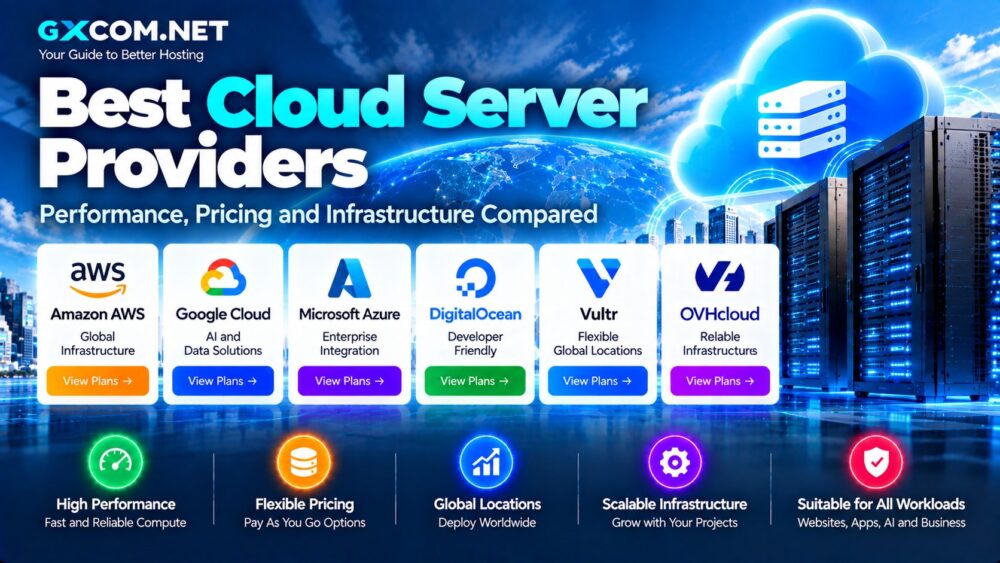
Best Cloud Server Providers Compared
| Provider | Main Strength | Best For |
|---|---|---|
| Amazon Web Services (AWS) | Largest cloud ecosystem | Enterprise applications |
| Google Cloud Platform | Data analytics and cloud innovation | AI, data and applications |
| Microsoft Azure | Enterprise integration | Business workloads |
| DigitalOcean | Simple cloud computing | Developers and startups |
| Vultr | Flexible global cloud servers | Applications and deployments |
| OVHcloud | Infrastructure value | Businesses and advanced users |
What Is a Cloud Server?
A cloud server is a virtual machine running on cloud infrastructure.
Instead of depending on a single physical server, cloud servers are created from pools of computing resources including:
- CPU processing power
- Memory resources
- Storage systems
- Network capacity
- Virtualization technology
Cloud servers are commonly used for:
- Web applications
- SaaS platforms
- Enterprise software
- Databases
- Development environments
- AI workloads
- Game servers
Cloud Server vs Cloud VPS
| Feature | Cloud Server | Cloud VPS |
|---|---|---|
| Main Purpose | General cloud computing | Virtual private server hosting |
| Target Users | Businesses and developers | Developers and websites |
| Scaling | Highly flexible | Usually plan-based |
| Management | Technical infrastructure focus | Server hosting focus |
| Workloads | Applications and enterprise systems | Websites and smaller applications |
For virtual private server comparisons, see our Best Cloud VPS Providers guide.
1. Amazon Web Services (AWS)
AWS is one of the largest cloud infrastructure platforms worldwide.
Its cloud server service, Amazon EC2, provides configurable compute instances for almost any workload.
AWS features include:
- Hundreds of instance types
- Global availability zones
- Elastic scaling
- Advanced networking
- Database integration
- AI and machine learning services
AWS is commonly used by:
- Enterprise companies
- Large applications
- Technology startups
- Global platforms
Best for: organizations requiring extensive cloud capabilities.
2. Google Cloud Platform
Google Cloud provides cloud computing infrastructure with strong capabilities in data processing, analytics and artificial intelligence.
Its Compute Engine service allows users to deploy customizable virtual machines.
Key features include:
- Global cloud regions
- Custom machine configurations
- High-performance networking
- AI and data services
- Kubernetes support
Google Cloud is often selected for:
- AI applications
- Data platforms
- Cloud-native applications
- Enterprise systems
Best for: data-driven businesses and advanced applications.
3. Microsoft Azure
Microsoft Azure provides cloud infrastructure with strong integration into enterprise environments.
Azure Virtual Machines allow organizations to run Windows and Linux workloads in the cloud.
Azure advantages include:
- Enterprise identity integration
- Hybrid cloud support
- Windows ecosystem compatibility
- Global infrastructure
- Security services
Azure is widely used by organizations already working with Microsoft technologies.
Best for: enterprise businesses and hybrid cloud environments.
4. DigitalOcean Cloud Servers
DigitalOcean focuses on simplicity and developer experience.
Its Droplet cloud servers allow users to deploy virtual machines quickly without the complexity of larger enterprise cloud platforms.
Features include:
- Simple management interface
- Developer API
- SSD storage
- Multiple regions
- Kubernetes services
DigitalOcean is popular among:
- Developers
- Startups
- Small applications
- Independent projects
Best for: developers wanting simple cloud infrastructure.
5. Vultr Cloud Servers
Vultr provides cloud computing services across many global locations.
The platform offers flexible server configurations for different workloads.
Features include:
- Worldwide locations
- NVMe cloud servers
- Flexible compute options
- One-click applications
- Developer tools
Best for: users needing flexible international deployments.
6. OVHcloud
OVHcloud operates a large infrastructure network offering cloud servers, VPS and dedicated infrastructure.
Advantages include:
- Multiple geographic regions
- Competitive infrastructure pricing
- Dedicated server integration
- Advanced networking
Best for: businesses seeking infrastructure flexibility.
Cloud Server Performance Factors
Choosing a cloud server should involve more than comparing prices.
CPU Performance
CPU determines how quickly applications process requests.
High-performance workloads such as databases, analytics and AI applications often require stronger processors.
Memory Capacity
RAM affects application stability and the number of simultaneous processes a server can handle.
Storage Performance
Modern cloud servers commonly use SSD or NVMe storage.
Fast storage improves:
- Database performance
- Application loading
- File processing
- Virtual machine responsiveness
Network Performance
Network latency and bandwidth are important for global applications and distributed systems.
Cloud Server Pricing Explained
Cloud server pricing is different from traditional hosting because many providers use flexible billing models.
| Pricing Model | Description |
|---|---|
| Pay As You Go | Pay for actual resource usage |
| Monthly Plans | Fixed resource packages |
| Reserved Pricing | Lower cost for long commitments |
| Spot Pricing | Discounted unused capacity |
Before choosing a provider, calculate:
- Compute cost
- Storage cost
- Bandwidth fees
- Backup charges
- Additional services
Cloud Servers for Websites
Many websites do not require enterprise cloud infrastructure.
However, cloud servers can be useful for:
- High traffic websites
- Large WordPress installations
- Membership platforms
- Web applications
- Ecommerce systems
Smaller websites may find managed hosting or Cloud VPS easier to manage.
Cloud Servers for Developers
Developers use cloud servers because they provide:
- Root access
- Custom environments
- Automation
- API management
- Container support
- Testing infrastructure
Cloud servers are especially useful for modern software development workflows.
Cloud Servers for AI and Data Workloads
Cloud infrastructure is increasingly used for AI, machine learning and data processing.
Important factors include:
- GPU availability
- High-performance networking
- Large memory configurations
- Storage performance
- Scalable computing resources
Users running AI workloads should compare specialized GPU cloud products rather than standard cloud instances.
How to Choose the Best Cloud Server Provider
Understand your workload. Websites, databases, AI and applications have different requirements.
Compare total cost. Include storage, bandwidth and additional services.
Select suitable regions. Deploy close to your users whenever possible.
Review scalability. Future growth should not require rebuilding infrastructure.
Evaluate support. Enterprise workloads may require stronger technical assistance.
Common Cloud Server Mistakes
Ignoring Total Cost
Cloud bills can increase when additional resources are used.
Over-Provisioning
Buying excessive resources wastes money.
Underestimating Security
Cloud servers require proper access control and updates.
Choosing the Wrong Platform
A developer project and an enterprise application have different needs.
Best Cloud Server Providers: Final Thoughts
The best cloud server provider depends on your workload, technical requirements and budget.
AWS, Google Cloud and Azure provide extensive enterprise cloud ecosystems. DigitalOcean and Vultr offer simpler developer-friendly platforms, while OVHcloud provides infrastructure flexibility and competitive options.
Cloud servers provide the foundation for modern applications, websites and digital services. Before choosing a provider, compare infrastructure, performance, pricing models and long-term scalability rather than focusing only on the initial server cost.