Should you connect your ARK maps into one cluster or run separate servers? The answer affects survivor transfers, dinosaur ownership, backups, administration, and monthly hosting costs.
This ARK cluster hosting vs separate servers comparison explains three deployment models: a connected multi-map cluster, independent servers, and one server that switches between maps. We also examine managed hosting options from Survival Servers, Host Havoc, Sparked Host, and Shockbyte.
GXCOM.NET reviewed technical documentation and provider information. We have not conducted independent performance benchmarks.
ARK Cluster Hosting vs Separate Servers: Quick Verdict
Choose cluster hosting when players need to move between multiple active maps while retaining eligible survivors, creatures, and items.
Choose independent servers when communities require separate progression, different rules, or stronger administrative isolation.
Choose a single server with map switching when your budget is limited and simultaneous map access is unnecessary.
| Feature | Connected Cluster | Separate Servers | Map Switching |
|---|---|---|---|
| Active maps | Multiple | Multiple | One at a time |
| Cross-map transfers | Supported when configured | Not shared by default | No simultaneous destination |
| Server instances | One per active map | One per active map | One |
| World saves | Separate per map | Separate | Must be preserved when switching |
| Management complexity | Higher | Moderate | Lower |
| Typical audience | Connected communities | Independent communities | Small private groups |
What Is an ARK Server Cluster?
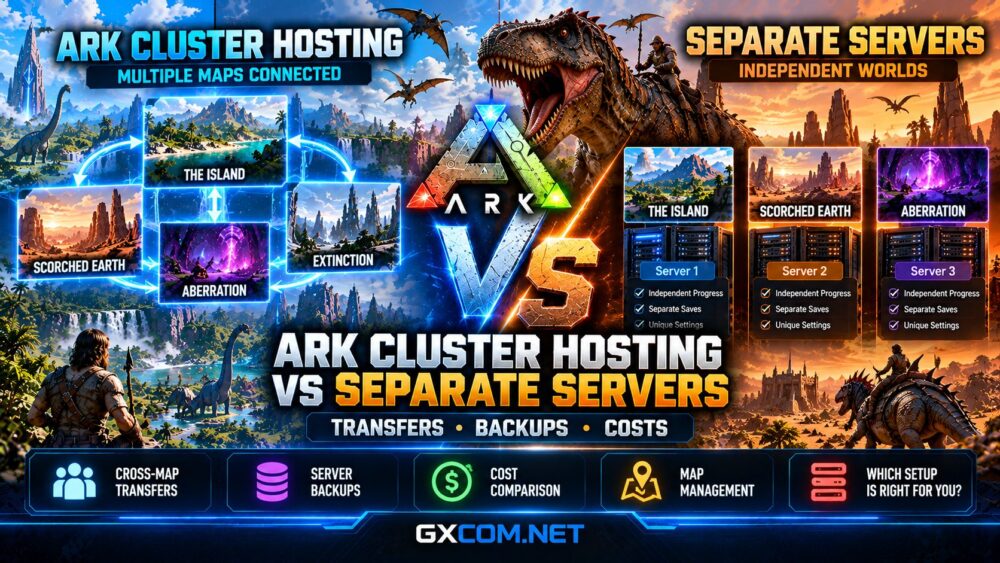
An ARK cluster consists of multiple dedicated server instances linked through compatible transfer settings and shared cluster data.
Each map runs independently, with its own world save, configuration, network ports, and resource requirements.
Clustering connects these instances for supported transfers. It does not combine several maps into one server process.
For self-managed installations, administrators commonly configure a matching cluster identifier and a shared transfer directory. Managed hosting companies may automate these steps.
For example, Survival Servers documents a Cluster Code workflow, while Host Havoc automatically links eligible ARK: Survival Evolved servers within the same customer account.
How Are Separate ARK Servers Different?
Independent ARK servers can run different maps without sharing player progression.
One community might operate a PvE building server and a separate PvP server with completely different settings.
Without a configured cluster, administrators should not expect characters or creatures to move freely between those environments.
This separation can be useful for tournaments, experimental modifications, private communities, or different administrative teams.
However, running servers independently does not automatically reduce hardware costs. Two active maps still require sufficient resources for two server instances.

Cross-Map Transfers: Survivors, Dinosaurs and Items
Transfer functionality is the primary reason many administrators choose clustering.
Supported in-game terminals allow eligible survivors, tamed creatures, and items to move between connected maps.
Administrators can configure restrictions for survivor uploads, survivor downloads, dinosaur transfers, and item transfers.
For instance, a community may permit characters to travel while preventing imported creatures from disrupting progression.
These permissions must be checked on every participating server. Inconsistent restrictions can prevent downloads even when uploads appear successful.
Transfers also carry risks. Mod conflicts, incompatible settings, or interrupted operations may affect transferred data.
Before enabling public transfers, test both directions with nonessential characters and items.
Cluster IDs and Server Configuration
Self-hosted ARK clusters generally require a shared cluster identifier and accessible transfer storage.
Every active map also needs appropriate network ports and separate save files.
Managed providers simplify this process differently.
Survival Servers allows eligible servers to share a Cluster Code through its configuration interface. Read our Survival Servers ARK cluster hosting review for maps, transfers, and costs.
Host Havoc documents automatic clustering for eligible ASE servers on the same account, using selected custom command lines.
Our Host Havoc ARK hosting review explains its administration and backup workflow.
Always confirm edition-specific procedures. ARK: Survival Evolved and ARK: Survival Ascended should not be treated as interchangeable server environments.
Backups: Which Deployment Is Safer?
Neither clustering nor independent hosting automatically guarantees safer backups.
In a cluster, each map maintains its own world data, while transfer-related information may be stored separately.
A reliable recovery strategy should preserve map saves, player and tribe information, configuration files, and relevant cluster transfer data.
Restoring only one map to an earlier point can create inconsistent progression across connected worlds.
Independent servers have fewer shared transfer dependencies, but each still needs its own backup and recovery plan.
For either approach, verify backup frequency, retention, downloadable archives, and restoration procedures before purchasing.
Schedule manual backups before major game updates, mod changes, or map migrations.
ARK Cluster Hosting Costs Compared
Cluster pricing is primarily driven by the number of simultaneously active server instances.
Consider three hypothetical deployment options:
| Deployment | Illustrative Monthly Cost |
|---|---|
| One server, rotating maps | $20 |
| Two-map cluster | $40 |
| Three-map cluster | $60 |
| Three independent servers | $60 |
Illustrative example only: $20 per instance. These are not verified provider quotations.
Real prices depend on edition, player slots, hardware, region, billing period, and optional services.
A three-map cluster does not necessarily cost more than three equivalent independent servers. Both require three active instances; clustering may add configuration work or provider-specific charges.
Ask whether cluster management is included, whether additional storage costs apply, and how renewal pricing works.
Performance and Resource Requirements
Every running ARK map requires CPU time, memory, storage, and network capacity.
Large bases, active players, extensive modifications, and high creature populations can increase demand.
Clustering does not inherently improve server tick rates or reduce memory consumption.
Administrators should monitor each map separately and choose locations close to their player communities.
For self-managed environments, consult our ARK dedicated server setup guide when planning installation and administration.
Managed ARK Hosting Providers to Consider
Four approved hosting brands are relevant to this purchasing decision.
Survival Servers
Survival Servers provides documented cluster configuration and transfer controls. It is worth evaluating when detailed ARK-specific administration matters.
Explore Survival Servers ARK Hosting
Host Havoc
Host Havoc offers automatic clustering for eligible ASE servers and a TCAdmin-based management environment.

Sparked Host
Sparked Host is another option for comparing managed game hosting resources and upgrade flexibility. Verify current ARK availability and clustering features before ordering.
Shockbyte
Shockbyte provides managed game hosting products. Confirm the exact ARK edition, supported maps, and cluster administration features for the selected package.
For a direct provider comparison, read our Survival Servers vs Host Havoc comparison.
Frequently Asked Questions
Does an ARK cluster need multiple servers?
Yes. Each simultaneously active map needs its own server instance, although multiple instances can sometimes share one physical machine.
Can independent ARK servers transfer dinosaurs?
Not through a shared private cluster by default. Compatible transfer configuration is required, and administrators may restrict uploads or downloads.
Is clustering more expensive?
Compared with one rotating-map server, usually yes. Compared with the same number of independent instances, infrastructure costs may be similar.
Can ASA and ASE share one cluster?
No standard cross-edition cluster should be assumed. They use separate game environments and require edition-specific hosting.
Final Verdict: Which Setup Should You Choose?
Choose ARK cluster hosting when your community needs connected maps and controlled player transfers.
Choose separate servers when independent progression and administrative isolation are more important.
For smaller communities, one server with carefully managed map switching may offer the lowest operating cost.
Before ordering, compare the number of active instances, transfer permissions, backup coverage, and complete recurring charges.
For more provider-specific guidance, see our Survival Servers hosting review.