Choosing a dedicated server based on processor branding alone can lead to expensive mistakes. Two servers carrying the Intel Xeon 6 name may deliver very different results because their processors prioritize different types of computing.
This Intel Xeon 6 Dedicated Server Review examines core density, power efficiency, memory architecture, virtualization, and workload suitability. It also explains how to compare dedicated hosting providers without paying for CPU capacity your applications cannot use.
Intel Xeon 6 Dedicated Server Review: Quick Verdict
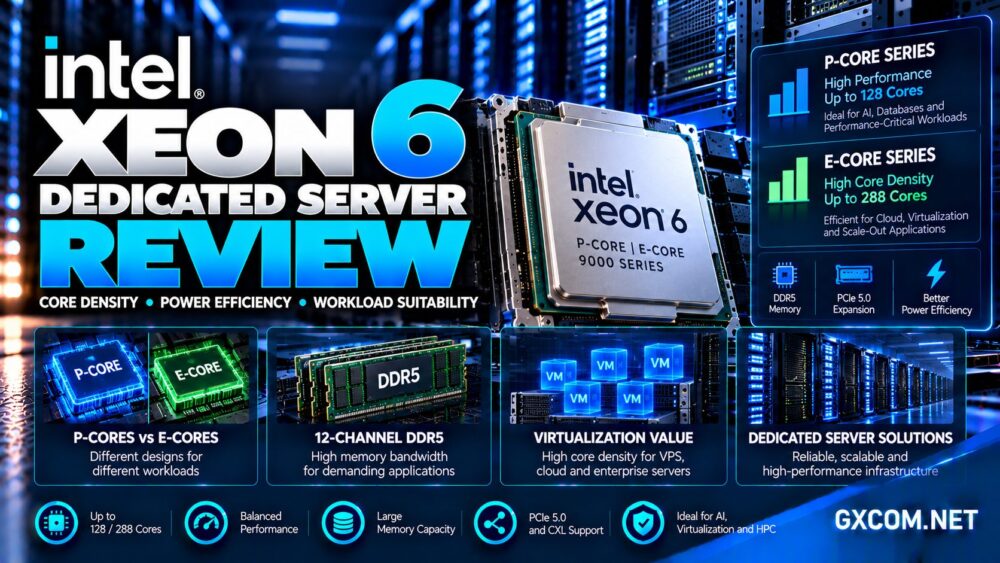
Intel Xeon 6 is a broad server processor family offering two distinct approaches: Performance-cores (P-cores) and Efficient-cores (E-cores).
P-core models target demanding applications, complex databases, AI processing, and high-performance computing. E-core models prioritize high core density and efficient execution of many independent tasks.
Our verdict: Xeon 6 can be an excellent dedicated server platform, but the best configuration depends on workload characteristics, memory requirements, licensing, and sustained utilization.
For buyers comparing physical infrastructure, our dedicated server hosting guide explains the practical differences between server ownership models.
What Is Intel Xeon 6?
Xeon 6 is Intel’s server processor family designed for modern data centers, enterprise applications, cloud platforms, and specialized computing.
Unlike a single processor generation with nearly identical core designs, Xeon 6 includes separate P-core and E-core product lines.
Intel also offers multiple platform families, including Xeon 6900, 6700, 6500, and entry-level configurations. Socket capabilities, memory channels, expansion options, and power requirements vary.
Therefore, a listing advertising only “Intel Xeon 6” provides insufficient information for a serious purchasing decision.
Intel Xeon 6 P-Cores vs E-Cores
| Feature | P-Core Xeon 6 | E-Core Xeon 6 |
|---|---|---|
| Design priority | Performance per core | Compute density |
| Maximum cores per socket | 128 | 288 |
| AVX-512 | Supported | Not supported |
| Intel AMX | Supported | Not supported |
| Typical workloads | Databases, HPC, AI | Microservices, scale-out computing |
These maximum core counts describe the respective processor families, not every available model.
When P-Cores Make Sense
P-core processors suit applications requiring strong individual-thread performance, advanced vector instructions, or substantial processing power per virtual machine.
Complex database queries, simulation software, enterprise applications, and CPU-based AI inference may benefit from these capabilities.
Intel Advanced Matrix Extensions and AVX-512 are particularly relevant when supported by the application and software libraries.
When E-Cores Make Sense
E-core processors emphasize running many independent tasks efficiently within limited rack space and power budgets.
They can be attractive for container platforms, content delivery, cloud-native services, and large collections of relatively lightweight workloads.
However, E-core processors do not provide the same instruction-set capabilities as P-core models.
Applications relying on AVX-512 or AMX should not be migrated without compatibility testing.
Core Density: Why More Cores Are Not Always Better
Core density describes how much processing capacity fits within a processor socket, server, or rack.
High-density Xeon 6 E-core configurations can consolidate many smaller workloads onto fewer physical machines.
This may reduce equipment count, networking complexity, and occupied rack space.
However, consolidation also increases the consequences of a hardware failure and can create shared memory or storage bottlenecks.

A website serving modest traffic may gain little from hundreds of cores. A platform hosting thousands of independent application processes may benefit substantially.
Power Consumption and Performance Per Watt
Power efficiency is a major selling point of modern server processors, but CPU thermal design power is not the same as total server electricity consumption.
Memory modules, NVMe drives, network cards, fans, and power conversion losses all contribute to operating costs.
E-core configurations are designed for favorable throughput per watt in highly parallel workloads. P-core systems may finish demanding individual jobs faster.
The most efficient choice is whichever completes the required workload using fewer total resources.
Why Utilization Matters
A high-core-count server operating mostly idle can represent poor value despite impressive theoretical efficiency.
Conversely, a well-utilized machine may replace multiple older servers and reduce total infrastructure overhead.
Measure completed transactions per watt, application throughput, and utilization over realistic business cycles.
DDR5 Memory and Server Performance
Xeon 6 platforms support modern DDR5 memory, while selected P-core configurations also support higher-bandwidth MRDIMM technology.
Memory capabilities depend on the processor series, motherboard, and installed DIMMs.
High core counts require adequate memory bandwidth to prevent processing resources from waiting on data.
For virtualization, total RAM capacity is equally important because every guest operating system consumes memory.
Ask providers about DIMM population, ECC support, maximum expansion, and whether the server configuration delivers its expected memory-channel bandwidth.
Xeon 6 for VPS and Virtualization Hosting
Virtualization providers can benefit from Xeon 6’s range of performance and density configurations.
P-core models are useful when customers require strong performance per virtual CPU. E-core models can support large numbers of smaller, parallel workloads.
Nevertheless, advertised vCPU counts do not guarantee exclusive physical CPU resources.
Oversubscription policies, CPU scheduling, memory allocation, and storage contention influence the performance experienced by individual customers.
Our dedicated server vs VPS comparison explains when a physical server provides meaningful advantages.
NUMA and Resource Placement
Large server configurations may expose multiple NUMA domains, where memory access latency depends on processor and memory locality.
Virtual machine placement, CPU affinity, and memory allocation should be considered for latency-sensitive workloads.
Simply assigning more vCPUs cannot compensate for inefficient resource placement.
Storage, PCIe and Networking
Modern Xeon 6 platforms support high-speed I/O technologies suitable for NVMe storage, networking, and accelerators.
Actual connectivity depends on the processor and server platform.
For databases and hosting environments, storage latency and consistent IOPS often matter more than headline sequential bandwidth.
Likewise, a high-speed network port does not guarantee unrestricted throughput or low latency to every destination.
Review storage redundancy, traffic allowances, uplink capacity, and hardware replacement policies before purchasing.
Intel Xeon 6 vs AMD EPYC Turin
Intel Xeon 6 and AMD EPYC Turin both offer modern server architectures with high core counts, DDR5 connectivity, and extensive platform capabilities.
Intel differentiates Xeon 6 through dedicated P-core and E-core product lines, while AMD Turin includes Zen 5 and dense Zen 5c configurations.
Neither family is universally faster or more economical.
For CPU-intensive databases, benchmark specific processor models. For virtualization, compare performance per allocated VM, memory capacity, and sustained concurrency.
For licensing-sensitive applications, calculate software costs before selecting the processor with the highest core count.
Dedicated Server Providers Worth Comparing
Processor selection matters, but the surrounding hosting infrastructure determines whether a server delivers reliable long-term value.
OVHcloud: Dedicated Infrastructure and Networking
OVHcloud offers dedicated server families for businesses requiring physical resource control and established network infrastructure.
Compare CPU generations, storage options, regional availability, and included network protection.
Confirm the exact Xeon 6 model rather than assuming every Intel-based server uses the latest processor family.
Hetzner: Dedicated Server Economics
Hetzner is relevant for buyers evaluating dedicated server value, particularly when comparing European deployment options.
Its available Intel processor generations vary by product and inventory.
Evaluate the complete hardware configuration and expected workload performance rather than focusing on the lowest monthly rate.
Cherry Servers: Configurable Bare Metal
Cherry Servers provides bare metal infrastructure suited to organizations requiring operating system control and configurable hardware.
Ask about available CPU SKUs, memory capacity, provisioning, storage, and networking.
Our bare metal server providers guide provides additional comparisons.
ServerMania: Dedicated Hosting Alternatives
ServerMania is another relevant provider for businesses comparing dedicated server configurations and managed infrastructure options.
Buyers should verify hardware availability, support scope, network commitments, and upgrade procedures.
These providers are comparison candidates, not confirmation that a specific Xeon 6 SKU is available in every location.
Xeon 6 Dedicated Server Pricing and TCO
The real cost of dedicated hosting extends beyond the advertised server rental fee.
Memory upgrades, storage, bandwidth, backups, support, software licenses, and downtime risks affect total cost of ownership.
Some commercial software products charge according to physical cores or other licensing metrics, potentially reducing the economic benefit of extremely dense processors.
Compare monthly cost per completed workload, not simply cost per core.
Our affordable dedicated server deals guide helps frame infrastructure purchasing decisions.
How to Benchmark a Xeon 6 Server
Test representative applications under sustained load, using realistic datasets and concurrency levels.
Record per-thread latency, total throughput, CPU utilization, memory bandwidth, storage response times, and power behavior where available.
For virtualized workloads, measure performance across multiple guests and examine scheduling delays.
Verify BIOS settings, power policies, NUMA configuration, and supported instruction sets.
A short synthetic benchmark should never replace production-style testing.
Frequently Asked Questions
How many cores can Intel Xeon 6 support?
The family includes P-core processors with up to 128 cores and E-core processors with up to 288 cores per socket, depending on the model.
Are Xeon 6 E-cores suitable for virtualization?
Yes, especially for many parallel, lightweight workloads. Performance-sensitive applications may benefit more from P-core configurations.
Does Xeon 6 support AVX-512?
Xeon 6 P-core processors support AVX-512, while E-core processors do not.
Is Xeon 6 better than AMD EPYC Turin?
The answer depends on processor SKU, application behavior, memory configuration, software licensing, and total hosting cost.
Final Verdict: Which Intel Xeon 6 Server Should You Choose?
This Intel Xeon 6 Dedicated Server Review finds a versatile processor family with different strengths across enterprise computing and cloud-scale infrastructure.
Choose P-core configurations for demanding applications and advanced compute instructions. Consider E-core systems when high task parallelism and efficient density are more important.
OVHcloud, Hetzner, Cherry Servers, and ServerMania are useful infrastructure comparison points, subject to specific CPU availability.
Before ordering, verify the exact processor model, memory configuration, resource isolation, support arrangements, and complete operating costs. The best dedicated server is the one that consistently matches your workload.